

Product
PHP and Composer Support Is Now in Beta
Socket’s PHP and Composer support is now in Beta for all customers, with PHP reachability analysis generally available.
By Trevor Norris, Benjamin Barslev - Aug 21, 2026
@agentrhq/webcmd
Advanced tools
Turn websites, browser sessions, desktop apps, and local tools into deterministic CLI surfaces for humans and AI agents.


Teach a coding agent a website once. Get back a script it can run forever.
Coding agents are great at driving a browser and terrible at remembering how. Every session they re-learn the same login, the same clicks, the same fragile selectors. Webcmd records a real browser task session, distills it into a durable capability graph for that app, and materializes the result as a deterministic workflow script or a standalone task CLI — so the next run is one command instead of another exploratory crawl.
Screen recording / demo goes here.
npm install -g @agentrhq/webcmd
webcmd setup
Webcmd turns one messy browser session into reusable, deterministic artifacts through five stages:
webcmd open. Everything is captured to a raw journal (DOM snapshots, actions, and redacted network evidence) by default..mjs replay script) or a CLI (a standalone package grounded in graph capabilities, shipped with its own SKILL.md).| Term | What it is |
|---|---|
| Session | A live browser run, identified by --session <name>. Records by default. |
| Journal | The raw event log of a session — snapshots, actions, network evidence. |
| Snapshot | A semantic capture of page state. Webcmd can diff two snapshots. |
| Capability graph | The distilled, durable model of an app's capabilities, built from journals. |
| Workflow | A deterministic .mjs script that replays a task. No SKILL.md. |
| CLI | A standalone package generated from graph capabilities. Ships a SKILL.md. |
| Profile | A workspace identity context under .webcmd/profiles/<name> — may hold auth for several apps. |
| Authoring packet | A planning step that decides the safe next action when creating, updating, or healing an artifact. |
From an empty workspace to a runnable CLI:
# 1. Install skills and prepare runtime
webcmd setup

# 2. Record a task in a headed browser (this shell stays alive until close)
webcmd open "https://news.ycombinator.com" --session hn --headed

# 3. From another shell, drive and inspect the session
webcmd snapshot --session hn
webcmd click --session hn --role link --name "Learn more"
webcmd network summary --session hn

# 4. Let the authoring packet pick the safe next step
webcmd author cli --operation create \
  --task "Collect top Hacker News posts" \
  --app-id hacker-news \
  --url https://news.ycombinator.com

# 5. Materialize the CLI from a plan, then run it
webcmd cli hacker-news --plan <plan.json>
webcmd run top-posts

# 6. Done — close the session
webcmd close --session hn
Sessions record by default; pass --no-record only for ephemeral sessions.
Webcmd is built to be driven by a coding agent (Claude Code, Cursor, and similar), not typed by hand.
Install the skills. webcmd setup installs the canonical Webcmd skills so your agent knows how to record, inspect, distill, and materialize.
webcmd setup                          # global: ~/.agents/skills/
webcmd setup --scope local            # workspace: .agents/skills/
webcmd setup --skills-root /path/to/.agents/skills
Generated CLIs teach the next agent. Every CLI Webcmd materializes ships with a SKILL.md whose frontmatter records command metadata, graph-capability provenance, and safe smoke tests. Install it alongside the CLI or into a shared skills root:
webcmd cli <app-id> --plan <plan.json> --install-skill
webcmd cli <app-id> --plan <plan.json> --install-skill /path/to/skills
Workflows never get a SKILL.md; CLIs always do.
The primitives your agent drives. Open a session, then control it from another shell:
webcmd snapshot --session default
webcmd click --session default --role link --name "Learn more"
webcmd press Enter --session default
webcmd goto "https://example.com" --session default
webcmd wait url_contains "example.com" --session default --timeout-ms 5000
webcmd close --session default
Webcmd opens a CloakBrowser-backed session by default:
webcmd open "https://example.com" --session default
Run headed when you need to watch or hand off — the command stays alive until the session closes:
webcmd open "https://example.com" --session default --headed
Use stock Playwright Chromium explicitly when you'd rather not use CloakBrowser (install browsers first):
npm run browsers:install
webcmd open "https://example.com" --browser chromium
Named profiles are workspace identity contexts under .webcmd/profiles/<name>. A single profile can carry auth for more than one app. Use default for the normal workspace identity:
webcmd open "https://accounts.google.com" --session login --headed \
  --profile default --browser chromium --channel chrome
Or point at a dedicated absolute profile directory:
webcmd open "https://accounts.google.com" --session google --headed \
  --user-data-dir /absolute/dedicated/profile --browser chromium --channel chrome
Do not point
--user-data-dirat your daily Chrome profile while Chrome is open. Use a dedicated Webcmd profile.
Generated workflows and CLIs that initialize with auth: true reuse .webcmd/profiles/default unless the caller passes another profile or userDataDir.
Validate profile state and open a headed login flow:
webcmd auth doctor linkedin --profile default
webcmd auth login linkedin --profile default --browser chromium --channel chrome
webcmd auth bind linkedin --session login
Use Camofox when a normal Playwright browser is blocked:
webcmd open https://example.com --browser camofox --camofox-url http://localhost:3000
Captured sessions write redacted request evidence to .webcmd/sessions/<session>/network.jsonl; reviewer marks live separately in network.marks.json.
webcmd network list --session default --method POST
webcmd network show n1 --session default
webcmd network summary --session default
webcmd network candidates --session default
webcmd network mark n1 --session default --mark side-effect
Marking side-effecting requests helps the distill step reason about which calls are safe to replay.
Use an authoring packet when the user asks to create, update, or heal a CLI or workflow and you need to decide whether existing graph evidence is enough.
webcmd author cli --operation create --task "Create a Hacker News CLI" --app-id hacker-news --url https://news.ycombinator.com
webcmd author cli --operation update --task "Add saved jobs" --app-id linkedin
webcmd author cli --operation heal --task "jobs search fails" --app-id linkedin --target .webcmd/exports/clis/www.linkedin.com

webcmd author workflow --operation create --task "Collect top Hacker News posts" --app-id hacker-news --url https://news.ycombinator.com
webcmd author workflow --operation update --task "Return JSON with title and URL" --app-id hacker-news
webcmd author workflow --operation heal --task "top posts workflow no longer finds titles" --app-id hacker-news --target .webcmd/exports/workflows/news.ycombinator.com/top-posts.mjs
The packet tells the agent which phase to run next:
| Phase | What to do |
|---|---|
discovery | Record browser and network evidence within the discovery budget. |
distill | Distill existing recorded sessions into the graph. |
build | Prepare a CLI or workflow materialization packet. |
repair | Reproduce and classify the failure before patching. |
The packet only chooses the safe next step — the actual artifact always comes from webcmd cli, webcmd workflow, and webcmd verify.
webcmd workflow <app-id> --plan <plan.json>
webcmd workflow list
webcmd run <workflow_name>
webcmd run <domain>/<workflow_name>
webcmd run <workflow_name> --help

webcmd cli <app-id> --plan <plan.json>
webcmd cli <app-id> --plan <plan.json> --install-skill
~/.webcmd/exports/workflows/<domain>/<workflow-name>.mjs.~/.webcmd/exports/clis/<domain>/ as standalone packages grounded in graph capabilities.Pause for a human to demonstrate a step, then resume from the user-authored journal events:
webcmd handoff --session default
# user demonstrates the workflow in the headed browser
webcmd resume --session default
webcmd journal        # read an existing recorded session
webcmd run <name>     # execute an exported workflow .mjs
| Path | Purpose |
|---|---|
~/.agents/skills/ | Global skills install target (webcmd setup). |
.agents/skills/ | Local/workspace skills (webcmd setup --scope local). |
.webcmd/ | Runtime state — created automatically when needed. |
.webcmd/profiles/<name> | Named identity profiles (auth, storage). |
.webcmd/sessions/<session>/network.jsonl | Redacted request evidence. |
.webcmd/sessions/<session>/network.marks.json | Reviewer marks. |
~/.webcmd/exports/workflows/<domain>/ | Exported workflow .mjs scripts. |
~/.webcmd/exports/clis/<domain>/ | Exported standalone CLI packages. |
Common flags: --session <name>, --profile <name>, --browser <cloak\|chromium\|camofox>, --channel chrome, --headed, --no-record, --user-data-dir <path>, --timeout-ms <n>.
--user-data-dir conflict / profile locked — Chrome is likely open on that profile. Close Chrome or use a dedicated Webcmd profile under .webcmd/profiles/<name>.webcmd auth doctor <app> --profile default, then webcmd auth login <app> ... and re-bind with webcmd auth bind <app> --session login.--browser camofox --camofox-url http://localhost:3000.npm run browsers:install before using --browser chromium.--session name matches the one used with webcmd open; headed sessions must still be alive.node --version and upgrade.Webcmd requires Node >= 20.
npm install -g @agentrhq/webcmd
webcmd --help
One-off usage without a global install:
npx @agentrhq/webcmd --help
npm install
npm test
npm run check
npm run build
Release engineering (Release Please, Conventional Commits, npm Trusted Publishing, and first-publish bootstrap) is documented separately in CONTRIBUTING.md .
In short: fix: → patch, feat: → minor, ! or BREAKING CHANGE: → major. CI runs npm ci && npm run check && npm test && npm run build && npm pack --dry-run on every push and PR; merging the Release Please PR cuts the GitHub release and publishes to npm.
Released under the terms in LICENSE.
FAQs
Turn websites, browser sessions, desktop apps, and local tools into deterministic CLI surfaces for humans and AI agents.
The npm package @agentrhq/webcmd receives a total of 1,095 weekly downloads. As such, @agentrhq/webcmd popularity was classified as popular.
We found that @agentrhq/webcmd demonstrated a healthy version release cadence and project activity because the last version was released less than a year ago. It has 1 open source maintainer collaborating on the project.
Product
Socket’s PHP and Composer support is now in Beta for all customers, with PHP reachability analysis generally available.
Product
Socket is bringing experimental protection to Firefox, scanning 97,000+ extensions in Mozilla's official directory for malware and risky updates.
Research
/Security News
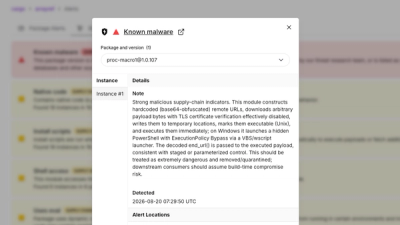
Three compromised Rust crates pulled in a malicious dependency that downloaded and executed cross-platform malware during Cargo builds.