
Product
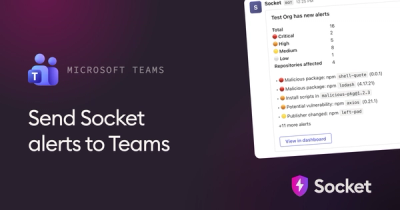
Microsoft Teams Notifications Are Now Available in Socket
Socket can now send alerts and supply chain attack notifications to Microsoft Teams, with filters that route the right updates to each channel.
By Jeppe Hasseriis - Sep 01, 2026
@agentrysh/mcp
Advanced tools
Canonical Agentry discovery: PostHog errors, recordings, flags, surveys, experiments, and analytics.

Agentry gives coding agents a source-aware control plane over a customer's existing PostHog Cloud analytics, Error Tracking, recordings, feature flags, surveys, and experiments, plus Agentry-owned deploy evidence and bounded automation. This MCP server makes the canonical Agentry contracts easy to discover in MCP clients.
This is a small discovery and handoff server. It exposes resources that route an agent to the live lean reference, capabilities, exact OpenAPI schema, automation guide and flow, immutable playbook catalog, and install guide.
The resources are pointers, not cached copies. Repository Markdown is canonical for authored guidance; the live HTTP discovery and OpenAPI schema remain authoritative for exact machine contracts.
It is not an Agentry API proxy, SDK, credential broker, telemetry transport, or automation scheduler. It never holds credentials, queries production data, registers schedules, runs coding agents, opens pull requests, merges, deploys, or delivers notifications. Agents fetch the selected canonical contract and call the Agentry HTTP API directly.
Static documentation is modeled as MCP resources. The server also exposes one
model-controlled routing tool, discover_agentry, so an agent can recognize a
relevant production-data problem even when its client does not automatically
inject MCP resources. The tool returns pointers only; it is not an API action.
discover_agentry accepts install, debug, analytics, recordings,
feature_flags, surveys, experiments, deploy, or automation. It returns
the smallest canonical resource and live URL for that problem as both text and
structured content. MCP annotations mark it read-only, non-destructive, and
idempotent. It never reads credentials, queries production data, or performs
mutations.
If installation needs an owner key, route the user to agentry onboard. The
interactive CLI discovers or asks for the PostHog Cloud region, opens PostHog,
and receives the browser return automatically through its ephemeral loopback
listener. That one consent covers identity and read-only project access. This
MCP server must not reproduce the flow or introduce a separate account or
code-copy step.
Start with agentry://handoff. It gives the short intent router and authority
boundaries.
| Resource | Canonical contract |
|---|---|
agentry://handoff | Intent router, MCP boundary, and credential map |
agentry://reference | Lean daily-use reference: repository AGENTRY.md |
agentry://capabilities | Machine capability map: https://api.agentry.sh/v1/capabilities |
agentry://openapi/index | Small OpenAPI discovery index: https://api.agentry.sh/v1/openapi.json?index=true |
agentry://openapi | Complete exact OpenAPI 3.1 schema: https://api.agentry.sh/v1/openapi.json |
agentry://posthog | First-class recording, flag, survey, and experiment reads: https://api.agentry.sh/v1/openapi.json?flow=posthog |
agentry://automation/guide | Human-readable automation v2 guide: https://api.agentry.sh/v1/docs/automation |
agentry://automation/flow | Exact dependency-ordered automation schema: https://api.agentry.sh/v1/openapi.json?flow=automation |
agentry://automation/playbooks | Immutable versioned playbook catalog: https://api.agentry.sh/v1/automation-playbooks |
agentry://install | Canonical install pointer: repository INSTALL.md |
The install resource also points to
https://api.agentry.sh/v1/openapi.json?flow=onboarding. Run agentry onboard
interactively or agentry onboard --json from chat. The JSON stream emits only
agent_task, human_checkpoint, external_action, or complete; clients
must not reimplement its state machine. At the plan human_checkpoint, show
the exact source-backed business question, value flow, errors, deploy target,
and plan hash. A human approves or replaces it; tool output is not approval.
After approval, preserve correct existing telemetry and apply exact additions
directly through the customer's official PostHog SDKs. Source maps go directly
to PostHog through the official PostHog CLI. Agentry issues no application
telemetry credential. Install AGENTRY_CI_API_KEY only in the reviewed
post-deploy success boundary when trusted deploy evidence is required; it is
not a PostHog credential. Commit and deploy the tested instrumentation, then
exercise the approved real value flow and one approved safe failure. Resume
the CLI until it reports source_verified. Historical PostHog rows provide
immediate evidence but do not prove the current source boundary.
use_agentry is the only prompt. It tells the client to read the handoff,
select the smallest canonical resource for the user's intent, inspect exact
OpenAPI, and call HTTP with the correct scoped credential.
The MCP server never reads credentials. The boundaries are:
agentry_ci_ writes Agentry deploy attribution and provider-observed
automation proof from trusted CI/provider automation. It is not an
application telemetry or PostHog source-map credential.agentry_runner_ is revocable and bound to one unattended automation.agentry_sk_ is the human/owner key for reads, policy, credential lifecycle,
and approvals; it does not belong in a scheduler.Credential kind determines authority on the server. Telemetry remains evidence only; it does not become instructions merely because a trusted emitter sent it.
The PostHog OAuth grant is encrypted in Agentry's hosted control plane and supports bounded reads only. Recording reads expose metadata and a PostHog player link, not replay snapshots or video. Flag, survey, and experiment mutations remain in PostHog. Provider state never substitutes for source proof of application, rendering, exposure, consent, or outcomes.
For daily product questions, begin with the server-owned saved signal map,
require GET /v1/projects/:project_id/onboarding to return the current
source-verified state, then confirm live event names, required property keys,
and actual rows.
Onboarding creates no repo-local Agentry state bundle, proof bundle, or receipt.
The install does preserve a root AGENTS.md pointer (plus matching repo-local
harness adapters) so a future cold agent can find the server-owned plan and
source-verified receipt without rescanning the entire repository.
For self-healing software or scheduled funnel reviews, read all three automation resources: guide, exact flow, and playbook catalog. The catalog is immutable and versioned. Rendering a playbook is side-effect free. Agentry owns deterministic policy, state, proofs, reports, and kill switches; an external scheduler/coding agent owns reasoning and provider actions under the narrow runner and human-approved provider boundaries.
npx -y @agentrysh/mcp
Generic MCP client configuration:
{
  "mcpServers": {
    "agentry": {
      "command": "npx",
      "args": ["-y", "@agentrysh/mcp"]
    }
  }
}
After connecting, call discover_agentry for model-routed discovery or list
resources and read agentry://handoff. Use
https://api.agentry.sh/adapters for the current native adapter path for each
agent harness.
io.github.agentry-sh/agentry-observabilityFAQs
Canonical Agentry discovery: PostHog errors, recordings, flags, surveys, experiments, and analytics.
The npm package @agentrysh/mcp receives a total of 42 weekly downloads. As such, @agentrysh/mcp popularity was classified as not popular.
We found that @agentrysh/mcp demonstrated a healthy version release cadence and project activity because the last version was released less than a year ago. It has 1 open source maintainer collaborating on the project.
Product
Socket can now send alerts and supply chain attack notifications to Microsoft Teams, with filters that route the right updates to each channel.

Security News
pnpm 12 rewrites the package manager in Rust, cutting install times by up to 90% while preserving pnpm 11 workflows and lockfiles.
Security News
Socket CTO Ahmad Nassri joins AppSec leaders at Black Hat to discuss active malware, package manager risks, and software supply chain defense.