
Research
/Security News
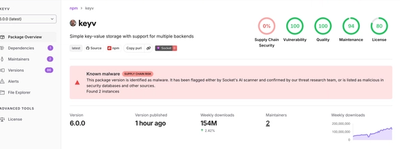
Popular npm Packages in the keyv and Cacheable Namespaces Compromised in Active Supply Chain Attack
Popular npm packages keyv and cacheable compromised.
By Socket Research Team - Aug 04, 2026
@agentutility/mcp-prooflayer
Advanced tools
MCP server for the @agentutility prooflayer cluster — pay-per-call x402 tools, no API keys, USDC on Base.
Trust + risk scanners for AI-built apps.
AI builds apps fast. Prooflayer verifies they're safe to ship — secrets, deploys, migrations, dependencies, prompt-injection, supply chain.
Pricing: pay-per-call in USDC on Base. No subscriptions, no API keys. See per-tool prices below.
Edit ~/Library/Application Support/Claude/claude_desktop_config.json (macOS) or %APPDATA%\Claude\claude_desktop_config.json (Windows):
{
  "mcpServers": {
    "agentutility-prooflayer": {
      "command": "npx",
      "args": ["-y", "@agentutility/mcp-prooflayer"],
      "env": { "X402_PRIVATE_KEY": "0xYOUR_PRIVATE_KEY_HEX" }
    }
  }
}
Restart Claude Desktop. 15 tools appear in the tool palette.
Add to .cursor/mcp.json:
{
  "mcpServers": {
    "agentutility-prooflayer": {
      "command": "npx",
      "args": ["-y", "@agentutility/mcp-prooflayer"],
      "env": { "X402_PRIVATE_KEY": "0x..." }
    }
  }
}
Send any amount of USDC on Base mainnet to the address derived from your X402_PRIVATE_KEY. The MCP server uses it to pay for tool calls automatically.
USDC on Base contract: 0x833589fCD6eDb6E08f4c7C32D4f71b54bdA02913
| Tool | Description |
|---|---|
ai-content-detector | (0.03 USDC/call) Detect AI-generated writing with a calibrated probability score. Returns a 0-1 likelihood, a verdict, suspicious phrases, and per-axis style signals (em-dash overuse, hedge phrases, formulaic transitions). Works as an AI content detector, GPT detector, or ChatGPT-text checker. |
app-store-rejection-explain | (0.02 USDC/call) Explains App Store and Google Play rejections and turns them into a resubmission plan. Parses rejection text and app metadata, identifies likely policy areas, extracts deadlines, and returns a policy-clean resubmission checklist plus reviewer-note outline. Does not promise approval or recommend platform-policy evasion. Use it for Google Play rejection triage or as a mobile app review policy checklist. |
brand-clearance | (0.25 USDC/call) Screens a candidate brand name across trademark, domain, and web-presence checks in a single composite signal. Runs four checks in parallel (in-process, no x402 self-billing): USPTO TM name search, domain availability across requested TLDs (default .com .ai .dev .io .co), Wikipedia presence, and a Hacker News mention scan. Returns risk_level (clear |
cve | (0.005 USDC/call) Looks up a CVE and returns the full NIST NVD vulnerability record. Short alias of cve-lookup: CVSS v3.1 + v2 vectors, severity, CWE class, affected CPE list, references, public-exploit indicator with reference URLs, and a bounded exploitability summary. Federal public data. Use it as a vulnerability lookup, NVD record fetch, CVSS scorer, vuln advisory fetch, exploit-known check, or patch-priority triage for Log4Shell-style records. |
cve-lookup | (0.005 USDC/call) Looks up a CVE and returns its canonical NIST NVD record: description, CVSS v3.1 and v2 vectors plus numeric scores, severity bucket, CWE class, affected CPE list, NVD references, and a public-exploit-known boolean with reference URLs. Takes a CVE-YYYY-NNNNN identifier and includes a bounded plain-English exploitability summary. Federal public data. Use it as a vulnerability database, NVD record fetcher, CVSS scorer, Log4Shell-style advisory inspector, known-exploit checker, CISA KEV adjacent tool, patch-priority triage aid, or CWE classifier. |
db-migration-risk | (0.02 USDC/call) Audits database migrations for risky SQL before deploy. Walks migrations/, prisma/migrations/, db/migrate/, supabase/migrations/, and alembic/versions/ and flags destructive DDL, lock-heavy ALTER TABLE, NOT NULL without DEFAULT, plain CREATE INDEX (vs CONCURRENTLY), unbounded TRUNCATE/DELETE, and FK validation without NOT VALID. Returns 0-100 score, per-finding kind/severity/path/line/evidence/recommendation, and a Venice plain-English verdict. Dual input: {repo: 'owner/name'} for public GitHub or {files: [{path, content}, ...]} for private / agent-workspace use. Use it as a SQL migration safety check, DROP COLUMN detector, unsafe ALTER TABLE detector, Postgres CREATE INDEX CONCURRENTLY check, Alembic op.drop_* detector, TRUNCATE/DELETE WHERE detector, foreign key NOT VALID check, or pre-deploy DB gate. |
dep-risk-summary | (0.03 USDC/call) Scores dependency risk for a whole repo from its manifests and lockfiles. Best-effort scan of package.json, pnpm-lock.yaml, package-lock.json, yarn.lock, bun.lock (JS); requirements.txt, pyproject.toml, poetry.lock (Python); go.mod, go.sum (Go). Samples 10 alphabetically-first direct deps via npm/PyPI registry for deprecation + install-script signals. Returns 0-100 score, per-finding kind/severity/path/evidence/recommendation, and a Venice plain-English verdict. Dual input: {repo: 'owner/name'} or {files: [{path, content}, ...]}. Use it as a package.json + lockfile vetter, unpinned dep detector, transitive dep counter, requirements.txt audit, pyproject dep risk check, deprecated dep detector, install-script dep detector, or Snyk-adjacent repo-level supply-chain risk score. |
deploy-config-risk | (0.02 USDC/call) Audits deploy configuration files for production risks. Fetches Dockerfile, wrangler.toml, vercel.json, netlify.toml, fly.toml, docker-compose.yml, and serverless.yml and flags open CORS with credentials, exposed admin ports (22/5432/6379/etc), plaintext secrets in inline env, dev/debug mode left enabled, and missing healthchecks. Returns 0-100 score, per-finding kind/severity/path/line/redacted-evidence/recommendation, and a Venice plain-English verdict. Dual input: {repo: 'owner/name'} for public GitHub or {files: [{path, content}, ...]} for private / agent-workspace use. Use it as a Dockerfile lint, vercel.json hardening pass, wrangler.toml review, docker-compose.yml safety check, fly.toml secrets check, netlify deploy gate, open CORS detector, exposed admin port detector, plaintext-secret-in-env detector, or production-readiness deploy gate. |
github-repo-health | (0.03 USDC/call) GitHub repo health score / open-source maintainability checker. 0-100 score + grade (abandoned/stale/okay/healthy/thriving). Commit activity, contributors, license, CI, tests. Plus LLM verdict. |
package-risk-npm | (0.03 USDC/call) Scores supply-chain risk for an npm package before you install it. Pulls registry metadata + download stats for the package (and optional version) and checks maintainer count, weekly downloads, install / postinstall script hooks, dependency tree depth, deprecation flag, package age, last-publish recency, and edit-distance to popular package names (typosquat). Returns a 0-10 score, risk_level bucket, contributing factors, typosquat candidate list, and a Venice plain-English summary. Use it as an npm supply-chain scanner, typosquat detector, postinstall-script flagger, npm install pre-flight audit, package.json + pnpm-lock.yaml vetter, or Snyk-adjacent / Socket.dev-adjacent pre-install safety gate. |
production-readiness-score | (0.10 USDC/call) Scores production readiness for a repo in one call, aggregating the Prooflayer cluster. Calls all 5 component scanners (secrets-exposure-check, deploy-config-risk, db-migration-risk, dep-risk-summary, prompt-injection-surface) in parallel in-process and rolls findings into a weighted composite score (default weights: secrets 0.30, migrations 0.20, deps 0.20, deploy 0.15, prompt 0.15). Returns composite 0-100, production_grade (production-ready |
prompt-injection-surface | (0.03 USDC/call) Scans AI app source code for prompt injection risk at LLM call sites. Walks .ts/.tsx/.js/.jsx/.py/.mjs/.cjs source files, locates LLM SDK call sites (anthropic, openai, @ai-sdk/*, google generative), and flags user input flowing into prompts without sanitization, calls without max_tokens caps, system/user prompt mixing, and LLM output used unvalidated in fetch/exec/eval. Returns 0-100 score, per-finding kind/severity/path/line/evidence/recommendation, and a Venice plain-English verdict. Dual input: {repo: 'owner/name'} (tree-walk, capped 500 files) or {files: [{path, content}, ...]}. Use it as an LLM call-site audit, unsanitized-user-input-in-prompts detector, system-message mixing flag, unbounded completion detector, AI app safety scan, or pre-deploy AI risk gate. |
pypi-package-risk | (0.01 USDC/call) Scores the supply-chain risk of a PyPI package before you install it. Pulls metadata + release history from pypi.org for a package (and optional version), evaluating age, recent download volume, maintainer count, post-install hook presence, dependency depth, deprecation flags, last-update recency, and string-distance to popular packages (typosquat). Returns a numeric score (0-10), risk_level bucket, contributing factor list, and an AI-written plain-English risk summary from Venice. Use it as a Python supply-chain scanner, pip dependency vetter, typosquat detector, pre-install audit, Python-package safety check, pyproject.toml / requirements.txt vetter, or poetry + uv pre-install gate. |
secrets-exposure-check | (0.02 USDC/call) Scans project config files for hardcoded secrets before you deploy. Fetches top-level config files (.env*, wrangler.toml, vercel.json, next.config.*, package.json, etc.) and scans for hardcoded AWS/OpenAI/Anthropic/Stripe/GitHub keys, private keys, DB URLs with passwords, JWT secrets, weak values in .env.example, and server-only env vars accidentally exposed via NEXT_PUBLIC_. Returns 0-100 score, per-finding kind/severity/path/line/redacted-evidence/recommendation, and a Venice plain-English verdict. Dual input: {repo: 'owner/name'} for public GitHub or {files: [{path, content}, ...]} for private / agent-workspace use. Use it as a secrets exposure scan, hardcoded API key detector, .env-committed-key audit, Next.js client env leak detector, or pre-deploy secret gate. |
vendor-questionnaire-draft | (0.08 USDC/call) Drafts vendor security questionnaire answers from evidence you supply. Takes questionnaire text plus evidence snippets and drafts only evidence-supported answers; unsupported questions are marked needs_evidence instead of invented. Useful for founders and agents answering customer security reviews without leaking private repo data or making unsupported compliance claims. Use it as a security questionnaire answerer, SOC 2 evidence answer helper, or vendor due diligence response builder. |
ai-content-detector).https://x402.agentutility.ai/ai-content-detector.X402_PRIVATE_KEY and retries.The agent never sees the payment flow — it just gets the result.
Version: 0.2.4 · License: MIT
FAQs
MCP server for the @agentutility prooflayer cluster — pay-per-call x402 tools, no API keys, USDC on Base.
The npm package @agentutility/mcp-prooflayer receives a total of 60 weekly downloads. As such, @agentutility/mcp-prooflayer popularity was classified as not popular.
We found that @agentutility/mcp-prooflayer demonstrated a healthy version release cadence and project activity because the last version was released less than a year ago. It has 1 open source maintainer collaborating on the project.
Did you know?

Socket for GitHub automatically highlights issues in each pull request and monitors the health of all your open source dependencies. Discover the contents of your packages and block harmful activity before you install or update your dependencies.
Research
/Security News
Popular npm packages keyv and cacheable compromised.

Security News
A misconfiguration gave three Anthropic models internet access, and one, believing it was in a simulation, shipped a credential-stealing package to PyPI.

Security News
/Company News
Socket has joined the new Composer and Packagist sponsorship program as a launch sponsor, supporting the team that keeps PHP's package ecosystem secure.