
Research
/Security News
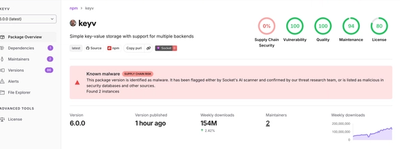
Popular npm Packages in the keyv and Cacheable Namespaces Compromised in Active Supply Chain Attack
Popular npm packages keyv and cacheable compromised.
By Socket Research Team - Aug 04, 2026
@ai-capabilities-suite/mcp-process
Advanced tools
MCP server for process management and monitoring with strict security boundaries. Launch processes, monitor resources, manage services, and orchestrate workflows - all within secure, configurable boundaries.
A Model Context Protocol (MCP) server that provides process management and monitoring capabilities for AI agents, with strict security boundaries enforced by executable allowlists and resource limits.
This package is now maintained in its own repository: https://github.com/Digital-Defiance/mcp-process
This repository is part of the AI Capabilities Suite on GitHub.
This server implements defense-in-depth security with 6 layers of validation:
See SECURITY.md for detailed security implementation.
docker pull digitaldefiance/mcp-process:latest
See DOCKER.md for detailed Docker usage instructions.
npm install @ai-capabilities-suite/mcp-process
yarn add @ai-capabilities-suite/mcp-process
npm install -g @ai-capabilities-suite/mcp-process
# Pull the image
docker pull digitaldefiance/mcp-process:latest

# Create config directory
mkdir -p config

# Create configuration
cat > config/mcp-process-config.json << EOF
{
  "allowedExecutables": ["node", "python3", "npm"],
  "maxConcurrentProcesses": 5,
  "enableAuditLog": true
}
EOF

# Run with docker-compose
docker-compose up -d
See DOCKER.md for detailed Docker instructions.
mcp-process --create-config ./mcp-process-config.json
This creates a sample configuration file with secure defaults.
Edit mcp-process-config.json to add your allowed executables:
{
  "allowedExecutables": ["node", "python3", "npm", "git"],
  "defaultResourceLimits": {
    "maxCpuPercent": 80,
    "maxMemoryMB": 1024,
    "maxCpuTime": 300
  },
  "maxConcurrentProcesses": 10,
  "maxProcessLifetime": 3600,
  "enableAuditLog": true,
  "blockShellInterpreters": true,
  "blockSetuidExecutables": true,
  "allowProcessTermination": true,
  "allowGroupTermination": true,
  "allowForcedTermination": false,
  "allowStdinInput": true,
  "allowOutputCapture": true,
  "requireConfirmation": false
}
mcp-process --config ./mcp-process-config.json
Or use environment variables:
export MCP_PROCESS_CONFIG_PATH=./mcp-process-config.json
mcp-process
Configure your AI agent (e.g., Kiro, Claude Desktop) to connect to the MCP server via stdio transport.
The server looks for configuration in the following order:
--config command line argumentMCP_PROCESS_CONFIG_PATH environment variableMCP_PROCESS_CONFIG environment variable (JSON string)./mcp-process-config.json./config/mcp-process.jsonSee SECURITY.md for detailed configuration options and security settings.
{
  "allowedExecutables": ["node", "python3"],
  "defaultResourceLimits": {
    "maxCpuPercent": 80,
    "maxMemoryMB": 1024
  },
  "maxConcurrentProcesses": 10,
  "maxProcessLifetime": 3600,
  "enableAuditLog": true,
  "blockShellInterpreters": true,
  "blockSetuidExecutables": true,
  "allowProcessTermination": true,
  "allowGroupTermination": true,
  "allowForcedTermination": false,
  "allowStdinInput": true,
  "allowOutputCapture": true,
  "requireConfirmation": false
}
The server exposes 12 MCP tools for process management:
Launch a new process.
Parameters:
executable (string, required): Path to executableargs (string[], optional): Command-line argumentscwd (string, optional): Working directoryenv (object, optional): Environment variablestimeout (number, optional): Timeout in millisecondscaptureOutput (boolean, optional): Whether to capture stdout/stderrresourceLimits (object, optional): Resource limitsReturns:
pid (number): Process IDstartTime (string): ISO timestamp of process startTerminate a process.
Parameters:
pid (number, required): Process IDforce (boolean, optional): Use SIGKILL instead of SIGTERMtimeout (number, optional): Timeout for graceful termination (ms)Returns:
exitCode (number): Process exit codeterminationReason (string): "graceful" or "forced"Get process resource usage statistics.
Parameters:
pid (number, required): Process IDincludeHistory (boolean, optional): Include historical dataReturns:
cpuPercent (number): CPU usage percentagememoryMB (number): Memory usage in MBthreadCount (number): Number of threadsioRead (number): Bytes readioWrite (number): Bytes writtenuptime (number): Process uptime in secondshistory (array, optional): Historical statisticsSend input to process stdin.
Parameters:
pid (number, required): Process IDdata (string, required): Data to sendencoding (string, optional): Text encoding (default: "utf-8")Returns:
bytesWritten (number): Number of bytes writtenGet captured process output.
Parameters:
pid (number, required): Process IDstream (string, optional): "stdout", "stderr", or "both" (default: "both")encoding (string, optional): Text encoding (default: "utf-8")Returns:
stdout (string): Captured stdoutstderr (string): Captured stderrstdoutBytes (number): Stdout buffer sizestderrBytes (number): Stderr buffer sizeList all managed processes.
Returns:
Get detailed process status.
Parameters:
pid (number, required): Process IDReturns:
state (string): "running", "stopped", or "crashed"uptime (number): Process uptime in secondsstats (object): Current resource usage statisticsCreate a process group.
Parameters:
name (string, required): Group namepipeline (boolean, optional): Whether to create a pipelineReturns:
groupId (string): Group identifierAdd a process to a group.
Parameters:
groupId (string, required): Group identifierpid (number, required): Process IDTerminate all processes in a group.
Parameters:
groupId (string, required): Group identifierStart a long-running service with auto-restart.
Parameters:
name (string, required): Service nameexecutable (string, required): Path to executableargs (string[], optional): Command-line argumentscwd (string, optional): Working directoryenv (object, optional): Environment variablesrestartPolicy (object, optional): Restart configurationhealthCheck (object, optional): Health check configurationReturns:
serviceId (string): Service identifierpid (number): Initial process IDStop a service and disable auto-restart.
Parameters:
serviceId (string, required): Service identifier// Launch a process
const result = await mcpClient.callTool("process_start", {
executable: "node",
args: ["--version"],
captureOutput: true,
});
console.log("Process started:", result.pid);
// Wait a moment for it to complete
await new Promise((resolve) => setTimeout(resolve, 1000));
// Get output
const output = await mcpClient.callTool("process_get_output", {
pid: result.pid,
});
console.log("Output:", output.stdout);
// Start a process
const result = await mcpClient.callTool("process_start", {
  executable: "python3",
  args: ["my_script.py"],
  resourceLimits: {
    maxCpuPercent: 50,
    maxMemoryMB: 512,
  },
});

// Monitor resources
const stats = await mcpClient.callTool("process_get_stats", {
  pid: result.pid,
  includeHistory: true,
});

console.log("CPU:", stats.cpuPercent + "%");
console.log("Memory:", stats.memoryMB + "MB");
// Start an interactive process
const result = await mcpClient.callTool("process_start", {
  executable: "python3",
  args: ["-i"],
  captureOutput: true,
});

// Send input
await mcpClient.callTool("process_send_stdin", {
  pid: result.pid,
  data: 'print("Hello from AI agent")\n',
});

// Wait and get output
await new Promise((resolve) => setTimeout(resolve, 500));
const output = await mcpClient.callTool("process_get_output", {
  pid: result.pid,
});

console.log("Output:", output.stdout);
// Start a service with auto-restart
const service = await mcpClient.callTool("process_start_service", {
  name: "my-api-server",
  executable: "node",
  args: ["server.js"],
  restartPolicy: {
    enabled: true,
    maxRetries: 3,
    backoffMs: 5000,
  },
  healthCheck: {
    command: "curl http://localhost:3000/health",
    interval: 30000,
    timeout: 5000,
  },
});

console.log("Service started:", service.serviceId);
// Create a process group
const group = await mcpClient.callTool("process_create_group", {
  name: "data-pipeline",
  pipeline: true,
});

// Start first process
const proc1 = await mcpClient.callTool("process_start", {
  executable: "cat",
  args: ["data.txt"],
  captureOutput: true,
});

// Add to group
await mcpClient.callTool("process_add_to_group", {
  groupId: group.groupId,
  pid: proc1.pid,
});

// Start second process (will receive output from first)
const proc2 = await mcpClient.callTool("process_start", {
  executable: "grep",
  args: ["pattern"],
  captureOutput: true,
});

await mcpClient.callTool("process_add_to_group", {
  groupId: group.groupId,
  pid: proc2.pid,
});
Cause: The executable you're trying to launch is not in the allowedExecutables configuration.
Solution: Add the executable to your configuration file:
{
  "allowedExecutables": ["node", "python3", "/path/to/your/executable"]
}
You can use:
/usr/bin/nodenode/usr/bin/*Cause: You're trying to launch a shell (bash, sh, cmd.exe, etc.) and blockShellInterpreters is enabled.
Solution: Either:
blockShellInterpreters: false in your configuration (not recommended)Cause: The process has already terminated or the PID is invalid.
Solution: Check if the process is still running using process_list or process_get_status.
Cause: The process exceeded configured resource limits.
Solution: Increase resource limits in your configuration or when launching the process:
{
  "defaultResourceLimits": {
    "maxCpuPercent": 90,
    "maxMemoryMB": 2048
  }
}
Cause: You've reached the maxConcurrentProcesses limit.
Solution:
maxConcurrentProcesses in your configurationCause: The process stdin is closed or the process doesn't support stdin input.
Solution: Ensure the process is still running and was started with stdin enabled.
Cause: The server can't find your configuration file.
Solution:
--config flag: mcp-process --config /path/to/config.jsonexport MCP_PROCESS_CONFIG_PATH=/path/to/config.json./mcp-process-config.jsonEnable debug logging by setting the audit log level:
{
  "enableAuditLog": true,
  "auditLogLevel": "debug"
}
Check the audit log for detailed information about process operations and security violations.
# Clone the repository
git clone https://github.com/digital-defiance/ai-capabilities-suite.git
cd ai-capabilities-suite/packages/mcp-process

# Install dependencies
npm install

# Build
npm run build
# Run all tests (unit, integration, and e2e)
npm test

# Run tests with coverage
npm run test:coverage

# Run tests in watch mode
npm run test:watch

# Run specific test file
npm test -- SecurityManager.spec.ts

# Run only e2e tests
npm run test:e2e

# Run minimal e2e smoke tests (quick validation)
npm run test:e2e:minimal
The MCP ACS Process Server includes comprehensive e2e tests that validate the complete system behavior by spawning the server as a child process and communicating via stdio using JSON-RPC protocol. These tests ensure the server works correctly in real-world usage scenarios.
E2E Test Structure:
server.e2e.spec.ts - Comprehensive e2e tests covering all MCP tools and protocol featuresserver.minimal.e2e.spec.ts - Quick smoke tests for basic functionality validation (< 30 seconds)Running E2E Tests:
# Run comprehensive e2e tests
npm run test:e2e

# Run minimal smoke tests for quick feedback
npm run test:e2e:minimal

# Run e2e tests with specific pattern
npm test -- --testPathPattern=e2e.spec.ts

# Run e2e tests with verbose output
npm test -- --testPathPattern=e2e.spec.ts --verbose
What E2E Tests Validate:
E2E Test Requirements:
npm run builddist/cli.jsDebugging E2E Test Failures:
If e2e tests fail, follow these steps:
Ensure the server is built:
npm run build
Check if the CLI exists:
ls -la dist/cli.js
Run tests with verbose output:
npm test -- --testPathPattern=e2e.spec.ts --verbose
Check for server startup errors:
Verify server can start manually:
node dist/cli.js --help
Run minimal tests first:
npm run test:e2e:minimal
If minimal tests pass but comprehensive tests fail, the issue is likely with specific functionality rather than basic server operation.
Check process cleanup:
# List any orphaned node processes
ps aux | grep node
Enable debug logging:
Set DEBUG=* environment variable to see detailed logs:
DEBUG=* npm test -- --testPathPattern=e2e.spec.ts
Common E2E Test Issues:
| Issue | Cause | Solution |
|---|---|---|
| "Server executable not found" | Server not built or wrong path | Run npm run build |
| "Server failed to start" | Server crash on startup | Check stderr output in test logs |
| "Request timeout" | Server not responding | Increase timeout or check server logs |
| "Process not cleaned up" | Test cleanup failure | Run npm test -- --forceExit |
| "Port already in use" | Previous test didn't clean up | Kill orphaned processes |
| "Permission denied" | Insufficient permissions | Check file permissions on dist/cli.js |
CI Environment Considerations:
E2E tests are designed to run in CI environments with the following considerations:
CI Configuration Example:
# .github/workflows/test.yml
- name: Build
  run: npm run build

- name: Run minimal e2e tests
  run: npm run test:e2e:minimal

- name: Run full test suite
  run: npm test
  env:
    CI: true
Property-Based Testing:
E2E tests include property-based tests using fast-check to validate universal properties:
These tests run multiple iterations with randomly generated inputs to ensure correctness across a wide range of scenarios.
npm run lint
# Clean build directory
npm run clean

# Build TypeScript
npm run build
# Publish to npm (requires authentication)
npm run publish:public
The MCP ACS Process Server consists of several core components:
Contributions are welcome! Please see the main repository for contribution guidelines: https://github.com/digital-defiance/ai-capabilities-suite
MIT License - see LICENSE file for details.
Built with:
FAQs
MCP server for process management and monitoring with strict security boundaries. Launch processes, monitor resources, manage services, and orchestrate workflows - all within secure, configurable boundaries.
We found that @ai-capabilities-suite/mcp-process demonstrated a healthy version release cadence and project activity because the last version was released less than a year ago. It has 1 open source maintainer collaborating on the project.
Did you know?

Socket for GitHub automatically highlights issues in each pull request and monitors the health of all your open source dependencies. Discover the contents of your packages and block harmful activity before you install or update your dependencies.
Research
/Security News
Popular npm packages keyv and cacheable compromised.

Security News
A misconfiguration gave three Anthropic models internet access, and one, believing it was in a simulation, shipped a credential-stealing package to PyPI.

Security News
/Company News
Socket has joined the new Composer and Packagist sponsorship program as a launch sponsor, supporting the team that keeps PHP's package ecosystem secure.