

Product
PHP and Composer Support Is Now in Beta
Socket’s PHP and Composer support is now in Beta for all customers, with PHP reachability analysis generally available.
By Trevor Norris, Benjamin Barslev - Aug 21, 2026
@ai-sdk/mcp
Advanced tools
The **Model Context Protocol (MCP) client** for the [AI SDK](https://ai-sdk.dev/docs) lets you connect to MCP servers and use their tools with AI SDK functions like `generateText` and `streamText`.
The Model Context Protocol (MCP) client for the
AI SDK lets you connect to MCP servers and use their
tools with AI SDK functions like generateText and streamText.
The MCP client is available in the @ai-sdk/mcp module. You can install it with
npm i @ai-sdk/mcp ai zod
If you use coding agents such as Claude Code or Cursor, we highly recommend adding the AI SDK skill to your repository:
npx skills add vercel/ai
Create an MCP client with createMCPClient(), fetch the server tools with
mcpClient.tools(), and pass them to an AI SDK call:
import { createMCPClient } from '@ai-sdk/mcp';
import { generateText, isStepCount } from 'ai';

const mcpClient = await createMCPClient({
  transport: {
    type: 'http',
    url: 'https://your-server.com/mcp',
    headers: {
      Authorization: `Bearer ${process.env.MCP_API_KEY}`,
    },
  },
});

try {
  const tools = await mcpClient.tools();

  const { text } = await generateText({
    model: 'openai/gpt-5.4',
    tools,
    stopWhen: isStepCount(10),
    prompt: 'Use the available tools to answer the user question.',
  });

  console.log(text);
} finally {
  await mcpClient.close();
}
The client converts MCP tool definitions into AI SDK tools, so model calls can
use them through the standard tools option.
The client supports legacy MCP protocol versions through the initialize
handshake and MCP 2026-07-28 through stateless protocol discovery. The
built-in stdio transport probes with server/discover and falls back to the
legacy handshake when connected to an older server.
Custom transports can opt into the same negotiation by setting
supportsProtocolVersionDiscovery to true. Modern requests include the
protocol version, client capabilities, and client information in _meta.
For streaming responses, close the MCP client when the stream finishes:
import { createMCPClient } from '@ai-sdk/mcp';
import { streamText } from 'ai';

const mcpClient = await createMCPClient({
  transport: {
    type: 'http',
    url: 'https://your-server.com/mcp',
  },
});

const result = streamText({
  model: 'openai/gpt-5.4',
  tools: await mcpClient.tools(),
  prompt: 'Use the available tools to answer the user question.',
  onEnd: async () => {
    await mcpClient.close();
  },
});

for await (const textPart of result.textStream) {
  process.stdout.write(textPart);
}
HTTP is recommended for production deployments:
Session persistence applies only to legacy MCP protocol versions. MCP
2026-07-28 is stateless and does not use session ids or cached initialize
results.
import { createMCPClient } from '@ai-sdk/mcp';

const savedSession = await loadMcpSession();
let currentSessionId = savedSession?.sessionId;

const mcpClient = await createMCPClient({
  transport: {
    type: 'http',
    url: 'https://your-server.com/mcp',
    initialSessionId: savedSession?.sessionId,
    initialProtocolVersion: savedSession?.initializeResult.protocolVersion,
    terminateSessionOnClose: false,
    onSessionIdChange: sessionId => {
      currentSessionId = sessionId;
    },
    onSessionExpired: sessionId => {
      if (currentSessionId === sessionId) {
        currentSessionId = undefined;
        void clearMcpSession();
      }
    },
  },
  initialInitializeResult: savedSession?.initializeResult,
});

if (currentSessionId) {
  await saveMcpSession({
    sessionId: currentSessionId,
    initializeResult: mcpClient.initializeResult,
  });
}
SSE is also supported for MCP servers that use Server-Sent Events:
const mcpClient = await createMCPClient({
  transport: {
    type: 'sse',
    url: 'https://your-server.com/sse',
  },
});
For local MCP servers, you can use stdio transport from the @ai-sdk/mcp/mcp-stdio
subpath:
import { createMCPClient } from '@ai-sdk/mcp';
import { Experimental_StdioMCPTransport } from '@ai-sdk/mcp/mcp-stdio';

const mcpClient = await createMCPClient({
  transport: new Experimental_StdioMCPTransport({
    command: 'node',
    args: ['server.js'],
  }),
});
Please check out the AI SDK MCP documentation for more information.
FAQs
The **Model Context Protocol (MCP) client** for the [AI SDK](https://ai-sdk.dev/docs) lets you connect to MCP servers and use their tools with AI SDK functions like `generateText` and `streamText`.
The npm package @ai-sdk/mcp receives a total of 2,650,017 weekly downloads. As such, @ai-sdk/mcp popularity was classified as popular.
We found that @ai-sdk/mcp demonstrated a healthy version release cadence and project activity because the last version was released less than a year ago. It has 3 open source maintainers collaborating on the project.
Product
Socket’s PHP and Composer support is now in Beta for all customers, with PHP reachability analysis generally available.
Product
Socket is bringing experimental protection to Firefox, scanning 97,000+ extensions in Mozilla's official directory for malware and risky updates.
Research
/Security News
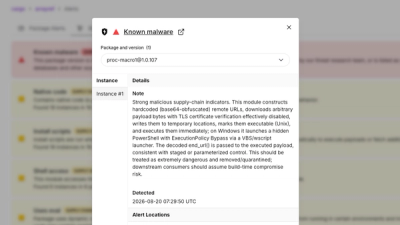
Three compromised Rust crates pulled in a malicious dependency that downloaded and executed cross-platform malware during Cargo builds.