
Product
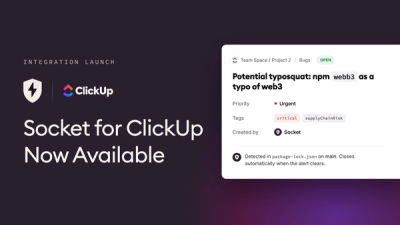
Socket for ClickUp Is Now Available
Create ClickUp tasks from Socket alerts, automate ticketing with custom rules, and keep alert and task status synchronized.
By Jeppe Hasseriis - Aug 26, 2026
@aishorty/sdk
Advanced tools
The official TypeScript SDK for the Shorty public API
(https://aishorty.com/v1). Transcribe media, summarize videos and web pages,
generate subtitles, and poll async jobs — with typed errors, automatic retries,
cursor pagination, and Standard-Webhooks signature verification.
fetch, node:crypto, AbortSignal.npm install @aishorty/sdk
# or: pnpm add @aishorty/sdk / yarn add @aishorty/sdk
import { Shorty } from '@aishorty/sdk'

const shorty = new Shorty({ apiKey: process.env.SHORTY_API_KEY })

// Start a summary job for a YouTube video…
const job = await shorty.summaries.create({
    source: 'youtube',
    url: 'https://www.youtube.com/watch?v=dQw4w9WgXcQ',
})

// …then wait for it to finish.
const finished = await shorty.jobs.waitFor(job.job_id)
console.log(finished.status, finished.output)
Shorty accepts exactly one auth form: a Bearer API key (shk_live_…), sent
on every request as Authorization: Bearer <key>. Create keys in your developer
console.
// Explicit:
const shorty = new Shorty({ apiKey: 'shk_live_…' })

// Or omit it and the SDK reads process.env.SHORTY_API_KEY:
const shorty = new Shorty()
The key is held in a closure — it never appears in JSON.stringify(client),
util.inspect(client), thrown errors, or debug logs.
| Option | Default | Description |
|---|---|---|
apiKey | process.env.SHORTY_API_KEY | Your shk_live_… key. Throws if unset. |
baseUrl | https://aishorty.com | API origin (paths already include /v1). |
timeoutMs | 60000 | Per-attempt timeout. |
maxRetries | 2 | Retries after the first attempt. |
fetch | globalThis.fetch | Override the fetch implementation. |
debug | false | true logs to stderr; a function receives redacted log lines. |
dangerouslyAllowBrowser | false | Allow construction where window exists (not recommended). |
await shorty.usage.get()

const page = await shorty.articles.list({ limit: 20 })
await shorty.articles.search({ q: 'transformers', article_type: 'YOUTUBE_ARTICLE' })
await shorty.articles.get(articleId)

await shorty.transcriptions.list()
await shorty.transcriptions.get(id)
await shorty.transcriptions.create({ url: 'https://example.com/audio.mp3' })

await shorty.summaries.create({ source: 'url', url: 'https://example.com/post' })
await shorty.summaries.create({ source: 'text', content: 'Long text to summarize…' })

await shorty.subtitles.create({ url: 'https://example.com/clip.mp4', style: 'TIKTOK' })
await shorty.subtitles.download(jobId, { kind: 'srt' })

await shorty.jobs.get(jobId)
await shorty.jobs.waitFor(jobId)
Every method takes a trailing opts? with { signal, timeoutMs, headers }
(and idempotencyKey on the create methods).
list() returns a Page. Iterate it with for await to walk every item
across all pages (the SDK follows the opaque cursor for you, reusing your
original filters), or page manually.
// Auto-iterate all items:
for await (const article of await shorty.articles.list({ limit: 50 })) {
    console.log(article.id, article.title)
}

// Manual page control:
let page = await shorty.articles.list({ limit: 50 })
while (page) {
    console.log(page.data.length, 'items; hasMore =', page.hasMore)
    page = (await page.nextPage()) ?? null
    if (!page) break
}
Cursors are filter-bound: a cursor minted under one query cannot be replayed against a different filter. The SDK never mutates your params while paging, so this is handled automatically — just don't hand a cursor to a different
list()call.
waitForWrites (transcriptions.create, summaries.create, subtitles.create) return
a 202 { job_id, status, tracking_url }. Poll with jobs.get(id), or use the
convenience poller:
try {
    const done = await shorty.jobs.waitFor(job.job_id, {
        pollIntervalMs: 2000, // default
        timeoutMs: 600_000, // default
        // signal: abortController.signal,
    })
    console.log('done:', done.output)
} catch (err) {
    if (err instanceof JobFailedError) {
        // The job ended in ERROR/CANCELLED — err.jobError has the reason.
    }
    if (err instanceof APITimeoutError) {
        // The deadline elapsed before the job finished.
    }
}
waitFor is a client-side loop — not a server feature. It resolves on
SUCCESS, throws JobFailedError on ERROR/CANCELLED, and APITimeoutError
on the deadline.
Every non-2xx response throws a typed error. The class is chosen by the problem
code first, falling back to the HTTP status class for any unknown/absent code
(so a new server code never breaks your instanceof handling).
import {
    APIError,
    AuthenticationError,
    PermissionDeniedError,
    NotFoundError,
    ConflictError,
    ValidationError,
    RateLimitError,
    QuotaExhaustedError,
    APIServerError,
    APIConnectionError,
    APITimeoutError,
} from '@aishorty/sdk'

try {
    await shorty.usage.get()
} catch (err) {
    if (err instanceof QuotaExhaustedError) {
        // Period allowance spent — back off until the next window.
    } else if (err instanceof RateLimitError) {
        console.log('retry after', err.retryAfterSeconds, 's')
    } else if (err instanceof APIError) {
        console.log(err.status, err.code, err.title, err.detail, err.requestId)
        console.log(err.errors) // field-level validation errors, when present
    }
}
Every APIError carries status, code, problemType, title, detail,
requestId, errors?, headers, and (on 429s) retryAfterSeconds. The
.message is title: detail (request_id) and never contains your API key.
| Code | Status | SDK error class |
|---|---|---|
unauthorized | 401 | AuthenticationError |
invalid_api_key | 401 | AuthenticationError |
insufficient_scope | 403 | PermissionDeniedError |
feature_not_enabled | 403 | PermissionDeniedError |
resource_not_found | 404 | NotFoundError |
idempotency_conflict | 409 | ConflictError |
idempotency_in_progress | 409 | ConflictError |
resource_not_ready | 409 | ConflictError |
validation_failed | 400 | ValidationError |
idempotency_key_reused | 422 | ValidationError |
request_too_large | 413 | ValidationError |
rate_limited | 429 | RateLimitError |
quota_exhausted | 429 | QuotaExhaustedError |
internal_error | 500 | APIServerError |
service_unavailable | 503 | APIServerError |
Transport-level failures throw APIConnectionError (with cause) or
APITimeoutError.
The SDK automatically retries transient failures up to maxRetries times
(default 2) after the first attempt.
Retried: connection errors · per-attempt timeouts · 408 · 429
rate_limited (or a 429 with no parseable code) · 500 / 502 / 503 /
504.
Never retried: 429 quota_exhausted (a spent period allowance — retrying
won't help) · any other 4xx · requests you aborted via your own signal.
Backoff: a Retry-After header is honored when present (both delta-seconds
and HTTP-date forms, capped at 60s); otherwise full-jitter exponential backoff,
random(0, min(0.5 · 2^attempt, 8)) seconds.
POST safety: an unsafe POST is retried only when it carries an
Idempotency-Key. The three create methods auto-generate one (a UUID) and reuse
the same key across every retry attempt, so retries are deduplicated
server-side. Supply your own via opts.idempotencyKey to make a call idempotent
across process restarts:
await shorty.summaries.create(
    { source: 'text', content: '…' },
    { idempotencyKey: 'my-stable-key-123' },
)
client.request(...) POSTs are not retried unless you pass an
idempotencyKey yourself.
Verify inbound Shorty webhooks with verifyWebhookSignature. It implements the
Standard Webhooks v1 scheme (HMAC-SHA256,
webhook-id / webhook-timestamp / webhook-signature headers, rotation via
multiple space-separated signatures, a 5-minute replay tolerance, constant-time
comparison).
import { verifyWebhookSignature } from '@aishorty/sdk'

// Express example — note express.raw(), NOT express.json():
app.post('/webhooks/shorty', express.raw({ type: '*/*' }), (req, res) => {
    const result = verifyWebhookSignature({
        payload: req.body, // the RAW body (Buffer/Uint8Array or string)
        headers: req.headers, // Headers object or lowercase-keyed record
        secret: process.env.SHORTY_WEBHOOK_SECRET!, // whsec_…
    })
    if (!result.valid) {
        return res.status(400).json({ error: result.reason })
    }
    // Safe to handle. Parse the body only AFTER verifying.
    const event = JSON.parse(Buffer.from(req.body).toString('utf8'))
    res.sendStatus(200)
})
Raw body only. You must verify the exact bytes you received. Do not
JSON.parseand re-JSON.stringifythe body before verifying — re-serialization reorders keys and changes whitespace, which will fail verification. In frameworks that auto-parse JSON, capture the raw body first (e.g.express.raw(), orawait request.text()in a Next.js route).
verifyWebhookSignature returns a discriminated result:
type WebhookVerifyResult =
    | { valid: true }
    | {
          valid: false
          reason:
              | 'missing_headers'
              | 'malformed_timestamp'
              | 'timestamp_out_of_tolerance'
              | 'no_matching_signature'
      }
MIT © Devino Solutions
FAQs
Official TypeScript SDK for the Shorty public API (aishorty.com/v1).
We found that @aishorty/sdk demonstrated a healthy version release cadence and project activity because the last version was released less than a year ago. It has 1 open source maintainer collaborating on the project.
Product
Create ClickUp tasks from Socket alerts, automate ticketing with custom rules, and keep alert and task status synchronized.
Product
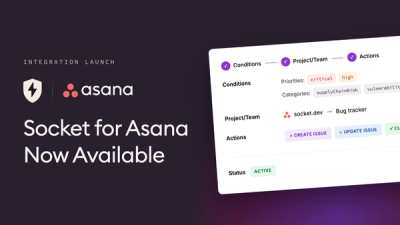
Create and manage Asana tasks directly from Socket alerts, with manual task creation, automated ticketing rules, and two-way sync.

Security News
Open VSX has removed three extension IDs from its malicious-extension list as the legitimate publishers they impersonated move to claim the names for themselves.