

Company News
AWS Security Hub Adds Socket for Supply Chain Security
Socket is now in the AWS Security Hub Extended plan. Adopt it through AWS, apply committed spend, and block malicious open source packages.
By Feross Aboukhadijeh - Aug 04, 2026
@applitools/mcp
Advanced tools
The Applitools MCP server helps you create, update, and analyze visual tests using Applitools Eyes with our Playwright (JavaScript/TypeScript) Fixtures SDK, with support for more frameworks coming soon.
It connects to AI assistants through the Model Context Protocol (MCP), allowing tools like Cline, Claude Code, and IDE assistants to help you set up tests, add visual checkpoints, and configure cross-browser testing.
To learn more, please visit our MCP documentation.
This server is built for developers, testers, or QA working with AI-assisted workflows.
It enables your AI assistant to:
All without requiring manual, error-prone steps.
Recommended: VS Code Extension or Cursor MCP Install
The easiest way to start using Eyes MCP is through the Applitools VS Code extension or by installing the MCP server directly in Cursor.


Alternatively, you can install the server manually by following the Manual Setup section below.
If you prefer not to use the extension, you can install the MCP server manually by following the examples below.
Standard MCP configuration:
{
  "mcpServers": {
    "applitools-mcp": {
      "type": "stdio",
      "command": "npx",
      "args": ["--yes", "@applitools/mcp@latest"]
    }
  }
}
Please see the VS Code MCP install guide and use the standard config above.
Alternatively, install it via the VS Code CLI:
code --add-mcp '{"name":"applitools-mcp","command":"npx","args":["@applitools/mcp@latest"]}'
Create or edit the configuration file ~/.copilot/mcp-config.json and add:
{
 "mcpServers": {
   "applitools-mcp": {
     "type": "local",
     "command": "npx",
     "tools": [
       "*"
     ],
     "args": [
       "@applitools/mcp@latest"
     ]
   }
 }
}
Follow the instruction in the section Configuring MCP Servers
Add the following to your cline_mcp_settings.json file:
{
  "mcpServers": {
    "applitools-mcp": {
      "command": "npx",
      "args": ["--yes", "@applitools/mcp@latest"],
      "disabled": false,
      "type": "stdio",
	   "timeout": 60
    }
  }
}
claude mcp add applitools-mcp npx @applitools/mcp@latest
Follow the MCP install guide, and use the standard MCP configuration above.
Checks your Applitools API key and optional Eyes server URL.
Searches common locations:
Guides the setup of Applitools Eyes in your Playwright project (Fixtures variant).
Includes:
Adds Eyes visual checkpoints to your existing Playwright test in line with best practices.
Configures the Ultrafast Grid (UFG) for cross-browser and cross-device testing. Guides you through UFG setup to run visual tests across multiple browsers, viewports, and devices simultaneously.
Retrieves structured visual test results, including:
Extracts and converts Eyes test result URLs from console output. Parses test execution output to find session URLs and converts them to batch URLs for viewing all test results together in the Eyes dashboard.
Ask your AI assistant about Applitools:
Built with ❤️ by Applitools
FAQs
Applitools MCP server for AI coding assistants
The npm package @applitools/mcp receives a total of 152 weekly downloads. As such, @applitools/mcp popularity was classified as not popular.
We found that @applitools/mcp demonstrated a healthy version release cadence and project activity because the last version was released less than a year ago. It has 48 open source maintainers collaborating on the project.
Did you know?

Socket for GitHub automatically highlights issues in each pull request and monitors the health of all your open source dependencies. Discover the contents of your packages and block harmful activity before you install or update your dependencies.
Company News
Socket is now in the AWS Security Hub Extended plan. Adopt it through AWS, apply committed spend, and block malicious open source packages.
Research
/Security News
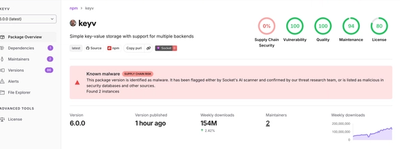
Popular npm packages keyv and cacheable compromised.

Security News
A misconfiguration gave three Anthropic models internet access, and one, believing it was in a simulation, shipped a credential-stealing package to PyPI.