This is an internal utility to help us deal with IP addresses.
It includes code from the Rust standard library code to parse
IPv4 and IPv6 and also contains some code from
pbojinov/request-ip.
We turned the Rust IP parser into TypeScript so that we have the exact same
functionality in both languages.
Similar functionality in alternative JavaScript libraries often uses regular
expressions but those can cause ReDoS attacks.
We sidestep that problem because the Rust IP parser algorithm does not use
regular expressions.
We chose to copy code from request-ip so that we only keep the functionality
that we use and keep our dependency tree as light as possible.
Our code is different: if we know we are running on Cloudflare for example then
we do not trust headers typically set by fly.io.
When should I use this?
You should not use this but use one of the alternatives instead.
This package matches our current needs which are likely different from yours.
Install
This package is ESM only.
Install with npm in Node.js:
This type represents a parsed CIDR range that you can use as a trusted proxy.
Type
typeCidr = Ipv4Cidr | Ipv6Cidr;
// Where each is an instance roughly equivalent to// `{bits: number, partSize: 8 | 16, parts: Array<number>, type: "v4" | "v6"}`,// with a `contains` function that can be passed an array of octets.
Options
You can pass these options to configure how findIp looks up the client IP.
Fields
platform (Platform, optional)
— the platform your code is running on; we use this to only trust
headers that are known to be set by that platform
proxies (Array<Cidr | string>, optional)
— a list of trusted proxies to skip when resolving the client IP
Platform
This type represents the platform names that findIp recognizes.
This type represents a request-like object that findIp can extract an IP
address from. It supports several shapes because different platforms expose
request information differently.
info ({remoteAddress?: string}, optional)
— some platforms pass connection info here
ip (unknown, optional)
— some platforms provide the IP directly on the request object
requestContext ({identity?: {sourceIp?: string}}, optional)
— some platforms pass a request context with identity info
socket ({remoteAddress?: string}, optional)
— some platforms pass a socket with the remote address
findIp(request[, options])
Finds the client IP address from a request-like object. If you pass a
platform in the options, we only trust headers that are known to be set
by that platform.
Parameters
request (RequestLike)
— the request to extract an IP from
options (Options, optional)
— configuration for platform and trusted proxies
Returns
The found IP address (string), or an empty string if no IP could be
determined.
parseProxy(value)
Parses a CIDR address string into a Cidr object, or returns
the value as-is if it is a plain IP address. You can use this to build a
list of trusted proxies.
Parameters
value (string)
— an IP address or CIDR range to parse
Returns
A parsed Cidr if the value is a range, or the given value
string if it is a plain IP.
Considerations
The IP should not be trusted as it can be spoofed in most cases, especially when
loaded via the Headers object. We apply additional platform guards if a
platform is supplied in the options argument.
If a private/internal address is encountered, it will be skipped. If only those
are detected, an empty string is returned.
Arcjet utilities for finding the originating IP of a request
We found that @arcjet/ip demonstrated a healthy version release cadence and project activity because the last version was released less than a year ago.It has 2 open source maintainers collaborating on the project.
Package last updated on 14 Apr 2026
Did you know?
Socket for GitHub automatically highlights issues in each pull request and monitors the health of all your open source dependencies. Discover the contents of your packages and block harmful activity before you install or update your dependencies.
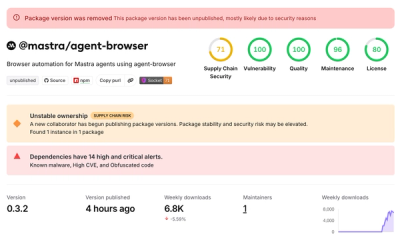
More than 140 Mastra npm packages were compromised in a supply chain attack that used a typosquatted dependency to deliver a cross-platform infostealer during installation.