Product
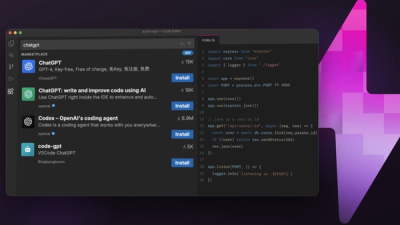
Socket Firewall Now Blocks Malicious VS Code and Open VSX Extensions
Socket Firewall blocks malicious VS Code and Open VSX extensions before install, protecting developers from compromised editor marketplaces.
@arcjet/stable-hash
Advanced tools
@arcjet/stable-hashArcjet stable hashing utility.
This is an internal utility to help us create stable hashes. It’s super minimal and matches similar internal code in other languages. This exists to make sure things work the same across languages.
This is an internal Arcjet package not designed for public use. See our Get started guide for how to use Arcjet in your application.
This package is ESM only. Install with npm in Node.js:
npm install @arcjet/stable-hash
import * as hasher from "@arcjet/stable-hash";
const id = await hasher.hash(
hasher.string("type", "EMAIL"),
hasher.uint32("version", 0),
hasher.string("mode", "LIVE"),
hasher.stringSliceOrdered("allow", []),
hasher.stringSliceOrdered("deny", []),
);
console.log(id);
// => 49573b7df8d854c2cd5d8a755a4c03aff4014493a41b963490861a279ad675b2
This package exports the identifiers
bool,
hash,
makeHasher,
stringSliceOrdered,
string, and
uint32.
There is no default export.
This package exports the TypeScript types
FieldHasher and
StringWriter.
FieldHasherThis type represents a function that hashes a single field. You get one of
these back from bool, string, stringSliceOrdered, and uint32.
type FieldHasher = (data: StringWriter) => void;
StringWriterThis type represents a writer that the hasher writes data into.
writeString(data: string): void
— writes data to the hashbool(key, value)Creates a field hasher for a boolean value.
key (string)
— the field namevalue (boolean)
— the boolean value to hashA field hasher (FieldHasher).
hash(…hashers)Hashes multiple fields together and returns a stable hash string. You pass
in the field hashers created by bool, string, stringSliceOrdered, and
uint32.
hashers (Array<FieldHasher>)
— the field hashers to combineA Promise that resolves to the hash (Promise<string>).
makeHasher(subtle)Creates a new hash function using the provided SubtleCrypto
implementation. We use this internally to support different crypto
implementations across runtimes.
subtle (SubtleCryptoLike)
— a SubtleCrypto-like implementationA hash function (hash).
stringSliceOrdered(key, values)Creates a field hasher for an ordered array of strings.
key (string)
— the field namevalues (ReadonlyArray<string>)
— the string array to hashA field hasher (FieldHasher).
string(key, value)Creates a field hasher for a string value.
key (string)
— the field namevalue (string)
— the string value to hashA field hasher (FieldHasher).
uint32(key, value)Creates a field hasher for an unsigned 32-bit integer.
key (string)
— the field namevalue (number)
— the integer value to hashA field hasher (FieldHasher).
Apache License, Version 2.0 © Arcjet Labs, Inc.
Derivative work based on feross/buffer licensed under
MIT © Feross Aboukhadijeh and contributors.
Our work picks its internal hex encoding logic adjusted for our use.
FAQs
Arcjet stable hashing utility
The npm package @arcjet/stable-hash receives a total of 55,210 weekly downloads. As such, @arcjet/stable-hash popularity was classified as popular.
We found that @arcjet/stable-hash demonstrated a healthy version release cadence and project activity because the last version was released less than a year ago. It has 2 open source maintainers collaborating on the project.
Did you know?

Socket for GitHub automatically highlights issues in each pull request and monitors the health of all your open source dependencies. Discover the contents of your packages and block harmful activity before you install or update your dependencies.

Product
Socket Firewall blocks malicious VS Code and Open VSX extensions before install, protecting developers from compromised editor marketplaces.

Research
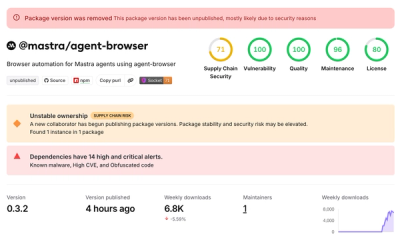
More than 140 Mastra npm packages were compromised in a supply chain attack that used a typosquatted dependency to deliver a cross-platform infostealer during installation.

Research
/Security News
A new npm package tests AI malware scanners with prompt injection, safety-triggering comments, context flooding, and obfuscated JavaScript.