
Security News
Federal Audit Finds NIST Wasted Funds With No Plan to Clear NVD Backlog
Federal audit finds NIST lacked a plan to clear the NVD backlog, wasted funds on duplicate work, and delayed use of CISA data.
By Sarah Gooding - Jun 03, 2026
@arealtimetech/adk-js
Advanced tools
The official JavaScript SDK for the A Realtime Tech (ART) platform.
Website · Documentation · About ART
A Realtime Tech (ART) is a realtime application platform that powers low-latency messaging, presence, and collaborative state for modern apps. Build chat, live dashboards, multiplayer experiences, IoT control planes, and CRDT-backed shared documents on a single managed backbone — without standing up your own websocket, presence, or sync infrastructure. Learn more at arealtimetech.com.
The JavaScript ADK (ART Development Kit) gives your application the tools it needs to talk to ART services. It ships only the runtime needed to connect, subscribe, send, receive, and synchronise state — no separate dev/prod build is required, so you can drop the same package directly into production.
Note — installing the package is not enough on its own. The ADK must also be authenticated using credentials issued by ART (see Configuration below).
npm install @arealtimetech/adk-js
The ADK supports two ways to provide credentials. Pick whichever fits your app.
AutoLoadCredsFromJSON)Set AutoLoadCredsFromJSON: true and the ADK will automatically fetch credentials from a JSON file at the configured path. This is the simplest setup and where you can place adk-services.json in the root of the project.
import Adk from '@arealtimetech/adk-js';

const adk = new Adk({
  Uri: "",                       // ART service URL
  AutoLoadCredsFromJSON: true,   // load credentials from JSON
});

adk.connect();
JSON file shape (served at the configured config path):
{
  "Client-ID":     "your-client-id",
  "Client-Secret": "your-client-secret",
  "Org-Title":     "your-org",
  "Environment":   "your-environment",
  "ProjectKey":    "your-project-key"
}
setCredentials)When AutoLoadCredsFromJSON is off (or omitted), you supply credentials in code via setCredentials(). Use this when credentials come from your own auth flow, an active user session, or any other runtime source.
import Adk from '@arealtimetech/adk-js';

const adk = new Adk({
  Uri: "",   // ART service URL
});

adk.setCredentials({
  ClientID:     "your-client-id",
  ClientSecret: "your-client-secret",
  OrgTitle:     "your-org",
  Environment:  "your-environment",
  ProjectKey:   "your-project-key"
});

adk.connect();
| Field | Type | Required | Description |
|---|---|---|---|
ClientID | string | yes | Client identifier issued by ART |
ClientSecret | string | yes | Client secret paired with ClientID |
OrgTitle | string | yes | Your organisation / tenant title |
Environment | string | yes | Target environment name |
ProjectKey | string | yes | Project key inside the environment |
import Adk from '@arealtimetech/adk-js';

const adk = new Adk({
  Uri: "",                      // service URL
  AuthToken: "",                // passcode generated by your server for the user
});

// Open the connection
adk.connect();

// Connection lifecycle
adk.on("open", async (event) => {
  console.log("ADK connection opened", event);
});

adk.on("close", () => {
  console.log("ADK connection closed");
});

// Tear down
adk.disconnect();
subscribe() joins a specific channel. Once subscribed, the channel is a real-time stream where you can send, receive, listen to events, and observe user presence.
const sub = await adk.subscribe("YOUR_CHANNEL_NAME");
fetchPresence() returns the list of users currently active in the channel.
sub.fetchPresence((users) => {
  console.log("Active users:", users);
});
listen() is a catch-all — every payload published to the channel is delivered to your callback.
sub.listen((data) => {
  console.log("Received:", data);
});
bind() filters by event name; the callback only fires for matching events.
sub.bind("EVENT", (data) => {
  console.log("Event received:", data);
});
push() publishes an event to the channel. Pass to to deliver only to specific users.
const payload = { message: "Hello!" };

sub.push("EVENT", payload, {
  to: ["username1", "username2"],   // optional — target specific users
});
On a channel that has orchestrator enabled, you can spin up isolated threads from a subscription. Each thread has its own id and only receives messages tagged with that id.
const sub = await adk.subscribe("YOUR_CHANNEL");

const thread = sub.thread();
console.log(thread.threadId);
Pass an existing id to attach to a known thread (for example, one created by the server):
const thread = sub.thread("thread_xxxxx");
thread.listen((msg) => {
  console.log(msg.event, msg.content);
});
thread.bind("status_update", (content) => {
  console.log(content);
});
The thread_id is attached automatically.
await thread.push("user_input", { message: "hello" }, {
  to: ["username"],
});
thread.remove("status_update");          // remove all callbacks for the event
thread.remove("status_update", myFn);    // remove a single callback
thread.dispose();
adk.orchestrator(id) connects directly to an orchestrator. The SDK subscribes to the orchestrator, so you can go straight to threads.
const orch = adk.orchestrator("your-orchestrator-id").connect();

const thread = await orch.thread();

thread.listen((msg) => {
  console.log(msg.event, msg.content);
});

await thread.push("user_input", { message: "hi" }, {
  to: ["username"],
});
Reuse an existing thread by id:
const thread = await orch.thread("thread_xxxxx");
adk.agent(id) connects directly to an agent. The SDK subscribes to the agent's.
const agent = adk.agent("your-agent-id").connect();

const thread = agent.thread();

thread.listen((evt) => {
  console.log(evt.event, evt.content);
});

// Start a run with user input
const run = await thread.run("Hello agent");

// Await the final output
const output = await run.done();
console.log(output);
Reply to a follow-up question from the agent:
await run.sendFeedback("yes, proceed");
A Shared Object Channel is a real-time, collaborative data structure backed by a CRDT. Multiple clients can update the same JSON tree concurrently and converge to a consistent state.
// Subscribe like any other channel
const sub = await adk.subscribe("YOUR_SO_CHANNEL_NAME");
Listen at a path inside the shared object — your callback receives plain JSON whenever that subtree changes.
// path examples: "", "user", "user.profile", "todos"
const unsubscribe = await sub.query("user.profile").listen((data) => {
  console.log("profile updated:", data);
});

// later
unsubscribe();
Path rules
"" (empty) or "index" → whole documentuser.profile.name)"todos"). Item keys are internal; per-item paths are not stable.Retrieve the current value at a path without subscribing for ongoing updates.
const profile = await sub.query("user.profile").execute();
sub.state() returns a live proxy. Mutate it like normal JavaScript — changes are batched and merged using CRDT rules. The proxy:
// Get the live state proxy once and reuse it
const state = sub.state();

/* ---------- Objects ---------- */
state.user.profile.name = "Jane Doe";

// Safe delete (no error if the key doesn't exist)
delete state.settings.theme;

/* ---------- Arrays ---------- */
state.todos.push({ text: "one" }, { text: "two" });

// Mutate newly added items immediately
state.todos[0].text = "ONE";

// Replace item at index 1
state.todos.splice(1, 1, { text: "two-ish" });

// Pop last item (returns the removed value)
const last = state.todos.pop();

/* ---------- Flushing ---------- */
// The client batches & compacts ops automatically.
// Call flush() to force-send the current batch now.
await sub.flush();
Array API (on any array path)
push(...items) / pop() / unshift(...items)splice(start, deleteCount?, ...insert)insertAt(index, item)move(fromIndex, toIndex)state.todos[0] = {...})delete state.todos[i] (remove at index)Notes
- You cannot create sparse indices by assignment (e.g.
todos[5] = ...when length is 1). UseinsertAt/splice.- For newly pushed items you can mutate them immediately (optimistic local state).
Full API reference and guides: docs.arealtimetech.com
Made with care by A Realtime Tech.
FAQs
JavaScript ADK to interact with the A Realtime Tech Platform.
We found that @arealtimetech/adk-js demonstrated a healthy version release cadence and project activity because the last version was released less than a year ago. It has 1 open source maintainer collaborating on the project.
Did you know?

Socket for GitHub automatically highlights issues in each pull request and monitors the health of all your open source dependencies. Discover the contents of your packages and block harmful activity before you install or update your dependencies.
Security News
Federal audit finds NIST lacked a plan to clear the NVD backlog, wasted funds on duplicate work, and delayed use of CISA data.
Research
/Security News
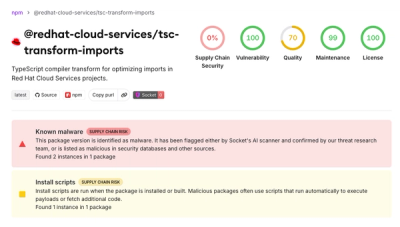
A mini Shai-Hulud campaign compromised Red Hat Cloud Services npm packages to steal developer and CI/CD secrets during installation.
Research
/Security News
The North Korean malware loader hides in a Packagist-listed package and its GitHub branch to fetch and execute remote code in a likely Contagious Interview-style lure.