

Company News
AWS Security Hub Adds Socket for Supply Chain Security
Socket is now in the AWS Security Hub Extended plan. Adopt it through AWS, apply committed spend, and block malicious open source packages.
By Feross Aboukhadijeh - Aug 04, 2026
@ask-llm/mcp
Advanced tools
Unified MCP server for multi-LLM consultation — registers tools from all available providers (Gemini, Codex, Claude, Ollama, Antigravity) behind runtime availability checks



All LLM providers in one MCP server — auto-detects what's installed
A unified MCP server that auto-detects installed LLM providers (Gemini, Codex, Claude, Ollama, Antigravity) and registers only the available tools. One install, all providers. Works with Claude Code, Codex CLI, Cursor, Warp, Copilot, and 40+ other MCP clients.
Part of the Ask LLM monorepo.
claude mcp add ask-llm -- npx -y @ask-llm/mcp
Add to claude_desktop_config.json:
{
  "mcpServers": {
    "ask-llm": {
      "command": "npx",
      "args": ["-y", "@ask-llm/mcp"]
    }
  }
}
ask-gemini toolsask-codex toolsask-ollama toolsOn startup, the unified server:
The orchestrator exposes a single ask-llm tool (not one tool per provider — ADR-029, for token efficiency); you pick the provider per call. When any provider is installed it registers:
| Tool | Purpose |
|---|---|
ask-llm | Route a prompt to a provider via the provider param (gemini, codex, claude, ollama, antigravity); optional sessionId for multi-turn |
multi-llm | Dispatch one prompt to multiple providers in parallel; structured per-provider report |
get-usage-stats | Per-session token totals + per-provider/model breakdowns (in-memory) |
diagnose | Environment diagnostics — provider CLI presence + versions |
ping | Connection test |
Claude is intentionally suppressed when the MCP host is already Claude Code because Claude Code rejects nested Claude sessions. It is auto-detected normally from Codex and other clients.
machine exposes a stdin-only JSON interface for factory controllers. It accepts one request of at most 2 MiB, with the prompt bounded to 150,000 characters by the schema, validates it before loading a provider, and writes exactly one typed result document to stdout. Prompts and issue content are never accepted through argv, and diagnostics go only to stderr.
Create a request file without putting its content in the command line:
{
  "schemaVersion": 1,
  "requestId": "factory-review-0001",
  "role": "review",
  "provider": "codex",
  "prompt": "<redacted review input>",
  "readOnly": true,
  "writerProvider": "claude",
  "includeDirs": ["packages/example"]
}
Then dispatch it through stdin:
npx -y ask-llm-mcp machine < request.json
A valid dispatch returns a typed success or provider-failure envelope:
{
  "schemaVersion": 1,
  "requestId": "factory-review-0001",
  "status": "success",
  "role": "review",
  "provider": "codex",
  "actualModel": "<redacted model>",
  "rawResponseSha256": "<redacted sha256>",
  "durationMs": 1200,
  "usage": { "inputTokens": 100, "outputTokens": 20, "totalTokens": 120 },
  "fallback": {
    "occurred": false,
    "requestedModel": "<redacted model>",
    "actualModel": "<redacted model>"
  },
  "session": { "sessionId": "<redacted session>", "transcriptPath": null },
  "payload": { "summary": "<redacted>", "findings": [] },
  "quotaSignal": { "kind": "runtime_proxy_required" },
  "failure": null
}
The complete envelope also records model, fallback, duration, token, response-hash, and session provenance. Provider-level failures use the same strict result contract and still exit successfully so controllers can parse and classify them.
All machine dispatches force readOnly: true and pass read-only sandbox options to the provider adapter. The interface supports Codex, Claude, and Antigravity; it does not provide a write path. Subscription usage percentages remain unknown unless the provider exposes them, and the dispatcher never infers a percentage from token counts.
| Exit code | Meaning | Stdout |
|---|---|---|
0 | Valid result envelope, including provider-level failure | One JSON document |
2 | Missing, oversized, malformed, or schema-invalid stdin request | Empty |
3 | Dispatcher infrastructure failure | Empty |
Use machine-schema to retrieve the stable canonical request/result schema bundle and its digest:
npx -y ask-llm-mcp machine-schema > machine-schema.json
{
  "digest": "<redacted sha256>",
  "failure": { "<redacted>": true },
  "request": { "<redacted>": true },
  "refinements": { "version": 1, "rules": [] },
  "result": { "<redacted>": true },
  "rolePayloads": { "brainstorm": {}, "review": {}, "verify": {} }
}
The whole bundle is authoritative. Validate a document against its Draft 2020-12 request, result, or failure schema first, then run validateMachineSchemaRefinements(target, document, bundle.refinements). The portable refinement descriptors cover sibling-field equality rules that standard JSON Schema cannot express, including self-review and fallback provenance checks. The digest covers every base schema, role payload schema, and refinement descriptor.
machine-schema is provider-independent: it neither detects nor loads a provider and does not require a provider CLI to be installed. The refinement interpreter and its MachineSchemaRefinement, MachineSchemaRefinementSet, MachineSchemaRefinementViolation, and MachineSchemaTarget types are exported from ask-llm-mcp/machine and the package root.
Full docs at lykhoyda.github.io/ask-llm
MIT
FAQs
Unified MCP server for multi-LLM consultation — registers tools from all available providers (Gemini, Codex, Claude, Ollama, Antigravity) behind runtime availability checks
The npm package @ask-llm/mcp receives a total of 103 weekly downloads. As such, @ask-llm/mcp popularity was classified as not popular.
We found that @ask-llm/mcp demonstrated a healthy version release cadence and project activity because the last version was released less than a year ago. It has 1 open source maintainer collaborating on the project.
Did you know?

Socket for GitHub automatically highlights issues in each pull request and monitors the health of all your open source dependencies. Discover the contents of your packages and block harmful activity before you install or update your dependencies.
Company News
Socket is now in the AWS Security Hub Extended plan. Adopt it through AWS, apply committed spend, and block malicious open source packages.
Research
/Security News
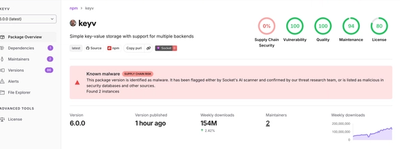
Popular npm packages keyv and cacheable compromised.

Security News
A misconfiguration gave three Anthropic models internet access, and one, believing it was in a simulation, shipped a credential-stealing package to PyPI.