


Company News
AWS Security Hub Adds Socket for Supply Chain Security
Socket is now in the AWS Security Hub Extended plan. Adopt it through AWS, apply committed spend, and block malicious open source packages.
By Feross Aboukhadijeh - Aug 04, 2026
@atriumn/cryyer
Advanced tools
Automated product update emails with per-product voice powered by LLM drafts


Automated product update emails, with per-product voice powered by LLM-drafted content. Supports multiple audiences per product, multiple LLM providers (Anthropic, OpenAI, Gemini), and multiple email providers (Resend, Gmail).
Website: cryyer.dev GitHub: atriumn/cryyer Issues: Report a bug
Cryyer supports two pipelines:
Release pipeline (manual approval before send):
main → release-please opens a version-bump PRdraft-email.yml generates a draft file (drafts/vX.Y.Z.md) and commits it to the PR branchrelease.yml publishes to npm → GitHub Release createdsend-email.yml fires on release publish but pauses for approval — review the draft, then approve to sendWeekly pipeline (manual review via GitHub issues):
weekly-draft.yml runs on cron (Monday 1pm UTC) — gathers GitHub activity, generates LLM drafts, creates GitHub issues for human reviewsend-update.yml fires when a draft issue is closed — sends emails to subscribersmkdir my-updates && cd my-updates
npx @atriumn/cryyer init
The interactive setup walks you through product name, GitHub repo, voice/tone, LLM provider, subscriber store, and API keys — then creates everything you need:
products/*.yaml — product configuration.env — API keys and settingssubscribers.json — subscriber list (when using JSON store).gitignore — ignores .env and data filesnpx @atriumn/cryyer init --yes \
--product "My App" \
--repo owner/my-app \
--voice "Friendly and concise" \
--pipeline weekly
Non-interactive mode (--yes or CI=true) skips all prompts. Secrets are read from environment variables (ANTHROPIC_API_KEY, RESEND_API_KEY, etc.) instead of being written to .env. Defaults: anthropic LLM, json subscriber store, resend email, no workflows.
Available flags: --product, --repo, --voice, --llm, --subscriber-store, --email-provider, --from-email, --pipeline (weekly, release, or both).
AI coding agents (Claude Code, Cursor, etc.) can skip init entirely and write the files themselves. All you need is a products/*.yaml file — see Product Configuration for the schema.
Then:
npx @atriumn/cryyer check # validate your setup
Run the two stages:
npx @atriumn/cryyer draft        # generate drafts → create GitHub issues
npx @atriumn/cryyer send         # send emails when a draft issue is closed
For release-triggered emails, use the file-based commands:
npx @atriumn/cryyer draft-file --product my-app --version 1.2.0  # generate a draft file
npx @atriumn/cryyer send-file drafts/v1.2.0.md --product my-app  # send from draft file
You can also create products/*.yaml files manually — see Product Configuration for all fields, and .env.example for all environment variables.
Set SUBSCRIBER_STORE to choose your backend. Default is supabase.
SUBSCRIBER_STORE=json
| Variable | Default | Description |
|---|---|---|
SUBSCRIBERS_JSON_PATH | ./subscribers.json | Path to subscriber data |
EMAIL_LOG_JSON_PATH | ./email-log.json | Path to email send log |
File format — array of objects with email, optional name, and productIds:
[
  { "email": "alice@example.com", "name": "Alice", "productIds": ["my-app", "other-app"] }
]
Public repos: Don't use the JSON store if your repo is public —
subscribers.jsonwould need to be committed, exposing subscriber emails. Use the GitHub Gist store instead.
Stores subscribers in a private GitHub Gist — same JSON format as the JSON file store, but private. Ideal for public repos.
SUBSCRIBER_STORE=gist
| Variable | Description |
|---|---|
GITHUB_GIST_ID | ID of a private Gist containing subscribers.json |
GITHUB_TOKEN | Classic PAT with gist scope (fine-grained PATs do not support gists; the default Actions token cannot access private gists) |
Setup:
subscribers.json containing []gist scope (fine-grained PATs don't work with gists)SUBSCRIBERS_GIST_ID, SUBSCRIBERS_GIST_TOKEN)Same file format as the JSON store:
[
  { "email": "alice@example.com", "name": "Alice", "productIds": ["my-app"] }
]
When using audiences, use compound keys in productIds (e.g. "my-app:beta").
SUBSCRIBER_STORE=supabase # or just don't set it
| Variable | Description |
|---|---|
SUPABASE_URL | Your Supabase project URL (https://[project-id].supabase.co) |
SUPABASE_SERVICE_KEY | Supabase service role key |
Expects a beta_testers table with columns: email, name, product, unsubscribed_at.
SUBSCRIBER_STORE=google-sheets
| Variable | Description |
|---|---|
GOOGLE_SHEETS_SPREADSHEET_ID | The ID from your spreadsheet URL |
GOOGLE_SERVICE_ACCOUNT_EMAIL | Service account email |
GOOGLE_PRIVATE_KEY | Service account private key (PEM format) |
Cryyer looks for a sheet tab named after the product ID (e.g. my-app), falling back to the first sheet. Expected columns: email, name (optional), unsubscribed (optional, set to true to exclude).
Email send logging is a no-op with this backend (read-only).
cryyer-sheets-reader) and click DoneFrom the downloaded JSON file, grab client_email and private_key:
GOOGLE_SERVICE_ACCOUNT_EMAIL=cryyer-sheets-reader@your-project.iam.gserviceaccount.com
GOOGLE_PRIVATE_KEY="-----BEGIN PRIVATE KEY-----\nMIIE...\n-----END PRIVATE KEY-----\n"
From the spreadsheet URL:
https://docs.google.com/spreadsheets/d/SPREADSHEET_ID_HERE/edit
                                       ^^^^^^^^^^^^^^^^^^^^
GOOGLE_SHEETS_SPREADSHEET_ID=1BxiMVs0XRA5nFMdKvBdBZjgmUUqptlbs74OgVE2upms
Share the spreadsheet with your service account email (from step 4) as an Editor (required for add/remove subscriber support; Viewer is sufficient for read-only use).
Row 1 should have these headers:
| name | unsubscribed | |
|---|---|---|
| alice@example.com | Alice | |
| bob@example.com | Bob | |
| charlie@example.com | true |
Name the sheet tab after your product ID (e.g. my-app), or just use the default first sheet if you have one product.
Set LLM_PROVIDER to choose your LLM backend. Default is anthropic.
| Variable | Default | Description |
|---|---|---|
LLM_PROVIDER | anthropic | anthropic, openai, or gemini |
LLM_MODEL | Per-provider default | Override the default model |
ANTHROPIC_API_KEY | — | Required when LLM_PROVIDER=anthropic |
OPENAI_API_KEY | — | Required when LLM_PROVIDER=openai |
GEMINI_API_KEY | — | Required when LLM_PROVIDER=gemini |
Default models: Anthropic claude-sonnet-4-5-20250514, OpenAI gpt-4o, Gemini gemini-1.5-flash.
Products are defined as YAML files in products/. Each file represents one product.
| Field | Required | Description |
|---|---|---|
id | Yes | Unique identifier, also used as GitHub issue label |
name | Yes | Display name |
voice | Yes* | LLM voice/tone instructions (injected into the draft prompt) |
repo | Yes | owner/repo for GitHub activity gathering |
emailSubjectTemplate | Yes* | Subject line template — use {{weekOf}} for the date or {{version}} for the release version |
audiences | No | List of audience-specific overrides (see docs site) |
tagline | No | Product tagline |
from_name | No | Override sender name for this product |
from_email | No | Override sender email for this product |
reply_to | No | Reply-to address |
* Required when audiences is not set. When using audiences, voice and emailSubjectTemplate are set per-audience instead.
weekly-draft.ymlRuns every Monday at 1pm UTC. Gathers GitHub activity and creates draft issues.
Secrets needed: GITHUB_TOKEN, CRYYER_REPO, and the API key for your chosen LLM_PROVIDER.
send-update.ymlFires when an issue with the draft label is closed. Sends emails to subscribers.
Secrets needed: GITHUB_TOKEN, email provider credentials (RESEND_API_KEY or GMAIL_REFRESH_TOKEN), FROM_EMAIL, plus the secrets for your chosen SUBSCRIBER_STORE.
draft-email.ymlRuns when a release-please--* PR is opened or synced. Generates drafts/vX.Y.Z.md via LLM and commits it to the PR branch.
release.ymlRuns on v* tag push (after release-please PR is merged). Typechecks, tests, publishes to npm, creates GitHub Release.
send-email.ymlRuns when a GitHub Release is published. Reads the draft file and sends emails to subscribers. Pauses for manual approval via a production environment with required reviewers.
ci.ymlRuns on push/PR to main. Lints, typechecks, and runs tests.
Reusable composite actions for consumer repos: atriumn/cryyer/.github/actions/draft-file@v0 and atriumn/cryyer/.github/actions/send-file@v0. Run cryyer init to scaffold wrapper workflows. See the docs site for full input references.
Cryyer includes an MCP server that lets you review, edit, and send drafts conversationally from any MCP client. It also supports subscriber management.
The MCP server uses stdio transport and is available as a separate binary: cryyer-mcp.
npx @atriumn/cryyer-mcp
Or if installed locally:
pnpm run build   # compiles dist/mcp.js
node dist/mcp.js
Add to your Claude Desktop config (~/Library/Application Support/Claude/claude_desktop_config.json on macOS):
{
  "mcpServers": {
    "cryyer": {
      "command": "npx",
      "args": ["@atriumn/cryyer-mcp"],
      "env": {
        "GITHUB_TOKEN": "ghp_...",
        "CRYYER_REPO": "owner/repo",
        "CRYYER_ROOT": "/path/to/cryyer",
        "RESEND_API_KEY": "re_...",
        "FROM_EMAIL": "updates@example.com",
        "SUBSCRIBER_STORE": "json",
        "LLM_PROVIDER": "anthropic",
        "ANTHROPIC_API_KEY": "sk-ant-..."
      }
    }
  }
}
Any MCP client that supports stdio transport can use Cryyer. The generic config is:
npx @atriumn/cryyer-mcp (or node /path/to/cryyer/dist/mcp.js)Only GITHUB_TOKEN and CRYYER_REPO are needed for read-only tools (list_drafts, get_draft). Other env vars are needed for sending, regenerating, and subscriber management.
Test the server interactively with the MCP Inspector:
npx @modelcontextprotocol/inspector node dist/mcp.js
All log output goes to stderr (stdout is reserved for JSON-RPC). If something isn't working, check stderr for error messages.
| Tool | Description |
|---|---|
list_drafts | List open draft issues |
get_draft | Get full draft content with subscriber count |
update_draft | Save revised subject + body |
send_draft | Send emails, close issue, post stats |
regenerate_draft | Re-gather activity + re-draft via LLM |
list_products | Show configured products |
list_subscribers | Show subscribers for a product |
add_subscriber | Add a subscriber to a product |
remove_subscriber | Unsubscribe someone from a product |
Use the review_drafts prompt for the Monday morning review workflow — it walks through each pending draft and asks whether to send, edit, regenerate, or skip.
Show that your project uses Cryyer for emails:
[](https://github.com/atriumn/cryyer)
pnpm install         # install dependencies
pnpm run build       # compile TypeScript
pnpm run init        # interactive product setup + .env scaffolding
pnpm run check       # validate config, tokens, and connections
pnpm run typecheck   # type-check without emitting
pnpm run lint        # ESLint
pnpm test            # run tests (vitest)
pnpm run test:watch  # run tests in watch mode
pnpm run dev         # build + run
pnpm run mcp         # run MCP server
FAQs
Automated product update emails with per-product voice powered by LLM drafts
We found that @atriumn/cryyer demonstrated a healthy version release cadence and project activity because the last version was released less than a year ago. It has 1 open source maintainer collaborating on the project.
Did you know?

Socket for GitHub automatically highlights issues in each pull request and monitors the health of all your open source dependencies. Discover the contents of your packages and block harmful activity before you install or update your dependencies.
Company News
Socket is now in the AWS Security Hub Extended plan. Adopt it through AWS, apply committed spend, and block malicious open source packages.
Research
/Security News
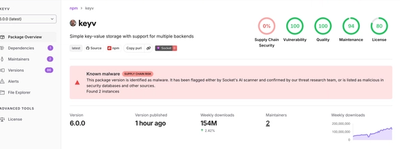
Popular npm packages keyv and cacheable compromised.

Security News
A misconfiguration gave three Anthropic models internet access, and one, believing it was in a simulation, shipped a credential-stealing package to PyPI.