

Company News
AWS Security Hub Adds Socket for Supply Chain Security
Socket is now in the AWS Security Hub Extended plan. Adopt it through AWS, apply committed spend, and block malicious open source packages.
By Feross Aboukhadijeh - Aug 04, 2026
@attest-dev/mcp
Advanced tools
Attest credential enforcement middleware for Model Context Protocol servers.
Two lines to protect every tool call on an existing MCP server.
npm install @attest-dev/sdk
@attest-dev/sdk ships both the core client and the MCP middleware as a single package with two entry points.
import { McpServer } from "@modelcontextprotocol/sdk/server/mcp.js";
import { withAttest } from "@attest-dev/sdk/mcp";

const server = new McpServer({ name: "my-tools", version: "1.0.0" });
const protectedServer = withAttest(server, {
  issuerUri: "https://api.attest.dev",
});

// Register tools exactly as before — every call is now credential-gated.
protectedServer.tool("send_email", schema, handler);
withAttest patches server.tool() in place and returns the same server object typed as the original. Everything else — connect(), close(), transports — works unchanged.
On every tool call, before the handler executes:
extra.authInfo.token (MCP auth middleware path), extra.meta.attest_token, or extra.meta.authorizationscopeForTool() and check the credential's att_scope covers itGET /v1/revoked/{jti} (10-second in-process cache)isError: true with a typed JSON payloadPOST /v1/audit — async, never blocks the tool callTool names are automatically mapped to resource:action scope strings. The first word (before the first _) becomes the action; the remainder becomes the resource.
| Tool name | Required scope | Notes |
|---|---|---|
send_email | email:send | |
read_file | file:read | |
list_documents | documents:list → documents:read | list aliases to read |
create_user | user:create → user:write | create aliases to write |
delete_record | record:delete | |
get_weather_forecast | weather_forecast:read | multi-word resources keep underscores |
run_query | query:run → query:execute | run aliases to execute |
Action aliases — these raw prefixes map to canonical actions:
| Raw prefix | Canonical action |
|---|---|
create, update, put, patch, set, upsert | write |
get, fetch, list, search, query, find, lookup | read |
remove, destroy | delete |
run, invoke, call | execute |
Multi-word resources keep their underscores in the scope string. get_weather_forecast → weather_forecast:read. This is intentional — the full noun phrase is preserved as the resource. When issuing credentials, use the same string: scope: ["weather_forecast:read"].
Override at registration — pass a AttestToolOptions object as the final argument to server.tool(). This is the preferred way to set scope for non-standard tool names because the scope lives next to the tool definition:
import { withAttest } from "@attest-dev/sdk/mcp";
import type { AttestToolOptions } from "@attest-dev/sdk/mcp";

protectedServer.tool("gh_create_issue", schema, handler, {
  requiredScope: "github:write",
} satisfies AttestToolOptions);

protectedServer.tool("stripe_charge", schema, handler, {
  requiredScope: "stripe:write",
} satisfies AttestToolOptions);

// Auto-mapping still applies when requiredScope is omitted.
protectedServer.tool("send_email", schema, handler);
// → "email:send"
The options object is consumed by withAttest and stripped before the MCP SDK sees the arguments — the SDK is unaware of it.
Override globally using toolScopeMap in options (applies to all tools that don't declare requiredScope explicitly):
const protectedServer = withAttest(server, {
  issuerUri: "https://api.attest.dev",
  toolScopeMap: {
    "send_message": "slack:send",
    "query_db":     "postgres:read",
  },
});
getAttestScopes() returns the live scope registry — every tool name mapped to its resolved scope string. Wire it to an HTTP endpoint so credential issuers can query what scopes a server requires without out-of-band coordination.
import { withAttest, getAttestScopes } from "@attest-dev/sdk/mcp";

const protectedServer = withAttest(server, { issuerUri: "https://api.attest.dev" });

protectedServer.tool("send_email", schema, handler);
protectedServer.tool("gh_create_issue", schema, handler, { requiredScope: "github:write" });

// Express / Hono / any HTTP framework:
app.get("/.well-known/attest-scopes", (_req, res) => {
  res.json({ tools: getAttestScopes(protectedServer) });
});
Response:
{
  "tools": {
    "send_email":      "email:send",
    "gh_create_issue": "github:write"
  }
}
An orchestrator agent issues credentials by fetching this endpoint first:
// Before starting a task, discover what the MCP server needs:
const { tools } = await fetch("https://my-mcp-server/.well-known/attest-scopes")
  .then(r => r.json());

// Issue a credential with exactly those scopes:
const { token } = await attestClient.issue({
  agent_id: "my-agent",
  user_id:  "usr_alice",
  scope:    Object.values(tools),   // ["email:send", "github:write"]
  instruction: "...",
});
No spreadsheet of scope strings. No manual sync between server and client. The server is the source of truth.
{
  "content": [
    {
      "type": "text",
      "text": "{\n  \"error\": \"attest_violation\",\n  \"reason\": \"scope_violation\",\n  \"detail\": \"Credential (jti: abc-123) grants [research:read] but tool \\\"send_email\\\" requires \\\"email:send\\\".\",\n  \"jti\": \"abc-123\",\n  \"taskId\": \"tid-xyz\"\n}"
    }
  ],
  "isError": true
}
isError: true signals the MCP framework that this is an error response. The reason field is machine-readable:
reason | Meaning |
|---|---|
no_credential | No Attest JWT found in the request |
invalid_credential | JWT signature verification failed or malformed |
credential_expired | JWT exp has passed |
credential_revoked | JTI is in the revocation list |
scope_violation | Credential does not grant the required scope |
withAttest(server, {
  // Required: URI of your Attest server
  issuerUri: "https://api.attest.dev",

  // How long to cache JWKS before re-fetching (seconds). Default: 3600
  jwksCacheTTL: 3600,

  // How long to cache revocation status per JTI (seconds).
  // Set 0 to disable caching (every call hits the server). Default: 10
  revocationCacheTTL: 10,

  // false = log violations via onViolation but don't block the call.
  // Useful for gradual rollout. Default: true
  requireCredential: true,

  // Per-tool scope overrides. Keys are exact tool names.
  toolScopeMap: {
    "send_message": "slack:send",
  },

  // Called on every scope violation (synchronous).
  // Use for metrics, alerting, structured logging.
  onViolation: (event) => {
    console.warn("Attest violation", {
      tool:     event.toolName,
      reason:   event.reason,
      required: event.requiredScope,
      granted:  event.grantedScope,
      jti:      event.jti,
    });
  },
});
After withAttest has already verified the credential, use getAttestContext to read the claims without re-verifying:
import { withAttest, getAttestContext } from "@attest-dev/sdk/mcp";

protectedServer.tool("send_email", schema, async (args, extra) => {
  const ctx = getAttestContext(extra);
  // ctx.att_uid   — the human who initiated the task
  // ctx.att_tid   — task tree ID (use for audit correlation)
  // ctx.att_scope — granted scopes
  // ctx.att_depth — delegation depth (0 = root)
  // ctx.jti       — this credential's unique ID

  await sendEmail(args.to, args.body, { actingAs: ctx?.att_uid });
  return { content: [{ type: "text", text: "sent" }] };
});
Add Attest to an existing server without blocking traffic until you're confident the mapping is correct:
const protectedServer = withAttest(server, {
  issuerUri: "https://api.attest.dev",
  requireCredential: false,   // observe, don't block
  onViolation: (event) => metrics.increment("attest.violation", {
    tool:   event.toolName,
    reason: event.reason,
  }),
});
Flip requireCredential to true once violation rates drop to zero in your monitoring.
Every tool call — pass or fail — fires a POST /v1/audit to your Attest server. Delivery is async and never blocks tool execution.
Audit delivery is best-effort with structured error surfacing. For guaranteed delivery, configure onAuditError and implement your own retry queue.
Failures surface in priority order — nothing is ever silently dropped:
onAuditError(error, event) — you handle it (retry queue, fallback log, pager)onViolation({ reason: "audit_failure", ... }) — surfaces to your existing monitoring if onAuditError is not setconsole.warn — last resort if neither callback is configuredconst protectedServer = withAttest(server, {
issuerUri: "https://api.attest.dev",
// Tier 1: implement a retry queue for guaranteed delivery
onAuditError: (err, event) => {
retryQueue.push({ event, attempts: 0, nextRetry: Date.now() + 5000 });
logger.error("attest audit delivery failed", {
jti: event.jti,
agent_id: event.agent_id,
error: err.message,
});
},
// Tier 2: violations (including audit_failure) go to your monitoring
onViolation: (e) => metrics.increment("attest.event", { reason: e.reason }),
});
Non-2xx responses from the audit endpoint are treated as delivery failures, not silent successes.
The audit event carries: event_type, jti, att_tid, att_uid, agent_id (mcp:<toolName>), scope, and an outcome meta field (allowed, scope_violation, blocked_revoked).
Query the audit chain for a task tree:
import { AttestClient } from "@attest-dev/sdk";

const client = new AttestClient({ baseUrl: "https://api.attest.dev", apiKey: "..." });
const chain = await client.audit(taskId);
chain.events.forEach(e => console.log(e.event_type, e.jti, e.created_at));
import { McpServer } from "@modelcontextprotocol/sdk/server/mcp.js";
import { StdioServerTransport } from "@modelcontextprotocol/sdk/server/stdio.js";
import { withAttest } from "@attest-dev/sdk/mcp";
import { z } from "zod";

const server = new McpServer({ name: "email-server", version: "1.0.0" });

server.tool(
  "send_email",
  { to: z.string().email(), subject: z.string(), body: z.string() },
  async ({ to, subject, body }) => {
    await sendEmail(to, subject, body);
    return { content: [{ type: "text", text: `Sent to ${to}` }] };
  },
);

// Wrap — every tool now requires a valid credential with "email:send" scope.
const protectedServer = withAttest(server, {
  issuerUri: process.env.ATTEST_URI ?? "http://localhost:8080",
  onViolation: (e) => console.warn("blocked:", e.reason, e.toolName),
});

const transport = new StdioServerTransport();
await protectedServer.connect(transport);
Apache-2.0
FAQs
Attest credential enforcement middleware for MCP servers
The npm package @attest-dev/mcp receives a total of 16 weekly downloads. As such, @attest-dev/mcp popularity was classified as not popular.
We found that @attest-dev/mcp demonstrated a healthy version release cadence and project activity because the last version was released less than a year ago. It has 1 open source maintainer collaborating on the project.
Did you know?

Socket for GitHub automatically highlights issues in each pull request and monitors the health of all your open source dependencies. Discover the contents of your packages and block harmful activity before you install or update your dependencies.
Company News
Socket is now in the AWS Security Hub Extended plan. Adopt it through AWS, apply committed spend, and block malicious open source packages.
Research
/Security News
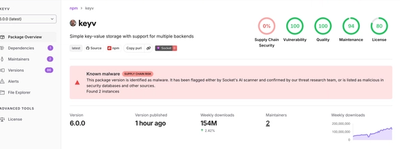
Popular npm packages keyv and cacheable compromised.

Security News
A misconfiguration gave three Anthropic models internet access, and one, believing it was in a simulation, shipped a credential-stealing package to PyPI.