

Product
PHP and Composer Support Is Now in Beta
Socket’s PHP and Composer support is now in Beta for all customers, with PHP reachability analysis generally available.
By Trevor Norris, Benjamin Barslev - Aug 21, 2026
@attestwire/en16931
Advanced tools
Validate EN 16931 e-invoices — XRechnung, ZUGFeRD, Factur-X, Peppol BIS 3.0 — and generate the UBL/CII XML. 295 rules, zero dependencies, runs in the browser, no Java.


Validate and generate EN 16931 e-invoices — UBL 2.1 and UN/CEFACT CII — with errors that teach the regulation.
Zero runtime dependencies, TypeScript-first, and entirely local: installing this package needs no account and no key, and nothing it does makes a network call.
Nothing here needs a JVM, and nothing here needs a server. The package uses no platform API beyond the JavaScript standard library — even the DEFLATE decoder the Factur-X reader needs is implemented in-repo rather than borrowed from Node — so the same build runs unchanged in Node, Deno, Bun, Cloudflare Workers and the browser. The playground is this package running client-side: the invoice never leaves the tab.
npm install @attestwire/en16931
A conformant XRechnung, as small as validity allows. Every identifier here is synthetic; the IBAN is the test IBAN used throughout German banking documentation.
import { validateInput, type InvoiceInput } from "@attestwire/en16931";

const invoice = {
  profile: "xrechnung-ubl",
  invoiceNumber: "2026-000142",
  issueDate: "2026-08-09",
  currency: "EUR",
  buyerReference: "04011000-1234512345-06", // Leitweg-ID
  deliveryDate: "2026-08-31",
  seller: {
    name: "Acme GmbH",
    vatId: "DE123456789",
    address: { line1: "Chausseestr. 1", city: "Berlin", postalCode: "10115", countryCode: "DE" },
    electronicAddress: { schemeId: "0204", value: "04011000-1234512345-06" },
    contact: { name: "Buchhaltung", phone: "+49 30 1234567", email: "rechnungen@acme.example" },
  },
  buyer: {
    name: "Stadt Bonn",
    address: { line1: "Berliner Platz 2", city: "Bonn", postalCode: "53111", countryCode: "DE" },
    electronicAddress: { schemeId: "0204", value: "04011000-1234512345-06" },
  },
  payment: { meansCode: "58", iban: "DE02120300000000202051" },
  lines: [
    { id: "1", description: "Consulting, August 2026", quantity: 10, unitCode: "HUR", unitPrice: 150, vatCategory: "S", vatRate: 19 },
  ],
} satisfies InvoiceInput;

const result = validateInput(invoice);

console.log(result.valid, result.errors.length); // true 0
That object is the whole input contract, and satisfies InvoiceInput is not
decoration: profile is a union of five string literals, so without it TypeScript
widens "xrechnung-ubl" to string and the validateInput(invoice) call below
does not compile. It feeds both generators: generateXRechnungUBL(invoice)
returns UBL 2.1
XML, generateCii({ ...invoice, profile: "xrechnung-cii" }) returns CII.
Remove the buyer reference — BT-10, the Leitweg-ID a German public-sector buyer requires — and you get a rejection that names the rule and tells you what to do:
const { buyerReference, ...missingReference } = invoice;

const rejected = validateInput(missingReference);

console.log(rejected.valid, rejected.errors.map((e) => e.rule)); // false [ 'BR-DE-15' ]
rejected.errors[0] is this object, in full:
{
  "rule": "BR-DE-15",
  "field": "BT-10",
  "severity": "fatal",
  "message": "XRechnung requires a buyer reference (BT-10). For German public-sector buyers this is the Leitweg-ID; business buyers may supply any reference, but the field must be present.",
  "fix": "Ask your client for their Leitweg-ID (public sector) or an order/customer reference, and set buyerReference.",
  "example": "\"buyerReference\": \"04011000-1234512345-06\"",
  "xpath": "/ubl:Invoice/cbc:BuyerReference",
  "docsUrl": "https://attestwire.com/rules/BR-DE-15"
}
Both snippets above are executed against this build by
src/readme-quickstart.test.ts (repository; the published tarball ships
dist only), including the stated console.log output and
the JSON above, so a README example cannot drift from the library.
Links
TeachingError
carries a docsUrl pointing at its page.valid means — fatal, warning and
information are three separate arrays.Both syntaxes generate and both parse: generateXRechnungUBL /
parseUbl for XRechnung UBL and Peppol BIS 3.0, generateCii /
parseCiiInvoice for XRechnung CII and the Factur-X EN 16931 payload. One
InvoiceInput model feeds either.
Invoices and credit notes. In UBL those are two different documents, and one
field picks between them: set invoiceTypeCode to "381" and
generateXRechnungUBL emits a ubl:CreditNote instead of a ubl:Invoice.
See Credit notes.
Every validation failure carries the official rule ID, the business term it constrains, a plain-English explanation of why the regulation requires it, a concrete fix, and a passing example — so a developer (or an agent) can correct the invoice without opening the spec.
Totals are always computed from the lines, never echoed from caller input, so a BR-CO arithmetic rejection cannot originate in the generated document.
Generation refuses rather than emitting a document that would be rejected
downstream: a profile in the wrong syntax throws (UnsupportedProfileError from
the UBL generator, UnsupportedCiiProfileError from the CII one — see
Refusals).
Factur-X and ZUGFeRD are CII XML inside a PDF/A-3 container. As of 0.7.0 the container is read (extraction); it is still never built.
Reading it is extractFacturX, which pulls the XML attachment out of a
Factur-X, ZUGFeRD or XRechnung-CII PDF so the rest of this package can parse and
validate it:
import { extractFacturX, parseCiiInvoice, validateInput } from "@attestwire/en16931";

const { xml, attachmentName, warnings } = extractFacturX(await readFile("invoice.pdf"));
const { invoice } = parseCiiInvoice(xml);
console.log(attachmentName, validateInput(invoice).valid);
It reads classic cross-reference tables, cross-reference streams and object
streams, and inflates FlateDecode with a DEFLATE implementation written into
this package — so the zero-dependency promise holds and the function stays
synchronous. warnings carries what was odd but survivable: a non-standard
attachment name, a missing or wrong /AFRelationship, more than one XML
attachment. Malformed PDFs raise a named error with a stable code, never a
crash.
Writing it is still not implemented, and is not planned here. generateCii
emits the XML: it does not build the container, does not attach the XML under
the required name (factur-x.xml, or xrechnung.xml for the XRECHNUNG
reference profile), and does not set the /AFRelationship value Germany
requires (Alternative). A file produced by this package is a CII XML
document, not a Factur-X or ZUGFeRD document. The asymmetry is deliberate:
extraction either returns the attachment or throws, while a half-conformant
PDF/A-3 writer would emit files that look like Factur-X and are not.
The eleven release fixtures in fixtures/ — the documents these
generators produce — are checked against the official
KoSIT validator 1.6.2 with the
XRechnung 3.0.2 configuration on release. The three UBL invoices go through the
UBL 2.1 XSD, the EN 16931 schematron and the XRechnung CIUS schematron; the two
UBL credit notes go through KoSIT's separate
EN16931 XRechnung (UBL CreditNote) scenario, which swaps in
UBL-CreditNote-2.1.xsd; the six CII documents go through the UN/CEFACT D16B
XSD, the EN 16931 CII schematron and the XRechnung CII schematron, under
KoSIT's own EN16931 XRechnung (CII) scenario. Reproduce it yourself with
scripts/kosit-check.sh, which needs a JDK.
The KoSIT run was performed on 2026-08-13 — validator 1.6.2, XRechnung
configuration 3.0.2, over all eleven committed fixtures: Acceptable: 11 Rejected: 0, with zero findings at any severity. The recorded output is in
scripts/kosit-check.md, together with the eight
credit-note probes that settled which rules do and do not apply to one — and the
two findings the CII run caught, earlier, before it went green.
Even a clean run
is a conformance check on eleven documents, not a parity suite: it says nothing
about the paths those fixtures do not exercise, and validateInput is a
pre-flight rather than a schematron (see
Not implemented yet).
A credit note is one field:
const creditNote = generateXRechnungUBL({
  ...invoice,                     // the invoice you are crediting
  invoiceNumber: "2026-G00021",   // its own number, from your own sequence
  invoiceTypeCode: "381",         // ← this is the whole API
  precedingInvoices: [{ invoiceNumber: "2026-000142", issueDate: "2026-08-09" }],
});
// → <ubl:CreditNote xmlns:ubl="…:xsd:CreditNote-2"> … </ubl:CreditNote>
There is no generateCreditNote and no documentType flag, because EN 16931
does not have one: BT-3 is the discriminant, and a second field would let an
input contradict itself. isCreditNote(input) exposes the same decision if you
need to branch on it yourself.
State the amounts positively. The document type conveys the direction of the
money. A credit note carrying negative amounts reverses it back — that is a
"negative invoice", a different (and equally lawful) idiom, and mixing the two
gets you a document that says the opposite of what you meant. Both schematrons
accept either, so no validator will catch it; ATW-CREDIT-NOTE-NEGATIVE-AMOUNTS
is a warning here for exactly that reason.
What changes in the emitted UBL, and nothing else does:
ubl:Invoice | ubl:CreditNote | |
|---|---|---|
| Root / namespace | Invoice, …:xsd:Invoice-2 | CreditNote, …:xsd:CreditNote-2 |
| BT-3 | cbc:InvoiceTypeCode | cbc:CreditNoteTypeCode |
| Lines | cac:InvoiceLine | cac:CreditNoteLine |
| BT-129 quantity | cbc:InvoicedQuantity | cbc:CreditedQuantity |
| BT-9 due date | cbc:DueDate | cac:PaymentMeans/cbc:PaymentDueDate — the document has no cbc:DueDate, and UBL-CR-412 exempts credit notes from the rule forbidding it here |
| BT-7 tax point | after cbc:Note | before cbc:CreditNoteTypeCode |
| BT-11 project | cac:ProjectReference | no element exists — dropped, and reported as ATW-CREDIT-NOTE-PROJECT-REFERENCE-UNBOUND |
| BT-25 preceding invoice | cac:BillingReference/cac:InvoiceDocumentReference | the same element — EN 16931 binds BG-3 to the invoice reference on both documents |
In CII none of that applies: there is one root element for both document
types, so a credit note is ram:TypeCode 381 and no other difference at all.
The rule set does not change either. EN 16931 has one semantic model and binds the same rule ids to both documents, so BR-CO-10 counts the same amounts and BR-DE-16 asks the same question. Two rules are worth knowing about:
381 — XRechnung's eight codes are one list tested against
both type-code elements. 261 (self-billed credit note) is a lawful EN 16931
code and is not one of the eight, so it draws a warning there.384 (corrected invoice)
and nothing else, on either document type, and KoSIT accepts a credit note with
no BG-3 at all. Supplying one is still the ordinary case — the buyer cannot net
two documents that do not reference each other — so this build says so at
information level, the flag the regulator itself reserves for advice, under
ATW-CREDIT-NOTE-NO-PRECEDING-INVOICE.Not covered: self-billing as a workflow, and the UBL SelfBilledInvoice /
SelfBilledCreditNote root elements. BT-3 389 and 261 generate and parse on
the ordinary root elements, which is what EN 16931's UBL binding uses; if a
platform demands one of those other roots, this package will not produce it.
Debit notes (ubl:DebitNote) are not supported either — EN 16931 has no binding
for them.
import { generateCii, parseCiiInvoice } from "@attestwire/en16931";

const xml = generateCii({ ...invoice, profile: "xrechnung-cii" });
const { invoice: readBack, unmapped } = parseCiiInvoice(xml);
generateCii accepts xrechnung-cii, facturx-en16931, en16931 and — since
0.7.0 — peppol-bis-3. The core profile is syntax-neutral, so you pick the
syntax by picking the function. xrechnung-ubl is the one profile name that is
genuinely UBL-bound, and it throws; xrechnung-cii is the name for the same
rules in this syntax.
Earlier releases refused peppol-bis-3 here, on the stated grounds that Peppol
BIS Billing 3.0 has no CII binding. That was wrong. OpenPEPPOL ships
PEPPOL-EN16931-CII.sch and a peppolbis-en16931-01-3.0-cii build
configuration, and the BIS describes CII D16B — the version this generator
emits — as optional rather than absent: UBL is mandatory for every receiver,
and CII is accepted by receivers who register for it in the SMP. So sending
Peppol CII is a thing you must agree with your counterparty, not a thing this
library should have been deciding for you. One behaviour change comes with it:
under peppol-bis-3 the CII generator omits BT-21 (ram:SubjectCode), which
PEPPOL-EN16931-R002 forbids outright, and validateInput now raises R002 as
a warning so you learn the rule rather than silently losing the field.
CII is not UBL with different names, and four differences are where a UBL habit produces a rejected file:
| UBL | CII | |
|---|---|---|
| Dates | <cbc:IssueDate>2026-08-09</cbc:IssueDate> | <ram:IssueDateTime><udt:DateTimeString format="102">20260809</udt:DateTimeString></ram:IssueDateTime> |
| Currency | on every amount, as @currencyID | once, in ram:InvoiceCurrencyCode; only BT-110 and BT-111 carry @currencyID |
| BT-21 note subject | no element — encoded into the note as #CODE#text | a real element, ram:SubjectCode |
| BT-90 SEPA creditor id | on the seller party, schemeID="SEPA" | on the settlement, ram:CreditorReferenceID |
Element order is part of schema validity in both syntaxes, and the two do not
agree on it. ram:PostalTradeAddress puts the post code before the street.
ram:SpecifiedTradeSettlementHeaderMonetarySummation puts charges before
allowances and the rounding amount before the grand total. A
ram:SpecifiedTradeAllowanceCharge puts the percentage and the base amount
before the amount, and the reason code before the reason text. Every
builder in generate-cii.ts quotes the XSD sequence it follows.
parseCiiInvoice is the inverse, and the round trip is tested: for each
committed CII fixture, generateCii(parseCiiInvoice(xml).invoice) returns the
identical document, and the result validates identically. It shares the hardened
XML reader — and every one of its security limits — with parseUbl, and
resolves everything by namespace URI rather than by prefix.
One thing it cannot tell you: Factur-X's EN 16931 profile and plain core
EN 16931 state the same BT-24 (urn:cen.eu:en16931:2017), so a
facturx-en16931 document reads back with profile: "en16931". Nothing is
lost — the rule set is identical and regenerating produces the same bytes — but
if you need the distinction, keep it yourself.
parseUbl reads a UBL 2.1 Invoice or CreditNote document into the same
InvoiceInput object the rest of this package uses. That is what lets you
answer the question people actually arrive with: my customer's platform
rejected this file — why?
The document type is detected from the root element, not asked for, and comes
back in invoice.invoiceTypeCode. Feed the result to generateXRechnungUBL and
you get the same document type out. (The function is still exported under its
old name, parseUblInvoice, which reads credit notes too.)
import { parseUbl, validateInput } from "@attestwire/en16931";

const { invoice, unmapped } = parseUbl(xmlString);
const findings = validateInput(invoice);

for (const item of unmapped) {
  console.log(item.kind, item.path, item.reason);
}
It is a reader, not an authority. It tells you what is in the document. It
does not tell you whether a receiver will accept the document. A file that
parses here, and then passes validateInput, can still be rejected by KoSIT or
by a receiving platform: validateInput checks the input model, not the XML,
and this build is not a schematron. See
Not implemented yet.
Every element generateXRechnungUBL emits, mapped back to the field it came
from. The round trip is tested: for each committed fixture,
generateXRechnungUBL(parseUbl(xml).invoice) returns the identical
document, and the result validates identically — for the credit-note fixtures as
well as the invoice ones.
Namespaces are resolved by URI, not by prefix. A document that calls the two
common namespaces b: and a:, or that puts the root in the default
namespace, reads the same as one using cbc: and cac:. Element order does not
matter to the reader.
The document's own totals (BT-106 to BT-115) are read into declaredTotals, so
validateInput checks the document's arithmetic against ours under the
BR-CO-* rules. The VAT breakdown and the line net amounts are recomputed from
the lines instead of being stored, because that is how the input model works.
parseUbl also returns customizationId and profileId — BT-24 and
BT-23 exactly as the document states them. invoice.profile is derived from
BT-24. If BT-24 is missing or unknown, the profile falls back to en16931 or is
guessed from the text, and the guess is reported in unmapped — because the
profile decides which CIUS rules run.
It throws rather than returning a half-read invoice. Every error extends
ParseError and carries a stable code.
| Error | code | When |
|---|---|---|
UnsupportedSyntaxError | unsupported_syntax | The root element is neither a UBL Invoice nor a UBL CreditNote. A CII document (ZUGFeRD, Factur-X, XRechnung CII) gets its own message saying so and pointing at parseCiiInvoice. |
UnsupportedCreditNoteError | unsupported_document_type | Never. Kept exported for compatibility; nothing has thrown it since credit notes became readable. |
XmlSecurityError | see below | The document hit one of the security limits. |
XmlSyntaxError | various | The document is not well-formed, or uses a construct outside the accepted subset. |
Factur-X and ZUGFeRD carry this CII inside a PDF/A-3. Since 0.7.0 that
container is read — extractFacturX returns the embedded XML, which is what
you then hand to parseCiiInvoice. It is still never written.
The XML comes from someone else. The reader is written for the UBL subset and refuses everything outside it, rather than accepting more and hoping.
| Defence | Limit | What it stops |
|---|---|---|
| No DTD processing | any <!DOCTYPE or <!ENTITY in the document is refused (xml_doctype_forbidden, xml_entity_declaration_forbidden) | XXE — an external entity that reads a local file or makes a network request. Also the declaration half of billion-laughs. The check runs on the raw text, so a DOCTYPE inside a CDATA section is refused too. |
| No custom entity expansion | only & < > " ' and numeric character references are decoded (xml_entity_forbidden) | Billion laughs. An unknown entity is refused, never silently dropped — dropping one would change the text of a tax document without saying so. |
| Depth cap | 100 elements (xml_too_deep) | Deeply nested documents. A UBL invoice nests about eight levels. |
| Size cap | 400,000 characters (xml_too_large) | Memory exhaustion from a very large upload. |
| Element cap | 50,000 elements (xml_too_many_elements) | A flat document of millions of tiny elements, which passes both caps above. |
| Attribute cap | 256 per element (xml_too_many_attributes) | A root carrying tens of thousands of xmlns: declarations, each of which enters the namespace map every descendant lookup uses. |
All four numbers are the defaults in DEFAULT_XML_LIMITS and can be raised per
call: parseUbl(xml, { maxCharacters: 2_000_000 }).
What the caps protect, and what they cost. They are memory limits, chosen
from measurement rather than from how big a file "feels". Every element in the
parsed tree retains roughly 250–400 bytes — the object, its four name strings,
its attribute array and its children array — and the smallest element that can
appear in a document is four characters (<x/>). So the size cap is really an
element cap in disguise: 400,000 characters is at most about 100,000 elements,
or about 25–40 MB retained.
The cost is that an unusually large invoice is refused rather than parsed. The
largest fixture in this repository is under 10 kB and a thousand-line invoice
lands around 300 kB, so this is not a limit ordinary use meets — but a document
carrying a base64 attachment can exceed it, and that is the case to raise
maxCharacters for, deliberately.
⚠ Changed in 0.4.0. The size cap was 10,000,000 characters and the element cap 200,000. Measured on Node 22, a legal document at the old size cap retained about 81 MB of heap and about 306 MB of RSS — over the 128 MB a Cloudflare Workers isolate is allowed, so a single such request was killed rather than rejected. A 785 kB body already retained about 47 MB. If you run this on a server with real memory and you know why you need it, raise the option.
The reader also refuses mixed content (an element holding both text and child elements), unbound namespace prefixes, and control characters XML 1.0 does not permit. Comments and processing instructions are skipped and never acted on: a stylesheet instruction cannot make this library fetch anything.
Anything in the document that does not reach the invoice object is returned in
unmapped, with its path, its name, its namespace and its text:
{
  path: "/ubl:Invoice/cac:AccountingSupplierParty/cac:Party/cbc:WebsiteURI",
  name: "cbc:WebsiteURI",
  namespace: "urn:oasis:names:specification:ubl:schema:xsd:CommonBasicComponents-2",
  kind: "unknown",
  reason: "This parser has no field for this element, so neither it nor anything inside it reached the invoice object.",
  text: "https://example.invalid"
}
kind separates the two reasons, and they are very different:
"unknown" — there is no field for it. The content is gone from the
model. If it matters to you, read it from the XML yourself."recomputed" — the element is understood, but the model derives the value
rather than storing it. Line net amounts (BT-131) and the VAT breakdown
(BT-116, BT-117) are the whole of this list for a document this package
generated. Nothing is lost; the values come back from the lines.An unmapped group is reported once, not once per element inside it. A number the reader cannot read is reported too — including an empty element, which slipped through this promise until 0.6.0 — and the field is left unset rather than guessed at.
For the six document totals that is no longer the end of it. Being left
unset used to mean nothing compared them and the document validated clean; since
0.6.0 the reader records what happened in declaredTotals.defects, and a total
that the document should state and does not fails BR-12, BR-13, BR-14 or
BR-15, while one that is present and unreadable — 12,34, say — fails
ATW-DECLARED-TOTAL-NOT-A-NUMBER. Building an invoice from the JSON model is
unaffected: omit a total there and the library computes it, as it always has.
Honestly: things this reader does not yet handle.
ubl:SelfBilledInvoice and ubl:SelfBilledCreditNote. Two more UBL root
elements, for documents the buyer issues. Refused by root element. BT-3 389
and 261 are read and written on the ordinary Invoice and CreditNote
roots, which is what EN 16931's binding asks for — it is the self-billing
workflow, not the type code, that is out of scope.cac:Signature, cbc:CopyIndicator, cbc:UBLVersionID and the other UBL
elements that carry no EN 16931 business term. These parse, and appear in
unmapped as "unknown". They are not errors.cbc:Note, a
second cac:PartyIdentification, a second cac:PaymentMeans. The first is
read; the rest are reported as "unknown".cac:PaymentTerms #SKONTO# lines. XRechnung encodes discount terms in
the payment-terms text. They are read as text, exactly as written, and are not
parsed into fields.VAT or FC on a party is reported rather than
taken for a VAT number.Nothing in that list produces a wrong invoice. Everything in it produces either
a clear refusal or an unmapped entry.
The quickstart shows one missing field and the object
it produces. Every finding has that shape, and a rejection is a list of them
rather than "validation failed": drop the buyerReference, the payment block
and the seller contact from the quickstart invoice and validateInput reports
three fatal findings — BR-DE-15, BR-DE-1, BR-DE-2 — with nothing in
warnings and nothing in information. (That count is asserted by
src/readme-quickstart.test.ts (repository) against this build.)
Errors explain the reason, not just the requirement. BR-S-05 does not say
"rate must be > 0"; it says a zero rate with category S is contradictory, and
that if no VAT is due the category should be Z, E, AE, K, G or O — each with
different evidencing requirements.
Findings are separated by severity, because the reference validators separate
them: KoSIT's schematron flags each assertion fatal, warning or
information, and a report that promotes an advisory to an error is as wrong as
one that misses it. result.valid reflects fatal rules only, so advisory rules
(BR-DE-27, BR-DE-28) never block a build. result.information is a third
array, deliberately kept out of warnings: a caller who fails a build on a
non-empty warnings array should not be stopped by a finding the official
validator raises and then accepts. BR-DE-TMP-32 — an invoice should state a
delivery date — is the rule that needs it.
If you switch or filter on severity, add the third value: a consumer that
allow-lists ['fatal', 'warning'] will silently drop information findings.
The union is exported as the type Severity, so a switch over it that misses
a case fails the build rather than the audit.
| Export | Purpose |
|---|---|
validateInput(inv) | Run all input rules. Returns { valid, profile, errors, warnings, information }. Reports every finding, not the first. |
generateXRechnungUBL(inv, options?) | JSON → UBL 2.1 Invoice XML string — or CreditNote, when invoiceTypeCode is a credit-note code. |
generateCii(inv, options?) | JSON → UN/CEFACT CII (D16B) CrossIndustryInvoice XML string, for xrechnung-cii, facturx-en16931, en16931 and peppol-bis-3. XML only — this function never writes a PDF. |
extractFacturX(bytes, limits?) | Factur-X / ZUGFeRD PDF → { xml, attachmentName, warnings }. Reads the embedded-file name tree and the /AF array, classic and stream cross-references, and object streams. Extraction only: the container is read, never built. |
toSarif(findings, provenance) / toJunitXml(findings, provenance, options?) | Findings → a SARIF 2.1.0 log object, or a JUnit XML string, for CI. Pure: no clock, no filesystem. |
parseCiiInvoice(xml, options?) | CII XML → { invoice, unmapped, customizationId, profileId }, the same shape parseUbl returns. Reads invoices and credit notes alike — in CII they are one document type. |
CII_GENERATABLE_PROFILES / type CiiGeneratableProfile | The profiles generateCii accepts, and the union type of them. |
CII_NAMESPACES | The four namespace URIs (rsm, ram, qdt, udt) a CII invoice uses — for resolving by URI when you walk a document yourself. |
toCiiDate(iso) / fromCiiDate(value) | ISO 8601 ↔ the CII format="102" form (YYYYMMDD). A value that is not a calendar date passes through untouched rather than being rewritten. |
SUPPORTING_DOCUMENT_TYPE_CODE / TENDER_OR_LOT_DOCUMENT_TYPE_CODE | "916" and "50". In CII one element, ram:AdditionalReferencedDocument, carries BG-24, BT-17 and BT-18, told apart only by these codes and by INVOICED_OBJECT_DOCUMENT_TYPE_CODE ("130"). |
parseUbl(xml, options?) | UBL 2.1 Invoice or CreditNote XML → { invoice, unmapped, customizationId, profileId }. Feed invoice to validateInput. See Reading an existing UBL invoice. |
parseUblInvoice(xml, options?) | The same function under its pre-0.5.0 name. Kept forever; parseUbl is the name to use in new code, since it reads both document types. |
ParseError and subclasses | What parsing throws instead of returning a half-read invoice: UnsupportedSyntaxError, UnsupportedCreditNoteError, XmlSecurityError, XmlSyntaxError. Each carries a stable code. |
DEFAULT_XML_LIMITS / type XmlLimits | The size, depth and element caps applied to every parse, and the shape for overriding them. |
parseXml(xml, limits?) | The hardened XML reader on its own, returning an XmlElement tree. With attr, firstChild and childrenNamed for walking it — useful for reading an element parseUbl reports as unmapped. |
computeTotals(inv) | BG-22 totals and the BG-23 VAT breakdown, as the BR-CO rules define them — including BT-107/BT-108 for document allowances and charges, and BT-113/BT-114. |
lineNetAmount(line) | BT-131 for a single line, net of its BG-27 allowances and BG-28 charges. |
round2(n) / formatAmount(n) | Half-up 2dp rounding, and its 2-decimal string form. |
inputRules | The raw rule array, if you want to run a subset. |
runInputRules(inv) | The flat TeachingError[] behind validateInput, in rule order and unsplit by severity — what you want if you are grouping findings yourself. |
effectiveRate(line) | The rate a line actually contributes to the BG-23 breakdown: undefined for the categories that carry none, 0 for the fixed-zero ones, otherwise vatRate. Use it rather than reading line.vatRate, or your grouping will disagree with ours. |
effectiveAllowanceChargeRate(entry) | The same normalisation for a document allowance (BT-96) or charge (BT-103), so BG-20/BG-21 land in the same group as the lines they adjust. |
DEFAULT_EXEMPTION_REASONS | The BT-120 wording this library supplies when you leave vatExemptionReasons unset — the standard texts named in BR-AE-10, BR-IC-10, BR-G-10 and BR-O-10. Category E is deliberately absent: the reason depends on which national exemption you claim. |
DEFAULT_INVOICE_TYPE_CODE | The BT-3 used when you supply none — "380", commercial invoice. |
INVOICED_OBJECT_DOCUMENT_TYPE_CODE | "130", the UNTDID 1153 code that marks a cac:AdditionalDocumentReference as the invoiced object identifier (BT-18) rather than a supporting document (BG-24). They share one element and are told apart only by this code. |
CUSTOMIZATION_IDS / PROFILE_IDS | BT-24 / BT-23 values per profile. |
UBL_GENERATABLE_PROFILES / type UblGeneratableProfile | The profiles generateXRechnungUBL accepts, and the union type of them — narrow to it and the compiler rejects a profile that would throw. |
CREDIT_NOTE_TYPE_CODES | The BT-3 values that make the document a credit note — 83, 261, 262, 296, 308, 381, 396, 420, 458, 502, 503, 532. A Set, used by both generators and both parsers to pick the document type. ⚠ It used to be the six codes generation refused; it is now the routing set, derived from CREDIT_NOTE_TYPE_CODES_CL minus the invoice list. isCreditNote(input) is the friendlier way to ask. |
isCreditNote / documentKindOf | isCreditNote({ invoiceTypeCode }) → boolean; documentKindOf(code) → "invoice" | "credit-note". The same decision generateXRechnungUBL makes, exported so a caller branching on the document type does not have to re-derive a code list. |
CREDIT_NOTE_TYPE_CODES_CL (and _SET) | The thirteen UNTDID 1001 codes BR-CL-01 admits on a credit note document (cbc:CreditNoteTypeCode) — 81, 83, 261, 262, 296, 308, 381, 396, 420, 458, 502, 503, 532. The _CL suffix means code list. CREDIT_NOTE_TYPE_CODES is derived from it: this list minus the codes that are also on the invoice list, which is 81 alone. Reach for CREDIT_NOTE_TYPE_CODES when you want to know which documents this build emits as a CreditNote, and for CREDIT_NOTE_TYPE_CODES_CL when you want to know what the regulation calls a credit note. |
PEPPOL_EAS_SCHEME_CODES, PEPPOL_CURRENCY_CODES (and their _SET variants) | Peppol's own narrower lists, enforced only on profile: "peppol-bis-3": the EAS schemes PEPPOL-EN16931-CL008 admits for BT-34/BT-49, and the currencies PEPPOL-EN16931-CL007 admits for BT-5. Both rules name these exports in their fix text, so this is where a caller following the error message lands. |
GenerationError and subclasses | What generation throws instead of emitting a wrong document. |
minimalXRechnung / reverseChargeXRechnung / discountedXRechnung | The example inputs behind the UBL fixtures/. |
minimalXRechnungCii / reverseChargeXRechnungCii / discountedXRechnungCii | The same three invoices with profile: "xrechnung-cii" — one model, two syntaxes. |
extendedXRechnungCii | A wide CII invoice: payee, tax representative, direct debit, deliver-to, attachments, VAT accounting currency, tax point date, gross price. It exists so KoSIT judges the groups the other three never reach. |
CURRENCY_CODES, COUNTRY_CODES, UNIT_CODES, VAT_CATEGORY_CODES, PAYMENT_MEANS_CODES, INVOICE_TYPE_CODES, EAS_SCHEME_CODES, ICD_SCHEME_CODES, OBJECT_SCHEME_CODES, ITEM_CLASSIFICATION_SCHEME_CODES, ALLOWANCE_REASON_CODES, CHARGE_REASON_CODES, VATEX_CODES, MIME_CODES, NOTE_SUBJECT_CODES, VAT_POINT_DATE_CODES (and a _SET for each) | The official code lists the BR-CL-* rules enforce. Build a picker that cannot offer a value the validator rejects. |
GenerateOptions: indent (default " "), customizationId, profileId — the
last two let you pin an older CIUS version such as XRechnung 2.3.
Each generator throws instead of returning XML in two cases. Every error extends
GenerationError, carries a stable code, and explains in the message what
is supported:
| Error | code | When |
|---|---|---|
UnsupportedProfileError | unsupported_profile | From generateXRechnungUBL: profile is not one of en16931, xrechnung-ubl, peppol-bis-3. xrechnung-cii and facturx-en16931 are CII documents — call generateCii for those. |
UnsupportedCiiProfileError | unsupported_profile | From generateCii: profile is not one of en16931, xrechnung-cii, facturx-en16931, peppol-bis-3. xrechnung-ubl names the UBL binding of XRechnung specifically — use generateXRechnungUBL, or xrechnung-cii for the same rules in CII. |
PdfParseError / PdfSecurityError / PdfUnsupportedFilterError / FacturXNotFoundError | see code | From extractFacturX: the bytes are not a readable PDF, a PdfLimits cap was hit, the file uses a compression filter this reader does not implement, or the PDF carries no XML attachment. All extend PdfError. |
UnsupportedDocumentTypeError | unsupported_document_type | Never. It existed for one case — a credit-note invoiceTypeCode — and that case now generates a ubl:CreditNote. Kept exported so an existing import or instanceof does not break; the branch is simply never taken. |
Both generators now throw on the syntax and on nothing else. A credit-note BT-3 is a document, not a refusal.
EN 16931 sums already-rounded line amounts. Rounding only the final sum
drifts by a cent or two on long invoices and gets rejected under BR-CO-10.
round2 is half-up and works around both JS traps: Math.round(1.005 * 100)/100
is 1.00, and (2.675).toFixed(2) is "2.67". Both are wrong for tax.
| Area | Coverage |
|---|---|
| XRechnung 3.0 UBL generation | Full document: namespaces, BT-24/BT-23, header terms, both parties (incl. electronic address with schemeID, VAT vs. national tax scheme, legal entity, party and registration identifiers with their ISO 6523 schemes, trading name, contact), payee and tax representative parties, delivery group, payment means with card (cac:CardAccount) and direct debit (cac:PaymentMandate), payment terms, tax breakdown, monetary totals, lines. Plus document and line allowances and charges (cac:AllowanceCharge), invoicing periods at both levels, preceding invoice references (cac:BillingReference), the project/contract/despatch/receipt/tender/sales-order references, the invoiced object identifier and supporting documents (cac:AdditionalDocumentReference, including an embedded base64 attachment), item identifiers, origin country, commodity classification and item attributes, a second cac:TaxTotal for the VAT accounting currency, and the price allowance for BT-147/BT-148. Element order follows UBL-Invoice-2.1.xsd, and all three fixtures validate against the UBL 2.1 XSD. |
| UBL credit notes | invoiceTypeCode: "381" (or any other code on the credit-note half of UNTDID 1001) emits a ubl:CreditNote instead: the CreditNote-2 namespace, cbc:CreditNoteTypeCode, cac:CreditNoteLine with cbc:CreditedQuantity, the tax point date before the type code, contract and additional references before the originator reference, and BT-9 in cac:PaymentMeans/cbc:PaymentDueDate because that document has no cbc:DueDate. Element order follows UBL-CreditNote-2.1.xsd; both credit-note fixtures pass KoSIT's own EN16931 XRechnung (UBL CreditNote) scenario. Every other business term is in the same place as on an invoice, and the whole rule set applies unchanged. |
| XRechnung 3.0 UBL ingestion | parseUbl (still exported as parseUblInvoice) reads a UBL 2.1 Invoice or CreditNote document back into the input model — every element the generator emits, resolved by namespace URI rather than by prefix, in any element order. Round-tripped over every committed fixture: parse then regenerate returns the identical document, and it validates identically. Anything not carried into the model is returned in unmapped. The XML reader is hand-rolled for the UBL subset and refuses DOCTYPEs, custom entities, mixed content and over-sized, over-deep or over-wide documents. The document type is detected from the root element and reported in invoiceTypeCode, so a credit note read here regenerates as a credit note. UBL is not carried in a PDF; for the CII-in-PDF case see extractFacturX. See Reading an existing UBL invoice. |
| CII (D16B) generation | generateCii emits a rsm:CrossIndustryInvoice for xrechnung-cii, facturx-en16931 and en16931, from the same InvoiceInput, with the same computed totals. Full document: the exchanged-document context (BT-23/BT-24), header terms, both trade parties (identifier vs. global identifier, legal organisation, contact, address, endpoint, VAT and national tax registrations), tax representative, payee, ship-to party and delivery event, payment means with financial card and direct debit, the VAT breakdown, document and line allowances and charges, billing periods at both levels, preceding invoices, the referenced-document family (BG-24 / BT-17 / BT-18 / BT-128, told apart by type code), procuring project, the monetary summation including BT-111, and lines with gross and net price, item identifiers, classification, origin country and attributes. Element order follows CrossIndustryInvoice_*_100pD16B.xsd; all six CII fixtures pass the D16B XSD and both CII schematrons. CII has no separate credit-note document, so a credit note is the same rsm:CrossIndustryInvoice with ram:TypeCode 381 and no other difference. |
| CII (D16B) ingestion | parseCiiInvoice reads a CrossIndustryInvoice back into the input model — every element the CII generator emits, resolved by namespace URI rather than by prefix, in any element order. Round-tripped over every committed CII fixture: parse then regenerate returns the identical document, and it validates identically. Same hardened XML reader and same security limits as the UBL path. Anything not carried into the model is returned in unmapped. |
| BT coverage | BT-1, 2, 3, 5, 6, 7, 8, 9, 10, 11, 12, 13, 14, 15, 16, 17, 18, 19, 20, 21, 22, 23, 24, 25, 26, 27, 28, 29, 30, 31, 32, 33, 34, 35, 36, 37, 38, 39, 40, 41, 42, 43, 44, 45, 46, 47, 48, 49, 50, 51, 52, 53, 54, 55, 56, 57, 58, 59, 60, 61, 62, 63, 64, 65, 66, 67, 68, 69, 70, 71, 72, 73, 74, 75, 76, 77, 78, 79, 80, 81, 82, 83, 84, 85, 86, 87, 88, 89, 90, 91, 92, 93, 94, 95, 96, 97, 98, 99, 100, 101, 102, 103, 104, 105, 106, 107, 108, 109, 110, 111, 112, 113, 114, 115, 116, 117, 118, 119, 120, 121, 122, 123, 124, 125, 126, 127, 128, 129, 130, 131, 132, 133, 134, 135, 136, 137, 138, 139, 140, 141, 142, 143, 144, 145, 146, 147, 148, 149, 150, 151, 152, 153, 154, 155, 156, 157, 158, 159, 160, 161. |
| Arithmetic | BT-131 = quantity × (BT-146 / BT-149) − Σ BT-136 + Σ BT-141; BT-106 = Σ BT-131; BT-107 = Σ BT-92; BT-108 = Σ BT-99; BT-109 = BT-106 − BT-107 + BT-108; the BG-23 taxable amount per (category, rate) group nets document allowances out and charges in; BT-117 from BT-116 × BT-119; BT-110 = Σ BT-117; BT-112 = BT-109 + BT-110; BT-115 = BT-112 − BT-113 + BT-114. Per-line half-up rounding, and sums taken over the rounded values. BT-107 and BT-108 stay separate sums even where the breakdown nets them — that asymmetry is the standard's. |
| Rules | 287 regulation rules with teaching errors (enumerated below), plus eight ATW- findings of our own (ATW-DECLARED-TOTAL-NOT-FINITE, ATW-DECLARED-TOTAL-NOT-A-NUMBER, ATW-VAT-CATEGORY-UNSUPPORTED, ATW-DATE-NOT-A-CALENDAR-DATE and the four credit-note ones) — 295 distinct rule ids. 270 are reachable from caller input; the other 25 constrain the library's own computed arithmetic and cannot be tripped by any input, which is what they are for. Both figures are read off a test run, not typed: src/rules-invariants.test.ts fires a battery of deliberately-broken invoices, and every rule id in the source must be either fired by it or named in that file's ARITHMETIC_INVARIANTS list with the reason no input can reach it. A rule that is neither fails the suite. (the reachable figure was five lower before 0.6.0: BR-12, BR-13, BR-14 and BR-15 became reachable once the parsers started recording a document total the document failed to state, which is what declaredTotals.defects is; ATW-DECLARED-TOTAL-NOT-A-NUMBER is new in the same release, for a total that is present and unreadable. 251 before 0.4.0: PEPPOL-EN16931-R120, BR-CO-17 and all nine members of the -08 family became reachable once declaredTotals started carrying the stated BT-131, BT-116 and BT-117 instead of discarding them. It then read 254 for a few hours on 2026-08-12, because the battery fired only one member of the -08 family and the count was taken from the battery. Reachability is a property of the rule, not of the battery that happens to exercise it, and reading it the other way put "you cannot trip this rule" on eight pages that a caller can trip. BR-Z-08, BR-E-08, BR-AE-08, BR-IC-08, BR-G-08, BR-O-08, BR-AF-08 and BR-AG-08 each have their own fixture now, and the guard is completeness rather than a number, so the same mistake cannot pass again.) |
| KoSIT conformance of the fixtures | Checked on release against the official validator 1.6.2 / XRechnung 3.0.2 config — for UBL: the UBL 2.1 XSD, the EN 16931 schematron and the XRechnung CIUS schematron; for CII: the UN/CEFACT D16B XSD, the EN 16931 CII schematron and the XRechnung CII schematron. The two UBL credit notes are judged by KoSIT's separate EN16931 XRechnung (UBL CreditNote) scenario, against UBL-CreditNote-2.1.xsd. Eleven documents, not a parity suite — run 2026-08-13, Acceptable: 11 Rejected: 0, zero findings (see scripts/kosit-check.md, which also records the eight credit-note probes and the two findings the CII run caught first). Run ./scripts/kosit-check.sh yourself before relying on it. |
Rules implemented, by family. This list is maintained by hand; the rule reference derives its own from the engine.
BR-02, BR-03, BR-04, BR-05, BR-06, BR-07,
BR-08, BR-09, BR-10, BR-11, BR-12, BR-13, BR-14, BR-15,
BR-16, BR-17 (payee), BR-18, BR-19, BR-20, BR-56 (seller tax
representative), BR-57, BR-CO-26.BR-21, BR-22, BR-23, BR-24, BR-25, BR-26, BR-27,
BR-28, BR-CO-04.BR-31, BR-32,
BR-33, BR-36, BR-37, BR-38, BR-CO-11, BR-CO-12, BR-CO-21,
BR-CO-22. Line level (BG-27/BG-28): BR-41, BR-42, BR-43, BR-44,
BR-CO-23, BR-CO-24.BR-45, BR-46, BR-47, BR-48, BR-CO-17,
BR-CO-18.-01 (breakdown cardinality), -02 (seller
identification), -03/-04 (allowance and charge identification), -05
(line rate), -06/-07 (allowance and charge rate), -08 (taxable amount),
-09 (VAT amount) and -10 (exemption reason) rules for all nine
categories: BR-S-*, BR-Z-*, BR-E-*, BR-AE-*, BR-IC-*, BR-G-*,
BR-O-*, BR-AF-*, BR-AG-*. Three of the nine are not named after the
code BT-151 carries: category K is BR-IC-*, L is BR-AF-* and M is
BR-AG-*, which is why CATEGORY_RULE_INFIX exists. The -10
rules cut both ways: on the exempting categories they require an exemption
reason, and on S and Z they forbid one. On top of those sit BR-IC-11,
BR-IC-12, BR-O-11, BR-O-12, BR-O-13 and BR-O-14.BR-CO-10, BR-CO-13,
BR-CO-14, BR-CO-15, BR-CO-16.BR-29, BR-30, BR-CO-03, BR-CO-19, BR-CO-20.BR-50, BR-51, BR-52, BR-53,
BR-54, BR-55, BR-64, BR-65.BR-DEC-01, BR-DEC-02, BR-DEC-05, BR-DEC-06,
BR-DEC-09, BR-DEC-10, BR-DEC-11, BR-DEC-12, BR-DEC-13, BR-DEC-14,
BR-DEC-15, BR-DEC-16, BR-DEC-17, BR-DEC-18, BR-DEC-19, BR-DEC-20,
BR-DEC-23, BR-DEC-24, BR-DEC-25, BR-DEC-27, BR-DEC-28.BR-CL-* rule in the reference schematron:
BR-CL-01, BR-CL-03, BR-CL-04, BR-CL-05, BR-CL-06, BR-CL-07,
BR-CL-08, BR-CL-10, BR-CL-11, BR-CL-13, BR-CL-14, BR-CL-15,
BR-CL-16, BR-CL-17, BR-CL-18, BR-CL-19, BR-CL-20, BR-CL-21,
BR-CL-22, BR-CL-23, BR-CL-24, BR-CL-25, BR-CL-26. (There is no
BR-CL-02, -09 or -12.)BR-CO-09, including the Greek EL derogation.BR-49, BR-61.BR-DE-1, BR-DE-2, BR-DE-3, BR-DE-4, BR-DE-5,
BR-DE-6, BR-DE-7, BR-DE-8, BR-DE-9, BR-DE-10, BR-DE-11,
BR-DE-14, BR-DE-15, BR-DE-16, BR-DE-17, BR-DE-18, BR-DE-19,
BR-DE-20, BR-DE-22, BR-DE-23-a, BR-DE-23-b, BR-DE-24-a,
BR-DE-24-b, BR-DE-25-a, BR-DE-25-b, BR-DE-26, BR-DE-27,
BR-DE-28, BR-DE-30, BR-DE-31, BR-DE-TMP-32.BR-62, BR-63, PEPPOL-EN16931-R010,
PEPPOL-EN16931-R020.profile: "peppol-bis-3") —
PEPPOL-EN16931-R003, R005, R040, R041, R042, R046, R055,
R061, R110, R111, R120, R121; the code-list rules
PEPPOL-EN16931-CL007 and CL008; the process rules
PEPPOL-EN16931-P0100, P0112 and the VATEX/category pairs P0104,
P0105, P0106, P0107, P0108, P0109, P0111; and the national
identifier checksums PEPPOL-COMMON-R040 .. R050, R052, R053.L): BR-AF-01 .. BR-AF-10;
IPSI (M): BR-AG-01 .. BR-AG-10.ATW- prefix, not rules of the
regulation) — ATW-DECLARED-TOTAL-NOT-FINITE, ATW-VAT-CATEGORY-UNSUPPORTED,
ATW-DATE-NOT-A-CALENDAR-DATE, and the four credit-note findings:
ATW-CREDIT-NOTE-NEGATIVE-AMOUNTS, ATW-CREDIT-NOTE-DUE-DATE-UNBOUND,
ATW-CREDIT-NOTE-PROJECT-REFERENCE-UNBOUND and
ATW-CREDIT-NOTE-NO-PRECEDING-INVOICE. (ATW-CREDIT-NOTE-UNSUPPORTED was
removed when the limitation it described was.)Every coded field this model can express is checked against the complete
official list, not against a shape. The tables live in src/codelists/ and are
generated by scripts/build-codelists.mjs from EN16931-UBL-codes.sch and
EN16931-UBL-model.sch in
ConnectingEurope/eInvoicing-EN16931
at validation-1.3.16 — the same artefacts the KoSIT validator evaluates, so the
lists cannot drift from the ones you will be judged against.
| List | Codes | Rule |
|---|---|---|
| UNTDID 1001 invoice type | 50 | BR-CL-01 |
| ISO 4217 currency | 178 | BR-CL-03, BR-CL-04, BR-CL-05 |
| ISO 3166-1 country | 251 | BR-CL-14, BR-CL-15 |
| UNTDID 4461 payment means | 84 | BR-CL-16 |
| UNCL5305 VAT category | 10 | BR-CL-17, BR-CL-18 |
| UN/ECE Rec 20 + Rec 21 unit | 2,162 | BR-CL-23 |
| CEF EAS scheme | 104 | BR-CL-25 |
| ISO 6523 ICD scheme | 243 | BR-CL-10, BR-CL-11, BR-CL-21, BR-CL-26 |
| UNTDID 2005 tax point date | 3 | BR-CL-06 |
| UNTDID 1153 object scheme | 818 | BR-CL-07 |
| UNCL 4451 note subject | 383 | BR-CL-08 |
| UNTDID 7143 item classification scheme | 185 | BR-CL-13 |
| UNCL 5189 allowance reason | 19 | BR-CL-19 |
| UNCL 7161 charge reason | 178 | BR-CL-20 |
| CEF VATEX exemption reason | 88 | BR-CL-22 |
| Attachment MIME type | 6 | BR-CL-24 |
Two details the generator script enforces rather than assumes. BR-CL-08's list
lives in EN16931-UBL-model.sch rather than in the codes file, because UBL has
no element for BT-21 and the note subject code has to be asserted inside the
model rules; the script fetches both files. And BR-CL-11, BR-CL-21 and
BR-CL-26 each restate the ISO 6523 list in full — the script asserts all three
literals are byte-identical to BR-CL-10's before exporting one shared array,
so a drift upstream fails the build instead of being silently resolved in
someone's favour.
Each list is a side-effect-free module exporting a frozen array and a Set. The
whole set is 16.6 kB gzipped, 6.0 kB of which is the unit list; a bundler that
sees no reference to a list drops it.
UBL and CII are not two spellings of one rule set. Where the reference
schematrons word the same rule differently, this build follows each one rather
than picking a compromise, so the verdict depends on profile.
The clearest case is BR-CO-09, the country prefix on a VAT identifier. UBL
tests contains(' 1A AD … ZW ', substring(cbc:CompanyID,1,2)); CII wraps the
needle in spaces, concat(' ', substring(.,1,2), ' '). Neither folds case and
neither strips whitespace, and the two literal lists are not even the same list
— UBL carries SS and not AN, CII carries AN and not SS. So:
| BT-31 | UBL | CII |
|---|---|---|
DE123456789 | accepted | accepted |
de123456789 | refused | refused |
D E123456789 | accepted ("D " is inside "AD ") | refused |
DE123456789 | accepted (" D" is inside " DE") | refused |
SS123456789 | accepted | refused |
AN123456789 | refused | accepted |
All of these were put to the KoSIT validator in both syntaxes; the table is the
validator's answers, not a reading of the rule text. The en16931 profile can
be emitted as either syntax, so an input carrying it has to satisfy both.
The list below is what is known to be missing, not a survey of what is. Four coverage gaps were found in the two days before 0.4.0 and none of them had a row here beforehand.
| Area | Status |
|---|---|
| Full schematron parity | Not reached, and this table is not a complete account of the gap. The build implements a large part of EN 16931 core, the XRechnung CIUS and Peppol BIS Billing 3.0 — 270 rule ids reachable from caller input — and the rows below name the exclusions we know about. They are not exhaustive: four separate coverage gaps were found in the two days before 0.4.0 (the seller half of BR-AE-02, BR-CO-09 on BT-63, BR-CL-14 on BT-69, and declared-versus-computed checks on BT-131, BT-116 and BT-117), none of which appeared in any earlier version of this list. Nothing in this repository measures coverage against the schematron, so treat an absent row as "not yet noticed", not as "does not exist". validateInput is still a fast pre-flight over the JSON input model, not an authority — it reads your input, not the XML a receiver will judge, so a document it accepts can in principle still be rejected by KoSIT. If you want the authoritative answer without running Java, the hosted API is the same engine, zero setup. |
| VAT category B (split payment) | L (IGIC) and M (IPSI) ship with their full BR-AF-* and BR-AG-* families. B does not. It is the one code of the ten with no -01/-05/-08/-09/-10 family — only BR-B-01 and BR-B-02, both of which exist to confine it to domestic Italian invoices — so expressing it would mean emitting rule ids the regulation does not define, or carving it out of every per-category loop for the sake of two checks. A line carrying "B" is a fatal ATW-VAT-CATEGORY-UNSUPPORTED finding rather than a silent pass. |
| XRechnung Extension and CVD profiles | BR-DEX-* and BR-DE-CVD-* apply to customization ids this build does not emit. |
| Rules that cannot be tested mechanically | BR-CO-05, BR-CO-06, BR-CO-07 and BR-CO-08 require a reason code and a reason text to "indicate the same type of allowance". The reference schematron binds all four to true() — the regulator does not test them either. BR-CO-25 is absent from both the reference schematron and Peppol's, so implementing it would reject documents the authority accepts. |
| Rules the generator controls | BR-01 and BR-DE-21 constrain BT-24, which generateXRechnungUBL derives from profile; the only override is GenerateOptions.customizationId, which validateInput never sees. BR-DE-13 is in the same position. They belong to a document-validation entry point, not an input pre-flight. |
| Validating existing XML | parseUbl reads a UBL 2.1 Invoice or CreditNote document into the input model, so an existing file can be checked: parse it, then validateInput the result. That is a pre-flight over the parsed input, not a schematron over the document. Two consequences. First, a rule that constrains the XML rather than the input — BR-01, BR-DE-13, BR-DE-21 on BT-24, and the rules the generator controls — still does not run. Second, the reader recomputes the totals and the VAT breakdown from the lines, so what is checked is the arithmetic of the model, with the document's own declared totals compared against it — and, since 0.6.0, checked for presence: a document that does not state BT-106, BT-109, BT-112 or BT-115 fails BR-12/BR-13/BR-14/BR-15, and one that states a total no reader can turn into a number fails ATW-DECLARED-TOTAL-NOT-A-NUMBER. TeachingError.xpath is populated but is not yet derived from the parsed document. |
| Writing a Factur-X / ZUGFeRD PDF | Not started, and not planned in this package — reading one has been supported since 0.7.0 via extractFacturX, and the two directions are not symmetrical. To write one, the XML must be attached under a fixed name (factur-x.xml, except for the XRECHNUNG reference profile, which uses xrechnung.xml), the PDF must be PDF/A-3 conformant — fonts embedded, colour profile, XMP metadata, a conformance claim a validator checks — and Germany requires /AFRelationship = Alternative for the BASIC, EN 16931, EXTENDED and XRECHNUNG profiles. Getting any of that subtly wrong produces a file that looks like Factur-X and is not, which is a failure mode extraction does not have. generateCii({ profile: "facturx-en16931" }) gives you the CII XML payload; take it to a PDF/A-3 library to make a Factur-X file. |
| Peppol rules inside the XRechnung schematron | KoSIT's XRechnung schematron — both the UBL and the CII one — includes a few PEPPOL-EN16931-* assertions (R040 among them). This build gates its Peppol rules on profile: "peppol-bis-3", so those do not run for an XRechnung input here even though KoSIT runs them. Found by the 2026-08-11 CII run; recorded in scripts/kosit-check.md. |
| Self-billing | The documents are supported — BT-3 389 (self-billed invoice) and 261 (self-billed credit note) generate, parse and validate, and both are lawful EN 16931 type codes on the ordinary root elements. What is not here: the UBL SelfBilledInvoice and SelfBilledCreditNote root elements (which EN 16931's UBL binding does not use), and anything about the self-billing process — the buyer-issues-the-document agreement, the supplier's approval loop, the reverse party mapping. If your platform requires one of those root elements, this package will not produce it. Note also that 261 is outside XRechnung's eight-code list, so it draws a BR-DE-17 warning there — KoSIT agrees, at warning level, and accepts the document. |
| Debit notes | Not supported, and not planned: UBL has a DebitNote root element and EN 16931 has no binding for it. |
| BT-11 on a UBL credit note | cac:ProjectReference does not exist in UBL-CreditNote-2.1.xsd, so no conformant UBL credit note can carry a project reference. Reported as ATW-CREDIT-NOTE-PROJECT-REFERENCE-UNBOUND rather than dropped silently. The CII binding keeps it. |
| XPaths on credit-note findings | TeachingError.xpath is a fixed string per rule, and most of them still read /ubl:Invoice/… even when the document is a credit note. The rules that exist because the document is a credit note name /ubl:CreditNote correctly; the rest do not, and an XPath is documentation here rather than a resolved location (see the row on validating existing XML). |
BR-CO-09 under the generic en16931 profile | The rule's list of accepted VAT prefixes is not the same list in the two syntaxes: UBL carries SS and not AN, CII carries AN and not SS. profile: "en16931" can be emitted as either document, so a value has to satisfy both lists — reporting only the laxer one would hand you valid: true on an input KoSIT rejects the moment you call the other generator. The cost is the other direction: SS123456789 (South Sudan, a real ISO 3166-1 code) is a fatal BR-CO-09 here under en16931, clean under xrechnung-ubl, and the UBL document carrying it is accepted by KoSIT. If you emit UBL only, say so with profile: "xrechnung-ubl" or "peppol-bis-3" and the rule is evaluated against the UBL list alone. The same applies to AN for a CII-only emitter. |
| VIES lookups | Out of scope for this package. |
fixtures/ ships in the npm tarball and holds eleven generated documents, all
checked against the official KoSIT validator on release:
xrechnung-ubl-minimal.xml — domestic German invoice, two lines at 19% and 7%.xrechnung-ubl-reverse-charge.xml — cross-border DE→NL, VAT category AE.xrechnung-ubl-discount.xml — a German Schlussrechnung: a line allowance, a
document allowance and a document charge in the 19% group, two VAT rates, an
invoicing period instead of a delivery date, a reference to the
Abschlagsrechnung it settles, a prepayment of 500.00 and a rounding amount of
0.47 that takes the payable figure to a round 1 680.00.xrechnung-cii-minimal.xml, xrechnung-cii-reverse-charge.xml,
xrechnung-cii-discount.xml — the same three invoices in CII. The inputs
differ from the UBL ones only in profile, which is asserted by a test, so
the pair is a like-for-like comparison of the two bindings.xrechnung-cii-extended.xml — a wide CII invoice added so the validator sees
the groups the other three never reach: payee (BG-10), seller tax
representative (BG-11), direct debit (BG-19) with mandate, SEPA creditor
identifier and debited account, deliver-to party and address (BG-13/BG-15),
two supporting documents (one external, one with an embedded attachment), the
VAT accounting currency and BT-111, the tax point date, a gross price with a
discount, and the full set of item identifiers.xrechnung-ubl-credit-note.xml — the minimal invoice, credited in full, as a
ubl:CreditNote. It exists to be diffed against xrechnung-ubl-minimal.xml:
root element, namespace, type-code element, line element, quantity element and
the home of BT-9 are the whole difference.xrechnung-ubl-credit-note-discount.xml — the Schlussrechnung's awkward
shapes, credited: a line allowance, a document allowance and a document charge
in the 19% group, two VAT rates, and a reference to the invoice being credited.
All amounts positive, because the document type carries the direction.xrechnung-cii-credit-note.xml, xrechnung-cii-credit-note-discount.xml —
the same two credit notes in CII, where the entire structural difference from
an invoice is ram:TypeCode 381.Regenerate and re-verify:
npm run build
node scripts/emit-fixtures.mjs
./scripts/kosit-check.sh      # needs a JDK 11+; see scripts/kosit-check.md
kosit-check.sh takes JAVA_BIN=/path/to/bin/java if java is not on your
PATH. Re-run it whenever a fixture is added: a new fixture is a document
nobody has validated.
npm test asserts the committed XML still matches current output, so generator
drift shows up as a test failure rather than a stale file.
npm install
npm test      # unit tests, the committed fixtures, and the rule-coverage battery
npm run build
MIT.
The MIT licence covers the code in this package and nothing else. "Attestwire"™ and the Attestwire logo are trademarks of this project's owner, and no trademark right is granted with the copyright licence.
Say what is true and there is no problem: that your product uses this library, or is built on it, or validates with it. What the licence does not let you do is name or brand a product or service "Attestwire", or word things so a reader would take your work for ours or for something we endorse.
FAQs
Validate EN 16931 e-invoices — XRechnung, ZUGFeRD, Factur-X, Peppol BIS 3.0 — and generate the UBL/CII XML. 295 rules, zero dependencies, runs in the browser, no Java.
We found that @attestwire/en16931 demonstrated a healthy version release cadence and project activity because the last version was released less than a year ago. It has 1 open source maintainer collaborating on the project.
Product
Socket’s PHP and Composer support is now in Beta for all customers, with PHP reachability analysis generally available.
Product
Socket is bringing experimental protection to Firefox, scanning 97,000+ extensions in Mozilla's official directory for malware and risky updates.
Research
/Security News
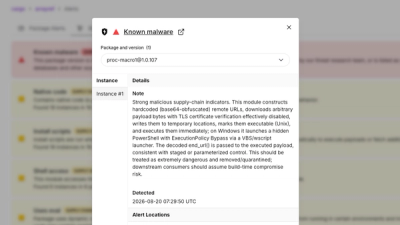
Three compromised Rust crates pulled in a malicious dependency that downloaded and executed cross-platform malware during Cargo builds.