
Product
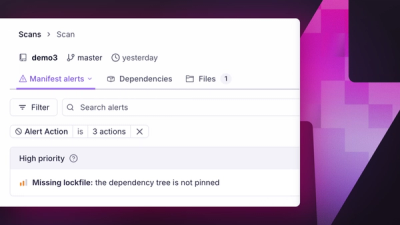
Introducing Manifest Alerts
Socket now detects supply chain risks in project manifests, starting with missing lockfiles that can make dependency installs non-reproducible.
By André Staltz, Trevor Norris - Jun 16, 2026
@auth0/auth0-api-js
Advanced tools
The @auth0/auth0-api-js library allows for securing API's running on a JavaScript runtime.
Using this SDK as-is in your API may not be trivial, as it is not a plug-and-play library for your framework. Instead, it is designed to be used as a building block for building framework-specific SDKs.



📚 Documentation - 🚀 Getting Started - 💬 Feedback
npm i @auth0/auth0-api-js
This library requires Node.js 20 LTS and newer LTS versions.
Create an instance of the ApiClient. This instance will be imported and used anywhere we need access to the methods.
import { ApiClient } from '@auth0/auth0-api-js';

const apiClient = new ApiClient({
  domain: '<AUTH0_DOMAIN>',
  audience: '<AUTH0_AUDIENCE>',
});
The AUTH0_DOMAIN can be obtained from the Auth0 Dashboard once you've created an application.
The AUTH0_AUDIENCE is the identifier of the API. You can find this in the API section of the Auth0 dashboard.
The SDK's verifyAccessToken method can be used to verify the access token.
const apiClient = new ApiClient({
  domain: '<AUTH0_DOMAIN>',
  audience: '<AUTH0_AUDIENCE>',
});

const accessToken = '...';
const decodedAndVerifiedToken = await apiClient.verifyAccessToken({
  accessToken,
});
The SDK automatically validates claims like iss, aud, exp, and nbf. You can also pass additional claims to be required by configuring requiredClaims:
const apiClient = new ApiClient({
  domain: '<AUTH0_DOMAIN>',
  audience: '<AUTH0_AUDIENCE>',
});

const accessToken = '...';
const decodedAndVerifiedToken = await apiClient.verifyAccessToken({
  accessToken,
  requiredClaims: ['my_custom_claim'],
});
When a downstream API receives a token issued through OBO, the verified claims may include an act claim. In this scenario, the downstream API verifies the token, confirms that the current actor is the expected MCP server, and records the full delegation chain for audit logging:
import { getCurrentActor, getDelegationChain } from '@auth0/auth0-api-js';

const claims = await apiClient.verifyAccessToken({ accessToken });
const currentActor = getCurrentActor(claims);
const delegationChain = getDelegationChain(claims);

// Authorize only the current actor.
if (currentActor && currentActor !== 'mcp_server_client_id') {
  throw new Error('Unexpected actor');
}

// Use the full chain for logging or audit only.
auditLogger.info('delegated_request', {
  user: claims.sub,
  currentActor,
  delegationChain,
});
Only the outermost act.sub should be used for authorization decisions. Use delegationChain for logging, audit, or attribution.
The verifyAccessToken method also supports validating DPoP-bound access tokens.
When using DPoP, you must also supply scheme, dpopProof, httpMethod, and httpUrl from the incoming HTTP request so the SDK can validate the proof and ensure the token is bound to that request.
const apiClient = new ApiClient({
  domain: '<AUTH0_DOMAIN>',
  audience: '<AUTH0_AUDIENCE>',
  dpop: {
    mode: 'required', // optional, defaults to 'allowed'
    iatOffset: 400, // optional, defaults to 300 seconds
    iatLeeway: 30, // optional, defaults to 30 seconds
  },
});

const accessToken = '...';
const decodedAndVerifiedToken = await apiClient.verifyAccessToken({
  accessToken,
  requiredClaims: ['my_custom_claim'],
  // Options required for DPoP bound token verification
  scheme: '<AUTHENTICATION_SCHEME>',
  dpopProof: '<DPOP_PROOF_JWT>',
  httpMethod: '<HTTP_METHOD>',
  httpUrl: '<HTTP_REQUEST_URL>'
});
See the DPoP Authentication in EXAMPLES.md for more examples and details.
The SDK supports OAuth 2.0 Protected Resource Metadata as defined in RFC 9728:
import {
  ProtectedResourceMetadataBuilder,
  BearerMethod,
  SigningAlgorithm,
} from '@auth0/auth0-api-js';

const resourceServerUrl = 'https://api.example.com';
const authServers = ['https://your-tenant.us.auth0.com'];

const metadata = new ProtectedResourceMetadataBuilder(resourceServerUrl, authServers)
  .withBearerMethodsSupported([BearerMethod.HEADER])
  .withResourceSigningAlgValuesSupported(
    SigningAlgorithm.RS256,
    SigningAlgorithm.ES256,
  )
  .withScopesSupported(['read', 'write', 'admin'])
  .build();

// Serve metadata from the standard RFC 9728 endpoint
app.get('/.well-known/oauth-protected-resource', (req, res) => {
  res.json(metadata.toJSON());
});
The SDK supports RFC 8693 OAuth 2.0 Token Exchange, allowing you to exchange tokens for different API audiences while preserving user identity.
Custom Token Exchange: Use when you control the subject token format. Common scenarios:
Access Token Exchange with Token Vault (via getAccessTokenForConnection): Use when exchanging for external provider's access tokens:
import { ApiClient } from '@auth0/auth0-api-js';

const apiClient = new ApiClient({
  domain: '<AUTH0_DOMAIN>',
  audience: '<AUTH0_AUDIENCE>',
  clientId: '<AUTH0_CLIENT_ID>',
  clientSecret: '<AUTH0_CLIENT_SECRET>',
});

// Exchange a custom token (e.g., from an MCP server or legacy system)
const result = await apiClient.getTokenByExchangeProfile(
  userToken, // The token to exchange
  {
    subjectTokenType: 'urn:example:custom-token', // Your custom token type URN
    audience: 'https://api.backend.com',
  }
);

// Handle token expiry - check expiresAt and re-exchange when needed
// Note: expiresAt is in seconds, Date.now() is in milliseconds
const tokenIsValid = Math.floor(Date.now() / 1000) < result.expiresAt;
if (!tokenIsValid) {
  // Re-exchange with a fresh subject token (e.g., from your auth provider)
  const newSubjectToken = await getNewTokenFromYourProvider();
  const refreshed = await apiClient.getTokenByExchangeProfile(newSubjectToken, {
    subjectTokenType: 'urn:example:custom-token',
    audience: 'https://api.backend.com',
  });
}
Security Note: The
extraparameter (if exposed in your application) should never contain Personally Identifiable Information (PII) or sensitive data. Extra parameters may be logged by Auth0 or included in audit trails. Only use it for non-sensitive technical parameters that don't identify users.
Learn more: Custom Token Exchange | Token Vault
Use getTokenOnBehalfOf() when your API receives an Auth0 access token for itself and needs
to exchange it for another Auth0 access token targeting a downstream API while preserving the
same user identity. This is especially useful for MCP servers and other intermediary APIs that
need to call downstream APIs on behalf of the user.
The following example verifies the incoming access token for your API, exchanges it for a token for the downstream API, and then calls the downstream API with the exchanged token.
function getBearerToken(authorizationHeader: string | null): string {
  if (!authorizationHeader?.toLowerCase().startsWith('bearer ')) {
    throw new Error('Missing Bearer access token');
  }

  return authorizationHeader.slice('Bearer '.length).trim();
}

export async function handleCalendarRequest(request: Request) {
  const incomingAccessToken = getBearerToken(request.headers.get('authorization'));

  await apiClient.verifyAccessToken({ accessToken: incomingAccessToken });

  const obo = await apiClient.getTokenOnBehalfOf(incomingAccessToken, {
    audience: 'https://calendar-api.example.com',
    scope: 'calendar:read calendar:write',
  });

  const downstreamResponse = await fetch('https://calendar-api.example.com/events', {
    headers: {
      authorization: `Bearer ${obo.accessToken}`,
    },
  });

  if (!downstreamResponse.ok) {
    throw new Error(`Downstream request failed with ${downstreamResponse.status}`);
  }

  return downstreamResponse.json();
}
In the current implementation, getTokenOnBehalfOf() forwards the incoming access token as the
RFC 8693 subject_token and relies on Auth0 to handle any DPoP-specific behavior for that token.
The OBO result only includes access-token-oriented fields. It does not expose id_token or
refresh_token.
We appreciate feedback and contribution to this repo! Before you get started, please read the following:
To provide feedback or report a bug, please raise an issue on our issue tracker.
Please do not report security vulnerabilities on the public GitHub issue tracker. The Responsible Disclosure Program details the procedure for disclosing security issues.

Auth0 is an easy to implement, adaptable authentication and authorization platform. To learn more checkout Why Auth0?
This project is licensed under the MIT license. See the LICENSE file for more info.
FAQs
Auth0 Authentication SDK for API's on JavaScript runtimes
The npm package @auth0/auth0-api-js receives a total of 20,343 weekly downloads. As such, @auth0/auth0-api-js popularity was classified as popular.
We found that @auth0/auth0-api-js demonstrated a healthy version release cadence and project activity because the last version was released less than a year ago. It has 18 open source maintainers collaborating on the project.
Did you know?

Socket for GitHub automatically highlights issues in each pull request and monitors the health of all your open source dependencies. Discover the contents of your packages and block harmful activity before you install or update your dependencies.
Product
Socket now detects supply chain risks in project manifests, starting with missing lockfiles that can make dependency installs non-reproducible.

Research
/Security News
The trojanized extensions use TinyGo-compiled WebAssembly and Solana transaction memos to resolve command-and-control infrastructure.

Security News
Anthropic says the directive cited national security concerns over a narrow jailbreak, but offered no specific technical details.