

Security News
Risky Biz Podcast: AI Agents Are Raising the Stakes for Software Supply Chain Security
Open source attacks are accelerating as AI coding agents pull in dependencies faster, with less human review.
By Sarah Gooding - Jun 30, 2026
@aws-sdk/client-sso
Advanced tools
AWS SDK for JavaScript SSO Client for Node.js, Browser and React Native.
AWS IAM Identity Center (successor to AWS Single Sign-On) Portal is a web service that makes it easy for you to assign user access to IAM Identity Center resources such as the AWS access portal. Users can get AWS account applications and roles assigned to them and get federated into the application.
Although AWS Single Sign-On was renamed, the sso and
identitystore API namespaces will continue to retain their original name for
backward compatibility purposes. For more information, see IAM Identity Center rename.
This reference guide describes the IAM Identity Center Portal operations that you can call programatically and includes detailed information on data types and errors.
AWS provides SDKs that consist of libraries and sample code for various programming languages and platforms, such as Java, Ruby, .Net, iOS, or Android. The SDKs provide a convenient way to create programmatic access to IAM Identity Center and other AWS services. For more information about the AWS SDKs, including how to download and install them, see Tools for Amazon Web Services.
To install this package, simply type add or install @aws-sdk/client-sso using your favorite package manager:
npm install @aws-sdk/client-ssoyarn add @aws-sdk/client-ssopnpm add @aws-sdk/client-ssoThe AWS SDK is modulized by clients and commands.
To send a request, you only need to import the SSOClient and
the commands you need, for example ListAccountsCommand:
// ES5 example
const { SSOClient, ListAccountsCommand } = require("@aws-sdk/client-sso");
// ES6+ example
import { SSOClient, ListAccountsCommand } from "@aws-sdk/client-sso";
To send a request, you:
send operation on client with command object as input.destroy() to close open connections.// a client can be shared by different commands.
const client = new SSOClient({ region: "REGION" });
const params = { /** input parameters */ };
const command = new ListAccountsCommand(params);
We recommend using await operator to wait for the promise returned by send operation as follows:
// async/await.
try {
  const data = await client.send(command);
  // process data.
} catch (error) {
  // error handling.
} finally {
  // finally.
}
Async-await is clean, concise, intuitive, easy to debug and has better error handling as compared to using Promise chains or callbacks.
You can also use Promise chaining to execute send operation.
client.send(command).then(
  (data) => {
    // process data.
  },
  (error) => {
    // error handling.
  }
);
Promises can also be called using .catch() and .finally() as follows:
client
  .send(command)
  .then((data) => {
    // process data.
  })
  .catch((error) => {
    // error handling.
  })
  .finally(() => {
    // finally.
  });
We do not recommend using callbacks because of callback hell, but they are supported by the send operation.
// callbacks.
client.send(command, (err, data) => {
  // process err and data.
});
The client can also send requests using v2 compatible style. However, it results in a bigger bundle size and may be dropped in next major version. More details in the blog post on modular packages in AWS SDK for JavaScript
import * as AWS from "@aws-sdk/client-sso";
const client = new AWS.SSO({ region: "REGION" });

// async/await.
try {
  const data = await client.listAccounts(params);
  // process data.
} catch (error) {
  // error handling.
}

// Promises.
client
  .listAccounts(params)
  .then((data) => {
    // process data.
  })
  .catch((error) => {
    // error handling.
  });

// callbacks.
client.listAccounts(params, (err, data) => {
  // process err and data.
});
When the service returns an exception, the error will include the exception information, as well as response metadata (e.g. request id).
try {
  const data = await client.send(command);
  // process data.
} catch (error) {
  const { requestId, cfId, extendedRequestId } = error.$metadata;
  console.log({ requestId, cfId, extendedRequestId });
  /**
   * The keys within exceptions are also parsed.
   * You can access them by specifying exception names:
   * if (error.name === 'SomeServiceException') {
   *     const value = error.specialKeyInException;
   * }
   */
}
Please use these community resources for getting help. We use the GitHub issues for tracking bugs and feature requests, but have limited bandwidth to address them.
aws-sdk-js
on AWS Developer Blog.aws-sdk-js.To test your universal JavaScript code in Node.js, browser and react-native environments, visit our code samples repo.
This client code is generated automatically. Any modifications will be overwritten the next time the @aws-sdk/client-sso package is updated.
To contribute to client you can check our generate clients scripts.
This SDK is distributed under the Apache License, Version 2.0, see LICENSE for more information.
The 'aws-sdk' package is the older version of the AWS SDK for JavaScript. It provides a comprehensive feature set for interacting with AWS services, including AWS SSO. However, it is not as modular as the newer '@aws-sdk/client-sso' and might result in larger bundle sizes if only a subset of services is needed.
The 'aws-amplify' package is a library designed to help build scalable full-stack applications on AWS. It includes authentication features through Amazon Cognito, which can be integrated with AWS SSO for user sign-in and access control. It is a higher-level abstraction compared to '@aws-sdk/client-sso' and includes a broader set of features beyond AWS service interaction.
FAQs
AWS SDK for JavaScript Sso Client for Node.js, Browser and React Native
The npm package @aws-sdk/client-sso receives a total of 18,832,503 weekly downloads. As such, @aws-sdk/client-sso popularity was classified as popular.
We found that @aws-sdk/client-sso demonstrated a healthy version release cadence and project activity because the last version was released less than a year ago. It has 2 open source maintainers collaborating on the project.
Did you know?

Socket for GitHub automatically highlights issues in each pull request and monitors the health of all your open source dependencies. Discover the contents of your packages and block harmful activity before you install or update your dependencies.
Security News
Open source attacks are accelerating as AI coding agents pull in dependencies faster, with less human review.

Research
/Security News
Malicious Chrome and Firefox extensions posed as free VPNs while stealing clipboard data through later extension updates.
Research
/Security News
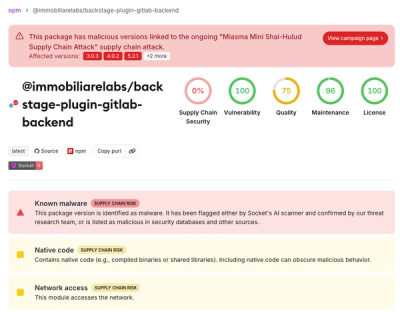
Miasma Mini Shai-Hulud hits @immobiliarelabs Backstage plugins, targeting GitLab and LDAP auth packages on npm.