BeeL MCP server — VeriFactu e-invoicing for AI agents
Servidor MCP de facturación electrónica española con VeriFactu (AEAT): crea, emite y rectifica facturas desde Claude, ChatGPT, Cursor o VS Code. MCP server for Spanish e-invoicing with VeriFactu compliance — issue, correct and register invoices with AEAT straight from your AI agent. beel.es · API docs · MCP guide · npm
An MCP (Model Context Protocol) server that lets an AI
agent issue legally compliant Spanish electronic invoices — VeriFactu registration
with AEAT, F1/F2 invoice types, R1–R5 correctives, NIF validation against the census,
and the regime keys the regulation requires. Connect it to Claude, ChatGPT, Cursor or
VS Code and your agent can handle Spanish invoicing — facturación electrónica and
factura electrónica VeriFactu — end to end, without you writing a single API call.
It is not a generated wrapper around an API. Three things make it usable by a model:
Tools are derived from the public OpenAPI contract, so each tool's input schema is
the operation's real schema — enums, line items, regime keys and all. The surface
cannot drift from the API.
A tool-inclusion policy decides what an agent should actually be given. Binary
downloads, multipart uploads, webhook plumbing, operations only a browser session can
authenticate, and deprecated ones are excluded by rule, not by hand.
Fiscal guardrails travel with the tools: the invariants a generated wrapper would
miss, both as documentation the model reads and as pre-flight checks that stop a
non-compliant request before it becomes a fiscal document.
One codebase, two transports: the hosted remote server at
https://mcp.beel.es/mcp (Streamable HTTP + OAuth — one login per user, nothing to
install), and a local stdio server built from this repository for headless use, where
an API key works and a browser-based login does not.
Quick start
Add https://mcp.beel.es/mcp as a connector in Claude, ChatGPT, Cursor or VS Code and
log in with your BeeL account. Nothing to install and no API key to handle: the server acts
with your own credentials, and the OAuth flow is discovered from the URL.
# Claude Code
claude mcp add --transport http beel https://mcp.beel.es/mcp
That is the whole setup for interactive use. Read on only if you need the local server.
Running it locally
Use the local server when OAuth cannot: a scheduled job that issues invoices, a CI
pipeline, or any headless process where no one is present to complete a browser login.
It authenticates with an API key instead.
# Claude Code
claude mcp add beel --env BEEL_API_KEY=beel_sk_test_xxx -- npx -y @beel_es/mcp
Keys prefixed beel_sk_test_ are safe to experiment with; beel_sk_live_ issues real
fiscal documents.
Releases are published from CI through npm trusted
publishing, so they carry provenance: npm
records the exact commit and workflow each build came from. Verify it with npm audit signatures.
Each release is also announced to the MCP
Registry as es.beel/mcp, listing both
transports, so clients that browse the registry find the server without being pointed at
it. The name is authenticated by a DNS record on beel.es, so it says the server comes
from us and not merely from some repository.
An earlier listing under io.github.beel-es/beel-mcp (v0.2.2) was retired when the name
moved. Registry names are identities rather than labels, so a rename is a new entry rather
than a redirect; both point at the same npm package and the same hosted server.
What it provides
117 API tools derived from openapi/public-api.yaml — invoices, customers,
products, recurring invoices, series and tax configuration, NIF validation, companies.
4 synthetic tools the API has no single endpoint for: beel_docs_search,
beel_docs_get, beel_docs_list over the documentation, and
beel_get_setup_status, which reports per NIF exactly what is missing before it can
issue and the one next action to take.
Guardrail resources under beel://guardrails/* — the fiscal invariants, plus
beel://guardrails/errors, a catalogue of every error code with the action it calls
for. Their summaries are woven into the description of every tool they constrain.
7 workflow prompts encoding the safe order of operations for the flows where the
order is what makes them safe: issue-invoice (validate NIF → choose F1/F2 → check the
VeriFactu gates → issue), fix-invoice (void vs correct), onboard-nif,
setup-representation, invite-member, connect-payments and upgrade-integration.
Inline invoice PDF viewer (MCP Apps):
generating an invoice PDF opens it in a side panel in hosts that support it.
A generated catalogue of every tool, with the scopes each requires, lives at
docs.beel.es/mcp/tools (npm run tools:catalog).
What is deliberately not a tool
Binary downloads (PDF preview, bulk ZIP, Excel/CSV export), multipart uploads (CSV/Holded
import, signed-PDF submission), webhook infrastructure, operations that only a browser
session can authenticate, and every deprecated operation. An agent cannot drive them,
and each one costs context that a usable tool needs. The rules are in
src/policy/tool-policy.ts.
The fiscal guardrails
Spanish e-invoicing has invariants an LLM will get wrong from the schema alone — voiding
an invoice that should have been corrected, using R1 on a simplified invoice, editing one
AEAT has already registered. The server addresses that in three layers, and the difference
between them matters:
1. Advisory — src/guardrails/rules/*.md, one Markdown file per topic: the invoice
lifecycle, void vs rectify, invoice types, invoice lines, regime keys, series numbering,
NIF validation, the VeriFactu gates, multi-NIF accounts. Each is exposed as an MCP
resource under beel://guardrails/* and its one-line summary is appended to the
description of every tool it constrains, so the constraint travels with the call.
2. Enforced — src/guardrails/validate.ts, checked before the request is sent, so a
bad payload never even consumes an idempotency key:
Check
Code
Exactly one pricing field per line
LINE_UNIT_PRICE_XOR_DECLARED_TOTAL
No discount on a declared total
LINE_DECLARED_TOTAL_FORBIDS_DISCOUNT
No IRPF withholding on a simplified (F2) invoice
SIMPLIFICADA_FORBIDS_IRPF
Equivalence surcharge only under regime 18, and 18 only with one
Numbering is only seeded in the call that activates the company
NUMBERING_REQUIRES_ACTIVATION
SUPLIDO lines carry their source reference
checked locally
Exemption text only under reason OTRO
checked locally
Correctives go through their own operation, not type: CORRECTIVE
checked locally
3. Explained — the BeeL API already answers well: its message is written for a
human in the caller's language, error.details carries the specifics, and the RFC 7807
type field links to a documentation page for that exact code (around 357 of them). The
server relays all of that untouched, and adds only the two things a response cannot
carry: the remedy as a tool call — the docs address someone with the dashboard open
("create a series in settings"), an agent needs beel_set_default_series — and
whether retrying can possibly help, which is what stops an agent looping on a 403
that needs an administrator. src/guardrails/catalog.ts holds only codes where one of
those applies; anything else passes through, because a paraphrase would be worse than the
original and would drift from it. The nested blockers[] of EMISSION_NOT_READY are the
clearest case: they arrive as bare strings with no message and no link, and each comes
back out naming the tool that clears it.
The BeeL API is the authority on all of it. Every enforced rule mirrors a rejection
the contract documents, so the pre-flight is a strict subset of what the API refuses: it
can only make failure faster and better explained, never permit something the API would
reject. Rules that depend on server-side state — AEAT census matching, the €3 000 F2
ceiling, whether a series exists — stay advisory on purpose, because guessing at them
locally would reject valid invoices. Set BEEL_DISABLE_PREFLIGHT=1 to bypass the local
checks entirely.
Hand-curated lists are anchored by tests: every catalogued code must still appear in the
contract, every checked operationId must still resolve to a real tool, and every
guardrail reference must point at a guardrail that exists. An API rename fails CI instead
of silently switching a fiscal check off.
Configuration
Local server only
Variable
Purpose
BEEL_API_KEY
API key. The prefix selects the environment: beel_sk_test_ → Test, beel_sk_live_ → Live.
BEEL_ENV / BEEL_CONFIG_DIR
Optional. With BEEL_API_KEY unset, falls back to the CLI's ~/.config/beel/config.json (beel login); BEEL_ENV (test/live, default test) picks which stored key.
Shared
Variable
Purpose
BEEL_BASE_URL
API base URL. Default https://app.beel.es/api.
BEEL_DOCS_URL
Documentation source for the docs tools. Default https://docs.beel.es.
BEEL_REQUEST_TIMEOUT_MS
Hard ceiling on a single API call. Default 30000.
BEEL_DISABLE_PREFLIGHT
Set to 1 to skip the enforced guardrails.
Every default lives in src/shared/defaults.ts; nothing is hardcoded twice. Remote
deployment variables are documented in DEPLOY.md.
The server starts and lists tools with no credentials at all — it only errors when an API
tool is actually called. POST requests carry a stable Idempotency-Key derived from the
request itself, so an agent retrying "create invoice" can never mint a second invoice.
Self-hosting
The remote server runs on Cloudflare Workers. See DEPLOY.md for the KV
namespace, the OAuth client BeeL must have registered, and the secrets involved.
Development
npm ci
npm run dev # stdio server from source
npm test# vitest
npm run typecheck # both the Node and the Worker configs
npm run build # single-file bundle to dist/index.js
npm run inspect # MCP Inspector against the local build
npm run spec:verify # the vendored contract still matches its lock
openapi/public-api.yaml is a generated copy of the API contract, and
openapi/spec.lock.json records its version, operation count and hash. CI fails if the
two disagree, which is what keeps a vendored contract honest. See
CONTRIBUTING.md.
The rest of the BeeL developer ecosystem
Everything below derives from the same OpenAPI contract, so the vocabulary — invoice
types, regime keys, series, VeriFactu states — is identical wherever you meet it.
llms.txt for agents that would rather read than guess
FAQ
What is the BeeL MCP server?
An MCP server that exposes Spanish VeriFactu e-invoicing
as tools an AI agent can call — so Claude, ChatGPT, Cursor or VS Code can create customers,
issue F1/F2 invoices, register them with AEAT, and post R1–R5 correctives on your behalf.
How do I connect VeriFactu invoicing to Claude / ChatGPT / Cursor?
Add https://mcp.beel.es/mcp as a connector and log in with your BeeL account — see
Quick start. Nothing to install, and no API key to paste for interactive use.
Is it actually VeriFactu-compliant?
Yes. Invoices are registered with AEAT under VeriFactu, numbering and series follow the
regulation, and the fiscal guardrails stop non-compliant requests
before they ever become a fiscal document.
VeriFactu or TicketBAI?
This server targets VeriFactu, the national AEAT system. TicketBAI (the Basque Country
regime) is out of scope.
Can I use it without an AI agent?
Yes — it is a standard MCP server, so any MCP-capable client works, and the same invoicing
surface is available as a REST API, CLI and n8n node.
Contributing
Bug reports and pull requests are welcome — see CONTRIBUTING.md for
how the project is laid out and which conventions are load-bearing, and
Discussions for questions. Issues
labelled good first issue
are a reasonable place to start. Everyone participating is expected to follow the
Code of Conduct. Security issues go to security@beel.es rather
than a public issue; see SECURITY.md.
MCP server for the BeeL invoicing API — VeriFactu-compliant electronic invoicing tools for LLM agents, derived from the public OpenAPI contract.
The npm package @beel_es/mcp receives a total of 48 weekly downloads. As such, @beel_es/mcp popularity was classified as not popular.
We found that @beel_es/mcp demonstrated a healthy version release cadence and project activity because the last version was released less than a year ago.It has 1 open source maintainer collaborating on the project.
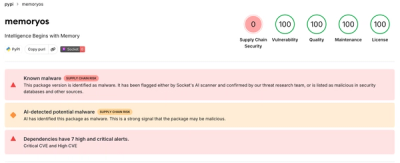
The compromise affects MemTensor's MemOS, an open source memory framework for large language models (LLMs) and AI agents. Both npm package @memtensor/memos-cloud-openclaw-plugin and the PyPI package MemoryOS are compromised. They drop cross-platform Go binaries that exfiltrate developer secrets.