

Product
PHP and Composer Support Is Now in Beta
Socket’s PHP and Composer support is now in Beta for all customers, with PHP reachability analysis generally available.
By Trevor Norris, Benjamin Barslev - Aug 21, 2026
@beyondnet/evolith-mcp
Advanced tools
Evolith MCP Gateway — NestJS-based Model Context Protocol server for AI agents. Supports stdio and SSE transports.
Bilingual navigation: Versión en Español
Decouples the MCP server from the CLI. It is a first-class product that exposes the MCP tools as a Gateway talking to @beyondnet/evolith-core (the reusable business-logic layer), instead of shelling out to CLI subprocesses.
sequenceDiagram
    participant Agent as "AI Agent<br/>(Cursor, Claude Desktop, Custom)"
    participant Gateway as "MCP Gateway<br/>@beyondnet/evolith-mcp"
    participant Core as "Business Logic<br/>@beyondnet/evolith-core"
    participant FS as "File System"
    participant Git as "Git"

    Note over Agent,Gateway: Transport: stdio (local) or Streamable HTTP (remote)

    Agent->>+Gateway: tools/call { name: "evolith-validate", args: { path: "/repo" } }

    Gateway->>Gateway: 1. Generate correlationId (evl-xxx)
    Gateway->>Gateway: 2. Lookup tool in ToolRegistry
    Gateway->>Gateway: 3. ABAC authorization check
    Gateway->>Gateway: 4. Start timing + structured log (Pino)

    Gateway->>+Core: ValidateSatelliteUseCase.execute({ satellitePath })
    Core->>+FS: Read evolith.yaml, rulesets/
    FS-->>-Core: Configuration + rule definitions

    Core->>+Git: Check ADR history, phase state
    Git-->>-Core: Phase & commit data

    Core->>Core: Evaluate rules (Native + OPA)
    Core-->>-Gateway: ValidationResult { status, issues }

    Gateway->>Gateway: 5. Wrap in SuccessEnvelope { success, data, meta }
    Gateway->>Gateway: 6. Audit log + completion duration

    Gateway-->>-Agent: { content: [{ type: "text", text: "{...}" }] }

    Note over Agent,Gateway: All errors wrapped in ErrorEnvelope with EvolithErrorCode
| Transport | Use | Command |
|---|---|---|
| stdio (JSON-RPC 2.0) | Local agents, Cursor, Claude Desktop | evolith-mcp serve |
| Streamable HTTP (official MCP SDK) | Remote agents, scalability | evolith-mcp serve --transport http --port 49100 |
The default port is
3000(main.ts: envPORTor--port, falling back to3000). The49100used in the examples is an arbitrary value, not the default.Logs are always written to stderr (Pino), because stdout is reserved for the JSON-RPC stream of the stdio transport.
# From the monorepo
npm install @beyondnet/evolith-mcp

# Or globally
npm install -g @beyondnet/evolith-mcp
# stdio (default) — for Cursor, Claude Desktop, etc.
evolith-mcp serve

# HTTP — for remote integration
evolith-mcp serve --transport http --port 49100
| Variable | Default | Description |
|---|---|---|
TRANSPORT | stdio | Active transport: stdio or http |
PORT | 3000 | Port for the HTTP transport |
MCP_HTTP_HOST | 0.0.0.0 | Bind host of the HTTP server. Use 127.0.0.1 for local-only |
EVOLITH_API_KEY | — | API key for authentication on the HTTP transport |
EVOLITH_MCP_ALLOW_NO_AUTH | false | HTTP only. Allows HTTP to start without an API key (non-production only). Ignored in production and on stdio (which warns at startup) |
JWT_SECRET | — | Optional secret used to validate a Bearer JWT (HS256) in addition to the API key |
NODE_ENV | development | In production, HTTP auth is mandatory |
LOG_LEVEL | info | Pino log level: trace, debug, info, warn, error |
REDIS_URL | — | Redis URL for the resource cache (e.g. redis://localhost:6379). The cache is optional. |
OTEL_EXPORTER_OTLP_ENDPOINT | — | OpenTelemetry endpoint for tracing |
OTEL_SERVICE_NAME | evolith-mcp | Service name used in the traces |
EVOLITH_MCP_REQUEST_STATE_SECRET | — | Key that seals the MRTR requestState (2026-07-28 path). Falls back to EVOLITH_API_KEY, then JWT_SECRET, then a per-process key. Set it explicitly whenever more than one replica is served, or an approval retry landing on another replica is rejected |
EVOLITH_MCP_RESOURCE_AUTH_SERVERS | — | Comma-separated authorization server issuers published in the Protected Resource Metadata document. Defaults to EVOLITH_MCP_OAUTH_ISSUER |
EVOLITH_MCP_RESOURCE_URI | request host | Canonical URI of this server (RFC 8707 resource identifier) published as resource |
EVOLITH_MCP_RESOURCE_SCOPES | read write | Scopes published as scopes_supported and challenged in WWW-Authenticate |
The binary also accepts the flags
--transport/-t,--port/-p,--api-keyand--allow-no-auth(HTTP only), as well as theevolith-mcp versionsubcommand.
No request authentication is required: the process is local, single-user, and the agent runs it directly. The transport establishes an explicit local session principal (id=local-stdio-session, role=local-session, roles=[local-session, operator], scopes=[read, write]) that is recorded in the audit trail of every call (GT-572).
This is not an authorization bypass: ABAC (native + OPA) is still evaluated on every tools/call with that identity, the deploy tools are still denied in production (they require architect), and every mutative tool still demands the HITL gate { apply, approvalToken }. --allow-no-auth / EVOLITH_MCP_ALLOW_NO_AUTH do not apply to stdio (there is no request authentication to skip); if they are passed together with --transport stdio, the server warns about it on stderr at startup.
In production (NODE_ENV=production), authentication is mandatory: validateAuth() ignores EVOLITH_MCP_ALLOW_NO_AUTH and rejects every request without a valid credential (401). The value of EVOLITH_API_KEY is an arbitrary secret (any string; no prefix required) compared by equality. It is accepted in either of these two headers:
Authorization: Bearer <EVOLITH_API_KEY>
x-api-key: <EVOLITH_API_KEY>
/health is public (a liveness probe) and requires no credential.
When an OAuth issuer is configured, /.well-known/oauth-protected-resource (and the path-inserted /.well-known/oauth-protected-resource/<path>) is also public: it is the RFC 9728 document an unauthenticated client reads to discover which authorization server to go to, so gating it behind the credential it is trying to obtain would make discovery impossible. It carries no MCP data — only the issuer, the resource identifier and the scope names. A 401 from a protected resource additionally carries a WWW-Authenticate: Bearer resource_metadata="…", scope="…" challenge, which is the discovery mechanism MCP clients must prefer. Without an issuer the endpoint returns 404 rather than publishing a document with an empty authorization_servers.
Client registration never flows through this server: it is a resource server, and the 2026-07-28 revision has clients obtain a client_id from a Client ID Metadata Document (or pre-registration) at the authorization server. Dynamic Client Registration is deprecated and is not implemented here; protected-resource-metadata.spec.ts fails the build if a registration endpoint is ever introduced.
The server answers two protocol revisions on the same HTTP endpoint:
| Revision | How a request selects it | Shape |
|---|---|---|
2026-07-28 (current) | _meta["io.modelcontextprotocol/protocolVersion"] on every request, or a server/discover call | Stateless. No initialize, no notifications/initialized, no Mcp-Session-Id. Every result carries resultType; the approval gate is expressed as an InputRequiredResult with a sealed requestState (MRTR) |
2025-11-25 | an initialize request | The handshake-based path served by @modelcontextprotocol/sdk, which mints and requires Mcp-Session-Id |
Both revisions run through one dispatch, so ABAC (native + OPA), the scope gate, the approval gate and the audit trail are the same code on either path. The 2025-11-25 path is retained because the published SDK still declares it as its latest revision; it is not an alternative design.
On the 2026-07-28 path a state-changing tool answers resultType: "input_required" with an elicitation/create request and an opaque requestState. The client gathers the human's approval and retries the original call — new JSON-RPC id, same parameters, plus requestState and inputResponses. The requestState is sealed with AES-256-GCM and bound to the principal, the tenant, the originating call and a short TTL, so it cannot be replayed across users, calls or time. A caller that already holds an approval may still pass { apply: true, approvalToken } inline and skip the round trip, exactly as on the 2025-11-25 path.
The
ApiKeyProvisioningService(below) is an advanced and optional mechanism for issuing keys with anevk_prefix, a SHA-256 hash and a TTL. It is independent of the startupEVOLITH_API_KEYdescribed here.
The ApiKeyProvisioningService manages the lifecycle of the keys:
| Operation | Description |
|---|---|
generateKey(label, options) | Generates a key with an evk_ prefix, a SHA-256 hash and a configurable TTL (90 days by default) |
validateKey(rawKey) | Validates the key against the stored hash and checks expiry |
rotateKey(keyId) | Revokes the current key and generates a new one for the same client |
revokeKey(keyId) | Revokes a key immediately |
Keys carry scopes: read, write, admin. They are bound to a tenant.
The AbacEvaluator controls which tools each user may invoke, based on their roles:
| Tool type | Allowed roles | Environment |
|---|---|---|
| Read (list, get, status) | Every authenticated role | Any |
| Write (fix, install, set) | operator, sre, architect, admin | Any |
| Write | developer, qa | Non-production only |
| Deploy (deploy, publish, merge) | architect, admin, operator, sre | Any |
| Deploy | Anyone except architect | Blocked in production |
ABAC codes:
| Code | Cause |
|---|---|
ABAC-01 | Tool denied for the user's role/environment |
ABAC-02 | User with no roles — every tool is denied |
ABAC-03 | Tool not classified into any known group |
Tool classification (substring heuristic). The internal role sets are DEVELOPER = {developer, qa}, OPERATOR = {operator, sre} and ARCHITECT = {architect, admin}. The read/write/deploy classification of each tool is a heuristic over its name (abac-evaluator.ts): it counts as read if the name contains read/list/get (or does not begin with evolith-); as write if it contains write/replace/run/fix/advance; as deploy if it contains deploy/publish/merge. Because of that heuristic, evolith-phase-advance is classified as write (the advance substring), even though it only proposes the transition. A tool that fits no group is rejected with ABAC-03.
Authentication precedence (HTTP). The guard (mcp-server-auth.ts) evaluates the API key first: if the Authorization: Bearer <token> or the x-api-key header matches EVOLITH_API_KEY, it grants an admin context (role admin, every tool allowed). Only if the key does not match and JWT_SECRET is defined does it try to validate the Bearer as a JWT HS256; in that case the roles in the JWT payload are what feed ABAC. /health is public. In production, auth is mandatory (it ignores EVOLITH_MCP_ALLOW_NO_AUTH).
The tools are obtained at runtime via tools/list. All of them return raw data, which the Gateway wraps in a SuccessEnvelope or an ErrorEnvelope.
| Tool | Description | Mutative |
|---|---|---|
evolith-validate | Validates a repository against the Evolith governance rules (GOV, INH, ACL, OCB) | No |
evolith-composable-validate | Combinable multi-mode validation: SDLC, Architecture, Ruleset, ADR, Ad-hoc | No |
evolith-composable-validate schema:
{
  "path": "string (required) — path to the satellite repository",
  "corePath": "string — path to the Evolith Core",
  "engine": "'native' | 'opa' — evaluation engine (default: native)",
  "topology": "'modular-monolith' | 'microservices' | 'serverless' | ... — enables Architecture mode",
  "phase": "'discovery' | 'design' | 'construction' | 'qa' | 'release' — enables SDLC mode (the schema also accepts the legacy aliases 'f1'..'f5', deprecated)",
  "ruleset": "string — enables Ruleset mode",
  "adr": "'adr-0002' | 'adr-0005' | 'adr-0010' | ... — enables ADR mode",
  "file": "string — enables Ad-hoc mode over a single file"
}
Modes are enabled by combining fields. Several of them can be used in a single call.
| Tool | Description | Mutative |
|---|---|---|
evolith-architecture-validate | Validates a satellite project against the architecture rules | No |
evolith-drift-detect | Detects drift between the declared architecture and the real one | No |
| Tool | Description | Mutative |
|---|---|---|
evolith-topology-list | Lists every architecture topology available in Evolith Core | No |
evolith-topology-get | Gets the full manifest of a topology by ID | No |
evolith-topology-list schema:
{
  "corePath": "string — path to the Core (optional, default: ../evolith)"
}
evolith-topology-get schema:
{
  "id": "string (required) — topology ID (e.g. modular-monolith)",
  "corePath": "string — path to the Core (optional)"
}
Available topologies: modular-monolith, distributed-modules, microservices, serverless, edge-computing, event-driven, data-mesh, agentic-ai
| Tool | Description | Mutative |
|---|---|---|
evolith-gate-evaluate | Evaluates a specific SDLC phase gate | No |
evolith-phase-advance | Proposes a phase transition | No¹ |
¹
evolith-phase-advanceonly proposes the transition — it does not execute it. Executing it is the responsibility of the operator or of the Tracker.
| Tool | Description | Mutative |
|---|---|---|
evolith-sdlc-status | Gets the current SDLC phase state of the repository | No |
evolith-sdlc-handoff | Runs the phase handoff, generating the evidence manifest | Yes |
evolith-dora-metrics | Approximates DORA metrics from the Git history: deployment frequency, lead time (approx.), total and merge commits within the window (days, default 90) | No |
| Tool | Description | Mutative |
|---|---|---|
evolith-moscow-create | Creates a MoSCoW matrix for a phase of the project | No² |
evolith-moscow-load | Loads an existing MoSCoW matrix | No |
evolith-moscow-update | Updates items in the MoSCoW matrix | No² |
evolith-moscow-remove | Removes items from the matrix | No² |
evolith-moscow-list | Lists the MoSCoW matrices of the project | No |
evolith-moscow-validate | Validates that the matrix is well formed | No |
evolith-moscow-report | Generates a MoSCoW prioritization report | No |
² The MoSCoW tools write to
.evolith/moscow/{phase}.jsonbut do not declaremutative: truein the code (moscow.tools.ts), so the dispatcher does not demandapply/approvalToken. Treat them as write operations that are not protected by the mutative guard.
| Tool | Description | Mutative |
|---|---|---|
evolith-agent-install | Installs an Evolith agent in the repository | Yes |
evolith-agent-list | Lists the installed agents | No |
evolith-agent-validate | Validates the configuration of an agent | No |
evolith-agent-upgrade | Upgrades an agent to the latest version of the template | Yes |
evolith-agent-remove | Removes an agent from the repository | Yes |
| Tool | Description | Mutative |
|---|---|---|
evolith-auto-fix | Applies automatic fixes to the detected violations | Yes |
| Tool | Description | Mutative |
|---|---|---|
evolith-config-get | Gets configuration values from evolith.yaml | No |
evolith-config-set | Updates values in evolith.yaml | Yes |
| Tool | Description | Mutative |
|---|---|---|
evolith-metrics | Returns internal MCP Gateway metrics (calls, latency, errors) | No |
Resources are obtained via resources/list and read via resources/read.
resources/list)| URI | Name | Description |
|---|---|---|
evolith://rulesets | Rulesets | Lists every ruleset of Evolith Core |
evolith://phase-gates | Phase Gates | Definitions and requirements of the phase gates |
evolith://agents | Agents | List of installed Evolith agents |
evolith://core/info | Core Info | General Core information (version, total rulesets, capabilities) |
evolith://governance/version | Governance Version | Version of the governance schema |
evolith://core/version | Core Version | Version of the Core schema |
evolith://repository/config | Repository Config | Contents of the current repository's evolith.yaml |
evolith://moscow/phase-0 | MoSCoW Phase 0 | MoSCoW matrix for the discovery phase |
evolith://architecture/topologies | Architecture Topologies | List of every available topology |
resources/read)| URI Pattern | Description |
|---|---|
evolith://ruleset/{name} | Contents of a ruleset by name (e.g. evolith://ruleset/governance/base) |
evolith://agent/{name} | Definition of an installed agent (e.g. evolith://agent/winston) |
evolith://architecture/topology/{id} | Manifest of a topology (e.g. evolith://architecture/topology/modular-monolith) |
evolith://open-core/artifacts | Open-Core boundary (OCB) rules |
evolith://acl/rules | Anti-Corruption Layer rules |
evolith://moscow/{phase} | MoSCoW analysis of any phase (e.g. evolith://moscow/phase-1) |
Prompts are obtained via prompts/list and invoked via prompts/get.
| Prompt | Description | Arguments |
|---|---|---|
evolith/validate-repository | Validate a repository against the governance rules | path (req), ruleset (opt) |
evolith/agent-onboarding | Install and configure a new agent | name (req), template (opt: standard/minimal/enterprise) |
evolith/architecture-review | F1/F2/F3 architecture review | path (req), level (opt: F1/F2/F3) |
evolith/prepare-discovery | Prepare the artifacts of the discovery phase | path (req) |
evolith/phase-gate-check | Check phase gate readiness | path (req) |
evolith/sdlc-handoff | Run the SDLC phase handoff | path (req), fromPhase (req), toPhase (req) |
evolith/ruleset-analysis | Analyse compliance with a ruleset | ruleset (req), path (opt) |
evolith/moscow-prioritization | Create a MoSCoW matrix for the SDLC | path (req), phase (opt, default: phase-0) |
Tools marked as mutative (mutative: true) require explicit approval in order to prevent accidental changes. The dispatcher (mcp-tool-dispatch.ts:137) rejects the call with FORBIDDEN unless the request carries both fields:
{
  "name": "winston",
  "dir": "/path/to/repo",
  "apply": true,
  "approvalToken": "<non-empty-token>"
}
apply must be exactly true.approvalToken must be a non-empty string. The server never logs it in the clear: it reduces it to a sha256:… fingerprint before auditing it.The
approvalTokenis the approval contract at the protocol level. Some tool schemas still declare aconfirmfield, and the helperisMutationAllowed()exists (it readsmcp.allowMutationsfromevolith.yaml), but the guard that actually blocks execution inhandleCallToolisapply+approvalToken— neitherconfirmnormcp.allowMutationsreplaces it.
| Tool | Operation |
|---|---|
evolith-agent-install | Writes the agent files into the repository |
evolith-agent-upgrade | Overwrites the agent configuration |
evolith-agent-remove | Deletes the agent directory |
evolith-config-set | Modifies evolith.yaml |
evolith-sdlc-handoff | Generates the handoff manifest and writes state |
evolith-auto-fix | Applies automatic fixes to the code |
Exactly 6 tools declare
mutative: truein the code (config-set,sdlc-handoff,agent-install,agent-upgrade,agent-remove,auto-fix). The MoSCoW tools do write to disk but are not marked as mutative, so theapply/approvalTokenguard does not apply to them.
The Gateway is a NestJS application (modules + dependency injection).
@beyondnet/evolith-mcp/
├── src/
│   ├── main.ts                         ← Bootstrap, parseArgs, stdio/HTTP startup
│   ├── app.module.ts                   ← Root module
│   ├── common/
│   │   ├── errors.ts                   ← ErrorCodes + DomainException
│   │   ├── envelopes.ts                ← SuccessEnvelope / ErrorEnvelope + correlationId
│   │   └── stderr-logger.ts            ← LoggerService over Pino → stderr
│   ├── mcp/
│   │   ├── mcp.module.ts
│   │   ├── tool.interface.ts           ← McpTool interface + MCP_TOOLS token
│   │   ├── tool-registry.service.ts    ← dynamic tool registry
│   │   ├── mcp-server.service.ts       ← MCP SDK Server + dispatch + transports
│   │   ├── mcp-tool-dispatch.ts        ← dispatch with ABAC + audit + mutative guard
│   │   ├── mcp-server-auth.ts          ← HTTP authentication (EVOLITH_API_KEY)
│   │   ├── abac-evaluator.ts           ← native ABAC evaluator + OPA
│   │   ├── api-key-provisioning.service.ts  ← API key lifecycle
│   │   ├── audit-logger.ts             ← structured log of every tool call
│   │   ├── mcp-cache.service.ts        ← resource cache in Redis
│   │   ├── metrics.service.ts          ← internal Gateway metrics
│   │   ├── prompts.service.ts          ← serves prompts/list and prompts/get
│   │   └── resources.service.ts        ← serves resources/list and resources/read
│   ├── tools/
│   │   ├── tools.module.ts             ← registers every tool
│   │   ├── validate.tool.ts            ← evolith-validate
│   │   ├── composable-validate.tool.ts ← evolith-composable-validate (GT-312)
│   │   ├── architecture.tools.ts       ← evolith-architecture-validate, drift-detect
│   │   ├── topology.tools.ts           ← evolith-topology-list, topology-get
│   │   ├── gate.tools.ts               ← evolith-gate-evaluate
│   │   ├── phase-advance.tools.ts      ← evolith-phase-advance
│   │   ├── sdlc.tools.ts               ← sdlc-status, sdlc-handoff, dora-metrics
│   │   ├── moscow.tools.ts             ← moscow-create/load/update/remove/list/validate/report
│   │   ├── agent.tools.ts              ← agent-install/list/validate/upgrade/remove
│   │   ├── auto-fix.tools.ts           ← evolith-auto-fix
│   │   ├── config.tools.ts             ← config-get, config-set
│   │   └── metrics.tool.ts             ← evolith-metrics
│   ├── resources/
│   │   └── corpus-resource.handler.ts  ← handler for documentary corpus resources
│   ├── watcher/
│   │   └── watcher.service.ts          ← watches workspace files for changes
│   └── domain/
│       └── domain.module.ts            ← wires @beyondnet/evolith-core to @beyondnet/evolith-infra-providers

@beyondnet/evolith-core               ← business logic (use-cases, validators, types)
@beyondnet/evolith-infra-providers    ← adapters (NodeFileSystem, YamlConfigParser, DiskRulesetRepository)
WatcherService watches workspace files (e.g. evolith.yaml) in order to invalidate caches or trigger re-validations when the user edits the configuration while the Gateway is running. It is enabled automatically on the long-lived stdio transport.
Handles access to documentary corpus resources (ADRs, playbooks, specs) so that agents can read structured architectural context without invoking mutative tools.
// prompts/get
{
  "name": "evolith/validate-repository",
  "arguments": { "path": "/Users/me/my-service" }
}
The prompt guides the agent to use evolith-validate and to report the blocking violations.
// prompts/get
{
  "name": "evolith/agent-onboarding",
  "arguments": { "name": "guardian", "template": "enterprise" }
}
The agent will invoke evolith-agent-install and evolith-agent-validate in sequence.
// tools/call
{
  "name": "evolith-composable-validate",
  "arguments": {
    "path": "/repo",
    "topology": "modular-monolith",
    "phase": "design",
    "engine": "native"
  }
}
Combines SDLC and Architecture validation in a single call.
1. tools/call evolith-sdlc-status     → current state of the phase
2. tools/call evolith-moscow-create   → create the prioritization matrix
3. tools/call evolith-gate-evaluate   → evaluate the gate of the current phase
4. tools/call evolith-sdlc-handoff    → generate the handoff manifest
5. tools/call evolith-phase-advance   → propose moving on to the next phase
// tools/call
{ "name": "evolith-topology-list" }
// → list of available topologies

{ "name": "evolith-topology-get", "arguments": { "id": "agentic-ai" } }
// → full manifest with rules and requirements
~/.cursor/config.json){
"mcpServers": {
"evolith": {
"command": "evolith-mcp",
"args": ["serve"],
"env": {
"LOG_LEVEL": "info"
}
}
}
}
claude_desktop_config.json){
"mcpServers": {
"evolith": {
"command": "evolith-mcp",
"args": ["serve"]
}
}
}
# Start the HTTP server
EVOLITH_API_KEY=evk_abc123 evolith-mcp serve --transport http --port 49100

# Call it from the agent
curl -X POST http://localhost:49100/mcp \
  -H "Authorization: Bearer evk_abc123" \
  -H "Content-Type: application/json" \
  -d '{"jsonrpc":"2.0","method":"tools/call","params":{"name":"evolith-validate","arguments":{"path":"/repo"}},"id":1}'
evolith-cli mcpPhase 1 — Coexistence (current): evolith-cli mcp keeps working. evolith-mcp serve is the new entry point.
Phase 2 — Deprecation: evolith-cli mcp will emit a console.warn. Migrate the Cursor / Claude Desktop configurations to evolith-mcp.
Phase 3 — Removal: Drop the MCP code from @beyondnet/evolith-cli in a major version bump. The CLI keeps its validation commands.
| Aspect | evolith-cli mcp (legacy) | evolith-mcp (new) |
|---|---|---|
| Transport | stdio only | stdio + Streamable HTTP |
| Auth | No auth | ABAC + API keys over HTTP |
| Cache | No cache | Optional Redis |
| Observability | Basic logs | Pino + OTEL + audit logger |
| Tools | A subset | The full 47 tools |
To add a new tool:
src/tools/my-tool.tool.ts implementing McpTool (schema, execute; add readonly mutative = true if it changes state).@beyondnet/evolith-core).McpServerService wraps it automatically in a SuccessEnvelope and captures errors into an ErrorEnvelope.tools.module.ts: add the provider and include it in the MCP_TOOLS factory.import { Injectable } from "@nestjs/common";
import { McpTool, McpToolSchema } from "../mcp/tool.interface";
@Injectable()
export class MyTool implements McpTool {
readonly schema: McpToolSchema = {
name: "evolith-my-tool",
description: "Description of what it does",
inputSchema: {
type: "object",
properties: { param1: { type: "string", description: "..." } },
required: ["param1"],
},
};
async execute(args: Record<string, unknown>): Promise<unknown> {
if (!args.param1) throw new Error("param1 is required");
return { ok: true };
}
}
For mutative tools, add readonly mutative = true. The dispatcher will then demand { "apply": true, "approvalToken": "..." } in the request before it runs the tool.
Every log goes to stderr (never stdout). Structured JSON format with correlationId, tool, duration and success.
# Follow the logs live (stdio)
evolith-mcp serve 2>&1 | grep '"level"'
evolith-metrics toolReturns the internal metrics of the Gateway:
{
  "uptimeMs": 1820345,
  "totalCalls": 142,
  "totalFailures": 4,
  "tools": {
    "evolith-validate": { "calls": 80, "failures": 1, "totalLatencyMs": 1440, "avgLatencyMs": 18 },
    "evolith-gate-evaluate": { "calls": 32, "failures": 0, "totalLatencyMs": 992, "avgLatencyMs": 31 }
  },
  "recentErrors": ["RULESET_NOT_FOUND: ..."]
}
OTEL_EXPORTER_OTLP_ENDPOINT=http://otel-collector:4318 \
OTEL_SERVICE_NAME=evolith-mcp \
evolith-mcp serve
Every tool call is recorded with: toolName, userId, tenant, environment, allowed (ABAC), durationMs and correlationId. The records go to stderr in JSON format.
evolith-validate before evolith-auto-fix so you know the real scope of the changes.resources/read.evolith-composable-validate instead of separate calls when several modes are needed — it cuts latency and correlates the results.Logs go to stderr. If the client merges stdout and stderr, separate the streams:
evolith-mcp serve 2>/tmp/mcp.log
Refusing to start the MCP stdio transport (GT-572)Under NODE_ENV=production, the stdio transport does not receive the local-session principal implicitly: it demands the same configured credential as any other production surface. Without it the server does not start — it fails loudly at startup on stderr and exits with code 78 (EX_CONFIG), instead of advertising all of its tools and then denying every tools/call with FORBIDDEN.
Fixes (any one of them):
export EVOLITH_API_KEY=<key>                                  # container: -e EVOLITH_API_KEY=<key>
evolith-mcp serve --transport stdio --api-key <key>
NODE_ENV=development evolith-mcp serve --transport stdio      # local development session
--allow-no-auth / EVOLITH_MCP_ALLOW_NO_AUTH is an HTTP-only development switch and deliberately does not stand in for the production credential.
401 UnauthorizedCheck that EVOLITH_API_KEY is configured on the server and that the request sends the same value in Authorization: Bearer <key> or x-api-key: <key>. The value is compared for exact equality (no evk_ prefix required). Under NODE_ENV=production, auth is mandatory even with EVOLITH_MCP_ALLOW_NO_AUTH=true.
Tool not found in registry)The tool may not be registered in tools.module.ts. Check that the provider has been added and that the name in schema.name matches exactly the one being invoked.
ABAC-02: No roles presentThe user context (mcp-user-context) carries no roles. On the HTTP transport, check that the JWT or the user context carries the role claims correctly.
The cache degrades gracefully. Resources are served straight from the filesystem with no cache, and a warning is emitted in the logs.
policy.wasm not foundThe OPA evaluator requires sdk/cli/rulesets/opa/policy.wasm under CORE_PATH. The behaviour when a policy is missing is fail-closed (GT-348/349), not fail-open: if the file does not exist and NODE_ENV === "production", the evaluator returns allowed: false with the ABAC_POLICY_MISSING violation (a hard denial). Only in non-production environments does the OPA evaluator abstain, returning allowed: true so that the native policy decides. An error inside the OPA engine always denies. To force native evaluation, do not specify engine: "opa".
ISC — Beyondnet
FAQs
Evolith MCP Gateway — NestJS-based Model Context Protocol server for AI agents. Supports stdio and SSE transports.
The npm package @beyondnet/evolith-mcp receives a total of 311 weekly downloads. As such, @beyondnet/evolith-mcp popularity was classified as not popular.
We found that @beyondnet/evolith-mcp demonstrated a healthy version release cadence and project activity because the last version was released less than a year ago. It has 1 open source maintainer collaborating on the project.
Product
Socket’s PHP and Composer support is now in Beta for all customers, with PHP reachability analysis generally available.
Product
Socket is bringing experimental protection to Firefox, scanning 97,000+ extensions in Mozilla's official directory for malware and risky updates.
Research
/Security News
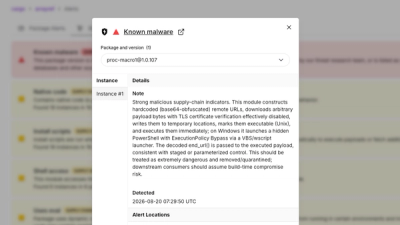
Three compromised Rust crates pulled in a malicious dependency that downloaded and executed cross-platform malware during Cargo builds.