Why blamejs
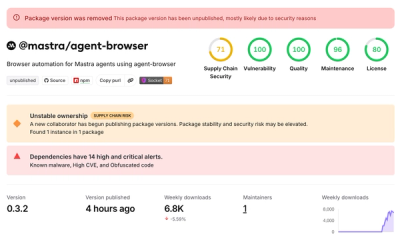
The modern Node app is a 1,200-package supply-chain liability with no LTS calendar, no curator, and no accountability. Frameworks peer-depend their internals onto you and call it modularity. blamejs takes the opposite stance:
- Vendored standard library. Auth, sessions, jobs, mail, storage, crypto, ORM, templating — bundled with the framework, not hunted on npm. Your
package.json has one entry.
- Security as a default, not a config flag. Post-quantum-aware crypto envelopes, sealed-by-default storage, server-rendered output, CSRF/origin/bot defenses, per-account brute-force lockout, all wired in from line zero.
- Server-rendering first. HTML out of the box; client JS is opt-in islands, not the foundation.
- A real LTS calendar. Major versions on a published cadence with documented deprecation windows. No silent semver-major surprises in transitive deps.
Status
Pre-1.0. Usable end-to-end — operators can build production apps on it today; the surface is still subject to change before 1.0. The latest release lives on GitHub, npm, and the container registry.
var b = require("@blamejs/core");

(async function () {
  var app = await b.createApp({
    dataDir: "./data",
    routes: function (router) {
      router.get("/", function (req, res) {
        b.render.htmlString(res, "<h1>Hello from blamejs</h1>");
      });
    },
  });
  await app.listen({ port: 3000 });
})();
Requirements: Node.js 24.16+ (current active LTS line; 24.14.1 fixed CVE-2026-21713 non-constant-time HMAC compare, 24.16 is the current patch level). Node 26 satisfies the floor and the framework test suite runs cleanly on it today; the floor itself will bump to >=26.x when Node 26 promotes to Active LTS. Two Node 26 platform changes operators integrating with blamejs should know about: the new localStorage global (the framework's storage backend is b.backup.diskStorage; the legacy b.backup.localStorage alias was removed in v0.11.20 — update call sites accordingly), and the seed-only ML-KEM / ML-DSA PKCS8 export shape (sealed material from Node 24 re-imports cleanly on Node 26; new material from Node 26 in the seed-only shape). See SECURITY.md for the details.
What ships in the box
The framework bundles the surface a typical Node app reaches for. Every primitive listed is callable today; nothing is a stub.
Data layer
- SQLite with sealed-by-default columns —
b.db, migrations, seeders, atomic-file writes; the db handle constructs with a SQLITE_LIMIT_LENGTH parse-time cap (a >1 MiB statement is rejected) as a DoS floor on the raw-SQL surface
- Chainable query builder — atomic
.increment(col, delta), closure-form .whereGroup / top-level .orWhere OR composition, .search(fields, term) LIKE-OR with safe %/_ ESCAPE handling, .paginate(opts) returning { items, total, page, totalPages }; a column-membership gate (db.init({ columnGate }), default reject) fails a query closed when it names a column the table never declared, and whereRaw refuses an embedded string literal so values bind through placeholders
- Mongo-style document-store facade —
b.db.collection(name, opts?) with $set / $inc / $unset / $eq / $ne / $gt / $gte / $lt / $lte / $in / $like; schemaless-document opts via overflow: "<col>" (folds unknown fields into a JSON-text column; rewrites WHERE on virtual fields to JSON_EXTRACT), jsonColumns: [...] (auto-stringify on write + parse via b.safeJson on read), sealedFields: { email: "emailHash" } (co-locates a b.cryptoField sealed-column / derived-hash declaration so plaintext lookups auto-rewrite to hash-column lookups)
- DB lifecycle — in-memory encrypted snapshot via
b.db.snapshot(); standalone encrypted-DB-file lifecycle (b.db.fileLifecycle({ dataDir, vault }) — decrypt-to-tmpfs, periodic re-encrypt flush, graceful shutdown — same envelope as b.db, no schema/audit-chain coupling); db.init opt-outs frameworkTables: false / auditSigning: false and path overrides encryptedDbPath / encryptedDbName / dbKeyPath
- External RDBMS — bring-your-own Postgres / MySQL with pool tuning + role-aware connect + read-replica routing (
b.externalDb); declarative role-narrowed views and Postgres row-level-security migrations (b.db.declareView, b.db.declareRowPolicy); an opt-in requireTls transport posture refuses a non-TLS backend at boot, and query / transaction / read traces carry OpenTelemetry db.* attributes. The framework's own data layer — the signed audit chain, cluster leadership and lease fencing, sessions, break-glass, and the local queue / cache / scheduler — is composed through the dialect-aware b.sql builder (every identifier quoted by construction, every value bound as a placeholder, dialect-correct SQLite / Postgres / MySQL output), so the framework's tables run on a Postgres or MySQL backend, not only local SQLite; b.guardSql validates result rows against NUL bytes, quote-jump sequences, and per-column / total-size boundaries
- Object store — S3 / R2 / B2 / GCS / Azure with multipart upload + SSE + bucket-ops (create / delete / list / lifecycle / CORS); S3 Object Lock + per-object retention + legal hold for write-once-read-many compliance workloads, with versioned delete +
listVersions for right-to-erasure / crypto-shred against an Object-Lock bucket (b.storage, b.objectStore)
- Queues + cache — durable queue with priority + cron + flows on local SQLite, shared Redis, OR AWS SQS via SigV4 + AWSJsonProtocol_1.0 (
b.queue, b.jobs) — the local backend can target an operator-supplied database / table / schema; cluster-shared cache (b.cache)
Identity & access
- Passwords — Argon2id + policy primitive (
b.auth.password); NIST 800-63B / PCI-DSS 4.0 / HIPAA-AAL2 profiles; HaveIBeenPwned k-anonymity breach check; length / context / dictionary / complexity rules; rotation + history
- Multi-factor + WebAuthn — passkeys (WebAuthn), TOTP, JWT (PQ-default)
- JWK thumbprint — RFC 7638
base64url(SHA-256(canonical-JSON)) key identifier (b.jwk.thumbprint / canonicalize): EC / RSA / oct / OKP + the AKP post-quantum key type, SHA-256/384/512; the canonical key name behind DPoP jkt, ACME account keys, and DBSC session pins
- OAuth / OIDC RP —
b.auth.oauth
- RP-Initiated / Front-Channel / Back-Channel Logout 1.0 (
parseFrontchannelLogoutRequest + verifyBackchannelLogoutToken with jti-replay defense)
- RFC 9207 AS Issuer Identifier validation on callbacks (
parseCallback — refuses iss mismatch + OP error= redirect)
- OAuth 2.0 JARM signed-response decode (
parseJarmResponse)
- RFC 9101 JWT-Secured Authorization Request verification — server-side request-object parse with mandatory alg allowlist + iss/client_id/aud binding + anti-nesting (
b.auth.jar.parse)
- One-time-use refresh-token rotation with operator-supplied replay-defense callback (RFC 9700 §4.13 / OAuth 2.1 §6.1 —
refreshAccessToken({ seen }))
- Federation / VC — CIBA Core 1.0 (
b.auth.ciba, poll/ping/push); OpenID Federation 1.0 trust chain + metadata_policy (b.auth.openidFederation); SAML 2.0 SP with XMLDSig signature-wrapping defense + RFC 9525 server-identity (b.auth.saml); OpenID4VCI 1.0 issuer (b.auth.oid4vci); OpenID4VP 1.0 verifier with DCQL (b.auth.oid4vp); SD-JWT VC with key_attestation extension (b.auth.sdJwtVc)
- Sessions —
b.session
- PQC-sealed sid cookie (ML-KEM-1024 + P-384 hybrid + XChaCha20-Poly1305 wire envelope)
/24 IPv4 + /64 IPv6 subnet binding via fingerprintFields: ["clientIpPrefix"] (carrier-roaming-safe)- Pluggable storage via
b.session.useStore + first-party b.session.stores.localDbThin (tmpfs-fast)
- Opaque-userId anonymous sessions via
create({ anonymous: true })
- Idle / absolute timeouts, fingerprint drift detection + anomaly scoring, brute-force lockout
- Session-fixation rotation (
b.session.rotate) re-keys the sid-bound device fingerprint to the new id — pass the same { req, fingerprintFields } used at create (a fingerprint-bound session rotated without req is refused, so the binding can never silently break or false-drift)
- One-call secure logout (
b.session.logout(res, token)) destroys the session AND wipes client-side state — emits an RFC 9527 Clear-Site-Data header (cookies + storage + cache) and expires the session cookie before deleting the row
- Authorization — RBAC + per-role DB binding + role-spec
requireMfa + per-route MFA freshness window + ABAC predicate registry (b.permissions); API keys with rotation (b.apiKey)
- Workflow gates — break-glass column gates with second-factor + audit (
b.breakGlass); two-person-rule m-of-n approval with cooling-off lock + cancellation (b.dualControl)
- Financial / Open Banking — FAPI 2.0 Final composite posture (PAR + PKCE-S256 + DPoP-or-mTLS + RFC 9207); runtime enforcement helpers
b.fapi2.assertCallback (refuses missing iss + bare-param under message-signing) and b.fapi2.assertAuthzRequest (refuses non-JAR); CFPB §1033 / FDX 6.0 consumer-financial-data-sharing wrapper (b.fdx)
- DPoP proof-of-possession — RFC 9449 sender-constrained tokens;
b.middleware.dpop requires a replayStore (a b.nonceStore-shaped { checkAndInsert }) at mount so single-use jti-replay defense is always enforced — mounting it without the store throws at config time rather than failing open at request time
- Data-subject coordination — cross-table export / rectify / erase / restrict / objection (
b.subject, b.subject.eraseHard); subject-level legal-hold registry consulted by erase + retention paths (FRCP Rule 26/37(e), GDPR Art 17(3)(e), SEC Rule 17a-4, HIPAA §164.530(j)(2)) (b.legalHold). The legal-hold reason / custodian / citation and the Art. 18 restriction reason — free text that ties a subject to a legal matter — are sealed at rest under the vault key, not stored in clear
- WORM retention — write-once-read-many records over any backing store (
b.worm.create): compliance / governance Object-Lock modes, extend-only retainUntil, legal holds, and a tamper-evident SHA3-512 digest verified on read — the store-agnostic application-level companion to b.objectStore's S3 Object Lock, for sealed-DB / filesystem / non-S3 backends (SEC 17a-4(f), CFTC 1.31, FINRA 4511)
- Account safety — adaptive bot-challenge staircase (
b.authBotChallenge); session-to-device-posture binding with fail-closed verify (b.sessionDeviceBinding)
- Anonymous authorization — Privacy Pass origin side (RFC 9577/9578 —
b.privacyPass): issue a WWW-Authenticate: PrivateToken challenge and verify a presented Blind-RSA (type 0x0002) token against the issuer public key, with no issuer callback and no client identity
- Oblivious PRF — RFC 9497 OPRF / VOPRF (
b.crypto.oprf.suite): learn F(serverKey, input) without the server seeing the input — the primitive behind password hardening (pepper a password the server never sees), private set intersection, and Privacy Pass; oprf (base) + voprf (verifiable, DLEQ-proof) modes over ristretto255-SHA512 / P-256 / P-384 / P-521; validated against the RFC 9497 Appendix-A vectors
Crypto
- At-rest envelope — envelope-versioned PQC (ML-KEM-1024 + P-384 hybrid, XChaCha20-Poly1305, SHAKE256); vault sealing (
b.crypto, b.vault)
- Power-on self-test —
b.crypto.selfTest() runs FIPS 140-3-style integrity checks: NIST FIPS 202 known-answer tests (SHA3-256/512, SHAKE256), AEAD round-trip + tamper-detect, and ML-KEM-1024 / ML-DSA-87 / SLH-DSA-SHAKE-256f pairwise-consistency + negative tests; fails closed (throws) on any mismatch
- Field-level + crypto-shred —
b.cryptoField.eraseRow; per-column and per-row data residency tagging enforced at the write boundary (cross-border DML refused under GDPR / UK-GDPR / DPDP / PIPL / LGPD / APPI / PDPA postures) — on the structured builder, on raw SQL writes (b.db.runSql / b.db.prepare().run(), parsed quote-aware and failing closed when unparseable), on read-replica fan-out (a regulated read with no row region identified is refused), and surfaced by b.backup.create for any per-row-residency table whose admitted regions differ from the backup destination — plus per-row keys (each row's key derives from a CSPRNG row-secret sealed under the vault root, never from an on-disk value) so destroying a row's wrapped secret leaves its WAL / replica / backup residual ciphertext undecryptable even with the vault root key (b.cryptoField.declareColumnResidency, b.cryptoField.declarePerRowResidency, b.cryptoField.listPerRowResidency, b.cryptoField.declarePerRowKey)
- AAD-bound sealed columns — AEAD tag tied to
(table, rowId, column, schemaVersion); copy-paste between rows or schema-version replay surfaces as refused decrypt (b.vault.aad). The database encryption key is sealed the same way — bound to its purpose, data directory, and key path — so a relocated key file fails to unseal; an older unbound key upgrades itself on first load. A vault-key rotation re-seals every AAD-bound cell, the database key, and tenant archives under the new keypair and refuses rather than silently orphaning a store it cannot reach (b.vaultRotate, b.vault.aad.resealRoot, b.archive.rewrapTenant)
- Keyed lookup hashes — sealed-column equality-lookup hashes default to salted SHA3-512 and can opt into a keyed
hmac-shake256 MAC off a per-deployment key (cryptoField.registerTable({ derivedHashMode }), b.vault.getDerivedHashMacKey), making the lookup hash unforgeable and un-correlatable across deployments
- Signed webhooks + API encryption — SLH-DSA-SHAKE-256f default; ML-DSA-65 opt-in; ECIES API encryption (
b.webhook, b.crypto)
- HPKE / HTTP signatures — RFC 9180 HPKE with ML-KEM-1024 + HKDF-SHA3-512 + ChaCha20-Poly1305 (
b.crypto.hpke); RFC 9421 HTTP Message Signatures with derived components and ed25519 / ML-DSA-65 (b.crypto.httpSig); RFC 9530 Content-Digest / Repr-Digest body-integrity fields (SHA-256 / SHA-512, legacy algorithms refused — b.contentDigest) to sign the digest rather than the whole body
- X-Wing hybrid KEM —
b.crypto.xwing (draft-connolly-cfrg-xwing-kem, experimental): ML-KEM-768 + X25519 bound by SHA3-256, secure if either component holds — the conservative key-encapsulation shape for migrating off classical ECDH. keygen / encapsulate / decapsulate with a 1216-byte public key, 1120-byte ciphertext, and 32-byte shared secret
- Link header — RFC 8288 Web Linking codec (
b.linkHeader.parse / serialize): parse and build Link: <uri>; rel="next" relations, the standard REST pagination mechanism; quote-aware (a comma inside a quoted parameter never splits the list)
- URI Templates — RFC 6570 expansion (
b.uriTemplate.expand / compile): full Level 4 — every operator, the :N prefix and * explode modifiers — turning {/path}{?q*} plus variables into a concrete URI; validated against the official uritemplate-test suite. The {var} syntax behind OpenAPI links and HAL _links
- JSON Type Definition — RFC 8927 validation (
b.jtd.validate / isValid): portable, cross-implementation schema validation (all eight forms — type / enum / elements / properties / values / discriminator / ref / empty), returning instancePath / schemaPath errors; validated against the official 316-case suite. Interop companion to the fluent b.safeSchema builder
- JSON Schema 2020-12 — the OpenAPI 3.1 dialect (
b.jsonSchema.compile / validate / isValid): full vocabulary including every applicator, annotation-aware unevaluatedProperties / unevaluatedItems, and $ref / $dynamicRef / $anchor / $id resolution (external refs via an operator-supplied schema map, never a network fetch); format is an annotation unless assertFormat is set; returns located { valid, errors }. Validated against the official JSON-Schema-Test-Suite. Standards-track counterpart to b.safeSchema and b.jtd
- Base32 — RFC 4648 codec (
b.base32.encode / decode): standard + extended-hex alphabets, padded or bare, strict or lenient decode (case-insensitive, ignoring spaces / dashes for copied TOTP keys); validated against the RFC 4648 §10 vectors. The codec behind b.auth.totp secrets
- JSONPath — full RFC 9535 query evaluator (
b.jsonPath.query / paths): name / wildcard / index / slice / descendant selectors, ?filter expressions, and the five standard functions, with compile-time well-typedness checks (validated against the official 703-case compliance suite); complements the JSONPath guards
- JSON Pointer / Patch — RFC 6901
b.jsonPointer.get (reference a value by /foo/0/bar) + RFC 6902 b.jsonPatch.apply (atomic add / remove / replace / move / copy / test for HTTP PATCH; the input document is never mutated, structural test comparison) + RFC 7396 b.jsonMergePatch.merge (the merge-patch+json partial-document format; both PATCH formats are prototype-pollution-safe)
- Canonical JSON — RFC 8785 JSON Canonicalization Scheme (
b.canonicalJson.stringifyJcs): the deterministic, sorted-key byte form to hash or sign (custom credentials, receipts, deterministic request signing); UTF-16 key ordering + ECMAScript number formatting, with a lenient stringify variant for Buffers / Dates / BigInts
- Structured Fields — full RFC 9651 codec (
b.structuredFields.parse / serialize): Items / Lists / Dictionaries, Inner Lists, Parameters, and every bare-item type (Integer / Decimal / String / Token / Byte Sequence / Boolean / Date / Display String) with strict grammar + range enforcement — the parser behind Content-Digest, Client Hints, and HTTP Message Signatures
- CMS codec — RFC 5652 Cryptographic Message Syntax encoder + decoder with PQC signers (ML-DSA-65 / ML-DSA-87 / SLH-DSA-SHAKE-256f; RFC 9909 + 9881) and KEMRecipientInfo recipients (ML-KEM-1024; RFC 9629 + 9936); ChaCha20-Poly1305 content encryption (RFC 8103) so Efail-class malleability cannot apply (
b.cms)
- Stream throttle — shared token-bucket bandwidth limiter (RFC 2697 srTCM shape); N concurrent
node:stream pipelines draw from one operator-configured bytesPerSec budget (b.streamThrottle)
- TLS-RPT receiver — RFC 8460 inbound aggregate-report ingest; HTTPS POST handler + §4.4 schema parser with gzip-bomb / ratio-bomb / depth-bomb defenses (
b.mail.deploy.parseTlsRptReport / b.mail.deploy.tlsRptIngestHttp)
- TLS / channel binding — RFC 9266 TLS-Exporter token-to-session pinning (
b.tlsExporter); RFC 9162 CT v2 inclusion-proof verification (b.network.tls.ct.verifyInclusion); RFC 8555 ACME + RFC 9773 ARI for 47-day certs with { jitter: true } fleet-scheduling (b.acme.renewIfDue); draft-aaron-acme-profiles (acme.listProfiles() + newOrder({ profile })); draft-ietf-acme-dns-account-label (acme.dnsAccount01ChallengeRecord(token, { identifier })); RFC 8470 0-RTT inbound posture refuse / replay-cache (b.router.create({tls0Rtt})); RFC 9794 SecP256r1MLKEM768 in preferred-group order (b.network.tls.preferredGroups); RFC 6960 OCSP stapling — the cert manager (b.cert) fetches + validates each managed certificate's OCSP response (b.network.tls.ocsp.fetch) on a refresh cadence and exposes it on the served context for a TLS server's OCSPRequest handler to staple
- mTLS CA — pure-JS, issues clientAuth / serverAuth / dual-EKU certs with SAN; auto-detects highest-PQC signature alg (today ECDSA-P384-SHA384; self-upgrades to SLH-DSA / ML-DSA when X.509 ecosystem catches up); PQC TLS gates inbound + outbound (
b.mtlsCa, b.pqcGate, b.pqcAgent)
HTTP
- Router + API specs — schema-validated routes; OpenAPI 3.1 / 3.2 publication (
b.openapi — webhooks + jsonSchemaDialect) + AsyncAPI publication for event/streaming (b.asyncapi)
- Middleware stack (
createApp) — security layers wired ON by default (Core Rule §3); each is configurable via middleware.<name> (operator cookie / field names flow straight through — nothing static is baked in) or opt-out with false (disabling a default is audited via app.middleware.disabled). Ordered so each layer has what it needs (cookies + CSP nonce + fetch-metadata, then body parser, then CSRF last):
- Request-ID tagging and bot-guard
- Security headers with
Permissions-Policy defaults denying storage-access / browsing-topics / private-aggregation / controlled-frame
- Threat-aware cookie parser (
b.middleware.cookies)
- CSP nonce — generated per request, merged into the CSP (
b.middleware.cspNonce)
- Fetch-metadata resource-isolation guard (
b.middleware.fetchMetadata)
- Body parser — JSON / urlencoded / text / multipart; multipart file parts stream to a tmp dir or buffer in memory (
storage: "memory") for read-only / serverless filesystems
- CSRF protection — double-submit cookie + Origin/Referer cross-check; auto-skips Authorization-header / cookieless requests, which are not CSRF-able (
b.middleware.csrfProtect)
- CORS (W3C Private Network Access preflight refusal default +
allowPrivateNetwork opt) and rate-limit are wired when configured via middleware.cors / middleware.rateLimit
Cache-Control: no-store on every 401 from requireAuth / requireAal / requireStepUp per RFC 9111 §5.2.2.5- Every access-refusal layer takes a uniform
problemDetails: true for an RFC 9457 application/problem+json body or onDeny(req, res, info) to render the refusal itself — so a service can standardize one error envelope across its API without working around hardcoded bodies (b.problemDetails)
- Additional middleware to mount in your
routes callback: compression, SSE, request logging, request-time DB role binding (b.middleware.dbRoleFor), in-process CIDR fence (b.middleware.networkAllowlist)
- Outbound HTTP client — HTTP/1.1 + HTTP/2 with SSRF gate (cloud-metadata IPs hard-denied; private / loopback / link-local overridable per call); scheme + userinfo + per-host destination allowlist; redirects, multipart, interceptors, progress, encrypted cookie jar (
b.httpClient, b.ssrfGuard, b.safeUrl)
- Network configurability (
b.network) — env-driven NTP / NTS (RFC 8915), IPv4/IPv6 NTP, DNS with IPv6 / DoH / DoT (private-CA pinning) / cache / lookup timeout; local DNSSEC signature verification (RFC 4035 — b.network.dns.dnssec.verifyRrset over a canonicalised RRset against RSA / ECDSA P-256·P-384 / Ed25519 DNSKEYs, plus DS-digest + key-tag, plus verifyDenial for NSEC / NSEC3 (RFC 5155) NXDOMAIN / NODATA proofs with iteration caps + Opt-Out handling, plus verifyChain to validate a full root→TLD→zone delegation chain against the pinned IANA root anchors) so a resolver client can verify both positive and negative answers instead of trusting the upstream AD bit; DANE / TLSA certificate matching (RFC 6698/7671 — b.network.dns.dane.matchCertificate) to pin a service's key through DNSSEC instead of a public CA; TSIG transaction signatures (RFC 8945 — b.network.dns.tsig.sign / verify) for shared-key HMAC authentication of zone transfers, dynamic updates, and query/response pairs, with constant-time MAC compare + fudge-window check (verified against dnspython); outbound HTTP proxy (HTTP_PROXY / HTTPS_PROXY / NO_PROXY); runtime DPI trust-store CA additions; application-level heartbeats; TCP socket defaults
- Error pages — operator-rendered, no app-frame leakage (
b.errorPage)
Defensive parsers
- JSON / SQL / schema —
b.safeJson (with maxKeys cap defending CVE-2026-21717 V8 HashDoS), b.safeBuffer, b.safeSql, b.safeSchema
- URL + path —
b.safeUrl (IDN mixed-script / homograph refuse; canonicalize collapses obfuscated host + IP forms — decimal / octal / hex / IPv4-mapped / zero-compressed IPv6, IDN → punycode, default-port, trailing-dot, percent-encoding — to one comparable string so SSRF allowlist / dedup checks can't be bypassed by re-encoding the same address, with b.ssrfGuard.canonicalizeHost for the host-only path); b.safeJsonPath (refuses filter ?(...), deep-scan $.., script-shape (@.x) for safe Postgres JSONB ops)
- Binary codec —
b.cbor bounded deterministic CBOR (RFC 8949 §4.2): depth/size caps, indefinite-length + reserved-info + tag + duplicate-key refusal, requireDeterministic canonical-form check; the in-tree substrate under COSE / CWT / SCITT / WebAuthn attestation
- COSE messages —
b.cose the full RFC 9052 message-type set over b.cbor: COSE_Sign1 sign/verify (attached or detached payload), COSE_Encrypt0 single-recipient AEAD, COSE_Mac0 shared-key HMAC (mac0/macVerify0), plus importKey (COSE_Key → KeyObject) and exportKey (KeyObject → COSE_Key, the inverse — ship a verification key as RFC 9052 §7 bytes). Signatures use classical ES256/384/512 + EdDSA (final COSE ids, interoperable today) plus ML-DSA-87 (PQC-forward, draft id); bounded + alg-allowlisted + crit-bypass-checked verification; AEAD ChaCha20/Poly1305 default (AES-GCM opt-in); the signed-statement substrate under SCITT / CWT / mdoc / C2PA
- CBOR Web Token —
b.cwt CWT sign/verify (RFC 8392) over b.cose: standard-claim mapping (iss/sub/aud/exp/nbf/iat/cti) + exp/nbf clock-skew enforcement + iss/aud matching; the CBOR-native JWT for constrained / IoT / FIDO / verifiable-credential contexts
- Entity Attestation Token —
b.eat EAT sign/verify (RFC 9711) over b.cwt: device + software attestation claims (ueid / oemid / hwmodel / measurements / submods) with verifier-nonce freshness binding, dbgstat debug-status policy, and eat_profile pinning
- SCITT signed statements —
b.scitt sign/verify a signed, attributable claim about an artifact (signed SBOM, build attestation, release approval) over b.cose: the issuer + subject bind in the integrity-protected CWT_Claims header (RFC 9597); verification refuses any statement missing the iss/sub binding. The issuer side, on finalized RFCs; the transparency receipt (COSE Receipts draft) opts in on publication
- Trusted timestamping —
b.tsa RFC 3161 timestamp client: buildRequest a TimeStampReq, parseResponse, and verifyToken against your data — the message imprint, sent nonce, critical/sole id-kp-timeStamping EKU, and CMS signature are all checked, with optional certificate-chain verification. Timestamp a release artifact, audit checkpoint, or signed statement against any RFC 3161 TSA. Composes b.cms + the in-tree ASN.1 DER codec
- Verifiable Credentials —
b.vc W3C Verifiable Credentials Data Model 2.0 (VC-JOSE-COSE): issue / verify a signed credential, and present / verifyPresentation a holder-signed Verifiable Presentation wrapping credentials (with nonce/audience holder-binding) — as a compact JWS (vc+jwt / vp+jwt, ES256/384/512 + EdDSA) or a COSE_Sign1 (vc+cose / vp+cose, + ML-DSA-87) over b.cose. VCDM structural + validFrom/validUntil checks; the JOSE none algorithm is always refused. The W3C model, distinct from the IETF SD-JWT VC at b.auth.sdJwtVc
- Mobile credentials (mDL) —
b.mdoc ISO/IEC 18013-5 verification: verifyIssuerSigned checks the COSE_Sign1 IssuerAuth (issuer cert from the x5chain header), the MSO validity window, and every disclosed element's digest against the MSO valueDigests (selective-disclosure integrity), with optional issuer-chain verification; verifyDeviceAuth proves holder binding (§9.1.3 signature variant) — the device COSE_Sign1 over the DeviceAuthentication structure with the MSO device key + protocol sessionTranscript. The ISO credential ecosystem alongside b.vc and b.auth.sdJwtVc. Composes b.cose + b.cbor
- Decentralized Identifiers —
b.did W3C DID resolution (DID Core 1.0): resolve a did:key / did:jwk (deterministic, offline — Ed25519 / P-256 / P-384 / secp256k1) or did:web (operator-fetched document) to node:crypto verification keys, so a credential's issuer DID resolves to the key that verifies it (b.vc / b.mdoc / b.scitt). keyToDid names a key as a did:key or did:jwk; document/JWK keys are kty/crv-allowlisted before import
- Document parsers —
b.parsers (XML / TOML / YAML / .env); b.config (schema-validated env)
- File-type detection —
b.fileType magic-byte content classification with deny-on-upload categories (image / document / archive / executable / etc.)
Content-safety gates
- Composition contract —
b.gateContract uniform mode posture / hooks / forensic snapshot / decision cache / runtime cap
- Document guards —
b.guardCsv (formula injection, dangerous-function denylist, bidi / homoglyph / dialect ambiguity, CSV-bombs); b.guardHtml (XSS / mXSS / DOM-clobbering, dangerous-tag + event-handler family, URL-scheme with entity-decode bypass, CSS-injection in style); b.guardSvg (script / foreignObject / animation href hijack / DOCTYPE / XXE / SVGZ / cross-origin <use> SSRF); b.guardMarkdown (URL schemes pre-render, CVE-2026-30838 dangerous-tag, ReDoS emphasis runs)
- Structured data —
b.guardJson (prototype-pollution, dup keys, JSON5, depth/breadth caps); b.guardYaml (deserialization-tag RCE, billion-laughs aliases, Norway-problem); b.guardXml (XXE / billion-laughs / xi:include / signature wrapping; DOCTYPE refused at all profile levels)
- Archive + filename —
b.guardArchive (zip-slip, symlink + hardlink escape, decompression bombs, duplicate-entry); b.guardFilename (path traversal raw + percent-encoded + overlong-UTF-8, null-byte, Windows reserved, NTFS ADS, RTLO bidi)
- Email —
b.guardEmail (SMTP smuggling per CVE-2023-51764 / 51765 / 51766 class, CRLF header injection, IDN homograph, IP-literals, RFC 5321 length caps)
- Profiles + postures — every member ships strict / balanced / permissive plus hipaa / pci-dss / gdpr / soc2
- Aggregator —
b.guardAll registry; every shipped guard ON by default; opt-out per guard with audited reason via exceptFor: { name: { reason } }. b.fileUpload and b.staticServe wire b.guardAll.byExtension({ profile: "strict" }) + b.guardFilename.gate({ profile: "strict" }) automatically — operator opts out via contentSafety: null / filenameSafety: null (audited)
Communication
- WebSockets (server) — channel/room fan-out across cluster replicas; RFC 6455 §5.5 control-frame size + FIN enforcement on inbound (defends 1 MiB-PING-as-PONG amplification) (
b.websocket, b.websocketChannels)
- WebSockets (client) —
b.wsClient with PQC-TLS handshake, permessage-deflate negotiation with decompression-bomb cap, fatal UTF-8 validation, permanent-error classifier (skips reconnect on 4xx / accept mismatch / bad-subprotocol), exponential-backoff with full jitter
- Pub/sub + events — distributed pub/sub with cluster-table / Redis PUB/SUB / custom backends (
b.pubsub); framework-emitted signal bus for breach / integrity events (b.events)
- CloudEvents + SSE — CloudEvents 1.0.2 for AWS EventBridge / Knative / Azure Event Grid / Google Eventarc / CNCF:
wrap / parse envelopes, non-throwing validate / isValid, the JSON event + batch formats (toJSON / fromJSON / toJSONBatch / fromJSONBatch), and the HTTP binding in both binary and structured content modes with auto-detecting http.decode (b.cloudEvents); Server-Sent Events with newline-injection refusal in event: / id: / data: / Last-Event-ID (CVE-2026-33128 / 29085 / 44217 class) (b.sse, b.middleware.sse)
- Mail (outbound) — multipart + attachments + DKIM + calendar invites; bounce intake (
b.mail, b.mailBounce)
- Mail (outbound delivery) — turnkey MX-lookup → MTA-STS-fetch → DANE-TLSA → REQUIRETLS handshake → SMTP wire layer → RFC 3464 DSN-on-permanent-failure → deferred-retry scheduling, all wired once (
b.mail.send.deliver)
- Mail (inbound auth) — SPF / DMARC / ARC verify + ARC chain signing for relays, plus DMARC aggregate (RUA) + forensic (RUF) report parsing (
b.mail.spf, b.mail.dmarc, b.mail.arc)
- Mail server listeners — RFC 5321 MX inbound with connection-level gate cascade (HELO identity / DNS blocklist / greylisting) and a DATA-phase SPF/DKIM/DMARC gate that refuses policy-failing mail before storage (
b.mail.server.mx), RFC 6409 submission with SASL + identity-binding (b.mail.server.submission), RFC 9051 IMAP4rev2 with CONDSTORE / QRESYNC / NOTIFY / METADATA / CATENATE (b.mail.server.imap), RFC 8620 + RFC 8621 JMAP Core + Mail over HTTP/SSE/WebSocket (b.mail.server.jmap), POP3 (b.mail.server.pop3), ManageSieve (b.mail.server.managesieve)
- JMAP EmailSubmission reference — composes
b.mail.send.deliver to land the RFC 8621 §7.5 surface end-to-end (b.mail.server.jmap.emailSubmissionSetHandler)
- Mail crypto — PQC-first S/MIME via CMS (
b.mail.crypto.cms) + OpenPGP encrypt/decrypt + WKD key discovery with IDN-homograph defense (b.mail.crypto.pgp)
- Mail-stack agent — multi-threaded worker pool + queue dispatch + sealed mail-store backed by SQLite FTS5 (
b.mail.agent, b.mailStore)
- JSCalendar — RFC 8984 Event/Task/Note/Group with iCalendar (RFC 5545) round-trip + RRULE expansion (every BY* filter + BYSETPOS + multi-rule UNION) for JMAP Calendars interop (
b.calendar)
- Notifications — generic dispatcher with operator-supplied transports (
b.notify); TCPA / FCC 1:1 prior-express-written-consent + 10DLC carrier-shaped consent snapshot for SMS marketing (b.tcpa10dlc)
- File uploads — chunked with per-chunk SHA3-512 verification + atomic finalize + tombstone cleanup (
b.fileUpload)
AI / agentic
- MCP (Model Context Protocol) —
b.mcp.serverGuard with bearer auth + redirect_uri allowlist + dynamic-register refusal + tool/resource allowlists (CVE-2026-33032 / CVE-2025-6514 / confused-deputy class)
- MCP safety primitives
b.mcp.toolResult.sanitize — prompt-injection / dangerous-HTML / off-allowlist-URL detection (OWASP LLM07)b.mcp.capability.create — least-privilege capability scopes (OWASP LLM08)b.mcp.validateToolInput — JSON Schema 2020-12 input enforcement
- GraphQL Federation —
_service.sdl trust-boundary with router-token + nonce store (b.graphqlFederation)
- Prompt-injection classification — OWASP LLM01:2025 / NIST COSAIS RFI (
b.ai.input.classify), with per-source trust-tier classification for retrieval-augmented context (b.ai.input.classifyWithSources) and escape-by-default prompt assembly that fences untrusted segments in a per-render crypto-nonce delimiter the content can't forge (b.ai.prompt.template)
- LLM output handling — treats model output as untrusted before it reaches a browser / downstream fetcher / SQL / log: XSS neutralization with SSRF-gated markdown-image and link URLs (the EchoLeak zero-click exfiltration class, CVE-2025-32711) and SQL / command-shape flagging (
b.ai.output.sanitize), plus PII / secret redaction (b.ai.output.redact); OWASP LLM05:2025 + LLM02:2025
- Agent identity — A2A signed agent-card primitive (Linux Foundation Agentic AI Foundation v1.x, ML-DSA-87) (
b.a2a)
- Content provenance — C2PA 2.1 + California SB-942 / AB-853 manifest builder for AI-generated media (provider, model id + version, timestamp, content ID, signed) (
b.contentCredentials); COSE signatures carry an RFC 3161 timestamp countersignature (C2PA sigTst2, RFC 9921) verified through b.tsa so a manifest stays verifiable after its signing certificate expires, plus a CAWG identity assertion with trust-anchored verification
- AI usage quotas — per-tenant / per-model budgets metered by tokens / requests / cost-usd / compute-hours over calendar-aligned windows, with an atomic conditional reserve (no charge-then-refund race) + hard/soft/warn enforcement and an optional cross-node store; defends OWASP LLM10:2025 unbounded consumption / denial-of-wallet (
b.ai.quota)
- AI capability routing — model-capability registry (context window / modalities / tool use / reasoning tier / cost rates) + a router that picks the cheapest model satisfying a request's requirements, refusing capability mismatches before the inference call (NIST AI RMF MAP + Model Cards); composes with
b.ai.quota cost budgets (b.ai.capability)
- AEDT bias audit — NYC Local Law 144 bias-audit figures (
b.ai.aedtBiasAudit): selection / scoring rates and EEOC four-fifths-rule impact ratios across sex, race/ethnicity, and their intersection, with the most-selected group and adverse-impact flags (impact ratio < 0.8) for the annual published summary; sub-2% categories excludable per DCWP §5-301
- Frontier AI protocol — California SB 53 (Transparency in Frontier AI Act) obligations (
b.ai.frontierModelProtocol): classify the frontier-model (>10²⁶ training FLOPs) and large-frontier-developer (>$500M revenue) thresholds, enumerate the resulting obligations, check a safety framework for required elements, and build a critical-safety-incident report with the 15-day / 24-hour California OES notification deadline (.incidentReport)
- GPAI Code-of-Practice adherence — signed, tamper-evident EU AI Act Art. 53 / 55 adherence declarations with a regulation-derived obligation set (a systemic-risk model omitting the Art. 55 chapter is refused) and SHA3-512 evidence binding, emitted inside an ML-DSA-87-signed CycloneDX 1.6 ML-BOM and replay-checked on verify (
b.compliance.aiAct.gpai.declareAdherence / verifyAdherence)
- EU Digital Services Act records — dated, frozen builders for the content-governance loop the DSA (Reg 2022/2065) requires: Art. 16 notice-and-action with the action-due window, Art. 17 statement of reasons (exactly one legal-or-contractual ground, redress routes, automated-decision flag), and the Art. 15 / 24(3) transparency report (
b.dsa.noticeAndAction / statementOfReasons / transparencyReport)
- China PIPL cross-border transfer records — Art. 38/40/55 assessment that forces a CAC security assessment over a self-selected standard contract when a critical-information-infrastructure operator, important data, or the volume / sensitive-PI thresholds are in scope, plus an Art. 40 security-assessment certificate with a 3-year validity clock (
b.pipl.sccFilingAssessment / securityAssessmentCertificate)
Compliance regimes
- Posture coordinator —
b.compliance cascades operator-declared regime into retention / audit / db / cryptoField via POSTURE_DEFAULTS:
- US —
hipaa / hipaa-2026 / hhs-repro-24 / hitech / pci-dss / glba-safeguards / sox-404 / soc2 / soc2-cc1.3 / sec-cyber / sec-17a-4 / finra-4511 / fda-21cfr11 / fda-annex-11 / modpa / nydfs-500 / staterramp / ferpa / fl-fdbr / coppa / coppa-2025 / gina / vppa / can-spam / il-gipa / nist-pf-1.1
- EU / UK —
gdpr / dora / nis2 / cra / eu-data-act / eaa / uk-g-cloud / uk-duaa / dsa / dga / eu-cer / eu-cyber-sol / eidas-2
- APAC + LATAM —
dpdp / pipl-cn / lgpd-br / appi-jp / pdpa-sg / quebec-25 / irap / kr-ai-basic / pipa-kr / au-privacy / th-pdpa / vn-pdp / id-pdp / my-pdpa / cl-pdpa / mx-lfpdppp / ar-pdpa
- Child privacy / age-appropriate design —
ca-aadc / ny-safe-kids / ny-saffe / md-kids-code / vt-aadc
- Financial / data-portability —
fapi2 / fapi-2.0-message-signing / fdx / dsr
- AI governance —
co-ai / il-hb3773 / tx-traiga / ut-aipa / nyc-ll144 / nyc-ll144-2024 / sb-53 / ca-tfaia / ca-sb942 / ca-ab853 / cn-ai-label / iso-42001 / iso-23894 / nist-ai-rmf-1.0 / nist-ai-600-1-genai
- Federal / sectoral —
42-cfr-part-2 / hti-1 / uscdi-v4 / irs-1075 / nist-csf-2.0 / nist-800-53-r5-privacy / nist-800-172-r3 / m-22-09 / m-22-18 / ffiec-cat-2 / cri-profile-v2.0
- Critical infrastructure / info-sharing —
soci-au / tlp-2.0
- Accessibility —
wcag-2-2
- Other —
bsi-c5 / ens-es / etc.
- AI Act ⇄ ISO cross-walk —
b.compliance.aiAct.crossWalkIso42001() + crossWalkIso23894() map every AI Act article (Art. 9 risk management → Art. 73 incident reporting) to the matching ISO/IEC 42001:2023 Annex A controls and ISO/IEC 23894:2023 risk-management clauses for ISO-certification audit packs
- EU Data Act — Regulation 2023/2854 connected-product data access workflow with DMA-gatekeeper share refusal (Art 32 §1) and 30-day switch-request notice cap (Art 28 §3) (
b.dataAct)
- Audit + segregation — 21 CFR Part 11 §11.10(e) audit-content gate + §11.50(b) electronicSignature (
b.fda21cfr11); PCI DSS 4.0 Req 10.4.1.1 daily-review automation (b.auditDailyReview); SOX §404 + SOC 2 CC1.3 segregation-of-duties via Postgres trigger DDL (b.audit.bindActor, b.audit.assertSegregation)
- Change control + WORM — m-of-n approver DDL change-control with maintenance-window + ML-DSA-87 signed proposals (
b.ddlChangeControl); row-level WORM triggers boot-asserted under sec-17a-4 / finra-4511 / fda-21cfr11 (b.db.declareWorm); dual-control physical delete + crypto-erase + REINDEX in one transaction (b.db.declareRequireDualControl, b.db.eraseHard)
- Consumer-protection — FTC click-to-cancel UX-parity attestation (
ftc-2024 / ca-sb942 / strict) (b.darkPatterns)
- Differential privacy — float-safe DP for aggregate releases: snapping-mechanism Laplace (Mironov 2012) + discrete Gaussian (Canonne–Kamath–Steinke 2020), CSPRNG noise, per-scope ε/δ budgets with basic + Rényi-DP accounting; defends the floating-point distinguishing attack that breaks naive Laplace samplers (NIST SP 800-226) (
b.ai.dp)
- Privacy / DSR — GDPR Articles 15–22 / CCPA / CPRA / LGPD / PIPEDA data-subject-rights workflow (
b.dsr); IAB TCF v2 consent-string parse + encode + disclosedVendors validator (b.iabTcf); IAB MSPA / GPP universal-opt-out (USNAT / USCA / USVA / USCO / USCT / USUT) + GPC mirror (b.iabMspa); generic consent capture + withdrawal (b.consent); educational-only consent purpose with FERPA / SOPIPA lawful-basis gating + annual EdTech third-party vendor-review attestation (b.consent.recognizedPurpose, b.privacy.vendorReview)
- Incident reporters — EU DORA Article 17 ICT-incident workflow per Commission Delegated Regulation 2024/1772 (
b.dora); EU NIS2 (b.nis2); EU Cyber Resilience Act SBOM + secure-software-attestation (b.cra); SEC Form 8-K Item 1.05 cybersecurity-incident materiality-disclosure (b.secCyber); incident lifecycle coordinator (b.incident)
- Outbound DLP — interceptor-installed on httpClient + mail + webhook with built-in detectors for PAN (Luhn), SSN, EIN, IBAN (mod-97), api-key shapes, PEM, SSH private keys, JWTs, AWS access keys, PHI composite; refuse / redact / audit-only verdicts under pci-dss / hipaa / fapi2 / soc2 / gdpr presets (
b.redact.installOutboundDlp)
Observability
- Audit chain — tamper-evident, SLH-DSA-signed checkpoints; CADF (ISO/IEC 19395:2017) envelope export for federated SIEM (
b.audit, b.audit.export({ format: "cadf" }))
- Metrics + tracing —
b.metrics, b.tracing (OTel pass-through); OTLP/HTTP-JSON exporter for traces + metrics (b.otelExport). Span / metric / resource attribute values are scrubbed through the telemetry redactor before egress (b.observability.redactAttrs, default composes b.redact.redact) so a secret or PII in an attribute value never reaches the collector verbatim (CWE-532); operators building a custom exporter apply the same gate
- Log-stream sinks — local file rotation, generic webhook, OTLP/HTTP-JSON OR OTLP/gRPC, AWS CloudWatch Logs via SigV4 with optional autoCreate, RFC 5424 syslog over UDP/TCP/TLS (
b.logStream)
- PII redaction —
b.redact
- Decoy detection — canary-credential / decoy-record framework auditing every positive lookup as
honeytoken.tripped (b.honeytoken)
- Boot assertions — operator-callable security policy assertions (
b.security.assertProduction); tamper-evident config-baseline drift detection signed with audit-signing key + at-boot vendor-bundle SHA-256 integrity verification across lib/vendor/* (b.configDrift, b.configDrift.verifyVendorIntegrity)
- CSP reports + forensic export —
b.middleware.cspReport; post-incident audit-bundle composer (b.auditTools.forensicSnapshot); audit export / archive / forensic snapshot write to disk or return the encrypted bundle in memory (returnBytes) for read-only / serverless filesystems
i18n + format helpers
- i18n — CLDR plural rules, Accept-Language negotiation, Intl formatters, RTL (
b.i18n)
- CSV — RFC 4180 with Excel formula-injection prevention (
b.csv)
- IDs + slugs — RFC 9562 UUID v4 + v7 (
b.uuid); URL-safe slugs (b.slug)
- Time + archive — TZ-aware datetime (
b.time); ZIP creation + adversarial-safe read with bomb caps + path-traversal + LFH/CD-skew defense (b.archive + b.archive.read.zip); one-liner quarantine extraction (b.safeArchive.extract); one-liner in-memory extraction with no disk write for read-only / serverless filesystems (b.safeArchive.extractToMemory, or the low-level b.archive.read.zip(...).extractEntries() / .tar); fs / objectStore / http / buffer / trusted-stream adapter contract (b.archive.adapters); recipient-sealed envelopes — hybrid-PQC key-pair, peer certificate, or per-tenant key with no key-pair to manage (b.archive.wrap({ recipient: "tenant", tenantId }))
- Pagination + forms — HMAC-signed cursor pagination (
b.pagination); HTML form rendering + validation + CSRF (b.forms)
Production
- Cluster + scheduling — cluster leader election with fenced leases over Postgres/SQLite (
b.cluster); cron + interval scheduler that runs exactly-once globally (b.scheduler)
- CRDTs — state-based conflict-free replicated data types (
b.crdt): grow-only / PN counters, grow-only / two-phase / observed-remove sets, a last-write-wins register, and an observed-remove map; each merge is commutative / associative / idempotent so replicas converge with no coordination — the substrate for active/active and offline-first state, with state() / fromState() for snapshot via b.archive / b.backup
- Reliability — retry with full-jitter backoff + circuit breaker (
b.retry); graceful shutdown (b.appShutdown); NTP boot check (b.ntpCheck)
- Transactional integration — outbox + dedupe-on-receive inbox; exactly-once semantics across Postgres / SQLite (
b.outbox, b.inbox); Debezium-shape change-event envelope on the outbox (b.outbox.create({ envelope: "debezium" }))
- Backup + restore — end-to-end-encrypted bundles with pre-flush fail-closed mode + ML-DSA-87 signed manifests + scheduled backup-restore drills (
b.backup, b.backup.scheduleTest, b.backupBundle.verifyManifestSignature); restore with pulled-bundle footprint preflight (b.restore); disaster-recovery runbook generator (HIPAA / PCI-DSS / GDPR / SOC 2 / DORA postures) (b.drRunbook)
- Multi-tenant — per-tenant DB storage caps, query budgets, tenant-isolation breach detection (
b.tenantQuota); per-Postgres-role hardening with pg_roles enumeration guard (b.externalDb.assertRoleHardening)
- Data export — RFC 4180 strict CSV table export with SHA3-512 manifest + ML-DSA-87 signature + JSON Schema 2020-12 reflective metadata (
b.db.exportCsv, b.db.getTableMetadata)
- Retention — GDPR / PCI / HIPAA-shaped rules with multi-stage warn → archive → erase, legal-hold exemptions, dry-run preview, cross-table cascade (
b.retention)
- Feature flags — OpenFeature-spec client with pluggable providers + evaluation-context targeting + per-request
req.flag accessor (b.flag)
- Concurrency + kill-switches — per-resource lock with cooperative-cancel + audit (
b.resourceAccessLock); composite account-takeover kill-switch (b.atoKillSwitch)
- Sandbox + spawn —
worker_threads sandbox with strict resource limits (b.sandbox, composable into b.template.create({ sandbox: true })); hardened processSpawn refusing shell-string invocation (b.processSpawn)
- Egress allowlist — per-host outbound destination allowlist (wildcard / per-method) via
b.httpClient.request({ allowedHosts: [...] })
Documentation
Full primitive-by-primitive docs live at blamejs.com, which is itself the examples/wiki/ app running in production. The wiki is organized by concern:
CLI
blamejs ships an operator-facing CLI for the recurring ops work. Each subcommand boots a headless app instance from --data-dir (no HTTP listener), runs the operation, and shuts down. Same vault + DB + audit chain the running app uses.
blamejs migrate       up | down | status                          --db <path> [--dir <path>]
blamejs seed          run | status                                --db <path> --env <name> [--dir <path>]
blamejs dev           --command <cmd> [--watch <dir>...]
blamejs api-snapshot  capture | compare                           --file <path>
blamejs api-key       issue | revoke | list | rotate | verify     --data-dir <path> --namespace <ns>
blamejs audit         archive | export | verify-bundle | verify-chain | purge   --data-dir <path>
blamejs backup        inspect | verify | extract                  --bundle <path>
blamejs restore       list | inspect | apply | rollback | list-rollbacks         --data-dir <path> --bundle <dir>
blamejs mtls          status | show-cert | init | issue | issue-p12  --data-dir <path>
blamejs vault         status | seal | unseal | rotate             --data-dir <path>
blamejs security      assert                                      --data-dir <path>
blamejs config-drift  inspect | verify                            --data-dir <path>
blamejs file-type     detect <file>                               [--allowlist image,pdf,...]
blamejs password      check                                       --plaintext "..." [--profile pci-4.0|nist-aal2|hipaa-aal2] [--breach-check] [--email <e>] [--username <u>]
blamejs erase         --table <t> --row-id <id> --confirm         --data-dir <path>
blamejs retention     preview | run                               --data-dir <path> --table <t> --age-field <col> --ttl-ms <n> [--action soft-delete|delete|erase] [--soft-delete-field <col>]
blamejs version
blamejs help [<command>]
Pass --help to any subcommand for the full flag list (blamejs api-key --help etc.). Passphrases for crypto-backed operations resolve from the appropriate env var (BLAMEJS_VAULT_PASSPHRASE, BLAMEJS_BACKUP_PASSPHRASE, BLAMEJS_AUDIT_PASSPHRASE) so they don't end up in shell history.
Reference app + deployment
examples/wiki/ is a complete production-ready operator-built blamejs app — the wiki you're looking at when you visit blamejs.com. It demonstrates every framework primitive in real usage and ships with Dockerfile, docker-compose.yml (dev), docker-compose.prod.yml (Caddy + GHCR image), and a published OCI image at ghcr.io/blamejs/blamejs-wiki:<tag> (multi-arch amd64/arm64, cosign-signed via GitHub OIDC, Trivy-scanned, SHA3-512 digest).
See examples/wiki/DEPLOY.md for the full deployment walkthrough, including the operator-facing environment-variable matrix (WIKI_* and BLAMEJS_* keys) and the pin-to-version workflow for production updates.
Vendored dependencies
All runtime dependencies are committed to the repo — no transitive npm install at runtime, no node_modules lookup path for production. Server-side deps are bundled via scripts/vendor-update.sh:
./scripts/vendor-update.sh --check
./scripts/vendor-update.sh --diff @noble/ciphers
./scripts/vendor-update.sh @noble/ciphers 2.2.0
These libraries are exceptional work — blamejs wouldn't exist without them. All are MIT licensed (the SecLists password list is CC-BY-3.0). Per-package version, license, and provenance live in two manifests: lib/vendor/MANIFEST.json for the framework's server-side bundles and examples/wiki/public/vendor/MANIFEST.json for the wiki app's browser-side bundle. The framework's NOTICE file carries the upstream attributions.
Why "blamejs"
Because when something breaks, blame should know exactly where it lives. We own the stack so you don't have to chase the fault across an ecosystem.
Quality contract
Every release passes a layered gate at test/layer-0-primitives/codebase-patterns.test.js that operates on lib/ source:
- Bug-class detectors — raw byte / time literals,
JSON.parse on operator input without size cap, numeric opts that silently accept Infinity / NaN, ReDoS-risky regex without length cap, hash / token compares without timingSafeEqual, raw new URL skipping the SSRF gate, Math.random() in security-sensitive paths, and a couple dozen others — each a bug class the framework already swept once and won't re-introduce.
- Inline-shape catalog (n=1) — every primitive that's been extracted (
validateOpts.requireNonEmptyString, safeAsync.makeScheduledFlush, dbSchema.runInTransaction, etc.) registers the inline shape it replaced; new code that re-implements the shape fails the gate even if it's the only file matching.
- Cluster allowlist (n>=3) — duplicate-block detection across files. Genuine new clusters get extracted; clusters that resist extraction (parser error class signature mismatches, framework-convention shapes, cross-domain coincidences) get an entry with a documented structural reason. No silent allowlisting.
The gate is part of node test/smoke.js; the framework refuses to release without it green.
Contributing
Patches welcome. See CONTRIBUTING.md for the dev setup, house rules (zero npm runtime deps, PQC-only crypto, audit-on-every-action, ship-complete-not-incremental), and the PR loop. New to the codebase? Start with ARCHITECTURE.md for the orientation map.
Community standards: CODE_OF_CONDUCT.md (Contributor Covenant 2.1). Be excellent.
Security
Threat model, supported versions, vulnerability disclosure: SECURITY.md. Do not file public issues for security bugs — email security@blamejs.com.
License
Apache-2.0. See LICENSE for the full text and NOTICE for attribution of vendored components.