

Product
PHP and Composer Support Is Now in Beta
Socket’s PHP and Composer support is now in Beta for all customers, with PHP reachability analysis generally available.
By Trevor Norris, Benjamin Barslev - Aug 21, 2026
@browser-echo/vite
Advanced tools
Vite plugin for streaming browser console logs to your dev terminal with colors, stack traces, and optional file logging.
Vite plugin for streaming browser console logs to your dev terminal with colors, stack traces, and optional file logging.
This package provides a Vite plugin that includes dev middleware and a virtual module to forward browser console logs to your terminal during development. Works with React, Vue, TanStack Start, and any Vite-based project.
index.html or server-side rendered appsnpm install -D @browser-echo/vite
# or
pnpm add -D @browser-echo/vite
npm install -D @browser-echo/vite
# or
pnpm add -D @browser-echo/vite
// vite.config.ts
import { defineConfig } from 'vite';
import vue from '@vitejs/plugin-vue';
import browserEcho from '@browser-echo/vite';
export default defineConfig({
plugins: [
vue(),
browserEcho({
// Optional configuration
stackMode: 'condensed',
colors: true,
}),
],
});
That's it! Your Vue app will now stream console logs to your terminal during development.
npm install -D @browser-echo/vite
# or
pnpm add -D @browser-echo/vite
// vite.config.ts
import { defineConfig } from 'vite';
import react from '@vitejs/plugin-react';
import browserEcho from '@browser-echo/vite';

export default defineConfig({
  plugins: [
    react(),
    browserEcho({
      // Optional configuration
      stackMode: 'condensed',
      colors: true,
    }),
  ],
});
Your React app will now stream console logs to your terminal during development.
// vite.config.ts
import { defineConfig } from 'vite';
import react from '@vitejs/plugin-react';
import browserEcho from '@browser-echo/vite';

export default defineConfig({
  plugins: [
    react(),
    browserEcho({
      injectHtml: false, // Important: TanStack Start doesn't use index.html
      stackMode: 'condensed',
      fileLog: { enabled: true },
    }),
  ],
});
Important for TanStack Start: Since TanStack Start renders without an index.html, you need to set injectHtml: false and import the virtual module manually in your router:
// src/router.tsx
if (import.meta.env.DEV && typeof window !== 'undefined') {
  void import('virtual:browser-echo');
}
interface BrowserEchoViteOptions {
  enabled?: boolean;                 // default: true (dev only)
  route?: `/${string}`;              // default: '/__client-logs'
  include?: BrowserLogLevel[];       // default: ['log','info','warn','error','debug']
  preserveConsole?: boolean;         // default: true
  tag?: string;                      // default: '[browser]'
  colors?: boolean;                  // default: true
  injectHtml?: boolean;              // default: true
  stackMode?: 'none' | 'condensed' | 'full'; // default: 'condensed'
  showSource?: boolean;              // default: true
  batch?: { size?: number; interval?: number }; // default: 20 / 300ms
  truncate?: number;                 // default: 10_000 chars
  fileLog?: { enabled?: boolean; dir?: string; split?: boolean }; // default: disabled
  mcp?: {
    url?: string;                    // MCP server base URL (auto-discovered if not set)
    routeLogs?: `/${string}`;        // MCP logs route (default: '/__client-logs')
    suppressTerminal?: boolean;      // Suppress terminal output when forwarding (default: auto)
    headers?: Record<string,string>; // Custom headers for MCP requests
  };
  discoverMcp?: boolean;             // Enable MCP auto-discovery (default: true)
  discoveryRefreshMs?: number;       // Discovery refresh interval (default: 30000)
  networkLogs?: {
    enabled?: boolean;
    captureFull?: boolean;
    bodies?: {
      request?: boolean;
      response?: boolean;
      maxBytes?: number;                       // default 2048 bytes
      allowContentTypes?: string[];            // default ['application/json','text/','application/x-www-form-urlencoded']
      prettyJson?: boolean;                    // default true
    };
  }; // default disabled
}
The Vite plugin automatically discovers and forwards logs to MCP servers. No configuration needed in most cases!
📖 First, set up the MCP server for your AI assistant, then configure framework options below.
browserEcho({
  // MCP auto-discovery enabled by default
  // Logs forward to MCP when detected, terminal output suppressed
})
browserEcho({
  mcp: {
    url: 'http://127.0.0.1:5179',           // Explicit MCP base URL
    suppressTerminal: false,                 // Keep terminal output even when forwarding
    headers: { 'Authorization': 'Bearer ...' } // Custom headers if needed
  }
})
browserEcho({
  networkLogs: {
    enabled: true,
    bodies: {
      request: true,
      response: true,
      maxBytes: 2048,
      allowContentTypes: ['application/json','text/','application/x-www-form-urlencoded'],
      prettyJson: true
    }
  }
})
Output example:
[NETWORK] [POST] [/api/users] [200] [18ms]
    req: {"name":"Ada"}
    res: { "id": 1, "name": "Ada" }
browserEcho({
  discoverMcp: false,  // Disable auto-discovery
  mcp: { url: '' }     // Disable explicit MCP
})
BROWSER_ECHO_MCP_URL=http://127.0.0.1:5179/mcp — Set MCP server URLBROWSER_ECHO_SUPPRESS_TERMINAL=1 — Force suppress terminal outputBROWSER_ECHO_SUPPRESS_TERMINAL=0 — Force show terminal outputBROWSER_ECHO_FILE_LOG=true — Enable MCP-side file logging (ingest server)BROWSER_ECHO_SPLIT_LOGS=true — Split logs into logs/frontend vs combinedDiscovery order: BROWSER_ECHO_MCP_URL → port 5179 (dev) → project-local .browser-echo-mcp.json.
Enable optional file logging to write browser logs to disk:
browserEcho({
  fileLog: {
    enabled: true,
    dir: 'logs/frontend' // default: 'logs/frontend'
  }
})
Write separate files under per-tag subdirectories (e.g. logs/network/dev-*.log):
browserEcho({
  fileLog: {
    enabled: true,
    dir: 'logs',
    split: true
  },
  networkLogs: { enabled: true }
})
This produces, for example:
logs/browser/dev-YYYY-MM-DDTHH-MM-SS.loglogs/network/dev-YYYY-MM-DDTHH-MM-SS.loglogs/worker/dev-YYYY-MM-DDTHH-MM-SS.logThe plugin:
/__client-logsvirtual:browser-echo that initializes the clientindex.htmlThis package depends on @browser-echo/core for the client-side functionality.
index.html exists or you import the virtual module manuallyinclude: ['warn','error'] and use stackMode: 'condensed'preserveConsole: falseMIT
FAQs
Vite plugin for streaming browser console logs to your dev terminal with colors, stack traces, and optional file logging.
We found that @browser-echo/vite demonstrated a healthy version release cadence and project activity because the last version was released less than a year ago. It has 1 open source maintainer collaborating on the project.
Product
Socket’s PHP and Composer support is now in Beta for all customers, with PHP reachability analysis generally available.
Product
Socket is bringing experimental protection to Firefox, scanning 97,000+ extensions in Mozilla's official directory for malware and risky updates.
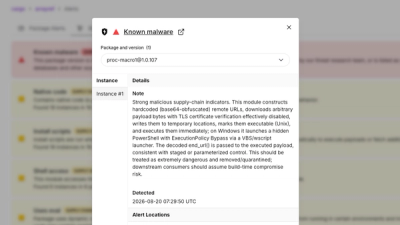
Research
/Security News
Three compromised Rust crates pulled in a malicious dependency that downloaded and executed cross-platform malware during Cargo builds.