
Product
Socket Now Protects the Firefox Extension Ecosystem
Socket is bringing experimental protection to Firefox, scanning 97,000+ extensions in Mozilla's official directory for malware and risky updates.
By John Tuckner - Aug 20, 2026
@budgetary/sdk
Advanced tools
TypeScript SDK for the Budgetary API — a hosted service that returns probabilistic pre-inference estimates of token spend for LLM queries. The SDK is a thin, typed HTTP wrapper with zero runtime dependencies; it speaks the v1 contract documented at docs/api-contract.md.
npm install @budgetary/sdk
# or: pnpm add @budgetary/sdk / yarn add @budgetary/sdk
The package publishes both ESM and CommonJS builds with type declarations for
each, so import and require both work from TypeScript and JavaScript.
import { BudgetaryClient, normalizeScenario } from "@budgetary/sdk";

// A free `bg_test_` key works immediately for development; `bg_live_` is the
// production key (and must be on an active plan). Get one at https://budgetary.tools
const client = new BudgetaryClient({ apiKey: process.env.BUDGETARY_API_KEY! });

const estimate = await client.estimate("fix the flaky test in the payments service", {
  model: "claude-opus-4-7",
  context: { host: "sdk", projectId: "proj_kx7" },
});

if (estimate.void || estimate.distribution === null) {
  // The server declined to estimate (out of domain). Not an error.
  console.log("No confident estimate for this query.");
} else {
  const { p10, p50, p90 } = estimate.distribution;
  console.log(
    `~${p50} tokens (p10–p90: ${p10}–${p90}), scenario: ${normalizeScenario(estimate.scenario)}`,
  );
}
A successful estimate is a range, not a point. distribution gives p10, p50, and p90 combined input+output tokens; treat p50 as the midpoint of that range, not a guaranteed cost. Three fields tell you how much to trust it:
scenario (contract §5) — confident (the range is reliable), uncertain (supported but wide), sparse_evidence (near the edge of what's been seen), or out_of_domain (returned with void: true). The server may add labels at any time, so fold unknown values with normalizeScenario(scenario), which maps anything unrecognized to "uncertain" — never treat an unknown label as confident.confidence — a single [0, 1] quality summary. Lower means a wider range and a rougher midpoint. Read it alongside scenario, not as a probability.void — true when the server declined to estimate (out of domain). Branch on it before reading distribution, which is null in that case. A void response is not an error.Don't render a low-confidence or void estimate as if it were a precise number — surface the range and the caveat.
The idiomatic read narrows distribution by branching on void first, then destructures in the non-null branch:
if (estimate.void || estimate.distribution === null) {
  // no prediction — render the caveat
} else {
  const { p10, p50, p90 } = estimate.distribution; // non-null here
}
After a run, submit the realized counts so future estimates calibrate, then read them back from the ledger. Token counts must be measured, never guessed.
// Submit realized usage for a prior estimate (idempotent on estimateId).
await client.submitActuals({
  estimateId: estimate.estimateId,
  tokensIn: 12_340,
  tokensOut: 36_210,
  success: true,
  durationMs: 420_000,
});

// Read the predicted-vs-actual ledger.
const page = await client.getLedger({ projectId: "proj_kx7", limit: 50 });
for (const entry of page.entries) {
  console.log(entry.queryExcerpt, entry.predicted.p50, entry.actual?.total ?? "pending");
}
submitActuals returns 202 and is idempotent on estimateId (safe to retry on a network failure). getLedger is paginated — pass the returned nextCursor as after for the next page, and set includeOrphans: true to include estimates with no actuals yet.
Every documented HTTP status maps to a typed exception. Retryable errors (429, 5xx) are retried automatically with exponential backoff and jitter — by the time an error reaches your code, retries have already been exhausted.
import {
  BudgetaryClient,
  BudgetaryRateLimitError,
  BudgetaryValidationError,
} from "@budgetary/sdk";

try {
  await client.estimate(query);
} catch (err) {
  if (err instanceof BudgetaryRateLimitError) {
    console.warn(`rate limited; retry after ${err.retryAfterSeconds}s`);
  } else if (err instanceof BudgetaryValidationError) {
    console.error(`bad input: ${err.message}`);
  } else {
    throw err;
  }
}
The full hierarchy:
BudgetaryError — base class (code, httpStatus, requestId).BudgetaryAuthError — 401 (key missing, invalid, or revoked — re-authenticate).BudgetaryPermissionError — 403 (valid key, but lacks scope or an active plan — distinct from 401).BudgetaryNotFoundError — 404.BudgetaryValidationError — 400, 409, 413.BudgetaryRateLimitError — 429; exposes retryAfterSeconds.BudgetaryServerError — 5xx.BudgetaryNetworkError — no response received (timeout, network, abort).| Option | Type | Default | Notes |
|---|---|---|---|
apiKey | string | required | Sent as Authorization: Bearer <apiKey>. |
baseUrl | string | https://api.budgetary.tools | Override for staging or self-hosted endpoints. |
timeoutMs | number | 10_000 | Per-request timeout via AbortSignal.timeout. |
maxRetries | number | 4 | Maximum retries on 429 and 5xx. Total attempts = maxRetries + 1 (5, per contract §8). |
fetchImpl | typeof fetch | global fetch | Inject a mock fetch in tests. |
estimate() accepts an optional clientRequestId that is forwarded to the server as client_request_id. It is a correlation id only: the server accepts it but currently ignores it — it does not provide idempotent replay. A retry with the same client_request_id produces a new estimate_id, recomputes, and is billed as a separate estimate. Do not rely on it for dedup.
POST /v1/actuals is idempotent on estimate_id, and is safe to retry on network failure. See §8 of the API contract.
// default — SDK generates a UUID
await client.estimate("...");

// caller-supplied
await client.estimate("...", { clientRequestId: "my-deterministic-id" });

// explicit opt-out — no client_request_id sent
await client.estimate("...", { clientRequestId: null });
snake_case (estimate_id, tokens_in, client_request_id).camelCase (estimateId, tokensIn, clientRequestId).The SDK converts at the HTTP boundary in both directions; callers never see snake_case.
For the full API contract — endpoints, error codes, scenario labels, idempotency semantics — see docs/api-contract.md.
Licensed under Apache-2.0.
FAQs
TypeScript SDK for the Budgetary API.
The npm package @budgetary/sdk receives a total of 63 weekly downloads. As such, @budgetary/sdk popularity was classified as not popular.
We found that @budgetary/sdk demonstrated a healthy version release cadence and project activity because the last version was released less than a year ago. It has 1 open source maintainer collaborating on the project.
Product
Socket is bringing experimental protection to Firefox, scanning 97,000+ extensions in Mozilla's official directory for malware and risky updates.
Research
/Security News
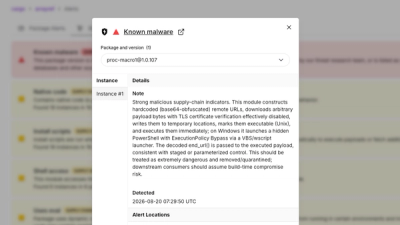
Three compromised Rust crates pulled in a malicious dependency that downloaded and executed cross-platform malware during Cargo builds.

Research
/Security News
Socket uncovered 77 linked Firefox extensions, including 40 that steal wallet secrets or credentials and 37 deceptive sports-score shells.