
Product
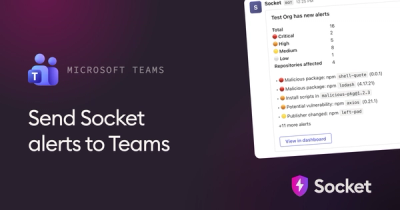
Microsoft Teams Notifications Are Now Available in Socket
Socket can now send alerts and supply chain attack notifications to Microsoft Teams, with filters that route the right updates to each channel.
By Jeppe Hasseriis - Sep 01, 2026
@buzzr/entertainment-engine
Advanced tools
Transparent sports entertainment scoring, hybrid ML prediction, and personalized game recommendations for Buzzr.
Transparent sports entertainment scoring, hybrid ML prediction, and personalized game recommendations for Buzzr.
The package is intentionally pure: it does not import React Native, Expo, Supabase, AsyncStorage, or app services — and it has zero runtime dependencies. Apps and jobs provide data through plain objects, then persist results however they choose.
import {
resolveBuzzScores,
enrichGameRowWithBuzzScores,
predictGameWithDiagnostics,
} from '@buzzr/entertainment-engine';
const resolved = resolveBuzzScores({
league: 'NBA',
status: 'scheduled',
startsAt: '2026-06-12T01:00:00Z',
homeTeam: 'Boston Celtics',
awayTeam: 'Los Angeles Lakers',
}, { upcomingLike: true });
const prediction = predictGameWithDiagnostics({
league: 'NBA',
status: 'scheduled',
startsAt: '2026-06-12T01:00:00Z',
homeTeam: 'Boston Celtics',
awayTeam: 'Los Angeles Lakers',
}, {
odds: { spread: -1.5, overUnder: 226.5 },
teamPower: { home: 9.2, away: 8.7 },
});
Every time-sensitive entry point accepts an optional now (epoch millis or a
Date). It defaults to Date.now(), so existing callers are unaffected, but
jobs and tests can pin the clock for full determinism:
resolveBuzzScores(game, { upcomingLike: true, now: Date.UTC(2026, 4, 1) });
enrichGameRowWithBuzzScores(row, { now: Date.UTC(2026, 4, 1) });
predictGameWithDiagnostics(game, { now: Date.UTC(2026, 4, 1) });
Primetime and weekend detection no longer depend on the host machine's
timezone. Game inputs may carry an explicit venueUtcOffsetMinutes or
localStartHour (also venue_utc_offset_minutes / local_start_hour on DB
rows). When absent, the engine derives US Eastern local time with a proper
DST calculation (second Sunday in March through first Sunday in November).
easternUtcOffsetMinutes(utcMs) is exported for reuse.
All rivalry, marquee, and shared-city lookups run through one exported
normalizeTeamName helper: lowercase, trimmed, whitespace-collapsed, and
diacritic-insensitive ('Los Ángeles Lakers' matches
'los angeles lakers'). The NFL rivalry table now includes modern rivalries
such as Bills–Bengals, Ravens–Steelers, Chiefs–Raiders, Bills–Chiefs, and
Cowboys–49ers.
ml-v5)The feature vector grew from 20 to 22 with two appended optional features:
searchHeat — from context.searchHeat: { home?, away? }, each in
[-1, 1], normalized to [0, 1] (absent → neutral 0.5).starPower — from context.starPower in [0, 1] (absent → 0.5).Old 20-length v1 weight arrays remain fully supported: the appended features are skipped for them, so v1 predictions are bit-identical to prior releases.
trainSGD(examples, opts) upgrades (defaults preserve pre-v5 behavior):
featureMeans/featureStds in the weights and
applied automatically at prediction time.momentum — classical momentum coefficient (default 0, plain SGD).validationSplit — chronological tail held out for validation, with
earlyStopping: true and patience stopping on validation MAE plateau.shuffle: true with seed — deterministic per-epoch shuffling via an
embedded mulberry32 PRNG.confidenceCalibration and applied by predictGameWithDiagnostics
(also exported directly as applyConfidenceCalibration).Freshly trained weights carry modelVersion: 'ml-v5'
(ML_MODEL_VERSION_V5), and buildModelRunReport carries the trained
model's version through to the report.
import { rankGamesForUser, explainRecommendation } from '@buzzr/entertainment-engine';

const ranked = rankGamesForUser(
  [
    { id: 'game-1', game: celticsLakers, baseScore: 8.1 },
    { id: 'game-2', game: kingsJazz }, // base score estimated transparently
  ],
  {
    favoriteTeams: ['Boston Celtics'],
    favoriteLeagues: ['NBA'],
    teamAffinity: { 'utah jazz': -0.4 },
    leagueAffinity: { NHL: 0.6 },
    socialSignal: { 'game-2': 0.8 }, // fire-ratio in [-1, 1] keyed by game id
  },
  { now: Date.UTC(2026, 4, 1), limit: 20 },
);

const breakdown = explainRecommendation(ranked[0]);
// { baseScore, personalAdjustment, socialAdjustment, totalScore, factors }
Scoring is the base entertainment score (provided baseScore, else a
transparent estimate) plus a bounded personal-affinity adjustment (±1.5,
MAX_AFFINITY_ADJUSTMENT) and a bounded social adjustment (±0.75,
MAX_SOCIAL_ADJUSTMENT). Ordering is deterministic: ties break by earliest
start time, then id. explainRecommendation returns the factor list the
app's BuzzBreakdownSheet renders — base score, personal adjustment, social
adjustment, and individual signed factor deltas.
resolveBuzzScores is deterministic and explainable.predictGameWithDiagnostics layers trained weights over transparent
features and returns factor impacts, input coverage, confidence, and model
version metadata.ENGINE_PACKAGE_VERSION reports the package version (5.0.0).FAQs
Transparent sports entertainment scoring, hybrid ML prediction, and personalized game recommendations for Buzzr.
The npm package @buzzr/entertainment-engine receives a total of 30 weekly downloads. As such, @buzzr/entertainment-engine popularity was classified as not popular.
We found that @buzzr/entertainment-engine demonstrated a healthy version release cadence and project activity because the last version was released less than a year ago. It has 2 open source maintainers collaborating on the project.
Product
Socket can now send alerts and supply chain attack notifications to Microsoft Teams, with filters that route the right updates to each channel.
Security News
pnpm 12 rewrites the package manager in Rust, cutting install times by up to 90% while preserving pnpm 11 workflows and lockfiles.
Security News
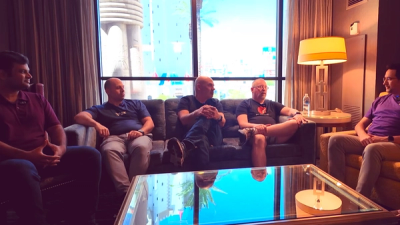
Socket CTO Ahmad Nassri joins AppSec leaders at Black Hat to discuss active malware, package manager risks, and software supply chain defense.