

Company News
AWS Security Hub Adds Socket for Supply Chain Security
Socket is now in the AWS Security Hub Extended plan. Adopt it through AWS, apply committed spend, and block malicious open source packages.
By Feross Aboukhadijeh - Aug 04, 2026
@bvcc/agent-mcp
Advanced tools
Model Context Protocol server exposing a BVCC Agent Wallet to AI runtimes (Claude Code, Cursor, Claude app). Tools are generated from the @bvcc/agent-sdk capability catalog.

Model Context Protocol server for a BVCC Agent Wallet. It lets MCP-speaking
AI runtimes — Claude Code, Cursor, the Claude desktop app — operate a BVCC Agent
Wallet on-chain: check balances and limits, plan and simulate swaps, send tokens,
swap on Uniswap v3/v4 (including to and from native ETH), provide liquidity on
Uniswap v3/v4 (including native-ETH pools), and lend, borrow and unwind
positions on Aave v3 — including closing or deleveraging a position in safe
steps on its own. It also ships built-in operating guides (listGuides /
getGuide, also exposed as prompts) so an agent can learn how to use each area on
demand.
Every tool is generated from the @bvcc/agent-sdk capability
catalog. There is no per-tool code here: add a capability to the SDK catalog and
it appears here automatically.
New here? Start with QUICKSTART.md — the full end-to-end setup (create wallet → authorize the agent on-chain → fund it with gas → configure → verify). It covers the two steps people miss without which the agent does nothing.
This server adds no powers. All limits — spend caps (native + per-token, daily + total), allowed tokens, allowed protocols, recipient whitelist, and a global pause — are enforced on-chain by the Agent Wallet contract. The worst any tool can do is bounded by what you authorized for the agent in the BVCC dashboard.
BVCC_MCP_READONLY=true to expose only read/simulate tools (no writes).Generated from the catalog and tagged by class:
Core (wallet, transfers, swaps):
| Class | Tools |
|---|---|
| 🟢 read | getAgentStatus, getCapabilities, getNativeBalance, getTokenBalances, getRemaining, needsApproval |
| 🟡 simulate | buildSwapPlan, dryRunSendNative, dryRunSendToken, dryRunSwapV3, dryRunSwapV4 |
| 🔴 write | sendNative, sendToken, approve, swapV3, swapV4, swapToNative, swapFromNative |
A 0.15% BVCC agent fee is charged automatically on-chain on agent actions, separate from gas and from your spend budget.
Aave v3 lending (aave module — Arbitrum, Ethereum, BNB, Base, Polygon):
| Class | Tools |
|---|---|
| 🟢 read | getAavePositions, getAaveMarket |
| 🟡 simulate | dryRunAaveSupply, dryRunAaveBorrow, aavePlanClosePosition, aavePlanDeleverage, aavePlanCollateralSwap, aavePlanDebtSwap |
| 🔴 write | aaveSupply, aaveWithdraw, aaveBorrow, aaveRepay, aaveRepayWithATokens, aaveSetCollateral, aaveSetEMode, aaveClosePosition, aaveDeleverage, aaveCollateralSwap, aaveDebtSwap |
Deposits and borrows are always for the wallet itself — no to or onBehalfOf
parameter exists, because the wallet's on-chain call policies pin the beneficiary.
⚠️ The four aave* unwinding tools can send several transactions in one call.
aaveClosePosition, aaveDeleverage, aaveCollateralSwap and aaveDebtSwap run a
chunked loop, re-deriving and re-simulating each step from live state. Call the
matching aavePlan* tool first to see what it intends to do. They stop rather than
proceed if the health factor would fall below hfFloor (default 1.05), if a swap
prices too far from the Aave oracle, if the loop stops making progress, or if the
agent's budget would run out.
Uniswap liquidity (lp module — open, collect, close positions on v3 & v4):
| Class | Tools |
|---|---|
| 🟢 read | getV3Position, getV4Position |
| 🟡 simulate | dryRunAddLiquidityV3, dryRunRemoveLiquidityV3, dryRunAddLiquidityV4, dryRunRemoveLiquidityV4 |
| 🔴 write | addLiquidityV3, removeLiquidityV3, collectFeesV3, burnV3, addLiquidityV4, removeLiquidityV4, collectFeesV4, burnV4 |
The position NFT is minted to the wallet and every proceed returns to it —
pinned on-chain. addLiquidityV3 sizes both sides to the pool's current price
(full-range by default, or pass ticks). v4 covers native-ETH pools; its tools
need the v4 PositionManager's DEEP validator active on-chain for the agent, else
the action fails closed. Note there is no increaseLiquidity on v3 (not
owner-gated on the NFPM — add by minting a fresh position).
Guides (meta module — always exposed, help):
| Class | Tools |
|---|---|
| 🟢 read | listGuides, getGuide |
listGuides names the how-to guides; getGuide({ area }) returns the playbook for
one area — the recommended workflow and the gotchas, naming the exact tools —
covering getting-started, swaps, lending and liquidity. They stay available
even under a module filter, so an agent restricted to one feature can still learn
how to use it. The same guides are also exposed as prompts (guide-<area>) so a
human can pull one as a slash-command.
Writes carry the MCP destructiveHint annotation so clients can require
confirmation. See GUIDE.md for the recommended operating workflow.
Recommended: keep the values — above all AGENT_PRIVATE_KEY — in a dedicated
env file and point the server at it with BVCC_ENV_FILE, instead of inlining the
key in your MCP host's config (which gets shared, synced and screenshotted).
chmod 600 that file and keep it outside any cloud-synced folder. You can still
inline the variables in the host's env block if you prefer; host env wins over
the file. See .env.example.
Example agent.env (path passed via BVCC_ENV_FILE):
AGENT_PRIVATE_KEY=0xYOUR_AGENT_KEY
WALLET_ADDRESS=0xYOUR_WALLET
CHAIN_ID=42161
| Variable | Required | Description |
|---|---|---|
AGENT_PRIVATE_KEY | yes | Agent EOA private key (0x + 64 hex). Used locally only. |
WALLET_ADDRESS | yes | The BVCC Agent Wallet this agent operates. |
CHAIN_ID | yes | Default chain: 42161 Arbitrum One · 56 BNB · 1 Ethereum · 8453 Base · 137 Polygon · 421614 Arbitrum Sepolia. |
RPC_URL | no | Custom RPC for the default chain (otherwise a public default). |
RPC_URL_<chainId> | no | Per-chain RPC override, e.g. RPC_URL_56. |
BVCC_ENV_FILE | no | Path to a dedicated env file to load (keeps the key out of the host config). Host env wins over it. |
BVCC_MCP_READONLY | no | true exposes only read/simulate tools. |
BVCC_MCP_MODULES | no | Comma-separated feature groups to expose: core, aave, lp. Unset = all. |
Narrowing what the agent can reach. BVCC_MCP_READONLY and BVCC_MCP_MODULES
are independent and combine. If an agent will never touch lending, leaving those
tools out is one less thing it can get wrong:
BVCC_MCP_MODULES=core              # wallet + swaps    (18 + 2 guides = 20)
BVCC_MCP_MODULES=aave              # Aave lending      (19 + 2 = 21)
BVCC_MCP_MODULES=lp                # Uniswap liquidity (14 + 2 = 16)
BVCC_MCP_MODULES=core,aave,lp      # everything (= unset)  (51 + 2 = 53)
BVCC_MCP_MODULES=core
BVCC_MCP_READONLY=true             # read-only wallet  (11 + 2 = 13)
The two guide tools (listGuides, getGuide, module meta) are always exposed on
top of these — that is the + 2 — so an agent restricted to one feature can still
read how to use it.
An unrecognised module name is ignored, so a typo yields a smaller surface, never a larger one. Neither switch is the security boundary — the contract is — but a smaller surface is fewer ways for a confused agent to act.
Multi-network: one server operates the agent on any supported chain. Every
tool takes an optional network (chain id or name: ethereum, bsc, arbitrum,
base, polygon, arbitrum-sepolia), defaulting to CHAIN_ID — so you can say "swap on
bsc" without restarting. The wallet address is the same on every chain (CREATE2);
the agent must be authorized on each chain you use.
npm install
npm run build
npm test          # builds + stdio smoke test (no chain calls)
claude mcp add bvcc-agent-wallet \
  --env BVCC_ENV_FILE=/secure/agent.env \
  -- npx -y @bvcc/agent-mcp
mcp.json){
"mcpServers": {
"bvcc-agent-wallet": {
"command": "npx",
"args": ["-y", "@bvcc/agent-mcp"],
"env": { "BVCC_ENV_FILE": "/secure/agent.env" }
}
}
}
The key lives in agent.env, not in the config above. If you'd rather inline it,
replace the env block with AGENT_PRIVATE_KEY / WALLET_ADDRESS / CHAIN_ID
directly (less safe — the key sits in the host config). Pin a version for
reproducibility, e.g. @bvcc/agent-mcp@0.2.1 (see Upgrading).
The SDK is bundled into this package, so updating the MCP is all you need to get
new capabilities (Aave lending shipped this way in 0.2.0) — you never install or update
@bvcc/agent-sdk separately.
"args": ["-y", "@bvcc/agent-mcp@0.2.1"]
npx caches, so an unpinned @bvcc/agent-mcp can keep running an old build.
To upgrade, bump the number (e.g. @0.2.1) — or use @latest if you prefer.
Global installs: npm i -g @bvcc/agent-mcp@latest.[bvcc-agent-mcp vX.Y.Z]).allowedProtocols — otherwise the action reverts
with ProtocolNotAllowed. Authorize it from the dashboard, same as a router.See CHANGELOG.md for what each version changes. Versioning follows
SemVer: patch = fix, minor = new compatible feature, and 0.x means the API may
still change.
@bvcc/agent-sdk  ──catalog──►  @bvcc/agent-mcp  ──MCP──►  Claude Code / Cursor / Claude
   (on-chain limits live in the Agent Wallet contract, not here)
The server loads the catalog, registers one MCP tool per capability (Zod schema →
tool input schema, kind → tool annotations), and routes each call to the SDK,
which signs with the agent key and submits executeAsAgent.
MIT © BlockVenture Chain Capital (BVCC)
FAQs
Model Context Protocol server exposing a BVCC Agent Wallet to AI runtimes (Claude Code, Cursor, Claude app). Tools are generated from the @bvcc/agent-sdk capability catalog.
The npm package @bvcc/agent-mcp receives a total of 364 weekly downloads. As such, @bvcc/agent-mcp popularity was classified as not popular.
We found that @bvcc/agent-mcp demonstrated a healthy version release cadence and project activity because the last version was released less than a year ago. It has 1 open source maintainer collaborating on the project.
Did you know?

Socket for GitHub automatically highlights issues in each pull request and monitors the health of all your open source dependencies. Discover the contents of your packages and block harmful activity before you install or update your dependencies.
Company News
Socket is now in the AWS Security Hub Extended plan. Adopt it through AWS, apply committed spend, and block malicious open source packages.
Research
/Security News
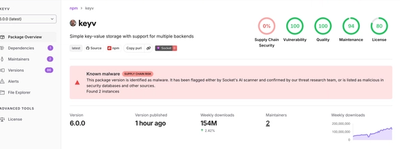
Popular npm packages keyv and cacheable compromised.

Security News
A misconfiguration gave three Anthropic models internet access, and one, believing it was in a simulation, shipped a credential-stealing package to PyPI.