

Product
PHP and Composer Support Is Now in Beta
Socket’s PHP and Composer support is now in Beta for all customers, with PHP reachability analysis generally available.
By Trevor Norris, Benjamin Barslev - Aug 21, 2026
@cafitac/agent-learner
Advanced tools
Reusable self-learning engine for agent workflows.
agent-learner provides a generic self-learning core plus installable
adapter overlays for Codex and Claude-style environments.


Many agent setups accumulate useful learning behavior inside a single
workspace, but the learning engine, session wrap-up logic, and adapter
install flow are often too coupled to one repo. agent-learner extracts
that logic into a reusable OSS foundation.
src/agent_learner/ - core packageplugins/codex/ - Codex adapter overlayplugins/claude/ - Claude adapter overlaytests/ - lifecycle and adapter testsdocs/ - install and architecture docsexamples/ - example consumer repo outcomesThe project treats these as mandatory for a shippable first release:
pipx install .
agent-learner bootstrap --target /path/to/repo
Recommended during development with uv:
uv sync --extra dev
uv run agent-learner bootstrap --target /path/to/repo
Alternative with pip:
python3 -m pip install -e .[dev]
agent-learner bootstrap --target /path/to/repo
Scaffold in progress with:
docs/install.mddocs/quickstart.mddocs/architecture.mddocs/adapter-convergence.mddocs/qa-codex-smoke.mddocs/distribution.mddocs/release-process.mddocs/prerelease-checklist.mdexamples/consumer-repo-layout.mdCONTRIBUTING.mdagent-learner is differentagent-learner is not trying to be a full agent runtime, a generic
memory database, or a framework-specific memory SDK.
Its current focus is narrower and more opinionated:
Hermes Agent presents itself as a self-improving agent runtime with built-in learning loops, memory, and skill evolution.
agent-learner is different:
In short:
LangMem is positioned as memory and learning SDK tooling for agents: memory extraction, long-term memory, and adaptation workflows.
agent-learner is different:
inbox -> drafts -> approved -> needs_review -> deprecated)In short:
OpenMemory and Mem0 focus on persistent memory storage, retrieval, and automatic context injection.
agent-learner is different:
In short:
agent-learner is todayCurrent implemented focus:
UserPromptSubmitinboxdraftsapprovedneeds_reviewdeprecatedagent-learner is notAt least in its current form, agent-learner is not:
The long-term direction is broader than file storage or simple memory recall.
Planned work includes:
Planned work includes:
Planned work includes:
CI now runs both qa-codex-smoke and qa-claude-smoke on Python 3.13 so the adapter-level smoke paths stay covered in automation.
CI now also installs the built wheel into a fresh environment and reruns CLI smoke checks so package-install behavior is verified, not just source-tree execution.
Installable npm wrapper direction:
npx @cafitac/agent-learner codex install
npx @cafitac/agent-learner codex qa
This wrapper uses the Python core via uv run in the repo checkout and is designed to use uvx --from agent-learner after the Python package is published.
Wrapper UX helpers:
npx @cafitac/agent-learner doctor
npx @cafitac/agent-learner version
doctor checks whether node/npm/uv/python are available and whether the wrapper will run in local-repo mode or published uvx mode.
Release automation now has separate pypi-publish and npm-publish workflows so the Python core can ship before the npm wrapper.
See docs/release-process.md for tag conventions, changelog expectations, and the recommended GitHub/PyPI/npm release order.
Lane-specific wrapper health checks:
npx @cafitac/agent-learner codex doctor --target /path/to/consumer-repo
npx @cafitac/agent-learner claude doctor --target /path/to/consumer-repo
These commands verify the expected adapter files/directories exist after installation and suggest the correct install command if anything is missing.
See docs/prerelease-checklist.md for the exact TestPyPI -> npm next rehearsal sequence before final release tags.
Release readiness helper:
python scripts/release/release_check.py --version 0.2.0
FAQs
npm delivery wrapper for the agent-learner Python core
The npm package @cafitac/agent-learner receives a total of 37 weekly downloads. As such, @cafitac/agent-learner popularity was classified as not popular.
We found that @cafitac/agent-learner demonstrated a healthy version release cadence and project activity because the last version was released less than a year ago. It has 1 open source maintainer collaborating on the project.
Product
Socket’s PHP and Composer support is now in Beta for all customers, with PHP reachability analysis generally available.
Product
Socket is bringing experimental protection to Firefox, scanning 97,000+ extensions in Mozilla's official directory for malware and risky updates.
Research
/Security News
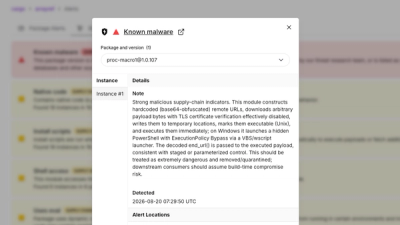
Three compromised Rust crates pulled in a malicious dependency that downloaded and executed cross-platform malware during Cargo builds.