
Product
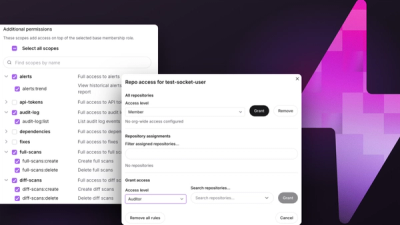
Introducing Repository Access Permissions and Custom Roles
Socket now supports Custom Roles and Repository Access Permissions so organizations can control who can access specific repositories and actions.
By Joe Werle - Jun 19, 2026
@cantoo/capacitor-audio-capture
Advanced tools
Capacitor v7 plugin that captures microphone audio and streams raw PCM (base64 Float32) chunks to the consumer (web/Android/iOS).
Capacitor v7 plugin that captures microphone audio on web / Android / iOS and streams raw PCM as
Float32Array(mono) chunks to the consumer. No format conversion, no compression — your app decides what to do with the samples.


| Platform | Implementation | Minimum |
|---|---|---|
| Web | getUserMedia + AudioWorklet (DSP off the main thread) | modern browser |
| Android | AudioRecord (44.1 kHz PCM16) on a dedicated thread | API 23 (Android 6) |
| iOS | AVAudioEngine.installTap on a dedicated queue | iOS 14 |
Native captures mono audio, resamples it to targetSampleRate via linear
interpolation, applies optional RMS silence filtering, and ships each chunk
over the bridge as base64 little-endian Float32 PCM. The JS wrapper decodes
that base64 once and hands the consumer a Float32Array — no further
encoding/decoding inside the plugin.
pnpm add @cantoo/capacitor-audio-capture
# or: npm i @cantoo/capacitor-audio-capture
# or: yarn add @cantoo/capacitor-audio-capture

npx cap sync
Info.plist:
<key>NSMicrophoneUsageDescription</key>
<string>Used to record audio while you use the app.</string>
RECORD_AUDIO is already declared by the plugin; permission is
requested at runtime on the first call to startCapture.localhost) and the user must
grant microphone access.import { AudioCapture } from '@cantoo/capacitor-audio-capture';
await AudioCapture.startCapture({
chunkDurationMs: 250,
targetSampleRate: 16000,
silenceThreshold: 0.01,
listener: (sequence, chunk) => {
// chunk: Float32Array, mono, at targetSampleRate (samples in -1..1)
console.log(sequence, chunk.length);
},
});
// later
await AudioCapture.stopCapture();
await AudioCapture.release();
Send to a backend (base64-encode just before the request):
listener: (_seq, chunk) => {
  const bytes = new Uint8Array(chunk.buffer);
  let bin = '';
  for (let i = 0; i < bytes.length; i++) bin += String.fromCharCode(bytes[i]);
  const base64 = btoa(bin);
  fetch('/api/audio', {
    method: 'POST',
    headers: { 'Content-Type': 'application/octet-stream' },
    body: chunk.buffer,
  });
}
Buffer for a client-side WAV:
await AudioCapture.startCapture({
  chunkDurationMs: 250,
  targetSampleRate: 16000,
  silenceThreshold: 0,
  accumulate: true,
});
// ... user stops ...
const { audio } = await AudioCapture.stopCapture();
// `audio` is a Float32Array of the full session — convert to Int16,
// prepend a 44-byte WAV header, and you have a playable file.
startCapture(options?)| Field | Type | Default | Description |
|---|---|---|---|
chunkDurationMs | number | 1000 | Duration of each emitted chunk. |
targetSampleRate | number | 16000 | Target sample rate. Audio is resampled to this value. |
silenceThreshold | number (RMS 0..1) | 0 | Chunks with RMS below this value are dropped (0 disables). |
voiceProcessing | boolean | true | Toggle the platform voice pre-processing bundle (echo cancellation, noise suppression, auto gain) on all platforms. Set false for the rawest signal. |
listener | (sequence: number, chunk: Float32Array) => void | — | Stream consumer. Without it, capture runs but emits nothing. |
accumulate | boolean | false | Buffer every emitted chunk and return the concatenated PCM from stopCapture. Silent chunks are skipped. |
sequence is monotonically increasing per session and resets on every
startCapture. It is incremented even for chunks dropped by silence
detection, so consumers can detect temporal gaps.
stopCapture()Stops capture and releases the active capture session. Returns
{ audio: Float32Array }. When the session was started with accumulate: true,
audio is the concatenated PCM (mono Float32 at targetSampleRate); otherwise
it is an empty Float32Array.
release()Stops capture, removes listeners, and frees every open resource.
import type {
  AudioCapturePlugin,
  AudioChunkListener,  // (sequence, chunk: Float32Array) => void
  AudioCaptureError,
  AudioCaptureErrorCode,
  StartCaptureOptions,
} from '@cantoo/capacitor-audio-capture';
Every rejected Promise from the plugin carries a .code from a closed set,
identical across iOS, Android, and Web. Branch on .code rather than parsing
messages — the messages are short and stable, but only the code is part of the
public contract.
| Code | When it's raised |
|---|---|
PERMISSION_DENIED | User denied microphone access (or never granted it). |
MICROPHONE_UNAVAILABLE | Microphone missing, busy, or fails to initialize (no input device, hardware/OS-level issue). |
ALREADY_CAPTURING | startCapture was called while a session is already running. |
UNAVAILABLE | Web only: getUserMedia or AudioWorklet is missing in this environment. |
INTERNAL_ERROR | Fallback for anything not matching the categories above. |
import { AudioCapture, type AudioCaptureError } from '@cantoo/capacitor-audio-capture';

try {
  await AudioCapture.startCapture({ /* ... */ });
} catch (e) {
  const code = (e as AudioCaptureError).code;
  if (code === 'PERMISSION_DENIED') {
    // prompt user to enable mic access in OS settings
  } else if (code === 'MICROPHONE_UNAVAILABLE') {
    // surface a "no microphone" state in UI
  } else if (code === 'ALREADY_CAPTURING') {
    // ignore or call stopCapture() first
  }
}
Float32Array in the API?Capacitor's native↔JS bridge can only carry JSON-serializable values.
Encoding the PCM samples as base64 is ~33% smaller than a JSON number array
and significantly faster to serialize/deserialize on both sides. The
plugin's wrapper does the one decode (base64 → Float32Array) so the
consumer always receives the natural representation for audio: a typed
array of mono samples in [-1, 1].
On web, the AudioWorkletProcessor is inlined as a string and loaded via
URL.createObjectURL(new Blob([...])). If the host app has a strict CSP
that doesn't allow blob: in script-src / worker-src, the worklet
won't load — simply allow blob: in the appropriate directive.
MIT © Cantoo
FAQs
Capacitor v7 plugin that captures microphone audio and streams raw PCM (base64 Float32) chunks to the consumer (web/Android/iOS).
We found that @cantoo/capacitor-audio-capture demonstrated a healthy version release cadence and project activity because the last version was released less than a year ago. It has 6 open source maintainers collaborating on the project.
Did you know?

Socket for GitHub automatically highlights issues in each pull request and monitors the health of all your open source dependencies. Discover the contents of your packages and block harmful activity before you install or update your dependencies.
Product
Socket now supports Custom Roles and Repository Access Permissions so organizations can control who can access specific repositories and actions.
Product
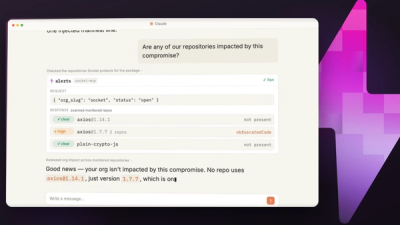
Socket MCP now lets AI assistants review org alerts, investigate threats using the Socket threat feed, and inspect package files in addition to dependency scoring.
Product
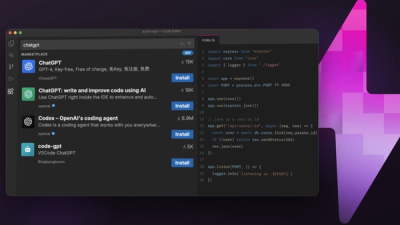
Socket Firewall blocks malicious VS Code and Open VSX extensions before install, protecting developers from compromised editor marketplaces.