
Research
/Security News
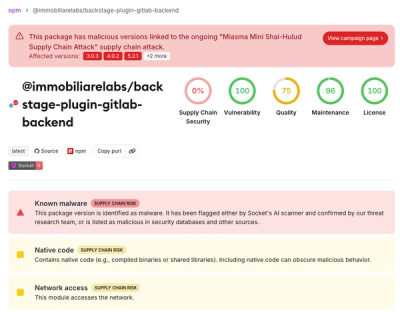
Miasma Mini Shai-Hulud Hits ImmobiliareLabs npm Packages
Miasma Mini Shai-Hulud hits @immobiliarelabs Backstage plugins, targeting GitLab and LDAP auth packages on npm.
By Socket Research Team - Jun 26, 2026
@captigo/react
Advanced tools
React hooks and components for captigo.
Provider-agnostic React integration for CAPTCHA widgets. Works with any captigo adapter — bring your own provider.
npm install @captigo/core
npm install @captigo/react
# plus your provider adapter, e.g.:
npm install @captigo/turnstile
React 18+ is required as a peer dependency.
For most use cases you just need the <Captcha> component. Create an adapter
from your provider package and pass it as a prop — the component handles the
full mount/unmount lifecycle.
import { Captcha } from "@captigo/react";
import { turnstile } from "@captigo/turnstile";
import { useState } from "react";

// Create the adapter once, outside the component.
const adapter = turnstile({ siteKey: "0x4AAAAAAA..." });

export function ContactForm() {
  const [token, setToken] = useState<string | null>(null);

  return (
    <form onSubmit={(e) => {
      e.preventDefault();
      if (!token) return;
      submitForm(token);
    }}>
      <input name="email" type="email" />

      <Captcha
        adapter={adapter}
        onSuccess={(t) => setToken(t.value)}
        onExpire={() => setToken(null)}
      />

      <button type="submit" disabled={!token}>
        Send
      </button>
    </form>
  );
}
For invisible CAPTCHAs (e.g. Turnstile with execution: "execute"), use a
ref to get the CaptchaHandle and call execute() imperatively on submit.
import { Captcha } from "@captigo/react";
import type { CaptchaHandle } from "@captigo/react";
import { turnstile } from "@captigo/turnstile";
import { useRef } from "react";

const adapter = turnstile({
  siteKey: "0x4AAAAAAA...",
  execution: "execute", // invisible widget
});

export function LoginForm() {
  const captchaRef = useRef<CaptchaHandle>(null);

  const handleSubmit = async (e: React.FormEvent) => {
    e.preventDefault();

    // Triggers the invisible challenge; resolves when done.
    const token = await captchaRef.current!.execute("login");

    await fetch("/api/login", {
      method: "POST",
      body: JSON.stringify({ token: token.value, ...formData }),
    });
  };

  return (
    <form onSubmit={handleSubmit}>
      <input name="username" />
      <input name="password" type="password" />

      {/* Invisible widget — renders nothing visible */}
      <Captcha ref={captchaRef} adapter={adapter} />

      <button type="submit">Log in</button>
    </form>
  );
}
useCaptcha hookUse the hook when you need direct access to the container ref (e.g. custom
layouts) or want the token in component state without the <Captcha> wrapper.
import { useCaptcha } from "@captigo/react";
import { turnstile } from "@captigo/turnstile";

const adapter = turnstile({ siteKey: "0x4AAAAAAA..." });

export function CheckoutWidget() {
  const { containerRef, token, execute, reset } = useCaptcha(adapter, {
    onSuccess: (t) => console.log("Token:", t.value),
    onExpire: () => console.log("Token expired"),
  });

  return (
    <div>
      {/* Attach this ref to any div — the widget renders into it. */}
      <div ref={containerRef} />

      <p>{token ? "✓ Verified" : "Solve the challenge above"}</p>

      <button onClick={() => execute("checkout")} disabled={!!token}>
        Trigger challenge
      </button>

      <button onClick={reset}>Reset</button>
    </div>
  );
}
Displaying a CAPTCHA is only half of the story — you must verify the token server-side before trusting it. This step is handled by the provider adapter, not by this React package.
// In an API route / server action:
import { adapter } from "./captcha.js"; // your shared adapter instance

export async function POST(request: Request) {
  const { token } = await request.json() as { token: string };

  const result = await adapter.verify(token, process.env.TURNSTILE_SECRET!);
  if (!result.success) {
    return Response.json({ error: "CAPTCHA failed" }, { status: 400 });
  }

  // Process the verified request...
}
See the @captigo/turnstile README for details.
<Captcha><Captcha
adapter={adapter} // required: any CaptchaAdapter
onSuccess={(token) => {}} // called with CaptchaToken when solved
onError={(err) => {}} // called with CaptchaError on failure
onExpire={() => {}} // called when the token expires
className="..." // forwarded to the container <div>
style={{...}} // forwarded to the container <div>
id="my-captcha" // forwarded to the container <div>
ref={captchaRef} // optional: attach for imperative control
/>
CaptchaHandle (ref)When a ref is attached, you get access to:
| Method | Description |
|---|---|
execute(action?) | Trigger the challenge. Returns Promise<CaptchaToken>. |
reset() | Reset to unsolved state. |
getToken() | Returns the current CaptchaToken | null. |
useCaptcha(adapter, options?)const { containerRef, token, execute, reset } = useCaptcha(adapter, {
onSuccess?: (token: CaptchaToken) => void,
onError?: (error: CaptchaError) => void,
onExpire?: () => void,
});
Returns:
| Property | Type | Description |
|---|---|---|
containerRef | RefObject<HTMLDivElement> | Attach to the widget container <div>. |
token | CaptchaToken | null | Current token. Triggers re-render on change. |
execute | (action?) => Promise<CaptchaToken> | Trigger the challenge. |
reset | () => void | Reset to unsolved state and clear the token. |
The adapter is used as the dependency in a useEffect. If you create the
adapter inline inside a component, a new adapter is created on every render,
which causes the widget to be destroyed and remounted on every render.
// ✗ Bad — new adapter on every render
function Form() {
  return <Captcha adapter={turnstile({ siteKey: "..." })} />;
}

// ✓ Good — stable adapter outside the component
const adapter = turnstile({ siteKey: "..." });
function Form() {
  return <Captcha adapter={adapter} />;
}

// ✓ Also good — useMemo for dynamic configs
function Form({ siteKey }: { siteKey: string }) {
  const adapter = useMemo(() => turnstile({ siteKey }), [siteKey]);
  return <Captcha adapter={adapter} />;
}
Unlike the adapter, onSuccess, onError, and onExpire callbacks can be
passed as inline functions — they are stored in a ref internally and will not
cause widget remounts.
The package is compatible with React Strict Mode. In development, effects run twice; the widget is destroyed and remounted, which is expected and harmless.
FAQs
React 18+ components and hooks for Captigo — works with any CAPTCHA adapter
The npm package @captigo/react receives a total of 23 weekly downloads. As such, @captigo/react popularity was classified as not popular.
We found that @captigo/react demonstrated a healthy version release cadence and project activity because the last version was released less than a year ago. It has 1 open source maintainer collaborating on the project.
Did you know?

Socket for GitHub automatically highlights issues in each pull request and monitors the health of all your open source dependencies. Discover the contents of your packages and block harmful activity before you install or update your dependencies.
Research
/Security News
Miasma Mini Shai-Hulud hits @immobiliarelabs Backstage plugins, targeting GitLab and LDAP auth packages on npm.

Security News
Rolldown paused Rust React Compiler integration after a 5MB binary size increase raised concerns about shipping React-specific code to all Vite users.

Security News
/Research
Mini Shai-Hulud expands into the Go ecosystem after hitting LeoPlatform npm packages and targeting GitHub Actions workflows.