
Product
Socket Now Protects the Firefox Extension Ecosystem
Socket is bringing experimental protection to Firefox, scanning 97,000+ extensions in Mozilla's official directory for malware and risky updates.
By John Tuckner - Aug 20, 2026
@chllming/wave-orchestration
Advanced tools
Generic wave-based multi-agent orchestration for repository work.
Wave Orchestration is my framework for "vibe-coding." It keeps the speed of agentic coding, but makes the runtime, coordination, and context model explicit enough to inspect, replay, and improve.
Wave is meant to be operated through an agent that uses the Wave runtime, not as a command-first workflow where a human manually drives every step from the shell.
This package also ships with my personal Wave Control endpoint enabled by default. A repo using the packaged defaults will emit project, lane, wave, run, proof, and benchmark metadata to https://wave-control.up.railway.app/api/v1 unless you actively opt out.
The framework does three things:
One orchestrator, many runtimes.
Planning, skills, evals, proof, and traces stay constant while the executor adapter changes.A blackboard-style multi-agent system.
Wave definitions, the coordination log, the control-plane log, and immutable result envelopes form the machine-trustable authority set; the rolling board, shared summary, inboxes, ledger, and integration views are generated projections over that state.Completion is goal-driven and proof-bounded.
Waves close only when deliverables, proof artifacts, eval targets, dependencies, and closure stewards agree.Context is compiled, not hand-maintained.
Wave builds runtime context from repo state, project memory, skills, Context7, and generated overlays.The system is inspectable and replayable.
Dry-run previews, logs, dashboards, ledgers, traces, and replay make the system debuggable instead of mysterious.Telemetry is local-first and proof-oriented.
Wave Control records typed run, proof, and benchmark events without making remote delivery part of the scheduler's critical path.docs/plans/waves/wave-<n>.md files, or generate them with wave draft.wave launch --dry-run to validate the wave and materialize prompts, shared summaries, inboxes, dashboards, and executor previews before any live execution.docs/plans/waves/design/ and implementation does not start until those packets are ready-for-implementation.cont-EVAL, optional security review, integration, documentation, and cont-QA evaluate validated envelopes plus canonical state through the wave's effective closure-role bindings, with starter defaults (E0, security reviewer, A8, A9, A0) filling gaps only when a wave does not override them.launcher.mjs
Thin orchestrator: parses args, acquires the launcher lock, and sequences the engines.implementation-engine.mjs
Selects the design-first or implementation fan-out for a wave or retry attempt.derived-state-engine.mjs
Computes shared summary, inboxes, assignments, dependency views, ledger, docs queue, and integration/security projection payloads from canonical state.gate-engine.mjs
Evaluates implementation, component, assignment, dependency, clarification, cont-EVAL, security, integration, documentation, and cont-QA gates.retry-engine.mjs
Plans reducer-driven resume and retry targets, reusable work, executor fallback changes, and blocking conditions.closure-engine.mjs
Sequences the staged closure sweep from implementation proof through final cont-QA.wave-state-reducer.mjs
Rebuilds deterministic wave state from canonical inputs for live queries and replay.session-supervisor.mjs
Owns detached agent launches, waits, dashboard tmux sessions, lock handling, resident orchestrator sessions, and observed wave_run, attempt, and agent_run lifecycle facts.projection-writer.mjs
Persists dashboards, traces, summaries, inboxes, board projections, assignment/dependency snapshots, ledgers, docs queues, and integration/security summaries.Wave contract
Shared plan docs, wave markdown, deliverables, proof artifacts, and eval targets define the goal.Shared state
Decisions come from the canonical authority set; boards, inboxes, dashboards, and other summaries are human-facing or operator-facing projections.Runtime abstraction
Executor adapters preserve Codex, Claude, and OpenCode-specific launch features without changing the higher-level wave contract.Compiled context
Project profile memory, shared summary, inboxes, skills, Context7, and runtime overlays are generated for the chosen executor.Proof and closure
Exit contracts, proof artifacts, eval markers, and closure stewards stop waves from closing on narrative-only PASS.Replay and audit
Traces capture the attempt so failures can be inspected and replayed instead of guessed from screenshots.Telemetry and control plane
Local-first event spools plus the Railway-hosted Wave Control service keep proof, benchmark validity, and selected artifacts queryable across runs.Representative rolling message board output from a real wave run:

Recent multi-agent research keeps returning to the same failure modes:
Cosmetic board, no canonical state
Agents appear coordinated, but there is no machine-trustable authority set underneath the conversation.Hidden evidence never gets pooled
One agent has the critical fact, but it never reaches shared state before closure.Communication without global-state reconstruction
Agents exchange information, but nobody reconstructs the correct cross-agent picture.Simultaneous coordination collapse
A team that looks fine in serial work falls apart when multiple owners, blockers, or resources must move together.Expert signal gets averaged away
The strongest specialist view is diluted into a weaker compromise.Contradictions get smoothed over
Conflicts are narrated away instead of being turned into explicit repair work.Premature closure
Agents say they are done before proof, evals, or integrated state actually support PASS.Wave is built to mitigate those failures with a canonical authority set, generated blackboard projections, explicit ownership, goal-driven, proof-bounded closure, replayable traces, and local-first telemetry. For the research framing and the current gaps, see docs/research/coordination-failure-review.md. For the concrete signal map, see docs/reference/proof-metrics.md.
Current release:
@chllming/wave-orchestration@0.9.6v0.9.5Highlights in 0.9.4:
gap alongside pass, concerns, and blocked for all five gate dimensions. Agents that report a documented gap (e.g. live=gap for an infrastructure topology constraint) no longer have their marker rejected entirely, and cont-QA treats gap values as a conditional pass instead of a hard blocker.wave launch now auto-triggers wave project setup when no project profile exists, matching existing wave draft behavior. The interactive setup flow now shows descriptive help text, explains all template and posture options inline, and adds whitespace between question groups for readability.PromptSession gains a describe(text) method for writing contextual help to stderr during interactive setup flows.parseArgs now passes the loaded config object through to runLauncherCli, avoiding a redundant loadWaveConfig() call.0.9.4 surface.Requirements:
pnpmtmux on PATH for dashboarded runsPATH: codex, claude, or opencodeCONTEXT7_API_KEY for launcher-side prefetchWAVE_API_TOKEN for owned Wave Control reporting, brokered provider access, and runtime credential leasingWAVE_CONTROL_AUTH_TOKENTelemetry defaults:
https://wave-control.up.railway.app/api/v1metadata-onlyprojectId, lane, wave, runKind, and related benchmark idswaveControl.enabled: false, waveControl.reportMode: "disabled", or wave launch --no-telemetryOwned Wave Control and security features:
wave-control app surface: Stack-backed browser sign-in, Wave-managed approval states, provider grants, PATs, service tokens, and encrypted per-user credential leasingexternalProviders.corridor can run in direct, broker, or hybrid mode, writes .tmp/<lane>-wave-launcher/security/wave-<n>-corridor.json, and can fail closure on fetch errors or matched blocking findings when requiredAtClosure stays enabledThe easiest way to set up Wave in any repo is:
Use direct CLI commands as a manual fallback, debugging surface, or validation aid. The intended interface is an agent using Wave, not a human memorizing the full command set.
Install into another repo:
pnpm add -D @chllming/wave-orchestration
Then give your coding agent this copy-paste prompt:
Set up and operate Wave Orchestration in this repository.

Start by inspecting the repo before changing anything.

Your job:
- determine whether this should be a fresh setup, an adopt-existing setup, or a migration from an older Wave version
- understand the repo well enough to recommend a Wave shape instead of guessing
- decide whether this repo should stay single-project or use monorepo projects with `defaultProject` plus `projects.<projectId>`
- explain the default telemetry behavior before enabling anything silently:
  - Wave sends project, lane, wave, run, proof, and benchmark metadata to `https://wave-control.up.railway.app/api/v1` by default unless the repo explicitly opts out
  - if this repo should opt out, say exactly how and why
- decide the right proof and closure posture for this repo:
  - what should count as proof
  - whether `cont-EVAL`, security review, stronger closure roles, or stricter proof artifacts are needed
  - whether non-proof follow-up should remain blocking or be marked soft, stale, or advisory
- configure Wave for this repo
- build detailed waves, not vague stubs
- validate the setup with the normal Wave checks
- summarize the resulting layout, assumptions, risks, and next recommended waves

Rules:
- inspect first, then change files
- prefer adopt-existing over destructive rewrites when Wave files or plans already exist
- ask only the missing high-impact product questions that cannot be inferred from the repo
- treat commands as implementation tools, not the user-facing interface

Required execution flow:
1. inspect the repo and determine fresh setup vs adopt-existing vs migration
2. install and initialize Wave appropriately
3. choose single-project vs monorepo project structure
4. configure telemetry intentionally and explain the default
5. define proof expectations and closure roles
6. draft or refine detailed waves
7. run Wave validation
8. report what you changed and what the human should review next

Validation to run:
- `pnpm exec wave doctor --json`
- `pnpm exec wave launch --lane main --dry-run --no-dashboard`
- `pnpm exec wave control status --lane main --wave 0 --json` if wave 0 exists

Useful docs:
- `README.md`
- `docs/plans/migration.md`
- `docs/guides/sandboxed-environments.md`
- `docs/guides/monorepo-projects.md`
- `docs/guides/planner.md`
- `docs/reference/runtime-config/README.md`
- `docs/reference/corridor.md`
- `docs/reference/wave-control.md`
If the repo already has Wave config, plans, or waves you want to keep, the agent should generally choose the adopt-existing path:
pnpm exec wave init --adopt-existing
Fresh init also seeds a starter skills/ library plus docs/evals/benchmark-catalog.json. The launcher projects those skill bundles into Codex, Claude, OpenCode, and local executor overlays after the final runtime for each agent is resolved, and waves that include cont-EVAL can declare ## Eval targets against that catalog.
For monorepos, wave.config.json can now declare defaultProject plus projects.<projectId>. Each project owns its own lanes, docs root, planner defaults, runtime overrides, and Wave Control identity, so multiple project/lane/wave tracks can run from one checkout without colliding in launcher state or tmux session names.
Use docs/guides/monorepo-projects.md for the full setup flow, state-path layout, cross-project dependency examples, and telemetry defaults or opt-out rules.
The starter surface includes:
docs/agents/wave-design-role.mdskills/role-design/skills/tui-design/ for terminal and operator-surface design workskills/signal-hygiene/ for intentionally long-running watcher agentsscripts/wave-status.sh and scripts/wave-watch.sh for external wait loopswave.config.json defaults for roles.designRolePromptPath, skills.byRole.design, and the design-pass executor profileInteractive wave draft scaffolds the docs-first design-steward path. If you want a hybrid design steward, author that wave explicitly or use an agentic planner payload that gives the same design agent implementation-owned paths plus the normal implementation contract sections.
If a non-resident agent should stay alive and react only to orchestrator-written signal changes, add signal-hygiene explicitly in ### Skills. That bundle uses the prompt-injected signal-state and ack paths instead of inventing a second wakeup surface. For shell automation and the wrapper contract, see docs/guides/signal-wrappers.md.
When runtime launch commands detect a newer npmjs release, Wave prints a non-blocking update notice on stderr. The fast path is pnpm exec wave self-update, which updates the dependency, prints the changelog delta, and then records the workspace upgrade report.
If Wave is running inside LEAPclaw, OpenClaw, Nemoshell, Docker, or another environment where the client shell is short-lived, do not bind the whole run to one blocking wave launch or wave autonomous process.
Use the async supervisor path instead:
# Long-lived daemon
pnpm exec wave supervise --project backend --lane main

# Short-lived client
runId=$(pnpm exec wave submit \
  --project backend \
  --lane main \
  --start-wave 2 \
  --end-wave 2 \
  --no-dashboard \
  --json | jq -r .runId)

pnpm exec wave status --run-id "$runId" --project backend --lane main --json
pnpm exec wave wait --run-id "$runId" --project backend --lane main --timeout-seconds 300 --json
Practical defaults for constrained environments:
wave.config.json instead of relying on per-command overridestmux optional and use --no-dashboard when you do not need a live dashboard.tmp/ and .wave/ across container restartswave attach --agent <id> for log-follow attach when there is no live interactive terminal sessionFor the full setup guidance, read docs/guides/sandboxed-environments.md.
These commands are still useful when you want to validate, debug, or inspect the runtime directly. They are not the recommended first-touch onboarding path.
# Save project defaults and draft a new wave
pnpm exec wave project setup
pnpm exec wave draft --wave 1 --template implementation

# Run one wave with a real executor
pnpm exec wave launch --lane main --start-wave 0 --end-wave 0 --executor codex

# Disable Wave Control reporting for a single launcher run
pnpm exec wave launch --lane main --no-telemetry

# Target a specific monorepo project
pnpm exec wave launch --project backend --lane main --dry-run --no-dashboard

# Inspect operator surfaces
pnpm exec wave feedback list --lane main --pending
pnpm exec wave dep show --lane main --wave 0 --json

# Submit a sandbox-safe run from a short-lived client
pnpm exec wave submit --project backend --lane main --start-wave 2 --end-wave 2 --no-dashboard --json

# Run autonomous mode only when the client shell can stay alive for the full run
pnpm exec wave autonomous --lane main --executor codex

# Pull the latest published package and record the workspace upgrade
pnpm exec wave self-update
wave launch and wave autonomous
Live execution, dry-run validation, retry cadence, terminal surfaces, and orchestrator options.wave control
Read-only live status plus operator task, rerun, proof, telemetry, and versioned signal surfaces. Seeded helper scripts scripts/wave-status.sh and scripts/wave-watch.sh are thin readers over wave control status --json.wave coord and wave dep
Coordination-log and cross-lane dependency utilities. wave control is the preferred operator surface; wave coord remains useful for direct log inspection and rendering.wave project, wave draft, and wave adhoc
Planner defaults, authored wave generation, and transient operator-driven runs on the same runtime.wave init, wave doctor, wave upgrade, and wave self-update
Workspace setup, validation, adoption, and package lifecycle.pnpm install
pnpm test
node scripts/wave.mjs launch --lane main --dry-run --no-dashboard
This repo includes a repo-local Railway MCP launcher so Codex, Claude, and Cursor can all talk to the same Railway project from the same checkout.
.codex-tools/railway-mcp/start.sh.mcp.json.cursor/.mcp.json.claude/settings.jsonb2427e79-3de9-49c3-aa5a-c86db83123c0One-time local checks:
railway whoami
railway link --project b2427e79-3de9-49c3-aa5a-c86db83123c0
codex mcp list
wave project and wave draft workflowCanonical source index:
The implementation is based on the following research:
Harness and Runtime Surfaces
Shared Coordination and Closure
Skills, Repo Context, and Reusable Operating Knowledge
FAQs
Generic wave-based multi-agent orchestration for repository work.
The npm package @chllming/wave-orchestration receives a total of 593 weekly downloads. As such, @chllming/wave-orchestration popularity was classified as not popular.
We found that @chllming/wave-orchestration demonstrated a healthy version release cadence and project activity because the last version was released less than a year ago. It has 1 open source maintainer collaborating on the project.
Did you know?

Socket for GitHub automatically highlights issues in each pull request and monitors the health of all your open source dependencies. Discover the contents of your packages and block harmful activity before you install or update your dependencies.
Product
Socket is bringing experimental protection to Firefox, scanning 97,000+ extensions in Mozilla's official directory for malware and risky updates.
Research
/Security News
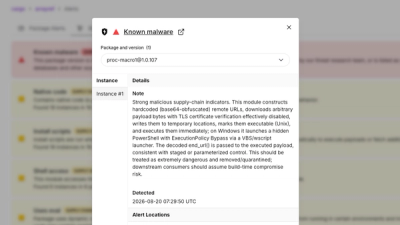
Three compromised Rust crates pulled in a malicious dependency that downloaded and executed cross-platform malware during Cargo builds.
Research
/Security News
Socket uncovered 77 linked Firefox extensions, including 40 that steal wallet secrets or credentials and 37 deceptive sports-score shells.