

Company News
AWS Security Hub Adds Socket for Supply Chain Security
Socket is now in the AWS Security Hub Extended plan. Adopt it through AWS, apply committed spend, and block malicious open source packages.
By Feross Aboukhadijeh - Aug 04, 2026
@clawops/cli
Advanced tools
clawops is a provider-agnostic CLI for deploying and operating self-hosted OpenClaw instances across AWS, GCP, Azure, and local VMs. It uses the Pulumi Automation API (embedded — no pulumi binary required) for idempotent infrastructure management and exposes every operation as both a CLI command and an MCP tool, so Claude Code, Cursor, and other AI agents can drive deployments deterministically.
npm install -g @clawops/cli
clawops init --provider aws
clawops plan --out /tmp/my-plan.json   # generate + review
clawops apply /tmp/my-plan.json        # apply after review
clawops logs -f
Every existing OpenClaw deployment path is cloud-specific, Kubernetes-bound, or fully managed SaaS. No open-source tool unifies provisioning + lifecycle management + remote agent interaction across providers under a single CLI with first-class AI agent integration.
| Capability | clawops |
|---|---|
| AWS, GCP, Azure, local VM | ✓ |
| Idempotent infra via Pulumi (embedded) | ✓ |
SSH transport (pure Node — no system ssh) | ✓ |
| MCP server (stdio + HTTP) | ✓ |
| Plan → review → apply discipline | ✓ |
JSON output everywhere (--json) | ✓ |
| No credentials in config | ✓ |
npm install -g @clawops/cli
# or without a global install:
npx @clawops/cli
# Write ~/.clawops/config.json and generate an SSH key pair
clawops init --provider aws

# Edit ~/.clawops/config.json — set stateUrl to your S3 bucket:
#   "stateUrl": "s3://my-clawops-state"

# Generate a deploy plan (runs pulumi preview internally)
clawops plan --provider aws --stack default --out /tmp/plan.json

# Review the plan JSON, then apply
clawops apply /tmp/plan.json

# Or preview + apply in one step (no plan file needed)
clawops up
clawops status              # Show stack outputs: IP, gateway URL, SSH info
clawops logs -f             # Tail OpenClaw logs over SSH
clawops ssh                 # Open an interactive SSH session
clawops ssh --command "docker ps"

clawops config get maxAgents
clawops config set maxAgents 8

clawops tunnel              # Port-forward gateway UI to localhost

clawops destroy --yes       # Destroy cloud-provider stack (AWS/GCP/Azure)
clawops down --yes          # Destroy local-provider stack
| Command | Description |
|---|---|
init | Interactive setup wizard — writes config, generates SSH key pair |
up | Provision or update stack (--dry-run for preview) |
down | Destroy local-provider stack (requires --yes; --dry-run shows current outputs) |
destroy | Destroy cloud-provider stack with confirmation prompt (--dry-run shows current outputs) |
status | Show stack outputs: IP, gateway URL, region, provisioned time |
plan | Generate a Maker deploy-plan JSON artifact (dry-run safe) |
apply | Apply a previously reviewed plan file (--dry-run validates and shows diff without applying) |
ssh | Interactive SSH session or run a remote command |
logs | Stream OpenClaw logs (-f, --tail N, --since 5m) |
tunnel | Local port-forward to gateway UI over SSH |
config | Get/set remote OpenClaw config values (--dry-run shows would-write JSON) |
agents | List or restart OpenClaw agents |
gateway | Restart the OpenClaw gateway service |
backup | Create or restore an OpenClaw state backup |
stacks | List named stacks and their state |
doctor | Check Node version, config, SSH key, provider credentials, and Pulumi home |
mcp | Start the embedded MCP server (mcp serve) |
Full flag reference: clawops <command> --help
For non-local providers, clawops enforces a review-before-apply discipline:
# 1. Generate a plan — runs `pulumi preview` internally, produces JSON
clawops plan --provider aws --region us-east-1 --out /tmp/plan.json

# 2. Review plan.json — it shows exactly which resources will change
cat /tmp/plan.json | jq .diff

# 3. Apply — reads and validates the plan file, then runs `pulumi up`
clawops apply /tmp/plan.json

# Without --yes, apply prompts: "Continue? (y/N)"
clawops apply /tmp/plan.json --yes    # skip prompt in automation
The plan JSON conforms to spec/deploy-plan.schema.json (AJV-validated). Plans are portable — generated on one machine, applied on another.
clawops ships an embedded MCP server. Claude Code, Cursor, and any MCP-compatible agent can drive deployments without leaving the chat interface.
Add to your Claude Code MCP config (~/.claude.json or project .mcp.json):
{
  "mcpServers": {
    "clawops": {
      "command": "clawops",
      "args": ["mcp", "serve"]
    }
  }
}
clawops mcp serve --http --port 3333 --bind 127.0.0.1
# MCP HTTP server listening on 127.0.0.1:3333
Point your MCP client at http://127.0.0.1:3333.
| Tool | Toolset | Description |
|---|---|---|
clawops_up | cli | Provision or update a stack |
clawops_status | read | Show stack outputs |
clawops_logs_tail | read | Tail OpenClaw logs |
clawops_ssh_exec | cli | Run a command over SSH |
clawops_plan | cli | Generate a deploy plan |
clawops_apply | cli | Apply a plan file |
clawops_destroy | cli | Destroy a stack (elicits confirmation) |
clawops_config_get | read | Read a remote config value |
clawops_config_set | cli | Write a remote config value |
clawops_agents_list | read | List running agents |
clawops_stacks_list | admin | List all stacks and their state |
clawops_task_status | read | Poll a long-running task |
clawops_workflow_deploy_app | workflow | End-to-end deploy: plan → confirm → apply → status |
Destructive tools require explicit confirmation (R19 elicitation) unless yes: true is passed.
Config lives at ~/.clawops/config.json (override with $CLAWOPS_HOME).
{
  "version": 1,
  "defaults": {
    "provider": "aws",
    "stack": "default"
  },
  "stacks": {
    "default": {
      "provider": "aws",
      "region": "us-east-1",
      "stateUrl": "s3://my-clawops-state"
    }
  },
  "ssh": {
    "keyPath": "~/.clawops/id_ed25519",
    "knownHostsPath": "~/.clawops/known_hosts"
  }
}
Cloud credentials are never stored in config — clawops reads them from the environment:
| Provider | Credential source |
|---|---|
| AWS | AWS_PROFILE or standard AWS credential chain (~/.aws/credentials) |
| GCP | GOOGLE_APPLICATION_CREDENTIALS or gcloud auth application-default login |
| Azure | AZURE_CLIENT_ID / AZURE_CLIENT_SECRET or az login |
| Local | SSH host + key configured in stacks[name].localOpts |
clawops
├── src/cli/          citty-based commands (one file per verb)
├── src/config/       ~/.clawops/config.json management
├── src/providers/    Cloud adapters (AWS, GCP, Azure, local)
│   ├── aws/          Pulumi inline program + ProviderAdapter
│   ├── gcp/
│   ├── azure/
│   └── local/        SSH bootstrap (no Pulumi)
├── src/pulumi/       Pulumi Automation API wrapper + output helpers
├── src/transport/    SSH client (ssh2) + connection pool + tunnels
├── src/mcp/          MCP server, tool handlers, progress tracking
├── src/plan/         Maker plan generation, AJV validation, apply
├── src/output/       ASCII table, spinner, JSON, human-readable output
├── src/errors/       Typed error hierarchy with exit codes
└── spec/             Machine-readable ground truth (JSON Schema, YAML)
Key design decisions:
pulumi binary required; Pulumi home is sandboxed to ~/.clawops/.pulumi; stack programs are inline TypeScript closuresgs://), S3 (s3://), Azure Blob — no local state files, no pulumi.yamlssh2: never shells out to /usr/bin/ssh; TOFU host verification against ~/.clawops/known_hosts; connection pool with 5-min idle TTLgeneratePlan() → review → applyPlan(); destructive changes always require human review of the plan JSONspec/mcp-tools.yaml; all destructive tools use R19 elicitationSee docs/architecture.md for a full narrative, and docs/decisions/ for ADRs.
git clone https://github.com/dfridkin/clawops.git
cd clawops
# Node 22+ required; use nvm: nvm use
pnpm install
pnpm dev doctor        # verify toolchain
pnpm dev                   # run CLI from src/ via tsx
pnpm build                 # tsup → dist/
pnpm test                  # vitest (356 tests, ~2s)
pnpm test:changed          # vitest --changed (fast edit loop)
pnpm typecheck             # tsc --noEmit
pnpm lint                  # eslint src/ tests/ scripts/ (--max-warnings=0)
pnpm gen:schemas           # regenerate src/providers/types.ts + src/mcp/tools/_generated.ts
pnpm gen:schemas --check   # CI guard: committed generated files match spec
pnpm changeset             # record a release note before merging
| Path | Purpose |
|---|---|
spec/ | Machine-readable ground truth: JSON Schema, YAML. Treat as source of truth. |
SPEC.md | Full technical specification (milestones, rules, schemas) |
DESIGN_RULES.md | 25 normative rules (R1–R25) referenced throughout the codebase |
docs/architecture.md | Narrative system overview |
docs/ci.md | CI integration guide: OIDC, env vars, plan → apply in CI |
docs/decisions/ | Architecture Decision Records |
.claude/skills/ | Invokable procedures: /add-provider, /release, /tdd, /mcp-tool |
.claude/rules/ | Path-scoped lint rules loaded by Claude Code |
Two files are generated from spec/ and must not be hand-edited:
src/providers/types.ts — ProviderAdapter interface from spec/providers.schema.jsonsrc/mcp/tools/_generated.ts — Zod schemas and type exports from spec/mcp-tools.yamlRun pnpm gen:schemas after modifying either spec file. CI enforces this with --check.
Use the /add-provider skill in Claude Code, or follow src/providers/CLAUDE.md. Every adapter must satisfy ProviderAdapter in src/providers/types.ts — do not relax the schema to fit the adapter.
Use the /mcp-tool skill. The skill adds the tool to spec/mcp-tools.yaml, runs pnpm gen:schemas, creates the handler in src/mcp/tools/<toolset>/<name>.ts, and wires it into the registry. All four annotation hints (readOnlyHint, destructiveHint, idempotentHint, openWorldHint) are required on every tool.
feat(scope): description
fix(scope): description
docs / refactor / chore / test / perf / ci
Use pnpm changeset to record a release note before merging a feat or fix.
| Milestone | Status | What ships |
|---|---|---|
| M0 — Scaffold | ✅ | Tooling, CI, stubs, generated types |
| M1 — GCP MVP | ✅ | init / up / down / status / ssh / logs on GCP |
| M2 — Remote Mgmt | ✅ | tunnel, config, agents, gateway; SSH connection pool |
| M3 — AWS + Azure | ✅ | AWS EC2 + Azure VM adapters; stacks list |
| M4 — Local VM | ✅ | Local adapter (SSH bootstrap, no Pulumi); doctor |
| M5 — MCP Layer | ✅ | mcp serve (stdio), all CLI ops as MCP tools, progress tracking |
| M6 — Plan/Apply | ✅ | plan + apply; deploy-plan schema; MCP HTTP transport; workflow_deploy_app |
| M7 — v1.0 Polish | ✅ | Full doctor surface; destroy command; --dry-run on up/down/destroy/apply/config; release.yml; CI integration guide |
MPL-2.0 — see LICENSE.
FAQs
Deploy and manage self-hosted OpenClaw instances across clouds
The npm package @clawops/cli receives a total of 52 weekly downloads. As such, @clawops/cli popularity was classified as not popular.
We found that @clawops/cli demonstrated a healthy version release cadence and project activity because the last version was released less than a year ago. It has 1 open source maintainer collaborating on the project.
Did you know?

Socket for GitHub automatically highlights issues in each pull request and monitors the health of all your open source dependencies. Discover the contents of your packages and block harmful activity before you install or update your dependencies.
Company News
Socket is now in the AWS Security Hub Extended plan. Adopt it through AWS, apply committed spend, and block malicious open source packages.
Research
/Security News
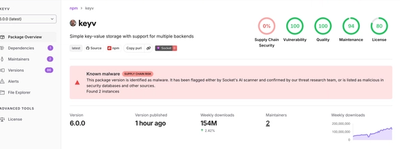
Popular npm packages keyv and cacheable compromised.

Security News
A misconfiguration gave three Anthropic models internet access, and one, believing it was in a simulation, shipped a credential-stealing package to PyPI.