
Product
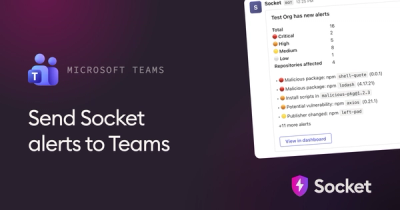
Microsoft Teams Notifications Are Now Available in Socket
Socket can now send alerts and supply chain attack notifications to Microsoft Teams, with filters that route the right updates to each channel.
By Jeppe Hasseriis - Sep 01, 2026
@cleocode/cleo-os
Advanced tools
CleoOS — the batteries-included agentic development environment wrapping Pi
The batteries-included agentic development environment. One developer. Many agents. One operating system for the work.
CleoOS wraps Pi — Mario Zechner's open-source coding agent — with CLEO's governance layer: task memory, lifecycle gates, multi-agent coordination, and the CANT DSL. Install once, get both.
npm install -g @cleocode/cleo-os
cleoos
That's it. CleoOS installs Pi automatically. The cleoos command launches
Pi with CleoOS extensions pre-loaded. The cleo CLI is also available for
task management, memory, and lifecycle operations.
| Goal | Start here |
|---|---|
| New to AI coding agents | The Hearth — what you see when you run cleoos |
| Already using Pi | What CleoOS Adds — the extensions Pi doesn't have |
| Comparing tools | Why CleoOS — how it differs from Claude Code, Cursor, Copilot |
AI coding agents can write code. What they cannot do is sustain a project across days, agents, and context windows. Each session starts fresh, forgets last week's architectural decision, and has no idea which tasks are blocked or why. The result: impressive demos, fragile projects.
CleoOS adds the missing layer. BRAIN persists memory across every session so agents never rediscover the same facts twice. The CANT DSL defines agent roles, permissions, and mental models in a checked-in file so governance is reproducible. The three-tier hierarchy gives leads the authority to coordinate without giving them the power to cause chaos, and gives workers a constrained domain where they can operate confidently.
The key differentiator is enforcement. Many tools describe role hierarchies. CleoOS enforces
them at the tool_call hook level inside Pi: lead agents literally cannot execute Edit,
Write, or Bash, and worker agents cannot write outside their declared file paths. There is
no workaround because the hook runs before Pi dispatches the tool call.
Pi provides excellent single-agent coding capability — a well-designed TUI, solid model integration, and a stable extension API. CleoOS is not a competitor. It is the governance shell that makes Pi production-ready for multi-agent workflows.
CleoOS is built on CLEO's five named powers. Each maps to a concrete runtime system:
| Power | What It Does |
|---|---|
| CLEO | Governs continuity, routing, and system action across all sessions |
| BRAIN | Stores durable project knowledge — observations, decisions, patterns, learnings |
| LOOM | Enforces order of operations through the RCASD-IVTR+C lifecycle |
| NEXUS | Connects projects without merging them — cross-project registry |
| LAFS | Standardizes outputs for tools and agents — progressive disclosure protocol |
CAAMP is the provisioning ally: it equips the realm with provider configs, skills, and injected instructions. See the CLEO World Map for the full narrative behind each power.
The Hearth is what you see when you run cleoos. It is Pi's terminal UI with CleoOS
extensions loaded automatically:
.cleo/cant/*.cant files and injects agent personas, tool ACLs,
and mental model preambles into the Pi session at startup. Compiles CANT DSL to system
prompt injection transparently.conduit.db
or api.signaldock.io. The chat room is a TUI view — it is not itself a messaging transport.The Hearth is the operator surface. Conduit is the agent relay below it.
The three-tier hierarchy is the headline feature of CleoOS. It brings structure to multi-agent projects by giving each tier distinct powers and hard constraints enforced at runtime.
Orchestrator (you, or /cleo:auto <epicId>)
    │
    ├── Engineering Lead (thinker, NEVER executes)
    │   ├── backend-dev   (worker, writes code)
    │   ├── frontend-dev  (worker, writes code)
    │   └── qa-engineer   (worker, writes tests)
    │
    ├── Validation Lead
    │   ├── security-reviewer (worker, audits)
    │   └── doc-writer        (worker, writes docs)
    │
    └── Release Lead
        └── release-manager   (worker, ships)
| Tier | Role | Power | Hard Constraint |
|---|---|---|---|
| Orchestrator | Runs the Conductor Loop (/cleo:auto <epicId>) | Full system access | HITL boundary — user approves epic-level decisions |
| Lead | Coordinates a worker group, reviews output, delegates | Read + think + delegate | CANNOT execute Edit, Write, or Bash — no exceptions |
| Worker | Executes concrete code changes within a declared domain | Read + write within domain | Path ACL: permissions.files: write[glob] — cannot write outside glob |
Enforcement runs at the Pi tool_call hook level. When a lead agent attempts to call
Edit, Write, or Bash, the hook intercepts the call before Pi dispatches it and
returns a rejection. When a worker agent attempts to write to a path outside its declared
glob pattern, the same hook rejects the call. There is no workaround at the agent level.
Teams are defined in .cleo/teams.cant:
team engineering-lead {
  role: lead
  workers: [backend-dev, frontend-dev, qa-engineer]
}

team backend-dev {
  role: worker
  permissions {
    files { write ["packages/core/**", "packages/contracts/**"] }
  }
}
| Feature | Status |
|---|---|
Lead tool blocking (Edit/Write/Bash rejected for role: lead) | Wave 7b shipped |
Worker path ACL (permissions.files: write[glob] enforced) | T422-T426 shipped |
.cleo/teams.cant definition format | Wave 0 shipped |
| Model tier routing (low/mid/high per tier) | Grammar shipped, router in progress |
| JIT agent composition (spawn team from task type) | Library exists, not wired to spawn path |
Conduit is CLEO's agent-to-agent communication layer, structured in four concentric shells. Each shell handles a different scope of agent communication.
Orchestrator-to-lead-to-worker communication inside a single session. Pi handles parent/child relay automatically via its JSONL subagent-link. No CLEO infrastructure needed. Zero latency. Zero cost.
Per-project local messaging in SQLite at .cleo/conduit.db. Provides messages,
conversations, delivery queue, and dead-letter handling. Used when agents communicate
across sessions or hand off state between orchestrator runs on the same machine. Also
holds project_agent_refs — per-project agent visibility overrides that layer on top of
the global identity registry.
Cross-machine and cross-project agent coordination via the signaldock-sdk Rust crate
against api.signaldock.io. Four services: AgentService, MessageService,
ConversationService, DeliveryOrchestrator. TypeScript reaches the cloud tier via
HttpTransport (polling) or SseTransport (real-time EventSource). Used when a fleet
of agents spans multiple machines or CI environments.
The CLEOOS-VISION message bus with Rust broker, TypeScript semantics, lease-based delivery, and dead-letter queue. Deferred until cross-worktree durability is required by real workflows.
Note: The Chat Room (
cleo-chatroom.ts) is a TUI view under The Hearth, not a Conduit shell. It gives the operator visibility into inter-agent messages. Messages displayed in the chat room flow throughconduit.dborsignaldock.io— the chat room itself is only a renderer.
| Capability | How | Source |
|---|---|---|
| CANT bridge | Injects agent personas from .cleo/cant/*.cant into Pi sessions at startup. Compiles CANT to system prompt injection. | extensions/cleo-cant-bridge.ts |
| Lead tool blocking | tool_call hook rejects Edit/Write/Bash for role: lead agents | Wave 7b |
| Worker path ACL | tool_call hook enforces permissions.files: write[glob] per worker | T422-T426 |
| Mental model injection | Fetches prior observations from BRAIN on spawn, injects validate-on-load preamble | Wave 8 |
| Chat room TUI | 4 inter-agent tools + below-editor widget showing last 15 messages | Wave 7 |
| XDG-compliant paths | All CleoOS state under ~/.local/share/cleo/ (Linux), ~/Library/Application Support/cleo/ (macOS) | src/xdg.ts |
| Pi keystore redirect | Pi credentials stored at ~/.config/cleo/auth/auth.json instead of Pi's default | src/keystore.ts |
| Postinstall scaffolding | Creates XDG dirs, deploys extensions, scaffolds model-routing.cant stub, installs CLEO skills | src/postinstall.ts |
CleoOS maintains five databases across two tiers per ADR-036 and ADR-037.
.cleo/)| Database | Purpose |
|---|---|
tasks.db | Task hierarchy, sessions, audit log, lifecycle pipelines |
brain.db | Observations, patterns, learnings, decisions (FTS5 searchable) |
conduit.db | Agent messaging, delivery queue, project_agent_refs |
$XDG_DATA_HOME/cleo/)| Database | Purpose |
|---|---|
nexus.db | Cross-project registry, federated queries |
signaldock.db | Canonical agent identity, cloud-sync tables |
Plus: global-salt (32-byte machine-bound key for API key derivation), machine-key,
extensions/, and cant/ directories for globally installed CANT files.
# One command installs both CleoOS and Pi
npm install -g @cleocode/cleo-os

# Verify
cleoos --version
cleo version
cleoos binary — launches Pi with CleoOS extensions pre-loadedcleo binary — CLEO CLI (90+ commands across 10 canonical domains)@mariozechner/pi-coding-agent — Mario Zechner's open-source AI coding agent~/.local/share/cleo/cleoos on first run, stored in ~/.config/cleo/auth/auth.json)+-----------------------------------------------------------+
| @cleocode/cleo-os |
| (CleoOS — batteries-included Pi wrapper) |
| |
| +------------------------+ +------------------------+ |
| | extensions/ | | extensions/ | |
| | cleo-cant-bridge.ts | | cleo-chatroom.ts | |
| | (CANT compile, | | (4 tools, TUI widget, | |
| | ACL enforcement, | | JSONL relay, | |
| | mental model inject) | | not a Conduit shell) | |
| +------------------------+ +------------------------+ |
| src/cli.ts <- cleoos launcher |
| src/postinstall.ts <- XDG scaffolding |
+-----------------------------------------------------------+
|
v (direct dependency)
+-----------------------------------------------------------+
| @mariozechner/pi-coding-agent |
| TUI, model providers, session management, |
| extension API, tool execution, subagent spawn |
+-----------------------------------------------------------+
|
v
+-----------------------------------------------------------+
| @cleocode/cleo |
| CLI (90+ commands), dispatch registry, |
| LAFS envelopes, 10 canonical domains |
+-----------------------------------------------------------+
|
v
+-----------------------------------------------------------+
| @cleocode/core |
| Tasks, sessions, memory, orchestration, |
| lifecycle, validation, backup, conduit |
+-----------------------------------------------------------+
|
v
+-----------------------------------------------------------+
| SQLite (node:sqlite via Drizzle ORM) |
| tasks.db brain.db conduit.db nexus.db |
| signaldock.db |
+-----------------------------------------------------------+
CleoOS runs a migration verify pre-check every time cleoos starts — before
Pi is imported and before any workers are dispatched. This prevents agents from
running against a drifted database and producing confusing mid-session errors.
cleoos invokes cleo upgrade --diagnose --json via subprocess (CLI
boundary — no direct imports from @cleocode/core). The result is classified
into three severity levels:
| Severity | Condition | Action |
|---|---|---|
| ok | All 5 DB findings are status:"ok" | Silent pass-through |
| warn | One or more findings are status:"warning" | Logged to stdout; startup continues |
| fatal | One or more findings are status:"error", OR the cleo binary could not be invoked | Structured error printed to stderr; startup halts (exit 2) |
warn corresponds to states the reconciler already auto-fixed (e.g. a missing
column that was backfilled, or signaldock.db not yet created). fatal
corresponds to states the reconciler could not resolve — a missing migration
folder, a schema missing a required table, or an unreachable cleo binary.
When CleoOS exits with code 2 and prints a fatal drift error:
CleoOS startup blocked — DB migration drift detected
═══════════════════════════════════════════════════════════

The following issues prevent safe worker spawn:

  [FATAL] tasks.db.journal
          Migration folder missing: .cleo/migrations/tasks does not exist
          Fix: Run: cleo init or cleo upgrade
Try these remediation steps in order:
cleo upgrade — applies pending migrations and repairs known drift.cleo upgrade --diagnose — detailed DB inspection showing every check.cleo init --force — resets tasks.db to a fresh state. Warning:
this destroys all task data. Run cleo backup add first if possible.cleo restore backup --file tasks.db — restore from the most recent
snapshot if the DB is corrupted.Set CLEO_SKIP_MIGRATION_CHECK=1 to skip the check entirely. This is
intended for CI environments where the DB is freshly initialised by the test
harness and no persistent CLEO state exists:
CLEO_SKIP_MIGRATION_CHECK=1 cleoos --version
The current implementation falls back to cleo upgrade --diagnose --json
because cleo admin migrations verify does not yet exist. When that verb
lands, the verifyMigrations() function will be updated to prefer it.
MigrationVerifyResult.usedDedicatedVerb will flip to true.
CleoOS ships in named waves. Each wave targets a vertical slice of the platform.
| Wave | Title | Status | Key Deliverable |
|---|---|---|---|
| 0 | CANT Grammar | Shipped | team, tool, mental_model document kinds |
| 2 | CANT Bridge MVP | Shipped | cleo-cant-bridge.ts — compile + inject at session_start |
| 3 | Launcher + Install | Shipped | cleoos binary, postinstall, XDG hub |
| 7 | Chat Room + Hierarchy | Shipped | 4 inter-agent tools, TUI widget, 3-tier enforcement |
| 7b | Lead Tool Blocking | Shipped | Edit/Write/Bash blocked for role: lead |
| 8 | Mental Model Injection | Shipped | validate-on-load from BRAIN on agent spawn |
| ACL | Worker Path ACL | Shipped | permissions.files: write[glob] enforcement |
| 1 | Render Pipeline | Partial | Rust stubs exist, no cant render CLI verb yet |
| 4 | Lifecycle Codegen | Partial | .cant files exist, stages.ts connection missing |
| 5 | JIT Agent Composer | Partial | Library shipped, not wired to spawn path |
| 6 | Model Router | In progress | Rust classifier crate exists |
| 9 | Three-Tier CANT Resolution | Not started | Global/user/project .cant file hierarchy |
MIT
FAQs
CleoOS — the batteries-included agentic development environment wrapping Pi
We found that @cleocode/cleo-os demonstrated a healthy version release cadence and project activity because the last version was released less than a year ago. It has 1 open source maintainer collaborating on the project.
Product
Socket can now send alerts and supply chain attack notifications to Microsoft Teams, with filters that route the right updates to each channel.
Security News
pnpm 12 rewrites the package manager in Rust, cutting install times by up to 90% while preserving pnpm 11 workflows and lockfiles.
Security News
Socket CTO Ahmad Nassri joins AppSec leaders at Black Hat to discuss active malware, package manager risks, and software supply chain defense.