


Product
PHP and Composer Support Is Now in Beta
Socket’s PHP and Composer support is now in Beta for all customers, with PHP reachability analysis generally available.
By Trevor Norris, Benjamin Barslev - Aug 21, 2026
@complyedge/sdk
Advanced tools
EU AI Act runtime enforcement SDK: OPA/Rego policy checks, Article 12 audit trails, risk assessment, and OpenAI middleware.
TypeScript/JavaScript SDK for ComplyEdge: runtime EU AI Act enforcement for AI agents.
Every check() call is evaluated against a deterministic Rego rule bundle, returns article-cited violations, and is written to an Article 12 audit trail.


npm install @complyedge/sdk
Requires Node.js 18 or later. Get an API key at dashboard.complyedge.io.
The SDK works in both ESM and CommonJS projects; no bundler-specific setup is required.
@complyedge/mcp runs the local, offline TrustLint MCP tools with npx.trustlint is the local Node.js CLI for offline rule checks.complyedge on PyPI is the Python SDK with the same enforcement API.@complyedge/sdk | trustlint | @complyedge/mcp | |
|---|---|---|---|
| Runs offline, no API key | ✗ | ✓ | ✓ |
| Rego / OPA evaluation | ✓ | ✗ | ✗ |
| Article 12 audit trail | ✓ | ✗ | ✗ |
| Bundled 64-rule corpus | ✗ | ✓ | ✓ |
| Temporal / effective-date rules | ✗ | ✗ | ✗ |
| ESM + CommonJS | ✓ | ✓ | ESM only |
| MCP host integration | ✗ | ✗ | ✓ |
Temporal / effective-date evaluation lives in the Python engine only. A shared version number across npm and PyPI is not a parity claim.
The TypeScript SDK and Python complyedge package have independent semantic versions. A version number does not imply feature parity across languages; each release documents and tests its own supported API surface.
import { ComplyEdgeClient } from "@complyedge/sdk";

const ce = new ComplyEdgeClient({ apiKey: process.env.COMPLYEDGE_API_KEY! });

const result = await ce.check("Score users based on their social behavior");

if (!result.allowed) {
  console.log("Blocked:", result.violations[0].ruleId);
  console.log("Why:", result.violations[0].ruleDescription);
  console.log("Audit event:", result.eventId);
}
Blocked output:
Blocked: rego-art5-1c-001
Why: Social scoring prohibited under Article 5(1)(c)
Audit event: evt_01J...
const ce = new ComplyEdgeClient({
  apiKey: process.env.COMPLYEDGE_API_KEY!,
  jurisdiction: "EU",   // default: "EU"
  agentId: "support-bot", // default: "default"
  timeout: 30_000,      // ms, default: 30_000
  baseUrl: "https://api.complyedge.io", // or COMPLYEDGE_API_URL
});
check(text, context?)Calls POST /v1/check, the deterministic OPA hot path. Returns:
| Field | Type | Meaning |
|---|---|---|
allowed | boolean | false means block before the model sees it |
status | "safe" | "violation" | Convenience mirror of allowed |
violations | ComplianceViolation[] | Rule ID, description, severity, reason, confidence |
eventId | string | Identifier of the audit record for this decision |
auditLogged | boolean | Whether the decision reached the Article 12 trail |
enginePath | string | opa, opa_fallback_llm, or opa_error |
latencyMs / opaLatencyMs | number | Server-reported latency |
bundleVersion | string | Rule bundle the decision was evaluated against |
evaluatedRules | string[] | Rule IDs considered |
Per-call context overrides the client defaults:
await ce.check(userPrompt, {
  direction: "prompt",     // "prompt" (user input) or "output" (model output)
  jurisdiction: "EU",
  agentId: "hr-screening",
  userRole: "recruiter",   // recorded for audit attribution
});
Wrap an OpenAI client so user messages are checked before they reach the model:
import OpenAI from "openai";
import { ComplyEdgeClient, withCompliance, ComplianceError } from "@complyedge/sdk";

const openai = withCompliance(
  new OpenAI(),
  new ComplyEdgeClient({ apiKey: process.env.COMPLYEDGE_API_KEY! }),
  { jurisdiction: "EU", blockOnViolation: true }
);

try {
  await openai.chat.completions.create({
    model: "gpt-4o",
    messages: [{ role: "user", content: prompt }],
  });
} catch (err) {
  if (err instanceof ComplianceError) {
    // Blocked before the request left your system.
  }
}
openai is an optional peer dependency. Install it only if you use the middleware.
const assessment = await ce.assessPreDeployment({
  systemPrompt: "You screen CVs and rank candidates.",
  jurisdiction: "EU",
});

console.log(assessment.riskTier);        // "high"
console.log(assessment.euAiActCategory); // "employment-workers"
detectSensitivity(text, context?)Legacy sensitivity detection (POST /v1/sensitivity/detect), kept for existing
callers. It runs the TrustLint and LLM pipeline, not OPA, and does not write
the Article 12 audit trail. Use check() for runtime enforcement.
Network and HTTP failures surface as AxiosError. The middleware throws
ComplianceError when a check blocks a request.
trustlint or @complyedge/mcp when a local-only check is required.pip install complyedgeApache-2.0. See LICENSE.
FAQs
EU AI Act runtime enforcement SDK: OPA/Rego policy checks, Article 12 audit trails, risk assessment, and OpenAI middleware.
The npm package @complyedge/sdk receives a total of 153 weekly downloads. As such, @complyedge/sdk popularity was classified as not popular.
We found that @complyedge/sdk demonstrated a healthy version release cadence and project activity because the last version was released less than a year ago. It has 1 open source maintainer collaborating on the project.
Product
Socket’s PHP and Composer support is now in Beta for all customers, with PHP reachability analysis generally available.
Product
Socket is bringing experimental protection to Firefox, scanning 97,000+ extensions in Mozilla's official directory for malware and risky updates.
Research
/Security News
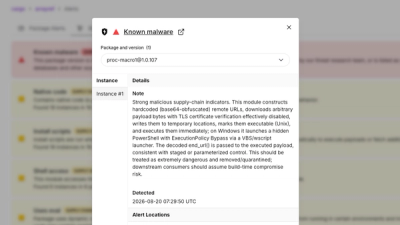
Three compromised Rust crates pulled in a malicious dependency that downloaded and executed cross-platform malware during Cargo builds.