
Product
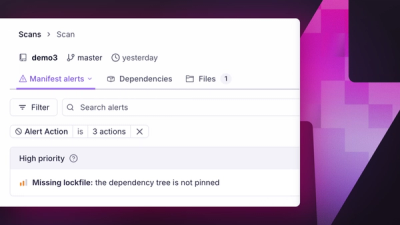
Introducing Manifest Alerts
Socket now detects supply chain risks in project manifests, starting with missing lockfiles that can make dependency installs non-reproducible.
By André Staltz, Trevor Norris - Jun 16, 2026
@computesdk/vercel
Advanced tools
Vercel Sandbox provider for ComputeSDK - serverless code execution for Python and Node.js on Vercel's edge network
Vercel provider for ComputeSDK - Execute Node.js and Python code in secure, isolated Vercel sandboxes.
npm install @computesdk/vercel
Vercel provider supports two authentication methods:
The simplest way to authenticate. Vercel manages token expiration automatically.
Development:
vercel env pull # Downloads VERCEL_OIDC_TOKEN to .env.local
Production: Vercel automatically provides VERCEL_OIDC_TOKEN in your deployment environment.
Alternative method using explicit credentials:
export VERCEL_TOKEN=your_vercel_token_here
export VERCEL_TEAM_ID=your_team_id_here
export VERCEL_PROJECT_ID=your_project_id_here
Get your token from Vercel Account Tokens
Use the gateway for zero-config auto-detection:
import { compute } from 'computesdk';

// Auto-detects Vercel from VERCEL_OIDC_TOKEN or VERCEL_TOKEN environment variables
const sandbox = await compute.sandbox.create();

// Execute Node.js command
const result = await sandbox.runCommand('node -e "console.log(\"Hello from Vercel!\")"');
console.log(result.stdout); // "Hello from Vercel!"

// Execute Python command
const pythonResult = await sandbox.runCommand('python -c "print(\"Hello from Python!\")"');
console.log(pythonResult.stdout); // "Hello from Python!"

await sandbox.destroy();
For direct SDK usage without the gateway:
import { vercel } from '@computesdk/vercel';

const compute = vercel({
  token: process.env.VERCEL_TOKEN,
  teamId: process.env.VERCEL_TEAM_ID,
  projectId: process.env.VERCEL_PROJECT_ID,
  runtime: 'python',
  timeout: 600000 // 10 minutes
});

const sandbox = await compute.sandbox.create();

const result = await sandbox.runCommand('node -e "console.log(\"Hello from Vercel!\")"');
console.log(result.stdout);

await sandbox.destroy();
# Method 1: OIDC Token (Recommended)
export VERCEL_OIDC_TOKEN=your_oidc_token_here

# Method 2: Traditional
export VERCEL_TOKEN=your_vercel_token_here
export VERCEL_TEAM_ID=your_team_id_here
export VERCEL_PROJECT_ID=your_project_id_here
interface VercelConfig {
  /** Vercel API token - if not provided, will use VERCEL_TOKEN env var */
  token?: string;
  /** Vercel team ID - if not provided, will use VERCEL_TEAM_ID env var */
  teamId?: string;
  /** Vercel project ID - if not provided, will use VERCEL_PROJECT_ID env var */
  projectId?: string;
  /** Default runtime environment */
  runtime?: 'node' | 'python';
  /** Execution timeout in milliseconds */
  timeout?: number;
}
// Execute Node.js code
const result = await sandbox.runCommand(`node - <<'JS'
const data = { message: "Hello from Node.js" };
console.log(JSON.stringify(data));
JS`);

// Execute Python code
const result = await sandbox.runCommand(`python - <<'PY'
import json
data = {"message": "Hello from Python"}
print(json.dumps(data))
PY`);

// Auto-detection (based on code patterns)
const result = await sandbox.runCommand('python -c "print(\"Auto-detected as Python\")"');
// List files
const result = await sandbox.runCommand('ls', ['-la']);

// Install packages (Node.js)
const result = await sandbox.runCommand('npm', ['install', 'lodash']);

// Install packages (Python)
const result = await sandbox.runCommand('pip', ['install', 'requests']);

// Run scripts
const result = await sandbox.runCommand('node', ['script.js']);
// Write file
await sandbox.filesystem.writeFile('/tmp/hello.py', 'print("Hello World")');

// Read file
const content = await sandbox.filesystem.readFile('/tmp/hello.py');

// Create directory
await sandbox.filesystem.mkdir('/tmp/data');

// List directory contents
const files = await sandbox.filesystem.readdir('/tmp');

// Check if file exists
const exists = await sandbox.filesystem.exists('/tmp/hello.py');

// Remove file or directory
await sandbox.filesystem.remove('/tmp/hello.py');
// Get sandbox info
const info = await sandbox.getInfo();
console.log(info.id, info.provider, info.status);

// Get existing sandbox
const existing = await compute.sandbox.getById(provider, 'sandbox-id');

// Destroy sandbox
await compute.sandbox.destroy(provider, 'sandbox-id');

// Note: Vercel doesn't support listing all sandboxes
// Each sandbox is ephemeral and single-use
The provider automatically detects the runtime based on code patterns:
Python indicators:
print( statementsimport statementsdef function definitionsf", __, etc.)Default: Node.js for all other cases
import { vercel } from '@computesdk/vercel';

try {
  const compute = vercel({
    token: process.env.VERCEL_TOKEN,
    teamId: process.env.VERCEL_TEAM_ID,
    projectId: process.env.VERCEL_PROJECT_ID
  });
  const sandbox = await compute.sandbox.create();

  const result = await sandbox.runCommand('invalid code');
} catch (error) {
  if (error.message.includes('Missing Vercel authentication')) {
    console.error('Set VERCEL_OIDC_TOKEN or VERCEL_TOKEN environment variables');
  } else if (error.message.includes('authentication failed')) {
    console.error('Check your Vercel credentials');
  } else if (error.message.includes('team/project configuration failed')) {
    console.error('Check your VERCEL_TEAM_ID and VERCEL_PROJECT_ID');
  } else if (error.message.includes('Syntax error')) {
    console.error('Code has syntax errors');
  }
}
import { vercel } from '@computesdk/vercel';

const compute = vercel({ runtime: 'node' });
const sandbox = await compute.sandbox.create();

const result = await sandbox.runCommand(`node - <<'JS'
const http = require('http');
const url = require('url');

// Simulate API endpoints
const routes = {
  '/api/users': () => ({
    users: [
      { id: 1, name: 'Alice', role: 'Developer' },
      { id: 2, name: 'Bob', role: 'Designer' }
    ]
  }),
  '/api/health': () => ({
    status: 'healthy',
    timestamp: new Date().toISOString()
  })
};

// Process request
const path = '/api/users';
const response = routes[path] ? routes[path]() : { error: 'Not found' };

console.log('Response:', JSON.stringify(response, null, 2));
JS`);

console.log(result.stdout);
await sandbox.destroy();
import { vercel } from '@computesdk/vercel';

const compute = vercel({ runtime: 'python' });
const sandbox = await compute.sandbox.create();

const result = await sandbox.runCommand(`python - <<'PY'
import json
import statistics
from collections import Counter

# Sample data
sales_data = [
    {"product": "laptop", "quantity": 5, "price": 999},
    {"product": "mouse", "quantity": 20, "price": 25},
    {"product": "keyboard", "quantity": 15, "price": 75},
    {"product": "laptop", "quantity": 3, "price": 999},
    {"product": "mouse", "quantity": 10, "price": 25}
]

# Aggregate sales
product_sales = {}
for sale in sales_data:
    product = sale["product"]
    revenue = sale["quantity"] * sale["price"]
    product_sales[product] = product_sales.get(product, 0) + revenue

# Calculate statistics
revenues = list(product_sales.values())
total_revenue = sum(revenues)
avg_revenue = statistics.mean(revenues)

print(f"Total Revenue: ${total_revenue}")
print(f"Average Revenue per Product: ${avg_revenue:.2f}")
print("\\nRevenue by Product:")
for product, revenue in sorted(product_sales.items(), key=lambda x: x[1], reverse=True):
    print(f"  {product}: ${revenue}")
PY`);

console.log(result.stdout);
await sandbox.destroy();
import { vercel } from '@computesdk/vercel';

const compute = vercel({ runtime: 'python' });
const sandbox = await compute.sandbox.create();

// Create project structure
await sandbox.filesystem.mkdir('/tmp/project');
await sandbox.filesystem.mkdir('/tmp/project/data');
await sandbox.filesystem.mkdir('/tmp/project/output');

// Create configuration file
const config = {
  project_name: "Vercel Data Pipeline",
  version: "1.0.0",
  settings: {
    input_format: "json",
    output_format: "csv",
    debug: true
  }
};

await sandbox.filesystem.writeFile(
  '/tmp/project/config.json',
  JSON.stringify(config, null, 2)
);

// Create sample data
const sampleData = [
  { id: 1, name: "Alice", department: "Engineering", salary: 95000 },
  { id: 2, name: "Bob", department: "Marketing", salary: 75000 },
  { id: 3, name: "Charlie", department: "Engineering", salary: 105000 },
  { id: 4, name: "Diana", department: "Sales", salary: 85000 }
];

await sandbox.filesystem.writeFile(
  '/tmp/project/data/employees.json',
  JSON.stringify(sampleData, null, 2)
);

// Process data
const result = await sandbox.runCommand(`python - <<'PY'
import json
import csv
from collections import defaultdict

# Read configuration
with open('/tmp/project/config.json', 'r') as f:
    config = json.load(f)

print(f"Running {config['project_name']} v{config['version']}")

# Read employee data
with open('/tmp/project/data/employees.json', 'r') as f:
    employees = json.load(f)

# Process data - calculate department statistics
dept_stats = defaultdict(list)
for emp in employees:
    dept_stats[emp['department']].append(emp['salary'])

# Calculate averages
results = []
for dept, salaries in dept_stats.items():
    avg_salary = sum(salaries) / len(salaries)
    results.append({
        'department': dept,
        'employee_count': len(salaries),
        'average_salary': round(avg_salary, 2),
        'total_salary': sum(salaries)
    })

# Sort by average salary
results.sort(key=lambda x: x['average_salary'], reverse=True)

# Write results as JSON
with open('/tmp/project/output/department_stats.json', 'w') as f:
    json.dump(results, f, indent=2)

# Write results as CSV
with open('/tmp/project/output/department_stats.csv', 'w', newline='') as f:
    writer = csv.DictWriter(f, fieldnames=['department', 'employee_count', 'average_salary', 'total_salary'])
    writer.writeheader()
    writer.writerows(results)

print("Processing complete!")
print(f"Generated {len(results)} department statistics")

# Print summary
for result in results:
    print(f"{result['department']}: {result['employee_count']} employees, avg salary ${result['average_salary']}")
PY`);

console.log('Execution Output:', result.stdout);

// Read and display results
const jsonResults = await sandbox.filesystem.readFile('/tmp/project/output/department_stats.json');
const csvResults = await sandbox.filesystem.readFile('/tmp/project/output/department_stats.csv');

console.log('JSON Results:', jsonResults);
console.log('CSV Results:', csvResults);

// List all generated files
const outputFiles = await sandbox.filesystem.readdir('/tmp/project/output');
console.log('Generated files:');
outputFiles.forEach(file => {
  console.log(`  ${file.name} (${file.size} bytes)`);
});

await sandbox.destroy();
import { vercel } from '@computesdk/vercel';

const compute = vercel({ runtime: 'node' });
const sandbox = await compute.sandbox.create();

// Install lodash
const installResult = await sandbox.runCommand('npm', ['install', 'lodash']);
console.log('Install result:', installResult.stdout);

// Use lodash in code
const result = await sandbox.runCommand(`node - <<'JS'
const _ = require('lodash');

const data = [
  { name: 'Alice', age: 25, city: 'New York' },
  { name: 'Bob', age: 30, city: 'San Francisco' },
  { name: 'Charlie', age: 35, city: 'Chicago' }
];

// Group by city
const grouped = _.groupBy(data, 'city');
console.log('Grouped by city:', JSON.stringify(grouped, null, 2));

// Calculate average age
const avgAge = _.meanBy(data, 'age');
console.log('Average age:', avgAge);

// Find oldest person
const oldest = _.maxBy(data, 'age');
console.log('Oldest person:', oldest.name);
JS`);

console.log(result.stdout);
await sandbox.destroy();
MIT
FAQs
Vercel Sandbox provider for ComputeSDK - serverless code execution for Python and Node.js on Vercel's edge network
The npm package @computesdk/vercel receives a total of 363 weekly downloads. As such, @computesdk/vercel popularity was classified as not popular.
We found that @computesdk/vercel demonstrated a healthy version release cadence and project activity because the last version was released less than a year ago. It has 1 open source maintainer collaborating on the project.
Did you know?

Socket for GitHub automatically highlights issues in each pull request and monitors the health of all your open source dependencies. Discover the contents of your packages and block harmful activity before you install or update your dependencies.
Product
Socket now detects supply chain risks in project manifests, starting with missing lockfiles that can make dependency installs non-reproducible.

Research
/Security News
The trojanized extensions use TinyGo-compiled WebAssembly and Solana transaction memos to resolve command-and-control infrastructure.

Security News
Anthropic says the directive cited national security concerns over a narrow jailbreak, but offered no specific technical details.