

Company News
AWS Security Hub Adds Socket for Supply Chain Security
Socket is now in the AWS Security Hub Extended plan. Adopt it through AWS, apply committed spend, and block malicious open source packages.
By Feross Aboukhadijeh - Aug 04, 2026
@contextstream/mcp-server
Advanced tools
MCP server that gives AI coding assistants persistent memory, semantic code search, a dependency graph, grounded Q&A, and team context (GitHub/Slack/Notion) — works with Claude Code, Cursor, VS Code Copilot, Windsurf, Cline, and any Model Context Protocol

Persistent memory, semantic code search, and team context for Claude Code, Cursor, VS Code Copilot, Windsurf — and every MCP-compatible AI coding assistant.
🏆 90.0% on LongMemEval-S — the full 500-instance suite with the official judge.
Beats supermemory with statistical significance; matches Zep. See the benchmarks →




Documentation • Pricing • FAQ
npx --prefer-online -y @contextstream/mcp-server@latest setup
That one command detects your AI editors, writes their MCP configs and rules, installs lifecycle hooks where supported, indexes your project in the background, and verifies everything it just did — then you restart your editor and your AI has memory. Free tier available.
Automating it? Zero-prompt mode takes every default:
npx --prefer-online -y @contextstream/mcp-server@latest setup --yes

ContextStream scores 90.0% on the full LongMemEval-S benchmark, the standard test of conversational memory over ~115k-token multi-session histories. That's the complete 500-instance suite with the official GPT-4o judge — 450/500 correct (89.6% single-shot, 90.0% with self-consistency k=3; Wilson 95% CI [87.1%, 92.3%]). Published June 14, 2026.
| System | LongMemEval-S | Notes |
|---|---|---|
| ContextStream | 90.0% | Full 500 instances, official GPT-4o judge |
| Zep | 90.2% | Vendor-published — a statistical tie (0.2 pt is inside measurement noise) |
| supermemory | 85.4% | Vendor-published — ContextStream wins with statistical significance |
On multi-session recall — the memory that actually matters for a coding agent working across days of sessions — ContextStream scores 81.2% vs Zep's published 57.9% in the per-family comparison. And on the agentic project-memory benchmark, the same memory raises agent task success from 58% to 96%.
Full methodology, per-family breakdowns, and judge-comparability notes (competitor numbers are cited from each vendor's own publications): contextstream.io/benchmarks
ContextStream is a Model Context Protocol (MCP) server that gives AI coding assistants long-term memory and deep codebase understanding. It indexes your code for semantic search, records your decisions, lessons, and plans across sessions, maps your dependency graph, and pulls in team knowledge from GitHub, Slack, and Notion — then delivers exactly the right slice of all that to your AI on every message.
It works with any MCP client: Claude Code, Cursor, VS Code + GitHub Copilot, Windsurf, Cline, Roo Code, Kilo Code, Codex CLI, OpenCode, Aider, Antigravity, and Claude Desktop.
ContextStream has independent release lines. A 0.5.x hosted version and a 0.4.x npm version are different runtimes, not evidence that either updater is broken.
| Runtime | How to identify it | Version line | Canonical release metadata and notes |
|---|---|---|---|
| Hosted MCP | Your editor config uses https://mcp.contextstream.io/mcp. help(action="version") reports runtime_type: rust-mcp. | Rust MCP 0.5.x | help(action="version") returns release notes inline when published and links the machine-readable R2 manifest. |
| Installed Rust MCP | Your editor launches a contextstream-mcp binary installed by https://contextstream.io/scripts/mcp.sh; run contextstream-mcp --version. | Rust MCP 0.5.x | The same machine-readable R2 manifest; help(action="version") maps this runtime to that manifest. |
| Legacy npm MCP (this repository) | Your editor launches npx ... @contextstream/mcp-server or a global npm install. help(action="version") reports runtime_type: legacy-typescript-mcp; npm list -g @contextstream/mcp-server shows the installed package. | TypeScript MCP 0.4.x | GitHub releases and this repository's CHANGELOG.md. |
| ContextStream Desktop | Check the app's About/update UI. Desktop may run the local sync bridge, but that does not change the MCP runtime configured in your editor. | Desktop 0.3.x (independent) | The in-app updater and the public Desktop version JSON, which includes release_notes and platform downloads. |
The version reported by help(action="version") is always the MCP process serving that tool call. Desktop's version is separate, even when Desktop added or indexed the local repository.
Because every conversation starts from zero. Your AI re-reads the same files, re-derives the same architecture, repeats last week's mistake, and loses the thread the moment the context window compacts. ContextStream fixes the whole class of problem:
| Without ContextStream | With ContextStream |
|---|---|
| AI greps files one-by-one, burning tokens | Semantic code search finds code by meaning in milliseconds |
| Context lost when conversations get long | Pre-compaction capture saves critical state before it's gone — and restores it after |
| Same mistakes repeated across sessions | Lessons system surfaces past failures before your AI repeats them |
| "Why did we choose X?" — nobody remembers | Decisions and plans persist and resurface when relevant |
| Team knowledge scattered across tools | GitHub, Slack, and Notion knowledge, queried automatically |
| Generic answers with no project awareness | Workspace context on every single message |
Ask "where do we handle authentication?" and get ranked, snippet-level answers instantly. Hybrid semantic + keyword search with exact-token fusion, so a symbol lookup like resolveWriteScope lands the definition — not lookalikes. Search works the moment setup finishes: keyword results come back immediately while the semantic index builds in the background.
Decisions, lessons, preferences, plans, tasks, docs, runbooks — captured during work and surfaced automatically on later turns, in later sessions, even after context compaction. Every prior session's transcript is indexed and queryable: "what did we decide about the id format last week?" just works.
The built-in Agent Q&A tool lets your AI ask your workspace's knowledge base — prior decisions, conventions, runbooks, guardrails — and get a grounded answer with citations for every claim.
"What depends on UserService?" "What breaks if I change this function?" Dependency mapping, impact analysis, circular-dependency and dead-code detection over your whole codebase.
ContextCapsule packages project state into a portable, shareable snapshot — bootstrap a fresh agent, hand off to a teammate, or share a token-gated link with an external agent.
Token pressure is tracked continuously (with thresholds sized to your model's context window). Before compaction hits, critical state is checkpointed; after it, context restores.
| Editor / Agent | Managed rules | MCP config | Lifecycle hooks |
|---|---|---|---|
| Claude Code | ✅ | ✅ | ✅ |
| Cursor | ✅ (.cursor/rules/*.mdc) | ✅ | ✅ |
| Windsurf | ✅ | ✅ | ✅ |
| Cline | ✅ | ✅ | ✅ |
| Roo Code | ✅ | ✅ | ✅ |
| Kilo Code | ✅ | ✅ | rules-based |
| VS Code + GitHub Copilot | ✅ | ✅ (incl. hosted OAuth) | rules-based |
| Codex CLI | ✅ | ✅ | rules-based |
| OpenCode | ✅ | ✅ | rules-based |
| Aider | ✅ | ✅ | rules-based |
| Antigravity | ✅ | ✅ | rules-based |
| Claude Desktop | — | ✅ | — |
Anything that speaks the Model Context Protocol can connect — the table just shows what the setup wizard configures automatically.
36 tools in the default surface, organized as consolidated domains so they cost ~75% fewer tokens than individual registrations. The tools your AI gets:
Plus focused write tools (capture_plan, memory_create_doc, session_capture_lesson, …) so agents that display tool names show what they're doing. Your AI uses all of this automatically — you just code.
Daily Recaps are generated around 23:00 in your configured timezone when there is enough activity. They are not triggered by closing an editor, changing an MCP session_id, or starting a new chat, so long-lived VS Code/Copilot connections do not suppress the nightly job.
session(action="list_recaps", workspace_id="<uuid>", limit=30) lists completed recaps newest-first with recap_date and generated_at timestamps.session(action="trigger_recap", workspace_id="<uuid>") queues an asynchronous manual recap. Call list_recaps afterward to verify completion.These actions use the same recap history and generation service as the dashboard.
contextstream-mcp setup            # interactive onboarding wizard
contextstream-mcp setup --yes      # zero-prompt setup with sane defaults (great for CI/dotfiles)
contextstream-mcp doctor           # ✓/✗ diagnostics: auth, scope, index health, rules, hooks
contextstream-mcp index [path]     # index a project folder on demand
setup --editors=claude,cursor limits configuration to specific editors; doctor tells you exactly what's misconfigured and how to fix it — it runs automatically at the end of every setup.
Skip this if you ran the setup wizard.
claude mcp add contextstream -- npx --prefer-online -y @contextstream/mcp-server@latest
claude mcp update contextstream -e CONTEXTSTREAM_API_URL=https://api.contextstream.io -e CONTEXTSTREAM_API_KEY=your_key
{
  "mcpServers": {
    "contextstream": {
      "command": "npx",
      "args": ["--prefer-online", "-y", "@contextstream/mcp-server@latest"],
      "env": {
        "CONTEXTSTREAM_API_URL": "https://api.contextstream.io",
        "CONTEXTSTREAM_API_KEY": "your_key"
      }
    }
  }
}
Locations: ~/.cursor/mcp.json • ~/Library/Application Support/Claude/claude_desktop_config.json
Local server:
{
  "$schema": "https://opencode.ai/config.json",
  "mcp": {
    "contextstream": {
      "type": "local",
      "command": ["npx", "-y", "contextstream-mcp"],
      "environment": {
        "CONTEXTSTREAM_API_KEY": "{env:CONTEXTSTREAM_API_KEY}"
      },
      "enabled": true
    }
  }
}
Remote server:
{
  "$schema": "https://opencode.ai/config.json",
  "mcp": {
    "contextstream": {
      "type": "remote",
      "url": "https://mcp.contextstream.com",
      "enabled": true
    }
  }
}
For the local variant, export CONTEXTSTREAM_API_KEY before launching OpenCode.
Locations: ./opencode.json • ~/.config/opencode/opencode.json
The easiest path is the hosted remote MCP with built-in OAuth — no API key in the config file:
{
  "servers": {
    "contextstream": {
      "type": "http",
      "url": "https://mcp.contextstream.io/mcp?default_context_mode=fast"
    }
  }
}
setup defaults VS Code/Copilot to this hosted remote on the production cloud. To force a local runtime, run setup with CONTEXTSTREAM_VSCODE_MCP_MODE=local, or use stdio directly:
{
  "servers": {
    "contextstream": {
      "type": "stdio",
      "command": "npx",
      "args": ["--prefer-online", "-y", "@contextstream/mcp-server@latest"],
      "env": {
        "CONTEXTSTREAM_API_URL": "https://api.contextstream.io",
        "CONTEXTSTREAM_API_KEY": "your_key",
        "CONTEXTSTREAM_TOOLSET": "complete"
      }
    }
  }
}
Keep both ~/.copilot/mcp-config.json (uses mcpServers) and .vscode/mcp.json (uses servers) in sync — setup writes both.
Use /mcp add interactively, or add to ~/.copilot/mcp-config.json:
{
  "mcpServers": {
    "contextstream": {
      "command": "npx",
      "args": ["--prefer-online", "-y", "@contextstream/mcp-server@latest"],
      "env": {
        "CONTEXTSTREAM_API_URL": "https://api.contextstream.io",
        "CONTEXTSTREAM_API_KEY": "your_key",
        "CONTEXTSTREAM_TOOLSET": "complete"
      }
    }
  }
}
See the GitHub Copilot CLI documentation for details.
Folders that aren't associated with any project (your home directory, ad-hoc scratch dirs) still work: init falls back to a hidden catch-all workspace in workspace-only mode, memory/session/context tools keep functioning, and project-bound actions return guided remediation instead of raw errors. The moment you enter a mapped project folder, the real workspace/project takes over.
An MCP (Model Context Protocol) server exposes tools and context to AI assistants over a standard protocol. Claude Code, Cursor, VS Code Copilot, Windsurf, and most modern AI coding tools are MCP clients — install one server, and every client you use gets the same capabilities.
Yes — all of them, plus Cline, Roo Code, Kilo Code, Codex CLI, OpenCode, Aider, Antigravity, and Claude Desktop. The setup wizard configures each editor's MCP config, managed rules, and (where the editor supports them) lifecycle hooks automatically.
Your code is private and securely stored, isolated per workspace with no cross-tenant access. You control exclusions with .contextstream/ignore (gitignore syntax), and project(action="purge") completely de-indexes a project on demand — without touching your captured memory.
There's a free tier to start with. Larger indexes, the full code graph, and team features are on paid plans: see pricing.
90.0% on the full 500-instance LongMemEval-S suite with the official GPT-4o judge (89.6% single-shot) — beating supermemory's published 85.4% with statistical significance and matching Zep's published 90.2% within the confidence interval. On multi-session recall specifically, ContextStream scores 81.2% vs Zep's published 57.9%. Methodology and per-family breakdowns: contextstream.io/benchmarks.
Most tools store notes. ContextStream combines memory (decisions, lessons, plans, session transcripts), semantic code search over your indexed codebase, a dependency/knowledge graph, grounded Q&A with citations, and team integrations (GitHub, Slack, Notion) behind one MCP server — and proactively delivers the relevant slice on every message instead of waiting to be asked.
Yes: setup --yes runs the entire wizard with zero prompts (set CONTEXTSTREAM_API_KEY in the environment), --editors=<list> scopes it, and contextstream-mcp doctor gives scriptable ✓/✗ diagnostics.
No. Project indexing runs in the background — keyword search works immediately, and semantic results fill in as the index builds. Check progress anytime with contextstream-mcp doctor.
Remove the contextstream entry from your editor's MCP config, and set CONTEXTSTREAM_HOOK_ENABLED=false (or re-run setup) to disable hooks. project(action="forget_local") unbinds a folder locally without touching server-side data.
contextstream-mcp doctor — it checks auth, API reachability, folder scope, index health, rule files, and hooks, with a fix hint per failure.CONTEXTSTREAM_API_URL and CONTEXTSTREAM_API_KEY are set; remove stale version pins like @contextstream/mcp-server@0.3.xx.vscode.dev; where that's blocked (corporate networks), use stdio with an API key instead.@modelcontextprotocol/sdk 1.28.0+ introduces breaking changes; this package pins >=1.25.1 <1.28.0. If you see Zod schema errors on startup, check your SDK resolution.Website: https://contextstream.io • Docs: https://contextstream.io/docs • Changelog: CHANGELOG.md
Stop teaching your AI the same things over and over.
ContextStream makes it brilliant from the first message.
FAQs
MCP server that gives AI coding assistants persistent memory, semantic code search, a dependency graph, grounded Q&A, and team context (GitHub/Slack/Notion) — works with Claude Code, Cursor, VS Code Copilot, Windsurf, Cline, and any Model Context Protocol
The npm package @contextstream/mcp-server receives a total of 153 weekly downloads. As such, @contextstream/mcp-server popularity was classified as not popular.
We found that @contextstream/mcp-server demonstrated a healthy version release cadence and project activity because the last version was released less than a year ago. It has 1 open source maintainer collaborating on the project.
Did you know?

Socket for GitHub automatically highlights issues in each pull request and monitors the health of all your open source dependencies. Discover the contents of your packages and block harmful activity before you install or update your dependencies.
Company News
Socket is now in the AWS Security Hub Extended plan. Adopt it through AWS, apply committed spend, and block malicious open source packages.
Research
/Security News
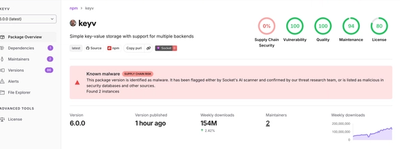
Popular npm packages keyv and cacheable compromised.

Security News
A misconfiguration gave three Anthropic models internet access, and one, believing it was in a simulation, shipped a credential-stealing package to PyPI.