

Company News
AWS Security Hub Adds Socket for Supply Chain Security
Socket is now in the AWS Security Hub Extended plan. Adopt it through AWS, apply committed spend, and block malicious open source packages.
By Feross Aboukhadijeh - Aug 04, 2026
@coo-quack/calc-mcp
Advanced tools
21 MCP tools for math, randomness, dates, encoding, hashing, and more — deterministic and accurate.


📖 Documentation — Full tool reference, examples, and install guides.
21 tools for things AI is not good at — deterministic math, cryptographic randomness, accurate date arithmetic, encoding, hashing, and more.
LLMs hallucinate calculations, can't generate true random numbers, and struggle with timezones. This MCP server fixes that.
# Claude Code
claude mcp add -s user calc-mcp -- npx --prefix /tmp -y @coo-quack/calc-mcp@2.0.4
# Or just run it
npx --prefix /tmp -y @coo-quack/calc-mcp@2.0.4
Works with Claude Desktop, VS Code Copilot, Cursor, Windsurf, and any MCP client — setup guides below.
Windows note: These examples use
/tmpas the npx prefix — on Windows, replace it with a writable directory such asC:\Temp.
| AI alone | With calc-mcp |
|---|---|
| "10 + 34 × 341 ÷ 23 = 507.8" ❌ | 514.087 ✅ (math) |
| "Here's a UUID: 550e8400-..." 🤷 fake | Cryptographically random UUID v4/v7 ✅ (random) |
| "100 days from now is..." 🤔 guess | 2026-05-22 ✅ (date) |
| "SHA-256 of password123 is..." 💀 hallucinated | {"hash": "ef92b778bafe..."} ✅ (hash) |
Ask in natural language — your AI assistant selects the appropriate tool.
| You ask | You get | Tool |
|---|---|---|
| What's 10 + 34 × 341 ÷ 23? | 514.087 | math |
| Convert 255 to binary | 11111111 | base |
| Is 4539578763621486 a valid card number? | true | luhn |
| You ask | You get | Tool |
|---|---|---|
| How many characters in "Hello, World! 🌍"? | 15 chars, 18 bytes | count |
| Base64 encode "Hello World" | SGVsbG8gV29ybGQ= | base64 |
| Base64 decode "eyJhbGciOiJIUzI1NiJ9" | {"alg":"HS256"} | base64 |
| URL-encode "hello world" | hello%20world | encode |
| URL-decode "hello%20world" | hello world | encode |
HTML-decode <script> | <script> | encode |
| SHA-256 hash of "password123" | {"hash": "ef92b778bafe..."} | hash |
| HMAC-SHA256 of "message" with key "secret" | {"hash": "8b5f48702995..."} | hash |
| You ask | You get | Tool |
|---|---|---|
| What time is it in New York? | 2026-02-10T19:00:00-05:00 | datetime |
| What's 100 days after 2026-02-11? | 2026-05-22 | date |
| When does "30 9 * * 1-5" run? | Mon–Fri at 9:30 | cron_parse |
| You ask | You get | Tool |
|---|---|---|
| Generate a UUID v7 | 019c4b54-aad2-7e52-... | random |
| Generate a readable 20-char password | hT9jZDojX6sHRJt8vaKS | random |
| Shuffle ["Alice", "Bob", "Charlie"] | ["Charlie", "Alice", "Bob"] | random |
| You ask | You get | Tool |
|---|---|---|
| 100 miles in kilometers? | 160.93 km | convert |
| 72°F in Celsius? | 22.22°C | convert |
| Convert #FF5733 to RGB | rgb(255, 87, 51) | color |
| Convert rgba(255, 0, 0, 0.5) to 8-digit HEX | #ff000080 | color |
| You ask | You get | Tool |
|---|---|---|
| Extract numbers from "abc123def456" | 123, 456 | regex |
| Does 1.5.3 satisfy ^1.0.0? | true | semver |
| Does 1.8.0 satisfy ">=1.5.0 <2.0.0"? | true | semver |
| IP range of 192.168.1.0/24? | 192.168.1.1 – .254 (254 hosts) | ip |
| Edit distance: "kitten" → "sitting" | 3 | diff |
| Unicode info for "€" | U+20AC, Currency Symbols | char_info |
Is {"name":"test"} valid JSON? | valid, object | format_validate |
| You ask | You get | Tool |
|---|---|---|
| Decode this JWT: eyJhbGci... | { alg: "HS256", name: "John Doe" } | jwt_decode |
| Parse https://example.com/search?q=hello | host: example.com, q: "hello" | url_parse |
| Tool | Description |
|---|---|
math | Evaluate expressions, statistics |
count | Characters (grapheme-aware), words, lines, bytes |
datetime | Current time, timezone conversion, UNIX timestamps |
random | UUID v4/v7, ULID, passwords (readable, custom charset), random number, shuffle |
hash | MD5, SHA-1, SHA-256, SHA-512, CRC32, HMAC |
base64 | Encode / decode |
encode | URL, HTML entity, Unicode escape |
date | Diff, add/subtract, weekday, wareki |
regex | Test, match, matchAll, replace |
base | Number base conversion (2–36) |
diff | Line diff, Levenshtein distance |
format_validate | Validate JSON, CSV, XML, YAML |
cron_parse | Human-readable cron + next runs (weekday/month names supported) |
luhn | Validate / generate check digits |
ip | IPv4/IPv6 info, CIDR contains check, range calculation |
color | HEX ↔ RGB ↔ HSL (alpha channel supported) |
convert | 8 categories, 146 unit names: length, weight, temperature, area (tsubo, tatami), volume, speed, data, time |
char_info | Unicode code point, block, category |
jwt_decode | Decode header + payload (no verification) |
url_parse | Protocol, host, path, params, hash |
semver | Compare, validate, parse, range satisfaction |
Windows note: The examples below use
/tmpas the npx prefix. On Windows, replace it with a writable directory such asC:\Temp.
claude mcp add -s user calc-mcp -- npx --prefix /tmp -y @coo-quack/calc-mcp@2.0.4
Also available as a plugin from the coo-quack marketplace:
/plugin marketplace add coo-quack/claude-code-marketplace
/plugin install calc-mcp@coo-quack
See the installation guide for details.
Add to your config file:
| App | Config path |
|---|---|
| Claude Desktop (macOS) | ~/Library/Application Support/Claude/claude_desktop_config.json |
| Claude Desktop (Windows) | %APPDATA%\Claude\claude_desktop_config.json |
| Cursor | ~/.cursor/mcp.json |
| Windsurf | ~/.codeium/windsurf/mcp_config.json |
{
  "mcpServers": {
    "calc-mcp": {
      "command": "npx",
      "args": ["--prefix", "/tmp", "-y", "@coo-quack/calc-mcp@2.0.4"]
    }
  }
}
Add to .vscode/mcp.json in your workspace:
{
  "servers": {
    "calc-mcp": {
      "command": "npx",
      "args": ["--prefix", "/tmp", "-y", "@coo-quack/calc-mcp@2.0.4"]
    }
  }
}
Calc MCP is available as a Docker image from GitHub Container Registry:
docker run --rm -i ghcr.io/coo-quack/calc-mcp:latest
Or use in MCP client config:
{
  "mcpServers": {
    "calc-mcp": {
      "command": "docker",
      "args": ["run", "--rm", "-i", "ghcr.io/coo-quack/calc-mcp:latest"]
    }
  }
}
Available tags:
ghcr.io/coo-quack/calc-mcp:latest — Latest releaseghcr.io/coo-quack/calc-mcp:X.Y.Z — Specific version (replace X.Y.Z with the desired version)Calc MCP works with any MCP-compatible client. Run the server via stdio:
npx --prefix /tmp -y @coo-quack/calc-mcp@2.0.4
Point your client's MCP config to the command above. The server communicates over stdio using the standard Model Context Protocol.
bun install
bun run dev       # Start dev server
bun test          # Run tests
bun run lint      # Biome
bun run format    # Biome
calc-mcp processes all data locally and does not:
For detailed security information, see SECURITY.md.
calc-mcp itself is local-only. However, when used via an LLM, your inputs are sent to the LLM provider (Anthropic, OpenAI, etc.).
Example:
# ❌ Unsafe: Any secret passed to MCP tool is sent to your LLM provider
# Tool: hash
# Input: { "input": "sk-1234567890abcdef", "algorithm": "sha256" }

# ✅ Safe: Use test data only (for learning/development)
# Tool: hash
# Input: { "input": "test-value-123", "algorithm": "sha256" }

# ✅ For production secrets: Use local-only LLMs or process outside MCP
Note: Error messages are automatically sanitized to prevent accidental data leakage.
For security issues, please see our Security Policy.
MIT
FAQs
21 MCP tools for math, randomness, dates, encoding, hashing, and more — deterministic and accurate.
We found that @coo-quack/calc-mcp demonstrated a healthy version release cadence and project activity because the last version was released less than a year ago. It has 1 open source maintainer collaborating on the project.
Did you know?

Socket for GitHub automatically highlights issues in each pull request and monitors the health of all your open source dependencies. Discover the contents of your packages and block harmful activity before you install or update your dependencies.
Company News
Socket is now in the AWS Security Hub Extended plan. Adopt it through AWS, apply committed spend, and block malicious open source packages.
Research
/Security News
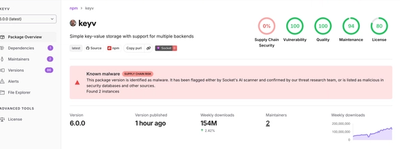
Popular npm packages keyv and cacheable compromised.

Security News
A misconfiguration gave three Anthropic models internet access, and one, believing it was in a simulation, shipped a credential-stealing package to PyPI.