

Company News
AWS Security Hub Adds Socket for Supply Chain Security
Socket is now in the AWS Security Hub Extended plan. Adopt it through AWS, apply committed spend, and block malicious open source packages.
By Feross Aboukhadijeh - Aug 04, 2026
@cross-deck/ai
Advanced tools
Crossdeck AI — the MCP connector that lets Claude, Cursor, and any AI tool query and operate your Crossdeck app. The product is 'Crossdeck understands your app'; MCP is just the transport.
Ask your app anything — revenue, errors, database read-cost, growth — in plain English, and get rendered charts and dashboards back.





"Which paying customer did this crash hit, and how much revenue is at risk?" — one question, answered across error, identity, and revenue. No single-layer tool can do that.
Most MCP servers are a connector to one system. Prism is an intelligence layer over your whole app — because Crossdeck already joins the layers about your users (identity · revenue · entitlements · errors · analytics · database read-cost) into one source of truth, by identity.
The point isn't "let AI read my data." It's the crossing: one question can span layers no other tool joins —
"This error
a1b2c3— who did it hit, and how many of them pay us?" → the named paying users behind the crash, each with their monthly revenue at risk, sorted by what's on the line.
That's the moat sentence. Prism gives it a voice in Claude, ChatGPT, Cursor, or any MCP client.
Prism is a hosted, OAuth-protected MCP endpoint:
https://api.cross-deck.com/mcp
Add it as a connector in your client, sign in with your Crossdeck account, pick a project, and approve. That's it — the client receives a short-lived, scoped workspace credential automatically.
Or open your dashboard at app.cross-deck.com → Developers → Prism → Connect AI for one-click "Add to Claude / ChatGPT / Cursor".
npm install -g @cross-deck/ai
{
  "mcpServers": {
    "crossdeck": {
      "command": "crossdeck-ai",
      "env": { "CROSSDECK_SECRET_KEY": "cd_sk_live_…" }
    }
  }
}
Use a secret key (cd_sk_) from your dashboard → API keys — never a publishable (cd_pub_) one. CROSSDECK_API_BASE overrides the endpoint (e.g. sandbox).
| Ask | Tool | You get |
|---|---|---|
| "What's our MRR and paying-customer count, split by Stripe/Apple/Google?" | get_revenue | MRR, paying count, three-rail split, optional daily trend |
"This error a1b2c3 — who did it hit and do any of them pay us?" | get_error_affected_users | The named paying users behind the crash, each with monthly revenue at risk |
"Show me everything about customer agent_8842." | open_moat_dashboard | A rendered dashboard: what they pay × entitlements × read-cost, joined by identity |
| "Draw our user growth over the last 30 days." | draw_user_growth | A rendered interactive line chart of visitors + page views |
| "What's driving our database reads — per-user vs overhead?" | get_read_cost | The per-user-vs-overhead split + reads by operation |
Data tools return clean JSON; draw_user_growth and open_moat_dashboard render interactive charts/dashboards inline in hosts that support MCP Apps (and fall back to a text summary elsewhere).
Eleven tools — all read-only (readOnlyHint), each with a human-readable title, scoped/paginated output, and actionable errors. Every read is a point-read of a maintained ledger, so asking questions never runs up your database bill.
Portfolio
list_projects — list every app this connector can read (your portfolio).use_project — set the current app for subsequent tools ("switch to ").Revenue & cost
get_revenue — MRR, paying-customer count, per-rail split (Stripe/Apple/Google), optional daily trend.get_read_cost — database read-cost split into per-user reads vs un-attributed overhead, by operation.The moat — error × identity × revenue
get_error_impact — for one error: how many distinct users hit it, and how many are paying (counts).get_error_affected_users — the named paying users an error hit, each with monthly revenue and last-hit, sorted by revenue at risk. Returns your own identifiers only — never emails/names you didn't provide.get_customer — one customer across every layer Crossdeck joins by identity: what they pay × active entitlements × read-cost.Analytics
get_host_analytics — page views + unique visitors for a host/subdomain you own (optional daily series).get_host_top_pages — top pages or referrers for a host you own.Rendered UI (MCP Apps)
draw_user_growth — an interactive line chart of visitors + page views over time.open_moat_dashboard — a customer's cross-layer dashboard (pay × entitlements × read-cost) rendered as cards.Prism is built on Crossdeck's bank-grade outbound-read spine. See SECURITY.md for the full model. In short:
readOnlyHint: true — no writes, no config mutations.MIT © Crossdeck
FAQs
Crossdeck AI — the MCP connector that lets Claude, Cursor, and any AI tool query and operate your Crossdeck app. The product is 'Crossdeck understands your app'; MCP is just the transport.
The npm package @cross-deck/ai receives a total of 83 weekly downloads. As such, @cross-deck/ai popularity was classified as not popular.
We found that @cross-deck/ai demonstrated a healthy version release cadence and project activity because the last version was released less than a year ago. It has 1 open source maintainer collaborating on the project.
Did you know?

Socket for GitHub automatically highlights issues in each pull request and monitors the health of all your open source dependencies. Discover the contents of your packages and block harmful activity before you install or update your dependencies.
Company News
Socket is now in the AWS Security Hub Extended plan. Adopt it through AWS, apply committed spend, and block malicious open source packages.
Research
/Security News
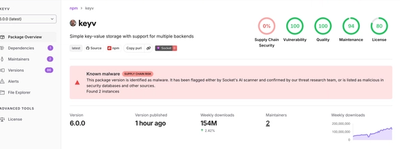
Popular npm packages keyv and cacheable compromised.

Security News
A misconfiguration gave three Anthropic models internet access, and one, believing it was in a simulation, shipped a credential-stealing package to PyPI.