

Product
PHP and Composer Support Is Now in Beta
Socket’s PHP and Composer support is now in Beta for all customers, with PHP reachability analysis generally available.
By Trevor Norris, Benjamin Barslev - Aug 21, 2026
@cubiczan/agent-conductor
Advanced tools
Agent Conductor — AGENTS.md in, governed agent team out. MCP server that compiles AGENTS.md contracts and SKILL.md skills into orchestrated, consensus-gated agent operations.


Cubiczan stack — Profile · CHP · You are here:
agent-conductor
AGENTS.md in, governed agent team out.
Agent Conductor is an MCP server that turns
the two conventions the coding-agent ecosystem has converged on —
AGENTS.md operating manuals and SKILL.md skills — from
passive documentation into an active orchestration layer, with a
consensus-hardened decision engine gating high-stakes changes.
Every serious agent tool — Claude Code, Cursor, Copilot, Codex, Gemini CLI —
now reads an AGENTS.md at the repo root and a catalog of SKILL.md files.
But both conventions are honor-system prose:
npm test before handing off"
is a suggestion, not a gate.Conductor makes the conventions executable — without asking any agent tool to change. It ships as a standard MCP server, so anything that speaks MCP gets contract compilation, skill discovery, and decision gating for free.
MCP client (Claude Code / Cursor / Copilot / ...)
        │  stdio (JSON-RPC, MCP)
        ▼
┌────────────────────────────────────────────────┐
│ TypeScript front end (src/)                    │
│   contract/parser.ts   AGENTS.md → contract    │
│   skills/loader.ts     SKILL.md discovery      │
│   server.ts            7 MCP tools             │
└────────────────┬───────────────────────────────┘
                 │  newline-delimited JSON, child stdio
                 ▼
┌────────────────────────────────────────────────┐
│ Python decision engine (engine/)               │
│   bridge.py → PyPI consensus-hardening-protocol│
│   R0 gates · foundation attacks · lifecycle    │
└────────────────────────────────────────────────┘
Three capability groups:
AGENTS.md into structured mission,
non-negotiable rules, layer do/don't boundaries, verification gates,
skill recommendations, and an out-of-scope list.SKILL.md skills across project and personal
scopes with progressive disclosure: metadata costs ~100 tokens, bodies
load only on demand.npx -y @cubiczan/agent-conductor
# decision_* tools also need:
# pip install -r engine/requirements.txt # after cloning, or use the published package's engine/
Requirements: Node 23+ (runs TypeScript natively) and Python 3.10+ with the published CHP package installed.
git clone https://github.com/icohangar-ops/agent-conductor.git
cd agent-conductor
npm install
pip install -r engine/requirements.txt
npm test            # TypeScript tests (parser, skills, live engine bridge)
npm run test:engine # Python bridge protocol tests
npm run build
Register with Claude Code:
claude mcp add agent-conductor -- node /path/to/agent-conductor/dist/index.js
Or in any MCP client's JSON config:
{
  "mcpServers": {
    "agent-conductor": {
      "command": "node",
      "args": ["/path/to/agent-conductor/dist/index.js"]
    }
  }
}
Set CONDUCTOR_PYTHON if your Python 3 lives somewhere other than python3.
Then, from any project that has an AGENTS.md:
"Load this project's agent contract, list its verification gates, and run a decision_adversary pass on the change I'm about to make."
contract_loadCompile an AGENTS.md (or CLAUDE.md) into a structured contract. Accepts a file path or a project directory; defaults to the current working directory.
// input
{ "path": "examples/pipeline-pulse" }

// output (abridged — real output from the bundled example)
{
  "source": "examples/pipeline-pulse/AGENTS.md",
  "title": "AGENTS.md — Pipeline Pulse CRM",
  "mission": "Pipeline Pulse CRM is a lightweight, local-first pipeline review dashboard...",
  "rules": [
    "Deterministic logic — same inputs → same scores, labels, and summaries...",
    "Logic in crm.js — keep main.js thin (fetch, render, events).",
    "... (6 total)"
  ],
  "layers": [
    { "layer": "src/crm.js", "role": "Domain logic",
      "do": "Deterministic scoring, filtering, summaries", "dont": "DOM manipulation" }
  ],
  "gates": [
    { "name": "Code change checklist", "commands": ["npm test"], "notes": "" },
    { "name": "Before completion", "commands": [], "notes": "npm test — all green...\n..." }
  ],
  "skills": [
    { "task": "CRM scoring / forecast changes", "skill": "obra/test-driven-development",
      "url": "https://github.com/obra/superpowers/...", "why": "Tests-first changes to deterministic logic" }
  ],
  "outOfScope": ["External CRM integrations (Salesforce, HubSpot, etc.)", "..."],
  "sectionCount": 28
}
The parser is lossless: sections it doesn't recognize are preserved verbatim, so nothing in an unconventional AGENTS.md is dropped.
contract_verificationReturns only the verification gates — the named checklists and shell commands that must pass before work is handed off. Pair it with your agent's workflow: run the commands, confirm success, then declare done.
skills_listDiscover SKILL.md skills visible from a project root. Metadata only.
// input
{ "projectRoot": "examples/pipeline-pulse" }

// output
{
  "skills": [
    {
      "name": "pipeline-scoring",
      "description": "Explain and modify scoreDealRisk weights in src/crm.js with matching test updates...",
      "version": "0.1.0",
      "scope": "project"
    }
  ]
}
Search order (first hit per skill name wins):
| Priority | Path | Scope |
|---|---|---|
| 1 | <project>/.conductor/skills/*/SKILL.md | project |
| 2 | <project>/.claude/skills/*/SKILL.md | project |
| 3 | <project>/.cursor/skills/*/SKILL.md | project |
| 4 | ~/.claude/skills/*/SKILL.md | personal |
| 5 | ~/.cursor/skills/*/SKILL.md | personal |
skill_loadLoad the full SKILL.md body for one named skill — the on-demand half of progressive disclosure. Call it only when the task matches the skill's description.
decision_gateThe Consensus Hardening Protocol R0 gate: the cheapest, highest-leverage check, run before doing the work.
// input
{ "solvable": true, "scoped": false, "valid": true, "worth_it": true }

// output
{ "verdict": "HALT", "results": { "Solvable": "PASS", "Scoped": "FATAL", "Valid": "PASS", "Worth_it": "PASS" } }
Any FATAL answer halts: stop and reframe before burning tokens on a
problem that isn't scoped, isn't understood, or isn't worth solving.
decision_adversaryA one-shot adversarial pass for high-stakes changes: CHP attacks the claim's foundations, scores them 0–100, and returns devil's-advocate findings plus a session status.
// input
{
  "claim": "Change scoreDealRisk stale-activity weight from 20 to 30",
  "context": "Tests updated; label distribution checked against fixture"
}

// output
{
  "status": "EXPLORING",          // or HALT / REFRAME_REQUIRED
  "foundation_score": 77,
  "findings": [
    "Treat every financial number as unverified until tied to source data.",
    "Require explicit flip criteria for any provisional recommendation."
  ],
  "verification_failures": ["PENDING third-party validation"],
  "report": "## TriangulationRunner Adversary Pass\n..."
}
Statuses map to the CHP decision lifecycle
(EXPLORING → PROVISIONAL_LOCK → LOCKED, with HALT and
REFRAME_REQUIRED exits): EXPLORING means the claim survived the attack
and work may proceed toward a lock; HALT/REFRAME_REQUIRED mean the
foundations failed.
engine_statusHealth-check the Python engine subprocess. Returns
{ ok, engine: "chp", version }.
contract_load is convention-based, not schema-based. It extracts the
patterns AGENTS.md files in the wild actually use:
| Contract field | Source convention |
|---|---|
mission | First Mission / Purpose / Overview section |
rules | List items under Non-negotiables > Engineering rules > generic rules (priority-ordered so a generic "Product rules" section never shadows explicit non-negotiables) |
layers | First table with a Layer column under an architecture-like heading |
gates | Shell code blocks + list items under checklist / verification / before-completion headings |
skills | Tables with Task / Skill / Why columns; links resolved to text + URL |
outOfScope | List under an out-of-scope / non-goals heading |
sections | Everything, verbatim — the lossless fallback |
Headings inside code fences are ignored; tables tolerate emphasis in headers; markdown links and emphasis are stripped from extracted text.
A skill is a directory containing SKILL.md with YAML frontmatter:
---
name: pipeline-scoring
description: Explain and modify scoreDealRisk weights in src/crm.js with matching test updates. Use when changing deal risk scoring, risk labels, or forecast thresholds.
version: 0.1.0
tools: [Read, Edit, Bash]
---

# Pipeline Scoring

Step-by-step instructions the agent follows when the task matches...
Quality bar (inherited from the awesome-agent-skills standards): third-person description with matchable keywords, metadata around 100 tokens, body under 500 lines, no machine-specific absolute paths, declare only the tools the skill needs.
The bundled example — examples/pipeline-pulse — is a complete real-world AGENTS.md plus a project-scoped skill, and is what the test suite compiles.
.
├── AGENTS.md                  # This repo's own contract (compiles with itself)
├── ARCHITECTURE.md            # Design decisions and component detail
├── src/
│   ├── index.ts               # stdio entrypoint
│   ├── server.ts              # MCP server: 7 tools
│   ├── contract/              # AGENTS.md → AgentContract compiler
│   ├── skills/                # SKILL.md loader + registry
│   ├── engine/chpBridge.ts    # Python engine client
│   └── utils/logger.ts        # stderr-only logging (stdout is the transport)
├── engine/
│   ├── bridge.py              # JSON-over-stdio router → PyPI `chp`
│   ├── requirements.txt       # consensus-hardening-protocol pin
│   ├── NOTICE.md              # attribution for the published engine
│   └── test_bridge.py         # protocol tests
├── examples/pipeline-pulse/   # real AGENTS.md fixture + example skill
└── test/                      # node:test suites (run the .ts directly)
pip install -r engine/requirements.txt
npm test            # TypeScript tests — includes a live engine round-trip
npm run test:engine # Python-side protocol tests
npx tsc --noEmit    # type check
npm run build       # emit dist/
npm run dev         # run the server from source (Node type stripping)
House rules (the full set is in this repo's own AGENTS.md):
@modelcontextprotocol/sdk
and zod; markdown/frontmatter stay hand-rolled. CHP is a PyPI dep.consensus-hardening-protocol; do not
re-vendor under engine/. Protocol fixes belong upstream.| Version | Theme | Scope |
|---|---|---|
| v0.2 | Enforcement | Execute contract_verification gates as real subprocesses and return pass/fail evidence — turning "reads the contract" into "enforces the contract" |
| v0.3 | Orchestration | Expose decision_lock + mesh session tools over MCP (multi-agent deliberation on top of published CHP) |
| v0.4 | Registry | Install vetted skills from remote catalogs (awesome-agent-skills format) with source-review prompts |
Conductor deliberately reuses proven components rather than rewriting them:
| Component | Source | License |
|---|---|---|
| Decision engine (PyPI) | consensus-hardening-protocol | MIT |
| MCP server + registry shape | onchainmind | MIT |
| Skill quality standards | VoltAgent/awesome-agent-skills | — |
| Example fixture | Pipeline Pulse CRM operating manual | fixture |
See engine/NOTICE.md and ARCHITECTURE.md for the two-language design.
| Governance | consensus-hardening-protocol · agent-conductor · compliance-as-code-agent · cleanmandate | | Platform | cubiczan-mcp-server · operational-intelligence · software-factory |
Conductor compiles AGENTS.md + SKILL.md into MCP tools and routes high-stakes decisions through CHP — the same lock model Metabocommand uses for finance approvals.
MIT — see LICENSE. Vendored components retain their original MIT licenses.
FAQs
Agent Conductor — AGENTS.md in, governed agent team out. MCP server that compiles AGENTS.md contracts and SKILL.md skills into orchestrated, consensus-gated agent operations.
We found that @cubiczan/agent-conductor demonstrated a healthy version release cadence and project activity because the last version was released less than a year ago. It has 1 open source maintainer collaborating on the project.
Product
Socket’s PHP and Composer support is now in Beta for all customers, with PHP reachability analysis generally available.
Product
Socket is bringing experimental protection to Firefox, scanning 97,000+ extensions in Mozilla's official directory for malware and risky updates.
Research
/Security News
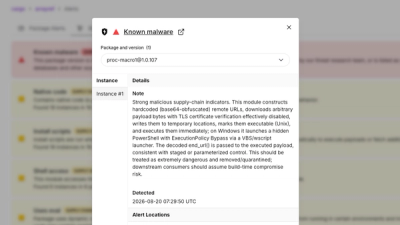
Three compromised Rust crates pulled in a malicious dependency that downloaded and executed cross-platform malware during Cargo builds.