



Research
/Security News
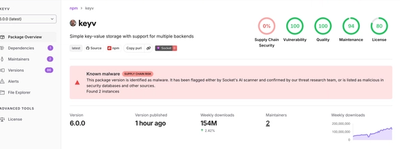
Popular npm Packages in the keyv and Cacheable Namespaces Compromised in Active Supply Chain Attack
Popular npm packages keyv and cacheable compromised.
By Socket Research Team - Aug 04, 2026
@datasynx/agentic-ai-cartography
Advanced tools
MCP-first infrastructure & agentic-AI cartography — install once, every AI agent knows your system landscape. Read-only discovery exposed over the Model Context Protocol.

AI-powered Infrastructure Discovery & Agentic AI Cartography












A Model Context Protocol server that gives any AI agent read-only awareness of your complete system landscape — local services, databases, SaaS tools, installed apps and their dependencies — with progressive disclosure, recursive dependency traversal and semantic search. Discovery runs deterministically (no LLM required) or via an optional Claude-driven loop. Provider-agnostic: works with Claude, OpenAI, Ollama, or any MCP-compatible host.
MCP-first quick start · Connect your client · Embed in your app · What it does · Cross-platform · Features · Platform & ecosystem · CLI commands · Architecture · Safety · Public API · Releasing · Star History
v2.0 inverts the architecture: the package's primary interface is now a production Model Context Protocol (MCP) server. Any MCP host — Claude Code, Cursor, Cline, Windsurf, VS Code Copilot, the Vercel AI SDK, LangGraph — connects to it and gains read-only awareness of your complete system landscape. The bundled Claude-driven discovery loop is now one optional turnkey adapter; the server needs no LLM dependency of its own.
The topology is exposed with progressive disclosure so agents never blow their context window:
cartography://graph/summary (low-token index — read first), cartography://nodes/{id}, cartography://services, cartography://databases, cartography://dependencies/{id}.query_infrastructure, search_topology (semantic), get_dependencies (recursive graph traversal), query_natural_language (plain-English topology questions, LLM-free), correlate_topology (collapse the same resource across clouds/on-prem), get_cost_summary, score_compliance, classify_drift, list_services, get_node, get_summary, run_discovery.audit-attack-surface, map-service-dependencies, onboard-to-system.# 1. Discover your system (read-only, deterministic — no LLM required)
npx -p @datasynx/agentic-ai-cartography cartography-mcp --help
datasynx-cartography discover # or the richer Claude-driven loop
# 2. Run the MCP server (stdio by default)
npx -p @datasynx/agentic-ai-cartography cartography-mcp
Let the harness write the correct config for your host — it parses the existing file and merges in the server entry without clobbering your other servers:
datasynx-cartography list-clients                          # supported hosts
# claude-code · cursor · vscode · codex · windsurf · cline · roo
# zed · junie · gemini · goose · openhands · claude-desktop
datasynx-cartography install --client claude-code          # global/user config
datasynx-cartography install --client claude-code --project # project-local (.mcp.json)
datasynx-cartography install --client claude-code --dry-run # preview the merge diff
Flags: --global (default) / --project scope, --dry-run (no write), --name <server>,
--http/--url <url> (register the HTTP endpoint), --db <path>, --session <id>,
--deeplink (print a one-click Cursor/VS Code install link instead of writing).
datasynx-cartography install --client cursor --deeplink   # cursor://… one-click link
datasynx-cartography install --client vscode --deeplink   # vscode://… + `code --add-mcp`
Thirteen hosts are supported today (see
list-clients). The server is also deployable on Smithery (TypeScript runtime,smithery.yaml) and published to the official MCP Registry (server.json).Smithery scope: the hosted runtime needs no secrets (
smithery.yamldeclaresenv: {}) because it serves a read-only catalog from an in-memory or supplied SQLite database. The cloud scanners (scan_aws_resources,scan_gcp_resources,scan_azure_resources,scan_k8s_resources) require the respective CLI and its credentials on the host, so they are intended for local/self-hosted runs, not the managed Smithery instance.
Claude Desktop one-click — build the portable bundle and double-click it (Settings → Extensions → Install), or drag it onto the window:
npm run build:mcpb # → dist/cartography.mcpb (validated against the mcpb v0.3 schema)
Claude Code — install as a plugin from the Datasynx marketplace (recommended):
/plugin marketplace add datasynx/claude-plugins
/plugin install cartography@datasynx
This wires up the MCP server in one step (verify with /mcp) — the same flow as
shadowing. The plugin lives
in plugin/. Prefer to wire it by hand instead?
claude mcp add cartography -- npx -p @datasynx/agentic-ai-cartography cartography-mcp
Cursor / Windsurf / Cline — mcp.json (or ~/.codeium/windsurf/mcp_config.json):
{
  "mcpServers": {
    "cartography": {
      "command": "npx",
      "args": ["-p", "@datasynx/agentic-ai-cartography", "cartography-mcp"]
    }
  }
}
VS Code (Copilot) — .vscode/mcp.json (note: servers, not mcpServers):
{
  "servers": {
    "cartography": { "command": "npx", "args": ["-p", "@datasynx/agentic-ai-cartography", "cartography-mcp"] }
  }
}
Remote / team use — Streamable HTTP (localhost-bound, DNS-rebind protected):
cartography-mcp --http --port 3737      # → http://127.0.0.1:3737/mcp (loopback, no auth)

# Exposing beyond loopback requires BOTH an explicit Host allowlist (CVE-2025-66414)
# AND a bearer token — clients must send `Authorization: Bearer <token>`:
export CARTOGRAPHY_HTTP_TOKEN=$(openssl rand -hex 32)
cartography-mcp --http --host 0.0.0.0 --port 3737 \
  --allowed-hosts cartography.internal:3737 --token "$CARTOGRAPHY_HTTP_TOKEN"
Binding a non-loopback
--hostwithout--allowed-hosts(DNS-rebinding) or without--token(CARTOGRAPHY_HTTP_TOKEN) is refused on purpose — it would leave the scanning tools open to anyone who can reach the host. Put it behind TLS / a reverse proxy for real deployments. The same flags work ondatasynx-cartography mcpand the Smithery deployment.
Vercel AI SDK (provider-agnostic):
import { experimental_createMCPClient } from 'ai';
const mcp = await experimental_createMCPClient({
  transport: { type: 'sse', url: 'http://127.0.0.1:3737/mcp' },
});
const tools = await mcp.tools(); // MCP tools → AI SDK tools, any model
Frameworks without a config file (CrewAI, AutoGen/MAF, LangGraph, Pydantic AI, OpenAI Agents SDK, Smolagents, Vercel AI SDK) load MCP tools via their own adapters — copy-paste snippets in docs/adapters.md.
Full documentation lives at datasynx.github.io/agentic-ai-cartography — quickstart, the client matrix, MCP tools and CLI reference. Drop AGENTS.md into a repo to give coding agents the standard config block.
import { createMcpServer, runStdio, createSemanticSearch, localDiscoveryFn, CartographyDB } from '@datasynx/agentic-ai-cartography';

const db = new CartographyDB('/path/to/cartography.db');
const server = createMcpServer({
  db,
  search: await createSemanticSearch(db),   // semantic (sqlite-vec) + lexical fallback
  discovery: localDiscoveryFn(),            // deterministic, LLM-free scanners
});
await runStdio(server);
$ datasynx-cartography discover

  CARTOGRAPHY  localhost
  ─────────────────────────────────────────────
  🔖  Browser bookmarks scanned…
  🖥  All installed apps scanned…
  +  Node  saas_tool:vscode           [saas_tool]   90%
  +  Node  saas_tool:cursor           [saas_tool]   90%
  +  Node  saas_tool:docker-desktop   [saas_tool]   90%
  +  Node  saas_tool:github.com       [saas_tool]   70%  🔖
  +  Node  web_service:localhost:5432 [database]    90%
  +  Node  web_service:localhost:6379 [cache]       90%
  ~  Edge  web_service:app → web_service:localhost:5432  uses
  ─────────────────────────────────────────────
  DONE  9 nodes, 3 edges  in 38.4s

  SEARCH MORE  — Refine discovery interactively
  → Search for (Enter = finish): hubspot windsurf
  ⟳  Searching for: hubspot windsurf
  +  Node  saas_tool:hubspot.com      [saas_tool]   70%  🔖
  +  Node  saas_tool:windsurf         [saas_tool]   90%
Cartography runs natively on Linux, macOS, and Windows — no WSL required on Windows.
| Capability | Linux | macOS | Windows |
|---|---|---|---|
| Network scanning | ss -tlnp | lsof -iTCP -sTCP:LISTEN | Get-NetTCPConnection |
| Process listing | ps aux | ps aux | Get-Process |
| Installed apps | dpkg, rpm, snap, flatpak, .desktop | /Applications, Homebrew, Spotlight | Registry, winget, choco, scoop |
| Command lookup | which | which | Get-Command (PowerShell) |
| File search | find | find | Get-ChildItem -Recurse |
| Shell | /bin/sh | /bin/sh | PowerShell (pwsh / powershell.exe) |
| DB service detection | CLI probes (psql, mysql, etc.) | CLI probes | Get-Service + CLI probes |
| Browser bookmarks | ~/.config/google-chrome + Snap/Flatpak | ~/Library/Application Support/... | %LOCALAPPDATA%\Google\Chrome\User Data |
| Firefox profiles | ~/.mozilla/firefox + Snap/Flatpak | ~/Library/.../Firefox/Profiles | %APPDATA%\Mozilla\Firefox\Profiles |
| Safety policy | Read-only allowlist (POSIX parser) | Read-only allowlist (POSIX parser) | Read-only allowlist (PowerShell mutating-cmdlet denylist) |
| Feature | Details |
|---|---|
| Installed App Scan | Linux: dpkg/snap/flatpak/rpm, macOS: /Applications + Homebrew + Spotlight, Windows: Registry + winget + choco + scoop. 70+ known tools checked via cross-platform command lookup |
| Browser Bookmarks | Chrome, Chromium, Firefox, Brave, Edge, Vivaldi, Opera — all platforms including Snap/Flatpak on Linux |
| Database Discovery | PostgreSQL, MySQL, MongoDB, Redis, SQLite file scan. Windows: Get-Service for DB engine detection |
| Cloud Scanning | AWS (EC2/RDS/EKS/S3), GCP (Compute/GKE/Cloud Run), Azure (AKS/WebApps), Kubernetes |
| Human-in-the-Loop | Chat with the agent mid-discovery: type "hubspot windsurf" to search for specific tools |
| Terraform Import | First-class terraform-state scanner — *.tfstate JSON → authoritative IaC nodes/edges, reconciled with observed reality (no terraform CLI, no extra credentials) |
| Multi-Cloud Correlation | Collapse the same logical resource discovered across AWS/GCP/Azure/on-prem into canonical entities + confidence-scored same_as links (correlate_topology, pure & deterministic) |
| Intelligence Layer | Cost attribution (FinOps rollups), compliance scoring (CIS/SOC2/ISO 27001 starters), anomaly detection (orphans / shadow IT), severity-classified drift |
| Export Formats | Mermaid topology, D3.js interactive graph, Backstage YAML, JSON |
| Safety First | Strict read-only allowlist (not a denylist): only known-safe commands run — shell-aware for POSIX and PowerShell, enforced at the command runner as defense-in-depth. 100% read-only |
Beyond the MCP server, Cartography ships a read-only platform for teams and an ecosystem of integrations. Everything below is opt-in, read-only by default, and never phones home — the same locked constraints as the core.
cartography api (and the cartography-api binary) exposes the topology over a read-only
HTTP API — REST under /v1/... with a published OpenAPI 3.1 document, and GraphQL at
/graphql (SDL + introspection, no Mutation type). It reuses the MCP transport's constant-time
bearer auth + DNS-rebinding hardening and the same tenant-scoped query layer — no new runtime
dependency (Node's built-in http).
cartography api                         # loopback dev — REST + /graphql + dashboard, no token
curl -s http://127.0.0.1:3737/v1/summary | jq .totals
# Exposed: a non-loopback bind REQUIRES both --allowed-hosts and --token
cartography api --host 0.0.0.0 --allowed-hosts cartograph.internal:3737 --token "$TOKEN"
cartography api --no-graphql            # REST only
cartography api --no-dashboard          # disable the / and /app web UI
The same server hosts a self-contained web dashboard at / and /app — a live, interactive
Canvas topology view with node drill-down (no CDN, no build step, zero new dependency). It fetches
the live /v1/* API, so it inherits the API's auth + RBAC/tenant scoping for free.
See docs/how-to/api-server.md and
docs/how-to/web-dashboard.md.
cartography auth layers identity + roles over the HTTP surfaces. A bearer token resolves to a
principal { subject, tenant, role }; the server returns 401 for an unknown token, 403 for
an insufficient role, and pins every read to the principal's tenant — no cross-tenant read by
spoofing a header. Roles are viewer ⊂ operator (adds run_discovery) ⊂ admin (adds credential
admin). Fully backward-compatible: with no credentials configured, the server behaves exactly as
before. Tokens are stored hashed (sha256), printed once on creation.
cartography auth add alice --role operator --tenant acme   # prints the bearer token ONCE
cartography auth list                                       # subjects/roles/tenants, never the token
cartography auth revoke alice
cartography api --auth-required                             # require auth even on loopback
See docs/how-to/rbac.md.
cartography mcp --server-mode runs the binary as a self-hostable central collector that pools
every employee's consented discovery into one org-wide topology — consent-first, never phones home.
It exposes an authenticated POST /ingest write route (the consent-gated push envelope, server-side
anonymization re-validation via --anon-mode reject|strip, per-org rate limit → 429 + Retry-After)
and an org-wide merged get_summary. Public GET /healthz (liveness) / GET /readyz (readiness)
probes and a deploy/ Docker bundle make it orchestrator-ready.
export CARTOGRAPHY_CENTRAL_TOKEN=$(openssl rand -base64 32)
cartography mcp --server-mode --host 0.0.0.0 \
  --allowed-hosts cartograph.internal:3737 --org acme --anon-mode reject
For an org-wide store at 10K+ nodes, opt into a Neo4j/Memgraph graph-DB backend for the
collector's merge + summary path (neo4j-driver is an optional dependency; if absent or unreachable
it degrades to SQLite, never fails):
cartography mcp --server-mode --store-backend graph \
  --graph-url bolt://graph.internal:7687 --graph-user neo4j --graph-password "$NEO4J_PASSWORD"
# or via env: CARTOGRAPHY_GRAPH_URL / _USER / _PASSWORD (kept out of process listings)
See docs/how-to/self-host-collector.md.
Cartography maps discovered infrastructure to Backstage catalog entities (Component/API/
Resource + dependsOn relations). Export a static catalog-info.yaml snapshot, or consume the
live, tenant-scoped endpoint GET /v1/backstage/catalog on the API server (re-mapped on every
request, RBAC-pinned). A reference CartographEntityProvider lives in
examples/backstage-plugin/. See
docs/how-to/backstage.md.
cartography drift classifies topology drift into info/warning/critical and fans it out to
the sinks configured under the drift block of cartography.config.json — stdout, slack,
pagerduty, jira, or a generic webhook. With no config it prints one redacted JSON line and makes
no outbound request. Every sink is hardened identically (https:-or-loopback only, bounded
timeout, body always credential-redacted, only host:port logged, one failing sink never blocks the
others). See docs/how-to/drift-and-ci.md.
cartography operator runs the deterministic, LLM-free discovery continuously inside a
cluster and reports drift between reconcile cycles — a "continuous CMDB for Kubernetes". It's a thin
reconcile loop (no CRD, no controller-runtime, no agent loop), read-only (kubectl get … via the
allowlist only). The deploy/k8s/ manifests ship a read-only ServiceAccount + ClusterRole
(get/list/watch only — no write verbs).
kubectl apply -f deploy/k8s/operator.yaml          # in-cluster, single-replica Deployment
cartography operator --once                         # local dev against your kube-context
cartography operator --interval 300                 # long-running reconcile loop
See docs/how-to/k8s-operator.md and docs/how-to/terraform-import.md.
datasynx-cartography discover): npm install -g @anthropic-ai/claude-code && claude login.sqlite-vec and a local embedder
(@huggingface/transformers) are present; otherwise it falls back to lexical search.
These ship as optionalDependencies and are lazy-loaded, so installs that skip them
pay no cost. On startup the server logs semantic search: ready when the upgrade is
active, or names the missing dependency and that it is using lexical search when it isn't.npm install -g @datasynx/agentic-ai-cartography
# Check all requirements (platform-aware)
datasynx-cartography doctor

# Discover your full infrastructure (autonomous agent scan)
# → scans bookmarks, installed apps, local services, cloud, config files
# → then interactive follow-up: type tool names to search further
datasynx-cartography discover

# Seed infrastructure manually (JSON file or interactive)
datasynx-cartography seed --file infra.json
datasynx-cartography seed

# View all browser bookmarks
datasynx-cartography bookmarks

# Full feature reference (shows platform-specific commands)
datasynx-cartography docs
datasynx-cartography discover [options]

  --entry <hosts...>    Start hosts          (default: localhost)
  --depth <n>           Max crawl depth      (default: 8)
  --max-turns <n>       Max agent turns      (default: 50)
  --model <m>           LLM model            (default: claude-sonnet-4-5-...)
  --org <name>          Org name for Backstage YAML
  -o, --output <dir>    Output directory     (default: ./datasynx-output)
  -v, --verbose         Show agent reasoning
Discovery pipeline (automatic, in order):
ss (Linux), lsof (macOS), Get-NetTCPConnection (Windows).env, docker-compose.yml, etc.datasynx-cartography export [session-id] [options]
--format <fmt...> mermaid, json, yaml, html, map (default: all)
-o, --output <dir> Output directory
datasynx-cartography show [session-id] Session details + node list
datasynx-cartography sessions List all sessions
datasynx-cartography diff [base] [current] Topology drift between two sessions (default: two most recent)
datasynx-cartography drift [base] [current] Severity-classified drift alert → sink (default: stdout)
--min-severity <s> info | warning | critical (drop items below this)
--webhook <url> Outbound webhook sink (opt-in; token via CARTOGRAPHY_DRIFT_TOKEN)
datasynx-cartography bookmarks View all browser bookmarks
datasynx-cartography seed [--file <path>] Manually add infrastructure nodes
datasynx-cartography cost --file <csv> Enrich nodes with owner/cost (FinOps)
datasynx-cartography compliance [session] --ruleset <name> Grade against baseline/cis/soc2/iso27001
datasynx-cartography consent <…> Per-employee sharing policy + anonymization
datasynx-cartography sync <status|review|push> Opt-in central-DB outbound pipeline
datasynx-cartography schedule --config <file> Recurring headless discovery + drift
datasynx-cartography prune [--older-than <days>] Prune old sessions / compact the audit trail
datasynx-cartography doctor Check all requirements + cloud CLIs
datasynx-cartography docs Full feature reference
datasynx-cartography mcp [--server-mode] [--http]  MCP server / central collector (Phase 4)
datasynx-cartography api [--no-graphql] [--no-dashboard]   REST + GraphQL + web dashboard (Phase 4)
  --host <h> --port <n> --token <secret> --allowed-hosts <list>   (non-loopback needs both)
  --tenant <id> / --org <id>                       Tenant whose topology to serve
datasynx-cartography auth add <subject> --role <viewer|operator|admin> --tenant <id>   RBAC (Phase 4)
datasynx-cartography auth list | revoke <subject>
datasynx-cartography operator [--once] [--interval <sec>]   Kubernetes operator (Phase 5)
The
cartography-mcpandcartography-apibinaries start the MCP server and the API server directly (used byserver.json/ containers vianpx).
datasynx-output/
├── catalog.json               Full machine-readable dump
├── catalog-info.yaml          Backstage service catalog
├── topology.mermaid           Infrastructure topology (graph TB)
├── dependencies.mermaid       Service dependencies (graph LR)
└── discovery.html             Enterprise discovery frontend (Map + Topology)
| Mode | Model | Interval | per Hour | per 8h Day |
|---|---|---|---|---|
| Discover | Sonnet | one-shot | $0.15–0.50 | one-shot |
The MCP server is the headline interface — LLM-agnostic and the same SQLite graph
underneath every entry point. Discovery (deterministic scanners or the optional Claude
loop) writes the graph; any MCP host reads it. The Phase 4 platform adds read-only
HTTP surfaces over that same graph — the REST/GraphQL API (cartography api), the web
dashboard, RBAC (cartography auth), the self-hostable central collector
(mcp --server-mode, with an optional Neo4j/Memgraph backend), and a live Backstage
data source — all sharing the MCP transport's bearer auth + tenant scoping.
                         ┌──────────────────────────────────────────┐
   MCP hosts ───────────►│  MCP server (src/mcp) — primary interface │
   (Claude Code,         │    Resources · Tools · Prompts            │
    Cursor, Cline,       │    stdio + Streamable HTTP transports     │
    Windsurf, VS Code,   └───────────────────┬──────────────────────┘
    Vercel AI SDK, …)                        │
                                             ▼
                              CartographyDB (SQLite WAL, src/db)
                         recursive-CTE traversal · search · summary
                                             ▲
                ┌────────────────────────────┴────────────────────────────┐
                │                                                          │
   Deterministic discovery (src/discovery, src/scanners)     Optional Claude loop (src/agent)
     bookmarks · installed-apps · local ports · DBs            runDiscovery() — human-in-the-loop
     LLM-free, registry-driven                                 LLM + Bash + custom MCP tools
                │                                                          │
                └──────────────────────────┬───────────────────────────────┘
                                           ▼
                    Platform layer (src/platform) + read-only allowlist (src/allowlist)
                    Shell/commands resolved per-OS · every command vetted before it runs
v2.0 replaces the old "block bad commands" denylist with a strict read-only allowlist
(src/allowlist.ts): a command runs only if it is explicitly known to be safe. The check
is shell-aware and enforced in two places — the command runner itself (defense-in-depth)
and the Claude loop's PreToolUse hook.
sudo/env/command-runners and brace
groups, and allows only read-only tools (ss, lsof, ps, which, find, DB
probes, cloud describe/list/get, kubectl get/describe, …). Redirections, pipes to
writers, and anything unrecognized are rejected.Remove-Item, Move-Item, Stop-Process, Stop-Service, Restart-Computer,
Format-Volume, Out-File, Set-Content, …).Cartography only reads — never writes, never deletes.
Add new discovery sources with zero core changes via the Scanner SPI. An out-of-tree
@datasynx/scanner-* package default-exports definePlugin({ name, register }) and is
loaded opt-in (config.plugins, --plugins, or CARTOGRAPHY_PLUGINS) — a plugin that
is not named is never loaded. The host validates, namespaces (plugin:<pkg>:<id>), and
enforces each scanner's declared allowedCommands against the read-only allowlist; a
broken plugin is logged and skipped, never aborting discovery. See the authoring guide in
docs/plugins.md and the template in
examples/scanner-template/.
import {
  CartographyDB,
  runDiscovery,
  exportAll,
  safetyHook,
  defaultConfig,
} from '@datasynx/agentic-ai-cartography';

// Run a discovery pass with optional user hint
await runDiscovery(config, db, sessionId, onEvent, onAskUser, 'hubspot windsurf');
release.yml publishes to npm automatically on every push
to main, in one of two modes — auto-selected by which secrets are present:
RELEASE_TOKEN present → full semantic-release.
Version, CHANGELOG.md, git tag v<version>, GitHub Release and the provenance-signed npm
publish are all derived from Conventional Commits
since the last tag (fix: → patch, feat: → minor, feat!:/BREAKING CHANGE: → major;
docs/chore/refactor/test/ci → no release). No manual version bumps. PR titles are linted
by pr-title.yml so the squash-merge commit stays analyzable.RELEASE_TOKEN absent → idempotent npm publish. The package.json version is published
(provenance-signed) only when it isn't already on npm — so doc/refactor merges are no-ops.
Bump the version + merge to release.Why two modes: every commit here carries
.github/workflows/files, and the ActionsGITHUB_TOKENmay not push a git ref that touches workflow files (it can't hold theworkflowscope). semantic-release pushes a tag, so it needs a workflow-scopedRELEASE_TOKEN. Until one exists, the idempotent publish keeps releases flowing with onlyNPM_TOKEN; addingRELEASE_TOKENlater upgrades to the full flow with no other changes.
Quality is gated independently by ci.yml on every PR and push:
lint/typecheck → test matrix (Node 20/22) + coverage → audit + license check → build &
validate (publint, are-the-types-wrong,
ESM/CJS consumer smoke tests).
Repository secrets (Settings → Secrets and variables → Actions):
| Secret | Required | Purpose |
|---|---|---|
NPM_TOKEN | yes | npm Automation/granular token with publish rights for the @datasynx scope. Provenance signing itself needs no secret (OIDC). |
RELEASE_TOKEN | optional | PAT (classic: repo + workflow) or deploy key. Unlocks full semantic-release (auto-versioning, changelog, tags, GitHub Releases). Without it, the idempotent npm publish is used. |
CODECOV_TOKEN | optional | Upload coverage to Codecov (non-blocking if absent). |

MIT — © Datasynx AI
FAQs
MCP-first infrastructure & agentic-AI cartography — install once, every AI agent knows your system landscape. Read-only discovery exposed over the Model Context Protocol.
We found that @datasynx/agentic-ai-cartography demonstrated a healthy version release cadence and project activity because the last version was released less than a year ago. It has 1 open source maintainer collaborating on the project.
Did you know?

Socket for GitHub automatically highlights issues in each pull request and monitors the health of all your open source dependencies. Discover the contents of your packages and block harmful activity before you install or update your dependencies.
Research
/Security News
Popular npm packages keyv and cacheable compromised.

Security News
A misconfiguration gave three Anthropic models internet access, and one, believing it was in a simulation, shipped a credential-stealing package to PyPI.

Security News
/Company News
Socket has joined the new Composer and Packagist sponsorship program as a launch sponsor, supporting the team that keeps PHP's package ecosystem secure.