

Product
PHP and Composer Support Is Now in Beta
Socket’s PHP and Composer support is now in Beta for all customers, with PHP reachability analysis generally available.
By Trevor Norris, Benjamin Barslev - Aug 21, 2026
@decantr/cli
Advanced tools
Decantr CLI - adopt, verify, graph, and govern frontend codebases touched by AI agents
Support status: core-supported
Release channel: stable
Decantr's main local operator surface for selecting an app, preparing governed task context, verifying changes, and maintaining Decantr projects.
npm install -D @decantr/cli
Or run it without installing:
npx @decantr/cli scan
npx @decantr/cli new my-app --blueprint=esports-hq
Use decantr setup when you are unsure which path applies. It detects whether the repo is empty, already attached, or a Brownfield app and recommends the right entry path.
Use decantr scan when you want a zero-commit Brownfield preview. It reads local files through the shared verifier discovery substrate, detects workspace/app scope, package manager, framework, language, route signals, taskable routes, component inventory confidence, styling/static-hosting/assistant-rule signals, previews typed Contract graph readiness in memory when a Decantr contract already exists, reports the contract capsule source-handle count and limit, prints a terminal report, and writes no .decantr files or report artifacts. Add --json when automation needs the ScanReportV2 payload.
Use decantr new for a greenfield workspace in a fresh directory. With a blueprint or archetype it creates a contract-only Decantr workspace by default; runnable legacy Decantr CSS adapters require explicit --adoption=decantr-css.
Use decantr adopt when you already have an app and want Decantr governance without adopting a blueprint. Brownfield attach is proposal-driven: Decantr inventories the app, writes an observed essence proposal, hydrates content API execution packs when online, and only applies the contract when you explicitly accept or merge it.
Use decantr studio after adoption when you want a local Control Room for routes, findings, evidence, authority, and next actions. Use decantr connect cursor when the opened workspace should get Cursor Agent MCP and project-rule activation; in monorepos use decantr connect cursor --project apps/web so the rule keeps the app scope. Use decantr doctor when the next step is unclear, decantr task <route> "<intent>" before asking an LLM to modify a route, decantr verify after the edit, decantr resolve when source and contract disagree, and decantr ci in required automation. If runtime source and Decantr context disagree, report the drift instead of guessing; in Brownfield the existing source is observed truth, accepted local law/style bridge is project authority where present, Essence V4 is the structural contract, and content packs stay advisory until mapped into local law. Use decantr graph when you want the Decantr 3 typed Contract graph, typed graph diff summary, manifest, content-addressed snapshot history, and cache-friendly contract capsule written under .decantr/graph; the capsule includes a bounded SourceArtifact path index so agents can discover valid file-impact handles without reading the full snapshot, and --capsule-source-limit <count> can tune that index for large repos. Add --route /feed --task "improve loading" --json when you want the exact task-ranked route-scoped subgraph an agent should inspect before editing, --node cmp:button --impact --json when you need the graph-shaped blast radius for a component, token, rule, finding, or source artifact, or --file src/app/page.tsx --impact --json when the agent knows the source file it is about to change. Route and impact ranking use deterministic weighted traversal plus local personalized PageRank and task boosts. Use --snapshot-id <id> to inspect a replayable history snapshot and --compare-to <id> --include-diff-ops --json to compare the selected/current graph against a prior snapshot. Use decantr codify --from-audit --style-bridge when you want project-owned UI patterns, optional behavior_obligations, local rules, and token/class bridge mappings such as button/card/shell/theme standards to appear in future task context and verification. Once accepted, that local law is the first Hybrid lane: the app still owns source and styling, but Decantr treats accepted local patterns, behavior obligations, rules, and style bridge mappings as project authority.
In monorepos, app-scoped commands accept --project <app-path>. setup shows attach guidance before adoption and the day-two loop after adoption. Candidate discovery ranks product UI apps ahead of docs, Storybook, API, MCP helper, workbench, and package surfaces; decantr workspace list --json includes rank, category, score, and reason metadata so automation can explain why apps/web, apps/remix, or apps/dashboard was suggested first. Once an app path is selected, scan/setup/adopt/doctor/task/verify/ci/connect preserve that app scope and inherit package-manager evidence from the workspace root, so a React app inside a pnpm Angular/React monorepo is reported as the React app, not the root or sibling app. Content pack hydration also follows the essence path: decantr content compile-packs apps/web/decantr.essence.json --write-context writes into apps/web/.decantr/context. In contract-only/offline Brownfield, deferred packs are optional context unless a present manifest references missing files.
Use decantr init, decantr analyze, decantr check, and decantr health as advanced primitives when you need direct control over one step. Direct init and Brownfield adopt retain bounded write receipts in .decantr/project.json; AdoptionTruthV1 reports governance writes, support artifacts such as assistant rules or formatter exclusions, and authored-source integrity independently.
App-scoped primitives now share the same --project posture as the primary workflow commands. From a workspace root, health, status, upgrade, add, remove, theme, export, suggest, magic, rules, and telemetry target the selected app instead of the root. Task/read paths, local-law summaries, and refresh change summaries are printed as openable workspace paths. Nonexistent project paths fail immediately, and Brownfield adoption refuses component packages unless you intentionally pass --force-package.
Legacy Decantr CSS starter adapter availability, only when --adoption=decantr-css is explicit:
react-vite is the React + Vite runnable bootstrap adapternext-app is the runnable Next.js App Router adaptervanilla-vite is the plain HTML/CSS/JS runnable bootstrap adaptervue-vite is the Vue 3 + Vite runnable bootstrap adaptersveltekit is the SvelteKit runnable bootstrap adapterangular is the Angular standalone runnable bootstrap adaptersolid-vite is the Solid + Vite runnable bootstrap adaptergeneric-web contract-only adapter until their runnable adapters landExplicit workflow/adoption flags:
decantr setup
decantr scan
decantr scan --project apps/web --json
decantr adopt --yes
decantr studio
decantr doctor
decantr ci --fail-on error
decantr ci init
decantr resolve
decantr codify --from-audit --style-bridge
decantr codify --map-pattern hero
decantr codify --accept --confirm-reviewed
decantr task /feed "add saved recipe actions"
decantr verify --brownfield --local-patterns
decantr graph --project apps/web
decantr graph --project apps/web --route /feed --json
decantr graph --project apps/web --node cmp:button --impact --json
decantr graph --project apps/web --file src/app/page.tsx --impact --json
decantr graph --project apps/web --compare-to graph:previous --include-diff-ops --json
decantr graph --check
decantr init --workflow=greenfield --adoption=contract-only
decantr analyze
decantr init --existing --accept-proposal
decantr init --existing --merge-proposal
decantr init --existing --adoption=style-bridge
decantr init --existing --adoption=decantr-css
decantr init --project=apps/web --yes
decantr init --assistant-bridge=preview
decantr connect cursor --preview
decantr rules preview
decantr rules apply
Adoption modes:
contract-only writes Decantr essence/context/governance files without Decantr CSS files or @decantr/css dependency guidance.style-bridge keeps runtime styling host-owned. Decantr writes proposal/accepted governance JSON under .decantr/, never runtime CSS, token stylesheets, or global styles; only an accepted .decantr/style-bridge.json has bridge authority.decantr-css writes the full Decantr CSS files and runtime guidance.Monorepos store portable, workspace-relative workspaceRoot and appRoot values. Install Decantr at the workspace root if that is where dependencies are managed, but attach Decantr to an app root with --project=<path>.
pnpm add -D -w @decantr/cli
pnpm exec decantr setup
pnpm exec decantr workspace list
pnpm exec decantr adopt --project apps/web --yes
pnpm exec decantr doctor --project apps/web
pnpm exec decantr codify --from-audit --style-bridge --project apps/web
pnpm exec decantr codify --map-pattern hero --project apps/web
pnpm exec decantr ci init --project apps/web
Assistant rule integration is preview-first: --assistant-bridge=preview writes .decantr/context/assistant-bridge.md, decantr rules preview prints the bridge, and --assistant-bridge=apply or decantr rules apply mutates supported rule files with updatable marked blocks. Normal decantr refresh keeps a configured or existing assistant preview current, and accepting a reviewed style bridge immediately refreshes both that preview and DECANTR.md. The block follows the recorded workflow: contract-only Greenfield bridges cite Essence, narrative context, and the Contract capsule; corpus-backed Greenfield/Hybrid bridges cite execution packs; Brownfield bridges cite observed analysis and doctrine artifacts. Cursor has a direct connector: decantr connect cursor writes .cursor/mcp.json and .cursor/rules/decantr.mdc, preserving existing MCP servers; use --preview to inspect first and --project <app> from a monorepo root. decantr task requires a current typed graph and exits nonzero with a structured regeneration action when graph artifacts are missing or stale. Its read targets start with the discovered route implementation file, not a generated route tree. decantr task --json projects the verifier-owned TaskCapsuleV1 into the existing top-level task fields, adds taskCapsuleVersion: "task-capsule.v1", and carries Contract capsule, route graph context, authority, accepted behavior obligations, content provenance, stop conditions, verification command, and changed-file impact. The canonical capsule and default task payload are bounded to 12,000 canonical UTF-8 bytes with deterministic ceil(bytes / 3) token estimation.
decantr scan is different from the mutating Brownfield primitives: it is look-don't-touch reconnaissance for fit, route/style evidence, typed Contract graph readiness, capsule source-handle bounds, and next-command guidance. Formal TanStack source files outrank generated route trees; nested React Router objects resolve lazy implementation files; Vue Router objects are recognized; pathname-only routes are medium confidence; and selected apps inherit repository-level assistant rules. Angular scans resolve the selected production bootstrap and router graph with the TypeScript compiler, exclude test/fixture paths, distinguish lazy route scopes from rendered pages, and report route authority, completeness, authority files, excluded-source counts, styling evidence, and limitations. An Angular scan with inferred/unresolved or partial route proof withholds adoption guidance; mutating Brownfield attach requires --force after manual review, while route tasks and CI v3 remain fail-closed. For attached Essence V4 apps scan derives the graph preview in memory, reports stale/missing .decantr/graph artifacts, and still writes nothing. decantr analyze writes .decantr/doctrine-map.json, a ranked source-precedence map across security/data, architecture, design-system, workflow/CI, feature/business, assistant-specific, stale, and unsafe-to-cite evidence. It also writes .decantr/brownfield-intelligence.json, .decantr/theme-inventory.json, and .decantr/enrichment-backlog.md. The proposal groups routes into observed semantic domains such as auth, RBAC, billing, reporting, facilities, settings, and public surfaces across Next App/Pages Router, React Router, Angular Router, SvelteKit, Vue Router, and Nuxt file routes. Existing styling systems such as Tailwind, Bootstrap, PrimeNG, Sass, MUI, Chakra, plain CSS, and Decantr CSS are observed as evidence instead of replaced. Theme variants are observed in the theme inventory without changing Essence V4. decantr adopt and Greenfield decantr init write the first typed Contract graph so Project Health, task context, and agents can anchor to graph artifacts immediately. Shared route discovery adds implementation provenance even when no Brownfield analysis artifact exists. When Prettier or Oxfmt is detected, Decantr adds generated artifacts to .prettierignore. decantr codify --from-audit proposes .decantr/local-patterns.proposal.json and .decantr/rules.proposal.json with Hybrid authority guidance, source-derived button/card/form/theme evidence, variant hints, confidence tiers, and optional behavior_obligations for form controls and destructive confirmation dialogs when source evidence is strong; decantr codify --style-bridge proposes .decantr/style-bridge.proposal.json, mapping Decantr intent to project-owned tokens/classes without requiring @decantr/css; decantr codify --map-pattern <slug> maps official content guidance into an advisory local-law proposal without changing source. After review, decantr codify --accept --confirm-reviewed promotes local patterns and rules only. Add --accept-style-bridge only when the team explicitly wants to activate the separate style bridge proposal and change adoption mode. decantr doctor reports whether the app is contract-only, Hybrid local law, style bridge, Decantr CSS, or Hybrid composition. decantr task prints that authority block and warns before mixing runtimes or adding Decantr CSS to a non-Decantr-CSS app. decantr suggest --from-code surfaces accepted local patterns and style bridge mappings from the app root or selected --project, and decantr ci prints accepted local-rule findings, behavior-obligation findings, plus style bridge status in text, markdown, and JSON reports. decantr verify --brownfield --local-patterns uses the Brownfield guard layer plus accepted local law to flag actionable missing doctrine coverage, unsafe context, missing assistant bridges, behavior-obligation drift, style drift, raw local-rule violations, and unsafe defaults without treating current database migrations as stale docs.
scan-report.v2 JSON with discovery evidence, app scope, route signal/taskable/excluded-source counts, authority, completeness, authority files, component/style confidence, and limitationsdecantr connect cursorcontract-capsule.json for agent sessionsAll, Featured, Certified, and opt-in Labsdecantr.essence.jsonThe CLI is intentionally a local project inspector and artifact writer. It reads selected project/workspace files, package manifests, routing/style/config files, .decantr artifacts, and Decantr cache/config files. It writes decantr.essence.json, DECANTR.md, .decantr/*, generated context packs, .decantr/graph/* typed graph artifacts, optional CI workflows/snippets, optional Cursor MCP/rule files, optional style/export files, and auth/telemetry config only when explicitly requested. decantr scan is the exception by design: it reads and prints only, and does not create .decantr, save reports, upload source, run package scripts, or install dependencies.
Telemetry is disabled by default. Content API reads and pack hydration are explicit command paths; hosted critique/audit uploads are retired. Screenshots and Evidence Bundles stay local. Release audits prove the installed package with npm pack --dry-run --json. See security permissions.
decantr setup
decantr scan
decantr scan --project apps/web
decantr scan --json
decantr new my-app --blueprint=esports-hq
decantr adopt --yes
decantr adopt --project apps/web --yes
decantr doctor
decantr doctor --project apps/web
decantr resolve --project apps/web
decantr codify --from-audit --style-bridge
decantr codify --map-pattern hero --project apps/web
decantr codify --accept --confirm-reviewed
decantr task /feed "add saved recipe actions"
decantr verify --brownfield --local-patterns
decantr verify --base-url http://localhost:3000 --evidence
decantr graph --project apps/web
decantr graph --project apps/web --route /feed --json
decantr graph --project apps/web --node cmp:button --impact --json
decantr graph --project apps/web --file src/app/page.tsx --impact --json
decantr graph --project apps/web --snapshot-id graph:previous --route /feed --json
decantr graph --project apps/web --compare-to graph:previous --include-diff-ops --json
decantr graph --check --json
decantr ci --project apps/web
decantr ci --project apps/web --fail-on warn
decantr ci --workspace --changed --since origin/main
decantr ci init --project apps/web
decantr init --existing --blueprint=esports-hq
decantr init --workflow=greenfield --adoption=contract-only
decantr rules preview
decantr rules apply
decantr connect cursor
decantr connect cursor --project apps/web --preview
decantr magic "AI-native analytics workspace"
decantr audit
decantr check
decantr studio --port 4319 --host 127.0.0.1
decantr telemetry status
decantr telemetry explain
decantr telemetry link --api-url https://telemetry.example/v1 --api-key <key>
decantr content check --ci --fail-on error
decantr content summary --namespace @official --json
decantr list blueprints --blueprint-set featured
decantr list blueprints --blueprint-set certified
decantr search dashboard --type blueprint --blueprint-set labs
decantr suggest "recipe feed with infinite scroll" --route /feed --from-code
decantr suggest --from-code --file app/page.tsx --project apps/web
decantr suggest "standardize buttons" --project apps/web
decantr list patterns
decantr showcase verification --json
suggest --from-code uses the selected app's source file to rank both official content patterns and accepted project-owned local patterns, so Brownfield button/card/form law can surface from real code instead of just the text query.
decantr verify is the workflow command most users should run locally after edits. It delegates to Project Health, can add Brownfield guard validation with --brownfield, requires an accepted local pattern pack with --local-patterns, scans .decantr/rules.json when present, supports workspace mode, and writes evidence to .decantr/evidence/latest.json by default when --evidence is used.
decantr doctor explains project/workspace state, adoption mode, adoption lane, generated artifacts, typed graph readiness, local law, visual evidence, design authority signals, CI wiring, and an ordered next-step queue. It is the command to reach for when an app is in a monorepo, has stale Decantr files, or someone is not sure what Decantr expects next.
decantr setup is non-mutating orientation. In an attached Brownfield app it reflects whether local law is already accepted, so the recommended verify command includes --local-patterns only when the project has that layer.
decantr ci is the blessed non-mutating automation gate. V2 remains the default and preserves its shipped baseline behavior. Explicit --report-version v3 emits decantr-ci-report.v3 with the existing health evidence plus verifier-owned AdoptionTruthV1 and GovernanceDeltaV1; project mode may add --since <git-ref> for changed-file scope, and workspace mode carries per-project contracts plus a deterministic aggregate gate. Missing, stale, or incompatible baseline/change evidence is not_proven, not an empty successful delta, and is non-passing unless --fail-on none is explicit. decantr ci init --report-version v3 opts a generated workflow into v3 and configures full Git history/base-ref collection; existing and newly generated workflows stay on v2 without that flag.
decantr health remains the advanced project observability primitive. It composes the existing verifier audit, guard checks, brownfield route drift checks, runtime evidence, component reuse drift, accepted style bridge drift, accepted behavior-obligation checks, typed Contract graph freshness, and execution-pack files into a v2 ProjectHealthReport with status, score, route summary, pack summary, findings, stable diagnostic codes, typed repair IDs, evidence tier, authority resolution, loop readiness, and AI-ready remediation prompts. The graph freshness slice emits GRAPH001 / regenerate-typed-graph when an attached app has missing, stale, or non-derivable .decantr/graph artifacts. The component reuse slice emits COMP001 / import-existing-component when production source locally redeclares a common primitive that already exists as an exported reusable component, and COMP010 / replace-raw-control-with-local-component when production JSX renders generic raw controls such as <button> or text-like <input> while the project already owns a reusable primitive. Specialized inputs such as file, hidden, checkbox, radio, color, range, and Dropzone getInputProps() controls are not treated as generic Input drift. Source audits also exclude tests, fixtures, generated files, and testing directories; explicit router guards satisfy protected-surface topology; generic callback utilities and fixed-position components need semantic evidence before they are treated as auth callbacks or dialogs. The behavior-obligation slice emits A11Y010, A11Y011, INT010, INT011, INT012, INT013, and COMP020 for high-confidence dialog/form regressions such as missing accessible names, missing label associations, missing visible destructive consequence copy, missing cancel affordances, missing submitting guards, implicit form button types, or bypassed project-owned interaction primitives. The style bridge slice emits TOKEN010 / replace-arbitrary-style-with-bridge-token when production JSX, common class helpers, hardcoded inline color styles, or hardcoded visual values in CSS/module stylesheets bypass .decantr/style-bridge.json after it has been accepted as project-owned style authority. The baseline slice emits VISUAL010 / review-visual-baseline-drift when --since-baseline detects changed screenshot hashes. When .decantr/graph/graph.snapshot.json exists, each finding is anchored to the most specific graph node Decantr can resolve, and JSON, markdown, text output, repair prompts, and Evidence Bundles carry that anchor. decantr graph also writes content-addressed history snapshots under .decantr/graph/snapshots/ so repeated graph runs can be replayed across an AI edit sequence. When .decantr/analysis.json exists, decantr graph links observed routes/pages to implementation source artifacts and links exported reusable component declarations to their source files. When browser evidence writes .decantr/evidence/visual-manifest.json, decantr graph ingests it as local route/page Evidence nodes without uploading screenshots. When .decantr/evidence/latest.json exists, decantr graph can also materialize saved findings, evidence strings, graph anchors, repair IDs, and referenced repair/read target files as typed graph nodes and edges. Health-baseline diffs remain continuity artifacts and are deliberately not graph inputs, preventing a continuity check from making the graph stale.
decantr verify
decantr verify --brownfield --local-patterns
decantr verify --brownfield --local-patterns --fail-on warn
decantr verify --base-url http://localhost:3000 --evidence
decantr verify --since-baseline
decantr doctor --project apps/web
decantr ci --project apps/web
decantr ci --project apps/web --since origin/main --report-version v3 --json
decantr ci init --project apps/web
decantr ci init --project apps/web --report-version v3
decantr ci init --provider generic --project apps/web
decantr health
decantr health --format json
decantr health --markdown --output health.md
decantr health --prompt <finding-id>
decantr health --project apps/web --prompt <finding-id>
decantr health --evidence --output .decantr/evidence/latest.json
decantr health --browser --base-url http://localhost:3000 --evidence
decantr health --save-baseline
decantr health --since-baseline
decantr health --diagnostics --markdown
decantr health --design-tokens .decantr/design/figma-tokens.json
decantr health --json --output decantr-health.json
decantr ci init
decantr ci init --fail-on warn --force
decantr ci init --project apps/web
decantr ci init --workspace
decantr ci --workspace --report-version v3 --json
decantr workspace list
decantr verify --workspace --changed --since origin/main
decantr export --to figma-tokens
Use --json for machines and schema validation, --markdown for summaries, --evidence for the privacy-redacted Evidence Bundle, and --prompt <finding-id> when you want a scoped remediation prompt for an AI assistant. Use --diagnostics --json when automation or agents need the stable diagnostic code and repair ID catalog without running a project audit. The prompt command prints instructions only; it does not modify source files. In monorepos, prompt commands preserve --project <path>, include app-prefixed read targets such as apps/web/DECANTR.md, and use root-safe runtime commands such as pnpm --dir apps/web build so the finding resolves from the same app that produced it. Prompt output includes the stable code and repair ID; if decantr graph has generated a snapshot, it also includes the graph node ID, node type, confidence, and snapshot ID for the finding. --browser uses a project-local Playwright install and a supplied base URL to capture local route screenshots under .decantr/evidence/screenshots/ and write .decantr/evidence/visual-manifest.json; missing Playwright becomes a visible setup finding/message, not a crash or silent skip. --save-baseline writes .decantr/health-baseline.json; --since-baseline writes .decantr/health-baseline-diff.json with changed files, route impact, finding deltas, screenshot hash drift, and contract drift. --design-tokens <path> compares a Tokens Studio/Figma token JSON export against Decantr CSS token names. decantr ci --fail-on error fails only when blocking errors exist; decantr ci --fail-on warn also fails on warnings.
decantr ci init installs .github/workflows/decantr-ci.yml for GitHub Actions. The generated workflow installs dependencies at the workspace root, writes JSON/markdown CI artifacts, gates with decantr ci, appends the markdown report to the GitHub step summary, and uploads both files as artifacts. Use --force to replace an existing workflow or --fail-on warn for stricter repositories. In monorepos, add --project <path> from the repository root; dependency install stays at the root while CI evaluates the app contract and uploads app-scoped artifacts. Use --workspace to generate an aggregate gate. Use --provider generic for Jenkins, Please, Buildkite, GitLab, Azure DevOps, or internal deployment tools. Generated CI uses the pinned local package-manager command and does not depend on @latest. V3 GitHub workflows fetch full history and resolve the pull-request base SHA or configured base ref before passing --since; v2 workflow generation is unchanged. Project Health remediation prompts are also monorepo-aware, so missing-pack fixes use apps/web/decantr.essence.json and CI recommendations include --project apps/web.
decantr workspace is the monorepo reliability namespace. Before attach, workspace list shows app candidates. After attach, it also discovers Decantr projects from .decantr/workspace.json or by finding decantr.essence.json files, and it distinguishes "attach another app" from the empty-workspace first attach. Workspace health runs projects with deterministic ordering, concurrency, per-project timeout, failure isolation, and aggregate JSON, and can limit a run to changed projects:
decantr workspace list
decantr workspace health
decantr workspace health --json --output .decantr/workspace-health.json
decantr verify --workspace --changed --since origin/main
In observed Brownfield projects, common section shorthands are accepted for page and feature additions when they resolve unambiguously. For example, decantr add page app/settings --route /settings --project apps/web and decantr add feature saved-recipes --section app --project apps/web resolve app to the single primary section, such as observed-primary, so docs and LLM prompts do not have to guess generated section IDs first.
decantr studio starts a local-only, read-only Control Room. Current-project mode computes Project Health, AdoptionTruthV1, and a deliberately not_proven in-memory governance delta when compatible baseline/change evidence is unavailable. Report mode reads project-mode Project Health v2, CI v2, CI v3, standalone AdoptionTruthV1, or standalone GovernanceDeltaV1 artifacts; it does not support saved workspace CI artifacts. Studio exposes read endpoints plus refresh-as-recompute, but it does not write project/report files, run Git/build/package-manager/repair commands, invoke an agent, or upload source.
decantr studio
decantr studio --port 4319 --host 127.0.0.1
decantr studio --report decantr-health.json
decantr studio --workspace
Studio is for local triage, not Decantr admin telemetry. The Control Room keeps the first decision simple: inspect adoption truth, governance delta, loop state, next action, authority lane, blocking findings, evidence tier, graph impact, and copyable commands. Commands and repair prompts are copy-only. The views cover Control Room, Routes, Graph Impact, Authority Resolver, Evidence, Repairs, and CI/Benchmarks without uploading source code, prompts, file paths, or project data.
Workspace Studio uses decantr workspace health behind GET /api/workspace and POST /api/workspace/refresh so large monorepos can triage many Decantr projects from one local dashboard.
Use report mode for customer-controlled reporting from CI artifacts:
decantr health --json --output decantr-health.json
decantr studio --report decantr-health.json
If a project has explicitly enabled Decantr CLI telemetry and configured DECANTR_TELEMETRY_ENDPOINT, new --telemetry, init --telemetry, analyze, check --telemetry, health, and studio may emit only aggregate product-activation metadata to that caller-controlled private sink. They never upload the health report, finding evidence, local paths, route names, source code, package names, or prompt text. Without the endpoint, opt-in remains a local preference and no events or opaque identifiers are created.
decantr telemetry reports whether a caller-controlled event sink is configured and exposes the aggregate event contract for review. Decantr does not operate a hosted telemetry sink or identity service.
decantr telemetry status
decantr telemetry status --json
decantr telemetry explain
decantr telemetry explain --json
DECANTR_TELEMETRY_ENDPOINT=https://telemetry.example/v1/events decantr init --telemetry
decantr telemetry link --api-url https://telemetry.example/v1 --api-key <key> --org <org-slug>
telemetry link is retained for private deployments only. It requires an explicit --api-url or DECANTR_TELEMETRY_IDENTITY_API_URL plus an API key; it never falls back to api.decantr.ai or DECANTR_API_URL. Only after those values are validated can it create and send opaque install/project ids, optional org slug, and optional label.
telemetry explain prints the CLI event catalog subset, aggregate field categories, current opaque ids if they already exist, and the explicit never-collected list. It is designed for security review and customer trust conversations before a team opts in.
decantr content check is the preferred content-author workflow for the official corpus in packages/content. decantr content-health remains as a backward-compatible primitive. Content Health is separate from Project Health: Project Health checks an end-user app against its Decantr contract, while Content Health checks official corpus inputs before they ship in @decantr/content or back the content API.
decantr content check
decantr content check --ci --fail-on error
decantr content-health
decantr content-health --json
decantr content-health --markdown --output content-health.md
decantr content-health --ci --fail-on error
decantr content-health --ci --fail-on warn
decantr content check --prompt <finding-id>
The report validates local patterns/, themes/, blueprints/, archetypes/, and shells/ against the published content schemas, checks hard references such as blueprint themes and composed archetypes, summarizes softer generation-coverage gaps such as missing pattern coverage, and emits AI-ready remediation prompts. It does not call the content API by default.
Use the built-in certification harness before releases when you want to prove that representative blueprints still scaffold into runnable starter projects:
pnpm --filter @decantr/cli certify:blueprints
By default it certifies portfolio, producer-studio, and agent-marketplace by:
decantr new in fresh temp directoriesDECANTR_CONTENT_DIR or the workspace packages/content corpusnpm run build in each scaffolded projectOverride the matrix or emit JSON when needed:
pnpm --filter @decantr/cli certify:blueprints -- --blueprints=portfolio,legal-research --json
Offline blueprint scaffolding expects a real local content source:
DECANTR_CONTENT_DIR=/path/to/content decantr new my-app --blueprint=esports-hq --offline
If a requested offline blueprint, archetype, or theme cannot be resolved from local cache/custom content or DECANTR_CONTENT_DIR, the CLI now stops explicitly instead of silently falling back to the default scaffold.
Run decantr sync before offline-heavy or CI-heavy workflows that depend on content API reads. Sync paginates the official content list endpoints, then fetches and stores each item by slug as a full content record under .decantr/cache/@official/. That keeps guard checks, Project Health, and context generation aligned with the canonical vocabulary contract instead of abbreviated public list summaries.
The broader workflow matrix now has its own certification entrypoint:
pnpm --filter @decantr/cli certify:workflows
It covers:
adopt -> task -> verify, with analyze -> init --existing --accept-proposal -> check --brownfield still covered as primitivescontract-only, style-bridge, decantr-css)--project handlingScaffolded projects include compiled execution packs under .decantr/context/, including:
scaffold-pack.md / scaffold-pack.jsonsection-*-pack.md / section-*-pack.jsonpage-*-pack.md / page-*-pack.jsonreview-pack.md / review-pack.jsonpack-manifest.jsonThose files are the compact task contracts meant for AI assistants and downstream tooling.
Recommended read order for AI-assisted scaffolding:
DECANTR.md for the design spec, CSS approach, and guard rules.decantr/context/scaffold-pack.md as the primary compiled shell, theme, feature, and route contract.decantr/context/scaffold.md as the broader app overview and topology guidesection-*-pack.md and section-*.md files before section workpage-*-pack.md files before route workTreat the compiled execution packs as the source of truth. Use the narrative docs as secondary explanation, start with the shell and route structure first, and run decantr check plus decantr audit after implementation.
For a broader health pass, run decantr verify after refresh or before opening a pull request, and run decantr ci inside CI. Install the default GitHub Actions gate with decantr ci init. Findings include remediation commands and can be turned into focused AI prompts with decantr health --prompt <finding-id>.
For cold-start harness or certification runs, use only the scaffolded workspace files as the contract. If local scaffold files disagree, stop and report the mismatch rather than relying on repo-global Decantr assumptions.
@decantr/essence-spec for schema and guard validation@decantr/content for official corpus contracts, provenance, resolution, and API access@decantr/registry only for Decantr 3.x compatibility imports@decantr/verifier for audit and critiqueMIT
FAQs
Diff-first UI change assurance and authority-aware governance for frontend codebases touched by AI agents
The npm package @decantr/cli receives a total of 299 weekly downloads. As such, @decantr/cli popularity was classified as not popular.
We found that @decantr/cli demonstrated a healthy version release cadence and project activity because the last version was released less than a year ago. It has 1 open source maintainer collaborating on the project.
Product
Socket’s PHP and Composer support is now in Beta for all customers, with PHP reachability analysis generally available.
Product
Socket is bringing experimental protection to Firefox, scanning 97,000+ extensions in Mozilla's official directory for malware and risky updates.
Research
/Security News
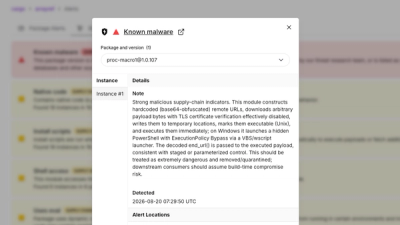
Three compromised Rust crates pulled in a malicious dependency that downloaded and executed cross-platform malware during Cargo builds.