

Product
PHP and Composer Support Is Now in Beta
Socket’s PHP and Composer support is now in Beta for all customers, with PHP reachability analysis generally available.
By Trevor Norris, Benjamin Barslev - Aug 21, 2026
@decantr/decantr
Advanced tools
AI-first web framework with signal-based reactivity, atomic CSS, and a structured registry of 100+ components.
AI-first web framework. Zero dependencies. Native JS/CSS/HTML. v0.4.0
Decantr is designed for LLMs to generate, read, and maintain — not for human readability. Every API is optimized for token efficiency: terse atomic CSS atoms, proxy-based tag functions, and a machine-readable registry so agents can look up props and exports without parsing source files.
npx decantr init my-app
cd my-app
npm install
npx decantr dev
decantr/core        — h(), text(), cond(), list(), mount(), onMount, onDestroy, ErrorBoundary, Portal, Suspense, Transition
decantr/state       — createSignal, createEffect, createMemo, createStore, batch, createResource, createContext, createHistory
decantr/router      — createRouter, link, navigate, useRoute, useSearchParams (hash + history modes, nested routes, guards)
decantr/form        — createForm, validators, useFormField, fieldArray
decantr/css         — css(), define(), setStyle(), setMode(), setShape(), 1000+ atomic CSS utilities
decantr/tags        — Proxy-based tag functions (div, p, span...) — ~25% fewer tokens than h()
decantr/components  — 100+ UI components (form, display, layout, overlay, feedback, chart, typography)
decantr/test        — render, fire, flush + node:test re-exports
h() / tags create real elements, no diffing_-prefixed utility atoms via css()Every component is a function that returns an HTMLElement:
import { tags } from 'decantr/tags';
import { text } from 'decantr/core';
import { createSignal } from 'decantr/state';
import { css } from 'decantr/css';

const { div, button, span } = tags;

export function Counter({ initial = 0 } = {}) {
  const [count, setCount] = createSignal(initial);
  return div({ class: css('_flex _gap2 _p4 _aic') },
    button({ onclick: () => setCount(c => c - 1) }, '-'),
    span(text(() => String(count()))),
    button({ onclick: () => setCount(c => c + 1) }, '+')
  );
}
decantr init [name]       # Scaffold a new project
decantr dev               # Start dev server with hot reload
decantr build             # Production build
decantr test              # Run tests
decantr test --watch      # Watch mode
Decantr ships a built-in Model Context Protocol server that exposes 9 read-only tools for querying the component registry, resolving atomic CSS classes, validating project essence files, and searching across the full design system. The server runs locally via stdio — no data is collected, transmitted, or stored externally.
npx decantr mcp
Claude Code (~/.claude.json):
{
  "mcpServers": {
    "decantr": {
      "command": "npx",
      "args": ["decantr", "mcp"]
    }
  }
}
Cursor (.cursor/mcp.json):
{
  "mcpServers": {
    "decantr": {
      "command": "npx",
      "args": ["decantr", "mcp"]
    }
  }
}
Generic MCP client (stdio transport):
{
  "command": "npx",
  "args": ["decantr", "mcp"],
  "transport": "stdio"
}
1. Look up a component
Prompt: "What props does the Button component accept?"
Tool call: lookup_component with { "name": "Button" }
Response:
{
  "found": true,
  "name": "Button",
  "props": {
    "variant": { "type": "string", "values": ["solid", "outline", "ghost", "link", "destructive"], "default": "solid" },
    "size": { "type": "string", "values": ["xs", "sm", "md", "lg"], "default": "md" },
    "disabled": { "type": "boolean", "default": false },
    "loading": { "type": "boolean", "default": false }
  }
}
2. Resolve atoms
Prompt: "What CSS does _flex _col _gap4 _p4 produce?"
Tool call: resolve_atoms with { "atoms": "_flex _col _gap4 _p4" }
Response:
{
  "total": 4,
  "valid": 4,
  "invalid": 0,
  "atoms": [
    { "atom": "_flex", "css": "display:flex", "valid": true },
    { "atom": "_col", "css": "flex-direction:column", "valid": true },
    { "atom": "_gap4", "css": "gap:var(--d-space-4)", "valid": true },
    { "atom": "_p4", "css": "padding:var(--d-space-4)", "valid": true }
  ]
}
3. Search the registry
Prompt: "Find everything related to tables"
Tool call: search_registry with { "query": "table" }
Response:
{
  "query": "table",
  "total": 5,
  "results": [
    { "type": "component", "name": "DataTable", "score": 80 },
    { "type": "pattern", "id": "data-table", "name": "Data Table", "score": 90 },
    { "type": "pattern", "id": "pricing-table", "name": "Pricing Table", "score": 80 },
    { "type": "component", "name": "Table", "score": 80 },
    { "type": "pattern", "id": "table-of-contents", "name": "Table of Contents", "score": 80 }
  ]
}
The MCP server runs locally via stdio. It reads only local registry JSON files shipped with the package. No data is collected, transmitted, or stored externally.
MIT
FAQs
AI-first web framework with signal-based reactivity, atomic CSS, and a structured registry of 100+ components.
The npm package @decantr/decantr receives a total of 0 weekly downloads. As such, @decantr/decantr popularity was classified as not popular.
We found that @decantr/decantr demonstrated a healthy version release cadence and project activity because the last version was released less than a year ago. It has 1 open source maintainer collaborating on the project.
Product
Socket’s PHP and Composer support is now in Beta for all customers, with PHP reachability analysis generally available.
Product
Socket is bringing experimental protection to Firefox, scanning 97,000+ extensions in Mozilla's official directory for malware and risky updates.
Research
/Security News
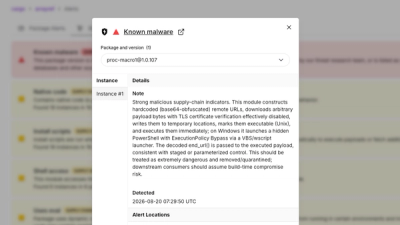
Three compromised Rust crates pulled in a malicious dependency that downloaded and executed cross-platform malware during Cargo builds.