

Product
PHP and Composer Support Is Now in Beta
Socket’s PHP and Composer support is now in Beta for all customers, with PHP reachability analysis generally available.
By Trevor Norris, Benjamin Barslev - Aug 21, 2026
@depixapp/sdk
Advanced tools
Non-custodial Liquid wallet SDK for AI agents — headless Node, local signing, Pix on/off-ramp.
The public product is now
@depixapp/mcp— one MCP: hosted receive + local full wallet (npx -y @depixapp/mcp). This package remains as the frozen 1.2.x lineage.
Agents: start here → AGENTS.md — the machine-first manifest (mental model, exact signatures, routing table, error catalog, guardrails, env vars, MCP tools). A concise link index lives in llms.txt.
Non-custodial Liquid wallet SDK for AI agents. An agent runs a full wallet in Node — its own seed, signing locally — to pay and receive over Pix/DePix, hold and convert the three Liquid assets (DePix, L-BTC, USDt), and buy gift cards, with client-side guardrails blocking anything over the owner's limits.
Nothing custodial: the seed never leaves the agent's environment and the backend
never signs. There is also an optional local MCP facade (depix-wallet-mcp)
so an MCP host (Claude Desktop, Claude Code, Cursor…) can drive the same wallet.
Companion — the payments-gateway MCP. To receive Pix (checkouts, products, status) without any custody, DePix runs a hosted gateway,
@depixapp/mcpathttps://mcp.depixapp.com/mcp(source). Don't confuse it with the localdepix-wallet-mcpfacade above: the gateway MCP is the receive side (no keys, no signing); this SDK holds, signs and moves the funds.
viem); npx caches a single download.npm install @depixapp/sdk
custodial: true on
results).0600 wallet file, and
therefore the wallet, regardless of the tool catalog. The mitigation there is
blast radius: fund the agent with only what it needs.A wallet cannot hand out a receive address until its seed has been backed up (so no funds can ever enter a wallet with no backup).
import { DepixWallet } from "@depixapp/sdk";

// Create a fresh 12-word wallet. In a real terminal (TTY) this runs an
// interactive backup ritual. In code/CI, pass mnemonicSecured: true to accept
// the backup consciously — the mnemonic is returned in the foreground so it is
// impossible not to receive it.
const { wallet, mnemonic } = await DepixWallet.create({
  passphrase: process.env.DEPIX_WALLET_PASSPHRASE, // ≥ 12 chars
  mnemonicSecured: true
});

// Store `mnemonic` with a human guardian (see "Fleet operators" for many
// agents). To make an explicit backup at any time:
const backup = await wallet.exportBackup(); // { kind: "mnemonic", mnemonic }
await wallet.confirmBackup();               // unlocks receive addresses

const address = await wallet.getReceiveAddress();
const { balances } = await wallet.getBalances();
await wallet.close();

// Later, reopen the same wallet dir:
const reopened = await DepixWallet.open({
  passphrase: process.env.DEPIX_WALLET_PASSPHRASE
});

// Restoring from an existing mnemonic is born backup-confirmed:
const restored = await DepixWallet.restore({
  passphrase: process.env.DEPIX_WALLET_PASSPHRASE,
  mnemonic
});
open() / create() / restore() read DEPIX_WALLET_DIR (default
~/.depix-wallet), DEPIX_WALLET_PASSPHRASE, DEPIX_API_KEY and
DEPIX_API_BASE from the environment when the options are omitted.
mnemonicSecured: trueIn an interactive terminal, create() runs a backup ritual: it prints the 12
words, challenges you to re-type a few of them at random positions, and asks
for an explicit "saved" declaration. Passing the ritual is what confirms the
backup and unlocks receive addresses.
A headless agent — CI job, daemon, MCP host, any process without a TTY — has
no human to run that ritual. There, create() still succeeds, but the wallet
is born unconfirmed: getReceiveAddress() and deposit() throw
BACKUP_REQUIRED until someone calls confirmBackup().
mnemonicSecured: true is the non-interactive substitute for the ritual. It
is an attestation: by passing it, your code declares that it captures the
returned mnemonic and stores it durably (secret manager, encrypted vault,
the human guardian's envelope — see "Fleet operators") before any funds can
arrive. The wallet is then born backup-confirmed and can receive immediately.
Rules of thumb:
mnemonic
somewhere a human can recover it from. This is the normal path for headless
agents.confirmBackup() only after the store succeeds.true — there is no env var and no silent default.
Skipping the ritual is a conscious, logged decision.restore({ mnemonic }) never needs the flag: possession of the mnemonic IS
the backup proof, so a restored wallet is always born confirmed.
An agent can open its OWN DePix account — no human filling a form. It proves
identity with an Ed25519 keypair (persisted encrypted in dataDir), and the
account is anchored to a human operator: the operator connects once via
OAuth (or a GitHub PAT) in the DePix dashboard and hands the agent an op_…
operator token. One operator can onboard many agents.
The receive liquid_address is taken from the agent's wallet (Quickstart 1) and
fixed at registration — the agent cannot change it later.
import { DepixWallet, DepixAgent } from "@depixapp/sdk";

// 1) Wallet (Quickstart 1) → its receive address is the merchant payout address.
const { wallet } = await DepixWallet.create({ passphrase: process.env.DEPIX_WALLET_PASSPHRASE, mnemonicSecured: true });
await wallet.confirmBackup();
const liquidAddress = await wallet.getReceiveAddress();

// 2) Create the agent identity keypair (encrypted in DEPIX_AGENT_DIR).
const agent = await DepixAgent.create({ passphrase: process.env.DEPIX_AGENT_PASSPHRASE });

// 3) Register. `operatorToken` comes from the human operator's one-time connect.
const { agent: me, keys, merchant } = await agent.register({
  name: "Acme Butler",
  operatorToken: process.env.DEPIX_OPERATOR_TOKEN!, // op_…
  operatorEmail: "ops@acme.com",
  liquidAddress
});

// Returned ONCE — persist them now:
//   keys.test.key        → sk_test_… (sandbox, immediate)
//   keys.liveStarter.key → sk_live_… wallet-only starter key (pre-graduation)
//   merchant.webhookSecret → verify inbound webhooks
console.log(me.username, keys.liveStarter.key);
Progress to full production is automatic: make real personal deposits with the
starter key; once matured, the account graduates and you can mint a full
sk_live_ key.
const status = await agent.status();
// { accountStatus, settledPersonalDeposits, graduated, graduationBlockedOn, keys }

if (status.graduated) {
  const key = await agent.createKey({ live: true, scopes: ["wallet_write"] });
  // key.key → full sk_live_… (returned once)
}

// Key lifecycle + webhook secret rotation, all signed by the identity keypair:
await agent.revokeKey(oldKeyId);
const { webhookSecret } = await agent.rotateWebhookSecret();
Receiving from third parties (and any merchant_*-scoped key) additionally
requires proving control of a domain — a two-phase DNS TXT challenge:
// Phase 1 — fetch the challenge (server-derived and stable; re-fetch any time).
const { recordName, recordValue } = await agent.verifyDomain("acme.com");
// → publish a DNS TXT record: name recordName ("_depix-verify.acme.com"),
//   value recordValue ("depix-verify=…").

// Phase 2 — once DNS has propagated, confirm. The server resolves the TXT
// record and stores the registrable domain (eTLD+1) as verified.
const { verifiedDomain } = await agent.verifyDomain("acme.com", { confirm: true });
domain_txt_not_found on confirm means the record has not propagated yet (or
mismatches) — wait and retry phase 2. domain_tld_not_allowed carries the
accepted list in details.allowed_tlds (also public at
GET /api/agents/domain-tlds), and free-subdomain hosts are rejected with
domain_free_host.
Errors branch on err.code (see AgentError for the catalog): before
graduation a live key throws graduation_pending; a merchant_* scope without a
verified domain throws domain_required (clear it with verifyDomain() above);
an expired signature throws agent_signature_expired (re-sign — clocks
drifted). DepixAgent.open({ ... }) reloads the identity in later sessions.
create() / open() read DEPIX_AGENT_DIR (default ~/.depix-agent),
DEPIX_AGENT_PASSPHRASE (falls back to DEPIX_WALLET_PASSPHRASE) and
DEPIX_API_BASE when the options are omitted.
The agent has no bank account. It receives DePix (its owner pays a Pix QR into
it) and pays out to a Pix key via withdraw(), signing the Liquid transaction
locally.
const wallet = await DepixWallet.open({
  apiKey: process.env.DEPIX_API_KEY // sk_test_… (sandbox) or sk_live_… (prod)
});

// ── On-ramp: create a deposit QR. The OWNER (a human with a bank) pays it. ──
const dep = await wallet.deposit({
  amountCents: 1000,            // R$ 10.00 (R$ 5–3000 server-side)
  payerTaxNumber: "OWNER_CPF"   // CPF/CNPJ of whoever pays the QR
});
console.log("Ask the owner to pay:", dep.qrCopyPaste);

const paid = await wallet.waitForDeposit(dep.id, { intervalMs: 5000 });
// paid.status === "depix_sent" → the DePix is now in the wallet.

// ── Off-ramp: pay out R$ 5 to a Pix key. Signed locally with the fee output. ──
const out = await wallet.withdraw({
  pixKey: "destination@pix.key",
  recipientTaxNumber: "HOLDER_CPF", // CPF/CNPJ of the Pix key's HOLDER
  amountCents: 500,                 // R$ 5.00
  mode: "send"                      // "send" = you send X; "payout" = they receive X
});
const settled = await wallet.waitForWithdrawal(out.withdrawalId, { intervalMs: 5000 });
// settled.status === "sent", settled.liquid_txid === out.txid.
Two different people, two different documents.
payerTaxNumberis the owner paying the deposit QR;recipientTaxNumberis the holder of the destination Pix key. Never reuse one for the other.
Rate/limit notes for the quickstart. Creating a deposit or withdrawal is
capped at 2/min per key; status reads at 30/min per endpoint — the SDK
paces both for you. A live key (sk_live_) needs the account's
merchant.api_access flag (admin-granted); when WhatsApp enforcement is on, the
owner must have WhatsApp verified in the app or deposit/withdraw return
whatsapp_verification_required.
await wallet.send({ asset: "LBTC", amountSats: 5000n, address: "lq1…" });

// Converting: quote every candidate route, then execute one — the PRIMARY surface.
const routes = await wallet.quote({ from: "DEPIX", to: "LBTC", network: "liquid", amount: 500_000_000n });
const result = await wallet.convert({ from: "DEPIX", to: "LBTC", network: "liquid", amount: 500_000_000n });

// Power users: the per-provider namespaces live under wallet.advanced.*
// (e.g. drive the SideSwap quote stream yourself, tick by tick).
const stream = await wallet.advanced.sideswap.quote({ from: "DEPIX", to: "LBTC", amountSats: 500_000_000n });
const quote = await stream.next();
const swap = await stream.execute(quote);
stream.close();

// Lightning + refunds live under wallet.advanced.*.
// A documented cross-network USDt route is custodial and marked custodial: true.
Gift cards (wallet.giftcards.*) — buy a gift card or mobile top-up from
CryptoRefills, paid over Lightning via Boltz (non-custodial), with a 1% DePix
service fee. The full agent loop is browse → pick a value → buy → poll → redeem:
// 1. Browse the catalog, then a brand's denominations.
const { brands } = await wallet.giftcards.list({ countryCode: "BR", query: "amazon" });
const products = await wallet.giftcards.listProducts({ brandName: "Amazon" });
// Each product is FIXED (pass its `denomination`; `priceSats` is the cost) or a
// RANGE product (`isDynamic: true` — pass denomination "range" + a `productValue`
// within `min`..`max`; price a custom value first if you want):
const custom = await wallet.giftcards.price({ brandName: "Amazon", faceValue: 150 }); // { priceSats, currency }

// 2. Buy. Returns after the L-BTC lockup is broadcast; Boltz then pays the
//    invoice in the background. The payment crosses the owner's guardrails first.
const order = await wallet.giftcards.buy({
  brandName: "Amazon",
  denomination: "50 BRL",         // or "range" + productValue for a dynamic product
  email: "agent@example.com",     // delivery target + the allowlisted beneficiary
});

// 3. Poll until terminal, then read the redemption code/URL.
const status = await wallet.giftcards.getOrderStatus(order.orderId);
if (status.terminal && status.delivery) {
  // status.delivery = { kind: "code" | "url" | "none", value }
}
The whole flow is gated on the operator's giftcardEnabled toggle
(GIFTCARDS_DISABLED when off). Over MCP the same loop is
wallet_list_giftcards → wallet_list_giftcard_products /
wallet_giftcard_price → wallet_buy_giftcard →
wallet_get_giftcard_order_status.
Guardrails run on every signature. Over the per-tx or daily ceiling, or (with
the allowlist on) to a destination that isn't allow-listed, the call throws a
GuardrailError (GUARDRAIL_PER_TX_LIMIT / GUARDRAIL_DAILY_LIMIT /
GUARDRAIL_ALLOWLIST_BLOCKED) before anything is signed.
depix-wallet-mcp)The SDK ships a stdio MCP server so an MCP host can drive the wallet with
wallet_* tools. It runs in the agent's environment — the seed never
leaves the machine. It is configured 100% by environment (no CLI flags for
secrets), boots by open()-ing the wallet (never auto-creates a seed), and
speaks JSON-RPC on stdout while every log line goes to stderr (secrets
redacted).
npx -p @depixapp/sdk depix-wallet-mcp
Claude Desktop / Claude Code (claude_desktop_config.json or the MCP config):
{
  "mcpServers": {
    "depix-wallet": {
      "command": "npx",
      "args": ["-p", "@depixapp/sdk", "depix-wallet-mcp"],
      "env": {
        "DEPIX_API_KEY": "sk_live_…",
        "DEPIX_WALLET_PASSPHRASE": "your-passphrase",
        "DEPIX_WALLET_DIR": "/home/agent/.depix-wallet"
      }
    }
  }
}
Tools: wallet_status, wallet_get_address, wallet_get_balances,
wallet_list_transactions, wallet_send, wallet_create_deposit,
wallet_wait_deposit, wallet_create_withdrawal, wallet_wait_withdrawal,
wallet_get_guardrails, plus swap/lightning/gift-card fast-follows, the
recovery pair wallet_recover / wallet_pending (re-drive everything pending
across all rails; list what is in flight — crash recovery also runs
automatically at boot) and the read-only wallet_diagnostics health snapshot
(versions, sync health, pending counters — never key material). Monetary
fields name their unit (amount_cents for Pix/BRL, amount_sats for
sends/swaps). There is no tool that exports the seed/mnemonic or changes
guardrails — those are never reachable by a tool call, even from a fully
injected model.
Two hosts, one wallet dir? Each host spawns its own process; a second process on the same
DEPIX_WALLET_DIRfails fast withWALLET_DIR_LOCKED. Point hosts at distinct dirs (distinct wallets) or share a single server.
| Variable | Required? | Default | Purpose |
|---|---|---|---|
DEPIX_WALLET_PASSPHRASE | Required when a seed exists | — | Unlocks the encrypted seed (Argon2id → AES-256-GCM). ≥ 12 chars or WEAK_PASSPHRASE. Never logged. |
DEPIX_API_KEY | Required for deposit/withdraw/status | — | sk_test_… (sandbox) or sk_live_… (production). |
DEPIX_WALLET_DIR | Optional | ~/.depix-wallet | Wallet data dir (encrypted seed, sync state, pending/guardrail files). One process per dir (WALLET_DIR_LOCKED). |
DEPIX_API_BASE | Optional | https://api.depixapp.com | Canonical API base. |
DEPIX_AGENT_PASSPHRASE | Required for DepixAgent | DEPIX_WALLET_PASSPHRASE | Unlocks the encrypted agent identity key (Ed25519). ≥ 12 chars. Falls back to the wallet passphrase. |
DEPIX_AGENT_DIR | Optional | ~/.depix-agent | Where DepixAgent stores its encrypted identity key. |
DEPIX_GUARDRAIL_PER_TX_BRL_CENTS | Optional | 10000 (R$ 100) | Per-transaction ceiling, in BRL cents. 0/negative is a config error; to disable, set Number.MAX_SAFE_INTEGER explicitly. |
DEPIX_GUARDRAIL_DAILY_BRL_CENTS | Optional | 50000 (R$ 500) | Rolling-24h ceiling, in BRL cents. |
DEPIX_GUARDRAIL_ALLOWLIST | Optional | off | JSON allowlist (liquidAddresses, pixKeys, per-rail opt-ins…). When on, any non-allow-listed / non-representable destination is fail-closed. |
DEPIX_MCP_MAX_WAIT_SECONDS | Optional | 900 | Ceiling (seconds) a wallet_wait_* MCP tool may block; the per-tool default is 300. |
DEPIX_SDK_LOG_LEVEL | Optional | info | debug | info | warn | error — minimum level written to stderr. |
Guardrail options passed to open() (guardrails: { … }) take precedence over
the env, which takes precedence over the defaults. Guardrails are set only at
open() and are immutable at runtime — there is no update method an injected
agent could reach.
SIDESHIFT_AFFILIATE_IDis a build/publish variable, not a runtime one. It is baked into the artifact at publish time (see Publishing) and is never read at runtime.
For one agent, the simplest safe thing is for the operator to store that wallet's mnemonic. At scale, use the envelope procedure with standard tools (age/PGP) — this is a documented manual procedure, not a feature of the SDK, and DePix never hosts the blobs:
DepixWallet.restore().One private key covers N wallets; the secret doesn't disappear, it changes shape.
Conversions move between the three Liquid assets and out to other rails. All are non-custodial — the SDK signs locally and funds return to your wallet — except SideShift, which is custodial and signalled as such (see below).
Primary surface — the intent layer. wallet.quote() enumerates every
candidate route (single- and multi-hop) with per-leg estimates; the callable
wallet.convert({ from, to, network, amount }) executes one, hiding the
provider mechanics (quote streams, watches, polling) and waiting for
settlement by default:
const routes = await wallet.quote({ from: "DEPIX", to: "LBTC", network: "liquid", amount: 500_000_000n });
const result = await wallet.convert({ from: "DEPIX", to: "LBTC", network: "liquid", amount: 500_000_000n, route: routes[0].id });
Advanced surface — wallet.advanced.*. The per-provider namespaces, for
power users who want fine-grained control (drive the quote stream tick by
tick, poll pegStatus, resume Boltz swaps manually, manage SideShift refund
addresses):
wallet.advanced.sideswap.* — market swaps + BTC↔L-BTC peg (non-custodial).wallet.advanced.boltz.* — Lightning send/receive + L-BTC→USDC/USDT EVM (non-custodial).wallet.advanced.sideshift.* — USDt cross-network — CUSTODIAL, signalled.Every money-moving method still crosses the owner's guardrails before signing — the advanced surface adds no bypass.
Deprecated aliases.
wallet.convert.sideswap/.boltz/.sideshiftstill work (they alias the very same instances) but are deprecated — usewallet.advanced.*. They will not be removed in 1.x.
wallet.advanced.*)Three primitives for agents that need to see and shape transactions directly:
// READ-ONLY: every UTXO of the wallet (asset, amount, outpoint, address, confirmations).
const utxos = await wallet.advanced.listUtxos();

// READ-ONLY: which UTXOs would cover a target (greedy, confirmed-first, largest-first),
// plus the estimated change. Informational — LWK's builder does its own selection
// at build time, and the network fee is not modeled here.
const pick = await wallet.advanced.selectCoins({ asset: "DEPIX", targetSats: 500_000_000n });

// MOVES FUNDS: one Liquid tx with N recipient outputs (assets can be mixed).
const { txid } = await wallet.advanced.sendMany({
  recipients: [
    { asset: "DEPIX", amountSats: 200_000_000n, address: "lq1…a" },
    { asset: "DEPIX", amountSats: 300_000_000n, address: "lq1…b" },
    { asset: "LBTC",  amountSats: 10_000n,      address: "lq1…c" }
  ]
});
sendMany crosses the same guardrail choke point as send(), on the
TOTAL: output amounts are summed per asset, valued in BRL (non-DePix assets
fail closed without a quote), and the grand total is enforced against the
per-tx and rolling-24h ceilings — N small outputs cannot slice under the cap.
With the allowlist on, every destination address must be opted in. The
spend is recorded at signing time, all under the wallet op mutex.
No raw PSET surface.
buildPset/signPset/broadcastPsetare deliberately not exposed: a signed PSET can be broadcast by any code path, so signing arbitrary PSETs outside the choke point would be a guardrail bypass. If you need a custom transaction shape, ask for a primitive that can carry the guardrail with it (likesendManydoes).
SideShift uses a deposit-address model: you send USDt to an address they give
you and they pay out from their reserve on the target network. This is the one
flow where funds leave the non-custodial sphere — once your send confirms the
USDt is in SideShift's custody (escrow states like review/refund apply). Every
result carries custodial: true, and the wallet_shift_usdt MCP tool says so in
its description. There is no blocking flag — the call works directly; the
custodial nature is documented, not gated (decision G4).
// SEND — USDt Liquid → another network (guardrailed: value + settle/refund allowlist).
const shift = await wallet.advanced.sideshift.send({
  network: "tron",              // ethereum | tron | bsc | polygon | solana
  amountSats: 10_000_000n,      // USDt base units (8 decimals on Liquid)
  settleAddress: "T…",          // FINAL destination on the target network
  refundAddress: "lq1…",        // optional Liquid refund address (allowlisted when the allowlist is on)
});
console.log(shift.custodial);   // true

// RECEIVE — external network → USDt into this wallet (an inflow; no guardrail).
await wallet.advanced.sideshift.receive({ network: "tron" });
await wallet.advanced.sideshift.getStatus(shift.shiftId);
With the guardrail allowlist enabled, a SEND requires the settleAddress (mapped
to its network class — evmAddresses / tronAddresses) and the
refundAddress (sideshiftRefundAddresses) to be opted in. A Solana settle has
no representable allowlist class, so it is fail-closed when the allowlist is on.
// Incremental sync (the default) — scans forward from the current state.
// Can take up to ~1 min (default timeout 60s, WARM_SYNC_TIMEOUT_MS). It polls
// the esplora provider chain, rotating to the next on failure.
await wallet.sync();

// Deep re-scan from ZERO — drops the local scan cache and re-derives the whole
// history. The recovery move when the wallet looks desynchronized (missing
// transactions, stale balances). Can take SEVERAL MINUTES (default timeout 600s
// / 10 min, COLD_START_TIMEOUT_MS — a virgin cold scan also uses this bound).
await wallet.sync({ rescan: true });

// NOTE ON TIMEOUTS: sync() owns its own timeout + provider rotation — do NOT wrap
// it in a shorter race (e.g. Promise.race with a 10s cap): that aborts a scan
// that would have finished, leaving stale balances. A warm sync may legitimately
// run up to ~1 min and a deep re-scan up to ~10 min. Both bounds are tunable when
// constructing the wallet (syncTimeoutMs / coldStartTimeoutMs); raise them for a
// heavily-used wallet or a slow provider rather than capping sync() externally.

// Read-only health snapshot for support: SDK/LWK versions, dataDir, backup
// state, sync health (last scan/success, last persist failure), per-rail
// pending counters and the guardrail budget. NEVER key material — no seed,
// mnemonic, passphrase or descriptor.
const diag = await wallet.diagnostics();
The same snapshot is exposed to MCP hosts as the read-only wallet_diagnostics
tool.
npm test — offline unit / sandbox / contract suite. Set DEPIX_SDK_OFFLINE=1
to skip the read-only live-network integration checks.npm run smoke — smokes the built dist/ (lwk_node init, descriptor + addr[0]
goldens, seed-store roundtrip) after npm run build.npm run openapi:diff — advisory drift check of the vendored OpenAPI fixture
against the live document.test/e2e/mainnet.test.ts) — opt-in, real funds, human in the
loop. Skipped unless RUN_MAINNET_E2E=1 and a sk_live_ DEPIX_API_KEY are
set; see the file header for the full prerequisites.CI runs the full suite (typecheck + lint + offline tests + build + smoke) on Node
24 / current × ubuntu / macos; the Node 22.4 engines floor is proven by
a separate smoke-only job (npm ci --omit=dev + npm run smoke on the prebuilt
dist/, because 22.4's bundled npm can't install the build's dev deps). Windows is
out for 1.0.
Release/publishing is maintainer-only — see CONTRIBUTING.md.
AGPL-3.0-only — see LICENSE. The network-copyleft applies: a
modified version offered over a network must make its source available under the
same terms. For use in a closed-source or commercial product without the AGPL
obligations, a separate commercial license is available — contact DePix at
suporte@depixapp.com.
FAQs
Non-custodial Liquid wallet SDK for AI agents — headless Node, local signing, Pix on/off-ramp.
The npm package @depixapp/sdk receives a total of 84 weekly downloads. As such, @depixapp/sdk popularity was classified as not popular.
We found that @depixapp/sdk demonstrated a healthy version release cadence and project activity because the last version was released less than a year ago. It has 1 open source maintainer collaborating on the project.
Product
Socket’s PHP and Composer support is now in Beta for all customers, with PHP reachability analysis generally available.
Product
Socket is bringing experimental protection to Firefox, scanning 97,000+ extensions in Mozilla's official directory for malware and risky updates.
Research
/Security News
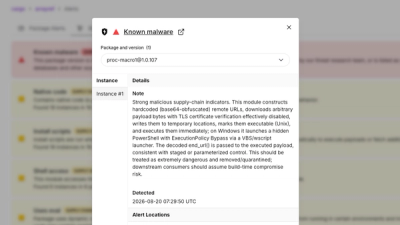
Three compromised Rust crates pulled in a malicious dependency that downloaded and executed cross-platform malware during Cargo builds.