

Company News
AWS Security Hub Adds Socket for Supply Chain Security
Socket is now in the AWS Security Hub Extended plan. Adopt it through AWS, apply committed spend, and block malicious open source packages.
By Feross Aboukhadijeh - Aug 04, 2026
@dikshanty94/webnav
Advanced tools
A navigation memory for AI agents — zero-LLM web-navigation CLI that recalls cheap, reliable routes instead of re-exploring.





Stop your web-browsing AI agent from re-exploring the same sites every run. Your agent maps
a website once — then travels it forever with webnav walk: deterministic, zero-LLM,
page-to-page autopilot that pauses only at genuine forks (what to buy, an irreversible button)
and hands the wheel back. It's a reusable site map, not page compression — most token-saving
tools shrink what the agent reads; webnav remembers where things are so it stops re-finding
the route. webnav is the map and the mechanics; the agent keeps all the judgment.
A real run against saucedemo's full checkout flow (map + credentials already recorded):
$ webnav walk --start www.saucedemo.com:login --goal www.saucedemo.com:checkout-overview
{ "status": "needs-navigation",
  "semanticStep": "open the shopping cart",
  "question": "before \"open the shopping cart\", fire these in-page affordances: aff_addcart",
  "snapshot": "…", "session": "walk-w-…", "browserSession": "w-…" }
   # ^ paused at a REAL fork: webnav won't decide what you buy. The agent picks from the snapshot:

$ webnav use click e54 --session w-…          # add-to-cart — the agent's one judgment call
$ webnav walk-resume walk-w-… --ref e124      # continue; e124 = the icon-only cart badge
{ "status": "done", "cost": { "playwright_calls": 12 } }
4 agent-visible CLI calls, login → inventory → cart → checkout form (auto-filled from locally-stored creds — never in the map) → overview. 12 browser actions underneath, zero agent tokens spent on navigation.
In our navigation benchmark (both arms on Haiku, the same
browser underneath), on a deep multi-step route walk used ~3× fewer agent steps than an agent
ad-hoc-driving the raw browser — median 6 calls vs 18 — and reached the goal more reliably (3/3 vs
2/3). Honest caveat, also in that file: the win shows up on deep, reliably-walked routes; on
shallow 1–2-hop routes, or when the agent falls back to manual driving, the two tie. webnav helps
most exactly where ad-hoc driving hurts most — the long, repeated journeys.
There's also a Chrome extension in webnav-extension/ — a docked side
panel where you type a goal and watch the agent drive your active tab (read / click / type /
scroll, via chrome.debugger/CDP), on your own Claude Code subscription. It recalls first
(list_routes → check_route) so a site you've mapped is replayed, not re-explored — and every
run is recorded back into the map, so the next time is the cheap deterministic walk.


Try it (needs the local server for the zero-LLM navigation + recording):
cd webnav-extension && npm i && npm run build   # emits the *.js next to *.ts
webnav dev agent-serve --port 7779              # prints a token — paste it into the panel
Then chrome://extensions → Developer mode → Load unpacked → pick webnav-extension/,
open the panel (toolbar icon or ⌘/Ctrl-E), paste the token, and type a goal. Runs show up on
the dashboard tagged Extension. Full walkthrough: webnav-extension/README.md.
Web agents re-discover the same websites every single day, paying the same token bill every time: snapshot → reason → click → snapshot. For sites you (or your agents) use repeatedly — internal tools, automation testing, back-office workflows — that navigation should be remembered, not re-reasoned. webnav stores the durable intent of each step, replays it deterministically, self-heals when the site drifts, and never auto-fires an irreversible action: commit points always pause for the agent (or you) to decide.
npm install && npm link     # Node 18/20/22; installs `webnav` on PATH (runs src via tsx — NO build step)
                            # also needs `playwright-cli` on PATH

# walk a site WITHOUT learning it — import a map someone already made:
webnav dev import-map mappacks/orangehrm.mappack.json     # 17 states, in-page repertoire + domain shadow
webnav dev creds set opensource-demo.orangehrmlive.com username=Admin password=admin123   # YOUR creds, local only
webnav walk --start opensource-demo.orangehrmlive.com:auth-login \
            --goal  opensource-demo.orangehrmlive.com:recruitment-viewcandidates --headless
#  → webnav drives login → dashboard → … → the Candidates list, pausing only at genuine forks.

webnav dev list             # the sites you have maps for (saucedemo ships seeded by default)
Three packs ship in mappacks/ (saucedemo · OrangeHRM · automationexercise) — skeleton
only, never credentials. To map your own site, hand an agent the prompt in
docs/LEARNING-A-SITE.md. Dev/contributor commands:
webnav --help               # the tool menu (a peer of playwright-cli)
npm test                    # unit tests (+ gated browser e2e)
npm run build               # tsc -> dist/ (only for the published build; the CLI runs src directly)
Using it from an MCP client (Claude Desktop/Code, etc.) — webnav serves every verb as an MCP
tool over stdio, so your agent gets walk/use/search/… natively, no shelling out. One line:
{ "mcpServers": { "webnav": { "command": "webnav", "args": ["mcp"] } } }
webnav is a map — and a fresh install is not blank, but it is small. Here's honestly what you get and how it grows, so there are no surprises:
What ships, out of the box. The first time you run any verb, webnav seeds a shared
map at ~/.webnav/webnav.db (per-user, shared across every terminal/folder on the
machine — not a per-directory file). It comes pre-seeded with one worked example:
saucedemo.com — a full login→browse→cart→checkout walk map. This works immediately:
webnav walk --start www.saucedemo.com:login \
            --goal www.saucedemo.com:checkout-complete      # saucedemo, seeded
Nothing else is seeded — webnav is a blank-slate map tool, and saucedemo is the single example that proves it works. You record your own sites (see below); that's the product. This fits any flow you repeat against the same site: automation testing, internal tools, back-office workflows, recurring agent tasks. (An earlier GitHub-recall
The map persists and self-heals. It's saved to ~/.webnav/webnav.db and reused on
every run — you do not rebuild it each time. When a remembered step drifts (a renamed
or moved element), a walk escalates once for the agent to pick the element, then writes
the fix back so the next run resolves it deterministically (principle #3). Routes you use
stay fresh. Credentials for login-gated sites live outside the
map, locally, at ~/.webnav/credentials.json (chmod 600) — never in the DB, never shared.
Mapping a NEW site — hand your AGENT the learn prompt. webnav is built for agents, so you
don't map by hand: you give an agent (even a cheap one — we use Haiku) the reusable prompt in
docs/LEARNING-A-SITE.md and let it run autonomously. It drives the
site once through webnav's use primitives while recording, then dev graph-analyse --draft folds
that into a SELF-VERIFIED map (absolute URLs, unique element fingerprints, the in-page affordance
repertoire, the declared domain shadow) which it persists with dev graph-edit. No hand-authoring
of fingerprints or URLs. (That prompt learned the seeded OrangeHRM map — login + 11 modules,
exercised — in a single one-shot run.) Re-learn cleanly with dev node-clear.
Or skip learning — import a map pack someone already made. A map travels as a pack, so only the
first person learns a site. webnav dev import-map <pack.json> loads a site's skeleton; set your own
login with dev creds set (packs are skeleton-only, never carry credentials). Two packs ship in
mappacks/ (saucedemo, OrangeHRM); dev export-map <site> makes your own to share.
Or record a site by browsing it yourself. No agent needed: run webnav dev record-live --session S --url <site> — it opens a headed browser at that URL, and you click through the
flow naturally. Every action you take is captured (real playwright a11y snapshots, never typed
values — only which field changed) into the same session store the agent-record path uses. Stop
with Ctrl-C or webnav dev record-stop --session S, then it's the same dev graph-analyse <session> --draft → graph-edit → walk pipeline.
Or drive + record from the Chrome extension — the side panel
above: give the agent a goal, it drives your active tab (recalling known routes first), and the
run is captured back into the map. (An earlier extension capture-only path that approximated the
a11y tree from the raw DOM is retired — it broke on SPAs; the current extension captures via real
CDP accessibility instead. dev ingest still exists as that legacy receiver.)
Inspect what you have anytime: webnav dev dashboard (a localhost operator UI). Its
Sessions tab lists every recorded run — tagged by source (Extension / Agent /
Manual), with a filter, step counts, and a Verified badge — plus record-by-clicking + replay:


Or the text views dev outline <site> / dev mermaid <site>.
TL;DR: out of the box you can walk saucedemo; everything else you map yourself. Same
machine + a mapped site → instant, cached, self-healing. A brand-new site → you (or your
agent) record it once first.
# Travel a map you've built (the core win: deterministic, low-token replay)
webnav walk --start <state> --goal <state>   autopilot a multi-step route; pauses at genuine forks
webnav walk-resume <session> --ref|--classify   answer a paused walk's fork and continue
webnav creds set <site> key=value...         store login/form creds locally (~/.webnav, chmod 600)

# Drive a live browser one step at a time (explore/build; each step recordable)
webnav use navigate <url> --session S        open a URL (records a landing if S is recording)
webnav use snapshot --session S              read the page + element refs (never records)
webnav use click <ref> / use type <ref> <t>  act on a ref; records the before/after effect
webnav read <url> [--raw]                    open a URL -> distilled content
webnav search "<query>" [--top N]            open-web search -> extracted evidence
webnav eval <url> "<js>" | network <url>     targeted JS extraction | the page's API calls

# Author a site's map (the record -> analyse -> edit flow)
webnav dev record-start / record-stop        bracket a mapping session
webnav dev record-live --session S --url U   headed browser; click through it yourself, webnav records
webnav dev agent-serve [--port 7779]         local server the Chrome extension drives (SSE + CDP); records each run
webnav dev ingest [--port 7778]              legacy receiver for the retired DOM-capture extension path
webnav dev graph-analyse --session S [--draft]  mechanical structure from what you recorded
                                             (--draft = a self-verified, ready-to-edit graph spec)
webnav dev graph-edit --node <id> --graph J  write the validated graph
webnav dev effects --session S               the RAW recorded before/after snapshots
webnav dev outline <site> | mermaid <site>   completeness check | renderable diagram
webnav dev graph-show --node <id>            a site's stored states + edges (JSON)
webnav dev export-map <site>                 a site's map pack as JSON (skeleton only, no creds)
webnav dev dashboard [--port N]              local operator UI: sites + JSON map + credentials
webnav dev list                              the sites you have maps for + state counts
webnav dev node-clear / node-rm --node <id>  empty a site's map (re-learn) / delete it entirely
webnav dev node-add / edge-add / capture     teach + inspect helpers
webnav <verb> --help for details. Output is JSON on stdout; exit 0 ok / 2 error / 3 empty.
webnav mcp serves every verb as an MCP tool over stdio — point an MCP client at it and
agents get the verbs natively (no shelling out). Tools are generated from the same command
registry as --help, and every call runs the real CLI, so the two surfaces can't drift:
{ "mcpServers": { "webnav": { "command": "webnav", "args": ["mcp"] } } }
Consumer verbs can also be invoked canonically as webnav use <verb> ... and map-authoring verbs as webnav dev <verb> ...; bare consumer verbs (e.g. webnav read ...) still work too.
The map is for the calling AGENT (walk), not a human dashboard. To inspect what's captured, use the text views — no UI:
webnav dev outline www.saucedemo.com    # top-to-bottom states + affordances + completeness cues
webnav dev mermaid www.saucedemo.com     # paste into GitHub/mermaid.live to render
webnav dev graph-show --node <id>        # raw JSON
needs-navigation/needs-classification "your move" response for
the agent. Never judges, never calls an LLM.src/)cli.ts, cli-spec.ts, cli-help.ts CLI: parsing, command registry, help rendering
protocol.ts, contract.ts walk response types · published @dikshanty94/webnav types
paths.ts, creds.ts, hosted.ts ~/.webnav paths · local credential store · remote-map client
mcp/ server.ts `webnav mcp`: every verb as an MCP tool (generated from cli-spec)
mapstore/ types.ts, store.ts, record.ts, schema.sql SQLite persistence (states+affordances+shadow, edges, nodes, node_edges, record sessions)
playwright/ adapter.ts, snapshot.ts, capture.ts, fingerprint.ts, sessions.ts, throttle.ts playwright-cli child-process · a11y snapshot parser · element fingerprints · session guardrails
explorer/ analyse.ts, diff.ts, draft.ts, shadow.ts, fingerprint.ts, fingerprint-page.ts analyse a recording → self-verified draft (affordances + declared domain shadow) + state recognition
router/ resolve.ts, replay.ts, path.ts, walk.ts, walk-live.ts, walk-session.ts deterministic resolve/replay + interactive multi-step walk + pathfinding
readiness.ts, extract.ts, extract-content.ts, tokens.ts, browse.ts, read.ts bot-wall detection · signal/content extraction · token-savings · page reading
search.ts, search-providers.ts, search-live.ts multi-provider open-web search
catalog.ts dev list (the map index)
graph/ seed.ts, teach.ts, edit.ts, show.ts, coverage.ts map authoring + inspection (saucedemo seed, graph-edit, graph-show, outline/mermaid)
dashboard/ server.ts, shell.ts `webnav dev dashboard` local operator UI
Tests mirror this under tests/. The live e2e walk tests are gated behind WEBNAV_LIVE=1.
All current work is merged to main, tests green. See docs/STATUS.md for the live
checklist, pending work, and known limitations; CLAUDE.md holds the settled design,
mental model, and principles. Design docs: docs/superpowers/specs/.
PRs welcome — see CONTRIBUTING.md (the settled principles, dev setup, and how
to contribute a site map — the highest-leverage contribution). Report security issues privately
per SECURITY.md. Be excellent to each other: CODE_OF_CONDUCT.md.
Apache License 2.0. Free to use, modify, and redistribute (including commercially)
with attribution: retain the copyright notice and the NOTICE file. Includes an
explicit patent grant. Copyright 2026 Dikshant Yadav.
FAQs
Did you know?

Socket for GitHub automatically highlights issues in each pull request and monitors the health of all your open source dependencies. Discover the contents of your packages and block harmful activity before you install or update your dependencies.
Company News
Socket is now in the AWS Security Hub Extended plan. Adopt it through AWS, apply committed spend, and block malicious open source packages.
Research
/Security News
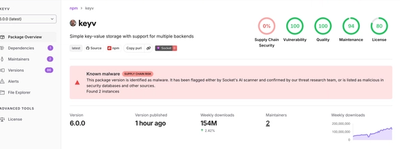
Popular npm packages keyv and cacheable compromised.

Security News
A misconfiguration gave three Anthropic models internet access, and one, believing it was in a simulation, shipped a credential-stealing package to PyPI.