

Research
/Security News
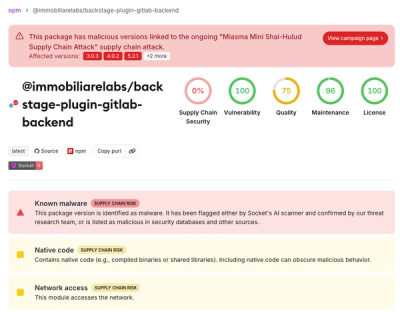
Miasma Mini Shai-Hulud Hits ImmobiliareLabs npm Packages
Miasma Mini Shai-Hulud hits @immobiliarelabs Backstage plugins, targeting GitLab and LDAP auth packages on npm.
By Socket Research Team - Jun 26, 2026
@directive-run/core
Advanced tools
The constraint-driven runtime for TypeScript. Declare what must be true — the runtime makes it happen.




Constraint-driven runtime for TypeScript. Declare requirements, let the runtime resolve them.
npm install @directive-run/core
import { createModule, createSystem, t } from "@directive-run/core";

const counter = createModule("counter", {
  schema: {
    facts: { count: t.number() },
    derivations: { doubled: t.number() },
    events: { increment: {}, reset: {} },
    requirements: {},
  },

  init: (facts) => {
    facts.count = 0;
  },

  derive: {
    doubled: (facts) => facts.count * 2,
  },

  events: {
    increment: (facts) => {
      facts.count += 1;
    },
    reset: (facts) => {
      facts.count = 0;
    },
  },
});

const system = createSystem({ module: counter });
system.start();

system.events.increment();
console.log(system.facts.count);     // 1
console.log(system.read("doubled")); // 2
Derivations auto-track which facts they read. No dependency arrays, no manual subscriptions. Derivations can depend on other derivations for composition:
const app = createModule("app", {
  schema: {
    facts: { items: t.array<string>(), filter: t.string() },
    derivations: {
      filtered: t.array<string>(),
      count: t.number(),
      summary: t.string(),
    },
    events: {},
    requirements: {},
  },

  init: (facts) => {
    facts.items = ["apple", "banana", "avocado"];
    facts.filter = "a";
  },

  derive: {
    filtered: (facts) => facts.items.filter((i) => i.startsWith(facts.filter)),
    count: (_facts, derived) => derived.filtered.length,
    summary: (_facts, derived) => `${derived.count} items match`,
  },
});
The constraint/resolver cycle is the core of Directive. Constraints declare what must be true. Resolvers declare how to make it true. The runtime connects them automatically.
import { createModule, createSystem, t } from "@directive-run/core";

const userModule = createModule("user", {
  schema: {
    facts: {
      userId: t.string().nullable(),
      profile: t.object<{ name: string }>().nullable(),
    },
    derivations: {},
    events: { login: { userId: t.string() } },
    requirements: { FETCH_PROFILE: { userId: t.string() } },
  },

  init: (facts) => {
    facts.userId = null;
    facts.profile = null;
  },

  events: {
    login: (facts, payload) => {
      facts.userId = payload.userId;
    },
  },

  constraints: {
    needsProfile: {
      when: (facts) => facts.userId !== null && facts.profile === null,
      require: (facts) => ({ type: "FETCH_PROFILE", userId: facts.userId! }),
    },
  },

  resolvers: {
    fetchProfile: {
      requirement: "FETCH_PROFILE",
      retry: { attempts: 3, backoff: "exponential" },
      resolve: async (req, context) => {
        const res = await fetch(`/api/users/${req.userId}`);
        context.facts.profile = await res.json();
      },
    },
  },
});

const system = createSystem({ module: userModule });
system.start();

// Dispatching login sets userId, which triggers the constraint,
// which emits the requirement, which the resolver fulfills automatically.
system.events.login({ userId: "u-123" });
Events provide typed imperative actions with payloads. Define them in your schema and handle them with events:
events: {
  addItem: (facts, payload: { name: string; price: number }) => {
    facts.items = [...facts.items, { name: payload.name, price: payload.price }];
  },
  removeItem: (facts, payload: { id: string }) => {
    facts.items = facts.items.filter((i) => i.id !== payload.id);
  },
},

// Typed and autocompleted:
system.events.addItem({ name: "Widget", price: 9.99 });
| Package | Framework | Reactivity Model |
|---|---|---|
@directive-run/react | React 18+ | useSyncExternalStore hooks |
@directive-run/vue | Vue 3+ | Ref / ShallowRef composables |
@directive-run/svelte | Svelte 4+ | Readable stores |
@directive-run/solid | Solid.js 1+ | Accessor signals |
@directive-run/lit | Lit 3+ | ReactiveController classes |
| Import | Purpose |
|---|---|
@directive-run/core | Core runtime – modules, systems, schema types |
@directive-run/core/plugins | Logging, devtools, persistence, observability, circuit breaker |
@directive-run/core/testing | Mock resolvers, fake timers, assertion helpers |
@directive-run/core/migration | Redux/Zustand/XState migration helpers |
@directive-run/core/worker | Web Worker support |
@directive-run/core/adapter-utils | Shared utilities for building framework adapters |
Every system exposes a typed system.observe(observer) stream – one listener receives every observation event with full TypeScript narrowing on event.type. Source-publish, source-drop, fact-change, constraint evaluation, requirement lifecycle, resolver lifecycle, and effect runs all flow through the same channel.
const unsubscribe = system.observe((event) => {
  if (event.type === "source.publish") {
    log("source published:", event.id, event.eventName);
  } else if (event.type === "source.drop") {
    // Pairs with `source.publish` so observers see both halves of the
    // publish path without polling `inspect().sources[i].dropCount`.
    // `reason` is the shared `SourceDropReason` union.
    log("source dropped:", event.id, event.eventName, event.reason);
  }
});
For plugin authors, the same hooks are available on Plugin:
import type { Plugin, SourceDropReason } from "@directive-run/core";

const alerter: Plugin = {
  name: "drop-alerter",
  onSourceDrop(id, moduleId, eventName, reason: SourceDropReason) {
    if (reason === "coalesced") metrics.incr("source.coalesce", { id });
    if (reason === "blocked-event-name") logger.error({ id, eventName });
  },
};
The SourceDropReason union is the single source of truth for drop reasons – SystemInspection.sources[i].lastDropReason, the Plugin.onSourceDrop hook signature, and the source.drop observation-event variant all reference the same type. Adding a new reason in one place flows to all three at compile time.
MIT
FAQs
The constraint-driven runtime for TypeScript. Declare what must be true — the runtime makes it happen.
The npm package @directive-run/core receives a total of 339 weekly downloads. As such, @directive-run/core popularity was classified as not popular.
We found that @directive-run/core demonstrated a healthy version release cadence and project activity because the last version was released less than a year ago. It has 1 open source maintainer collaborating on the project.
Did you know?

Socket for GitHub automatically highlights issues in each pull request and monitors the health of all your open source dependencies. Discover the contents of your packages and block harmful activity before you install or update your dependencies.
Research
/Security News
Miasma Mini Shai-Hulud hits @immobiliarelabs Backstage plugins, targeting GitLab and LDAP auth packages on npm.

Security News
Rolldown paused Rust React Compiler integration after a 5MB binary size increase raised concerns about shipping React-specific code to all Vite users.

Security News
/Research
Mini Shai-Hulud expands into the Go ecosystem after hitting LeoPlatform npm packages and targeting GitHub Actions workflows.