
Product
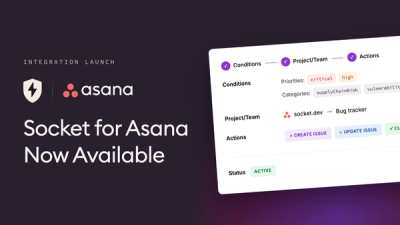
Socket for Asana Is Now Available
Create and manage Asana tasks directly from Socket alerts, with manual task creation, automated ticketing rules, and two-way sync.
By Jeppe Hasseriis - Aug 25, 2026
@dodomain/connect
Advanced tools
Official browser widget for DoDomain — opens the hosted domain-connect flow in a modal iframe and relays its lifecycle events.
Embeddable browser widget for DoDomain. Opens the hosted connect flow
in a modal iframe and relays its lifecycle events back to your app. Pairs with
@dodomain/node, which mints the session token on your server.
npm install @dodomain/connect
# or: pnpm add @dodomain/connect · yarn add @dodomain/connect
Zero runtime dependencies, ~3KB browser bundle (dual ESM+CJS + self-contained .d.ts; the
bundle stays zod-free — see test/build.smoke.test.ts).
import { showDoDomain } from "@dodomain/connect";

// token comes from your server: POST /api/v1/sessions via @dodomain/node
const { token } = await fetch("/my-api/domain-session").then((r) => r.json());

const handle = showDoDomain({
  token,
  onVerified: ({ domain }) => {
    console.log("connected:", domain);
    location.reload();
  },
  onClose: ({ state }) => {
    // "verified" | "pending" | "failed" | "unknown" — closing now tells you
    // something, so you don't have to re-poll your own backend to find out.
    if (state !== "verified") keepTheConnectDomainPromptVisible();
  },
  onError: (err) => {
    if (err.code === "MOUNT_BLOCKED") {
      // The iframe never mounted (host CSP, network, content blocker).
      // Same session, full page — see "Origins & CSP" below.
      location.assign(err.hostedUrl);
      return;
    }
    console.error("connect flow failed:", err.type, err.code);
  },
});

// handle.close() to dismiss it programmatically
showDoDomain(options) → { close }| Option | Type | Notes |
|---|---|---|
token | string | Required. Session token (dd_sess_…) from POST /api/v1/sessions. |
baseUrl | string | DoDomain origin. Defaults to https://app.dodomain.io. |
onVerified | (detail: { domain?: string }) => void | Fires when the domain verifies. |
onClose | (detail: DoDomainCloseDetail) => void | Fires when the modal is dismissed (backdrop click, in-flow close, handle.close()), with the session's last-known state — see below. A zero-arg () => … handler written against an older version keeps working. |
onError | (detail: DoDomainWidgetError) => void | Fires when the flow fails to load or reports a session error — see below. Absent by default (previously: silent). |
loadTimeoutMs | number | How long to wait for the hosted flow's load handshake before treating the embed as failed. Default 15000. |
Returns a handle with close(). Messages from the iframe are origin-checked against
baseUrl, so only the hosted flow can trigger callbacks. Must run in a browser.
onError — DoDomainWidgetErrorA cross-origin iframe's HTTP 404/500 doesn't fire onerror or expose readable content, so a
broken embed used to be entirely silent. Every onError detail carries a code and a
hostedUrl (the full-page flow for the same session), plus a type:
{ type: "load-timeout", code: "MOUNT_BLOCKED" } — no load handshake arrived within
loadTimeoutMs (a 404, DNS failure, offline network, content blocker, or a host-page CSP —
anything that never gets far enough to run the hosted flow's own JS).{ type: "load-error", code: "MOUNT_BLOCKED" } — a faster signal for the same fact: the
iframe's own error event fired, or your page's CSP reported blocking the frame
(securitypolicyviolation on frame-src/child-src/default-src), which lands in
milliseconds instead of waiting out loadTimeoutMs.{ type: "session-error", code: string } — the hosted page loaded and reported a failure.
code matches the same vocabulary the hosted page's own in-page error banner uses
(expired, not_found, invalid_request, internal). Two producers: a verify() call
failing mid-flow, and — since 2026-08-18 — a token that was already dead when the sheet
opened (expired / not_found), which previously reached you as a misleading
load-timeout instead. Treat this one as terminal: close the sheet and mint a fresh session
rather than retrying the same token.code === "MOUNT_BLOCKED" is the one check you need for "the embed is impossible here":
the sheet never came up, so nothing the user does inside it can succeed — send them to
err.hostedUrl instead. It is deliberately not called CSP_BLOCKED: from the parent page a
CSP block, a DNS failure and an ad blocker are indistinguishable, and all four want the same
fallback.
onClose — DoDomainCloseDetailonClose receives { state, domain? }, derived from the flow's own postMessage traffic, so a
dismissal is informative instead of ambiguous:
state | Meaning |
|---|---|
verified | The flow reported the domain verified (domain is set). Sticky — a later error can't downgrade it. |
pending | The flow mounted, but the user closed it before any outcome. |
failed | The flow reported an error (e.g. a verify() failure) and never verified. |
unknown | The widget never heard from the flow at all — pair this with a MOUNT_BLOCKED onError. |
The signed connection.verified webhook remains the source of truth; state is a UI cue, and
anything in a browser can be spoofed.
The widget loads the hosted flow in an iframe from one origin, so a Content-Security-Policy
on your page must allow it in frame-src (browsers fall back to child-src, then
default-src, so allow it in whichever of those you actually set):
Content-Security-Policy: frame-src https://app.dodomain.io;
https://app.dodomain.io is the production origin — the value of DODOMAIN_DEFAULT_ORIGIN
(packages/core/src/origin.ts), which is what baseUrl defaults to
and the single place this repo defines it. api.dodomain.io and connect.dodomain.io are
cosmetic names for the same deployment and are not served today — don't allowlist them.baseUrl (self-hosted or staging), allowlist that origin instead.frame-src is the
only directive it needs. It does listen for your page's own securitypolicyviolation events
to detect a block early — a read-only listener, nothing is reported anywhere.If the frame can't mount, fall back to the same session full-page — no second API call, the token is already yours:
showDoDomain({
  token,
  onError: (err) => {
    if (err.code === "MOUNT_BLOCKED") location.assign(err.hostedUrl); // {baseUrl}/connect/{token}
  },
});
hostedUrl deliberately omits the embed/origin/theme query params the iframe carries:
those put the flow into embedded mode, which is wrong for a top-level navigation. Pass
returnUrl when you mint the session so the user lands back in your app afterwards.
See src/index.ts for the implementation.
FAQs
Official browser widget for DoDomain — opens the hosted domain-connect flow in a modal iframe and relays its lifecycle events.
The npm package @dodomain/connect receives a total of 822 weekly downloads. As such, @dodomain/connect popularity was classified as not popular.
We found that @dodomain/connect demonstrated a healthy version release cadence and project activity because the last version was released less than a year ago. It has 1 open source maintainer collaborating on the project.
Product
Create and manage Asana tasks directly from Socket alerts, with manual task creation, automated ticketing rules, and two-way sync.

Security News
Open VSX has removed three extension IDs from its malicious-extension list as the legitimate publishers they impersonated move to claim the names for themselves.
Product
Socket’s PHP and Composer support is now in Beta for all customers, with PHP reachability analysis generally available.