

Product
PHP and Composer Support Is Now in Beta
Socket’s PHP and Composer support is now in Beta for all customers, with PHP reachability analysis generally available.
By Trevor Norris, Benjamin Barslev - Aug 21, 2026
@dotit/pdf
Advanced tools
Server-side PDF generation for IntentText (.it) documents — merge, seal, and render real PDF bytes for emailing and archiving. Opt-in companion to @dotit/core.
Server-side PDF generation for IntentText
(.it) documents — for the moments no human is at a browser: emailing an invoice,
archiving for compliance, month-end batch statements.
@dotit/core stays zero-dependency; this is the opt-in enterprise companion.
npm i @dotit/pdf
# plus ONE of:
npm i puppeteer        # bundles Chromium — zero config
npm i puppeteer-core   # uses your existing Chrome (set CHROME_PATH if not auto-found)
Merge data into the template → seal the merged document (tamper-evident SHA-256) → real PDF bytes:
import { issuePDF } from "@dotit/pdf";

const { source, hash, at, pdf } = await issuePDF(template.source, invoiceData, {
  signer: "Jadwal Billing",
  role: "Finance",
  theme: "corporate",
});

await db.invoices.updateOne({ _id }, { $set: { itSource: source, itHash: hash, issuedAt: at } });
await s3.putObject({ Key: `invoices/${number}.pdf`, Body: pdf });   // archive what was sent
await mailer.send({ attachments: [{ filename: `${number}.pdf`, content: pdf }] });
source — the sealed .it text. Store it on the record: it's the queryable,
hash-verifiable legal artifact (a few KB of text). Years later,
verifyDocument(source) from @dotit/core proves it unaltered.pdf — the bytes you email/archive.{{fields}} render blank (it's a finished document), pass
missing: "keep" to override.issueDocument() is the same flow minus the PDF — pure, synchronous, no Chrome:
import { issueDocument } from "@dotit/pdf";

const { source, hash, html } = issueDocument(template.source, data, { signer: "Jadwal Billing" });
// POST `html` to your HTML→PDF sidecar (e.g. Gotenberg), store `source` yourself.
import { renderPDF, htmlToPDF, createPdfRenderer } from "@dotit/pdf";

await renderPDF(itSource, { theme: "corporate" });   // finished .it → PDF bytes
await htmlToPDF(printHtml);                           // bring-your-own HTML → PDF bytes

// Batch (reuses one Chrome — launching costs ~1s):
const r = await createPdfRenderer({ theme: "corporate" });
for (const s of statements) {
  const { pdf } = await r.issuePDF(tmpl, s, { signer: "Jadwal Billing" });
  await s3.putObject({ Key: `statements/${s.id}.pdf`, Body: pdf });
}
await r.close();
puppeteer if installed (its bundled Chromium).puppeteer-core + a binary from: executablePath option →
$PUPPETEER_EXECUTABLE_PATH → $CHROME_PATH → common install paths
(macOS/Linux/Windows).In containers, pass launchArgs: ["--no-sandbox"] if your image requires it.
PDF/A (ISO 19005) is the archival standard regulated industries' auditors check
for. Pass pdfA to any render call (or use toPdfA directly) to add the
PDF/A identification XMP, an sRGB OutputIntent, and a stable document ID:
import { renderPDF, toPdfA } from "@dotit/pdf";
import { readFileSync } from "node:fs";

const iccProfile = new Uint8Array(readFileSync("sRGB.icc")); // a standard sRGB profile
const pdf = await renderPDF(source, {
  pdfA: { iccProfile, conformance: "3B", title: "Invoice INV-1", author: "Jadwal" },
});
// or post-process existing PDF bytes:  await toPdfA(bytes, { iccProfile })
An sRGB ICC profile is required (PDF/A needs an OutputIntent) — ship a standard
sRGB IEC61966-2.1 profile (e.g. from https://www.color.org) and pass its bytes.
Without it toPdfA throws (or set allowNoIcc for XMP+ID only — not valid
PDF/A).
Compliance is verified in CI with veraPDF (the ISO reference validator) —
.github/workflows/pdfa-verify.yml renders a sample and validates PDF/A-3B. The
toPdfA pass handles the post-processing concerns (XMP / OutputIntent / ID); full
compliance also depends on the render (fonts embedded, no JS/transparency), which is
exactly what the veraPDF gate confirms. Treat output as "PDF/A-oriented" until that
job is green.
Full integration guide (storage model, Mongo shapes, receipts, Arabic/RTL): ecosystem → ERP / App Integration in the IntentText docs.
FAQs
Server-side PDF generation for IntentText (.it) documents — merge, seal, and render real PDF bytes for emailing and archiving. Opt-in companion to @dotit/core.
The npm package @dotit/pdf receives a total of 33 weekly downloads. As such, @dotit/pdf popularity was classified as not popular.
We found that @dotit/pdf demonstrated a healthy version release cadence and project activity because the last version was released less than a year ago. It has 1 open source maintainer collaborating on the project.
Product
Socket’s PHP and Composer support is now in Beta for all customers, with PHP reachability analysis generally available.
Product
Socket is bringing experimental protection to Firefox, scanning 97,000+ extensions in Mozilla's official directory for malware and risky updates.
Research
/Security News
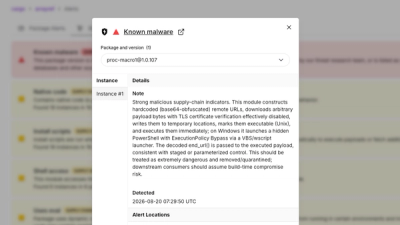
Three compromised Rust crates pulled in a malicious dependency that downloaded and executed cross-platform malware during Cargo builds.