Draft
Stop shipping AI-generated bugs.
One command runs a three-stage review on your branch — validation, spec compliance, code quality — and writes the missing tests. Free. Open-source. MIT.




Powered by codebase-memory-mcp by DeusData — a 159-language, 100% local knowledge-graph engine.
Website ·
Docs ·
Methodology ·
Watch (8 min) ·
All Videos
The 60-second pitch
Your AI assistant just wrote 200 lines. Some of them are bugs. Some don't match your patterns. Some skip tests.
/draft:review
Three stages, one command:
- Validation — runs your tests, lints, type-checks, and surfaces real failures
- Spec compliance — checks the diff against the agreed spec, not vibes
- Code quality — flags hotspots, blast radius, and missing test coverage using a tree-sitter knowledge graph of your repo
Free. No API keys. No paid tier. No vendor lock-in. Catches the 3 bugs you missed before they hit your reviewer.
Demo coming soon — for now, watch the 8-minute walkthrough.
Install (30 seconds)
One command installs Draft into your agent. No clone, no config.
npx @drafthq/draft install <host>
…or install the CLI once and reuse it:
npm install -g @drafthq/draft
draft install <host>
draft list
Each host installs the way that host actually loads extensions — no manual steps after the command:
| Claude Code | claude-code | Registers the plugin via claude plugin marketplace add + claude plugin install (user scope). Restart Claude Code. |
| Cursor | cursor | Copies the plugin into ~/.cursor/plugins/local/draft/ (auto-loaded). Restart Cursor. |
| Codex | codex | Writes ./AGENTS.md, which Codex reads automatically. |
| opencode | opencode | Writes ./AGENTS.md + ~/.agents/skills/draft/, both auto-discovered. |
Flags: --global / --project to pick scope, --dry-run to preview, --force to overwrite, --no-graph to skip the graph-engine fetch.
Then, in Claude Code (after restarting):
/draft:init
/draft:review
Run /draft for the full command map.
Other ways to install →
Claude Code — native marketplace
/plugin marketplace add drafthq/draft
/plugin install draft
Cursor — from GitHub
Cursor natively supports the .claude-plugin/ structure. Add via Settings > Rules, Skills, Subagents > Rules > New > Add from Github:
https://github.com/drafthq/draft.git
GitHub Copilot
Copilot reads a committed instructions file — copy it directly (not a draft install host):
mkdir -p .github && curl -o .github/copilot-instructions.md \
  https://raw.githubusercontent.com/drafthq/draft/main/integrations/copilot/.github/copilot-instructions.md
Gemini
curl -o .gemini.md https://raw.githubusercontent.com/drafthq/draft/main/integrations/gemini/.gemini.md
Beyond /draft:review — 32 more commands
/draft:review is the wedge. Once Draft has indexed your repo, you also get spec-driven planning, TDD-enforced implementation, exhaustive bug hunting, deep architectural audits, and 32 more commands covering the full development lifecycle.
What You Get
/draft | Overview, intent mapping, and command reference |
/draft:plan | Router for planning, architecture, and track management |
/draft:ops | Router for operations, deployment, incident, and lifecycle |
/draft:docs | Router for authoring and documentation workflows |
/draft:discover | Router for discovery, debugging, investigation, and quality |
/draft:init | Analyze codebase, create context files + state tracking |
/draft:graph | Build / refresh the knowledge-graph snapshot |
/draft:new-track | Collaborative spec + plan with AI |
/draft:decompose | Module decomposition with dependency mapping |
/draft:implement | TDD workflow with checkpoints |
/draft:coverage | Code coverage report (target 95%+) |
/draft:review | 3-stage review (validation + spec compliance + code quality) |
/draft:deep-review | Enterprise-grade module lifecycle and ACID audit |
/draft:bughunt | Exhaustive 14-dimension defect discovery with taint tracking |
/draft:learn | Discover coding patterns, update guardrails |
/draft:adr | Architecture Decision Records |
/draft:status | Show progress overview |
/draft:revert | Git-aware rollback |
/draft:change | Handle mid-track requirement changes |
/draft:debug | Structured debugging: reproduce, isolate, diagnose, fix |
/draft:quick-review | Lightweight 4-dimension code review |
/draft:deploy-checklist | Pre-deployment verification with rollback triggers |
/draft:upload | Pre-upload handoff gate (review, HLD, checklist, validators) |
/draft:testing-strategy | Test plan design with coverage targets |
/draft:tech-debt | Technical debt analysis across 6 dimensions |
/draft:standup | Git activity standup summary (read-only) |
/draft:incident-response | Incident lifecycle: triage, communicate, mitigate, postmortem |
/draft:documentation | Technical docs: readme, runbook, api, onboarding |
/draft:integrations | External system exports and syncs (jira preview / create) |
/draft:jira | Unified Jira workflows (preview / create / review) |
/draft:tour | Interactive architecture mentorship and codebase walk-through |
/draft:impact | ROI analytics tracking friction and timeline metrics |
/draft:assist-review | Summarize intent and highlight structural PR risks for reviewers |
See full command reference →
Recommended next step after install: run /draft:init to index your repo, then /draft:review on any branch with AI-generated changes. Once you've seen what it catches, explore the rest.
Built-in Code Intelligence
Draft is powered by a local knowledge graph engine (codebase-memory-mcp) that gives every command precise structural context — module boundaries, call graphs, dependencies, hotspots. It's 100% local (no API key, no SaaS), fetched during draft install (best-effort; --no-graph to skip), with first-use fetch as a fallback.
/draft:graph
scripts/tools/graph-impact.sh --file src/auth/login.go
| Multi-language extraction | Tree-sitter + LSP-grade resolution across 159 languages, 100% local |
| Call graph | Callers/callees with confidence signals so review/bughunt can weight findings |
| Impact analysis | Blast-radius with file-class dimension (code/test/doc/config) — answers "what breaks if I change this?" |
| Cycle detection | Flags circular call dependencies before they bite |
| Hotspot ranking | Fan-in score so high-risk symbols get extra scrutiny |
| Incremental indexing | git-aware, content-based; only changed code re-indexes |
| Track impact memory | metadata.json.impact snapshots each completed track's blast radius — /draft:new-track flags overlap with recent work |
The graph powers /draft:graph and /draft:impact, enriches /draft:bughunt and /draft:review, and is consumed by skills via core/shared/graph-query.md. The engine is installed via scripts/fetch-memory-engine.sh; the deterministic shell helpers live under scripts/tools/.
Deterministic helper tools
Skills also call into shell helpers under scripts/tools/ for mechanical work — git metadata, file classification, test-framework detection, hotspot ranking, freshness checks, ADR indexing, and live graph queries (graph-callers.sh, graph-impact.sh, hotspot-rank.sh, cycle-detect.sh, mermaid-from-graph.sh). All emit JSON or markdown, follow a uniform exit-code contract, and degrade gracefully when their input source is unavailable.
How It Works
┌─────────────────────────────────────────────────────────────┐
│                        /draft:init                          │
│    5-phase codebase analysis + signal detection + state     │
│  architecture.md + .ai-context.md + .state/ (freshness,    │
│                   signals, run memory)                      │
└────────────────────────────┬────────────────────────────────┘
                             │
                             ▼
┌─────────────────────────────────────────────────────────────┐
│                      /draft:new-track                       │
│            AI-guided spec.md + phased plan.md               │
└────────────────────────────┬────────────────────────────────┘
                             │
                             ▼
┌─────────────────────────────────────────────────────────────┐
│                     /draft:implement                        │
│              RED → GREEN → REFACTOR (repeat)                │
└────────────────────────────┬────────────────────────────────┘
                             │
                             ▼
┌─────────────────────────────────────────────────────────────┐
│                      /draft:review                          │
│        Three-stage review (validation + spec + quality)     │
└─────────────────────────────────────────────────────────────┘

         /draft:init refresh  ←── incremental: only re-analyze
                                   files with changed hashes
Full workflow →
Why Draft?
AI tools are fast but unstructured. Draft applies Context-Driven Development to impose clear boundaries: explicit context, phased execution, and built-in verification, ensuring outputs remain aligned, predictable, and production-ready.
product.md       →  "Build a task manager"
tech-stack.md    →  "React, TypeScript, Tailwind"
architecture.md  →  Comprehensive: 10-section graph-primary engineering reference, Mermaid diagrams (source of truth). Mature brownfield projects with strong existing agent docs (CLAUDE.md, INVARIANTS.md, etc.) receive early Context Quality Audit, graph fidelity dashboard, and explicit Relationship + Gaps sections (no blind duplication).
.ai-context.md   →  200-400 lines: condensed from architecture.md (token-optimized AI context)
.state/          →  freshness hashes, signal classification, run memory (incremental refresh)
spec.md          →  "Add drag-and-drop reordering"
plan.md          →  "Phase 1: sortable, Phase 2: persist"
Each layer narrows the solution space. By the time AI writes code, decisions are made.
Incremental refresh: After initial setup, /draft:init refresh uses stored file hashes and signal classification to only re-analyze what changed — no full re-scan needed.
Read methodology →
Contributing
Source of Truth
core/methodology.md — Master methodologyskills/<name>/SKILL.md — Command implementationsintegrations/ — Auto-generated (don't edit)
Update Workflow
./scripts/build-integrations.sh
Full architecture →
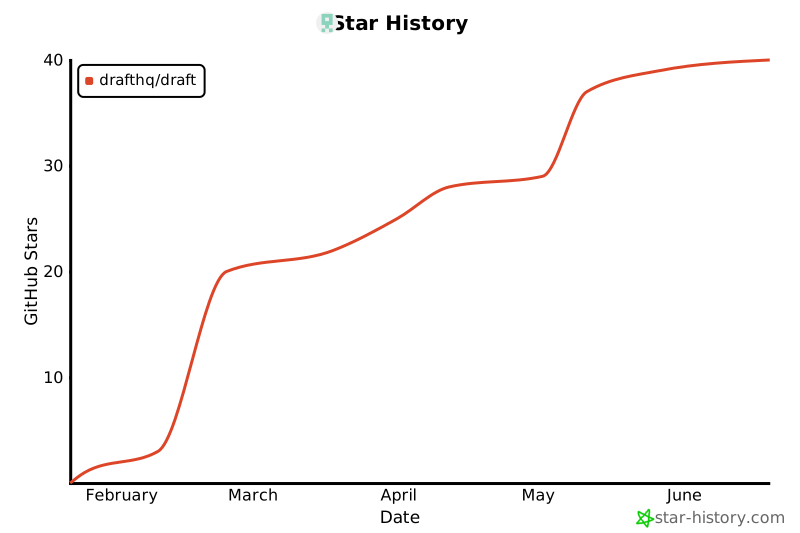
Star History
MIT License · Graph engine: codebase-memory-mcp by DeusData
Credits: Inspired by gemini-cli-extensions/conductor