
Product
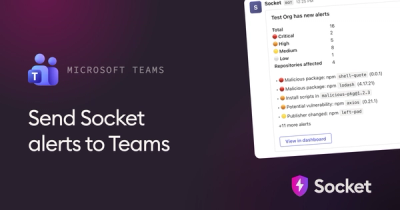
Microsoft Teams Notifications Are Now Available in Socket
Socket can now send alerts and supply chain attack notifications to Microsoft Teams, with filters that route the right updates to each channel.
By Jeppe Hasseriis - Sep 01, 2026
@drawcall/market
Advanced tools
Typed client, dependency resolver, and CLI for the [Drawcall Market](https://market.drawcall.ai) — an asset marketplace for 3D models, textures, animations, audio, environments, flipbooks, and templates.
Typed client, dependency resolver, and CLI for the Drawcall Market — an asset marketplace for 3D models, textures, animations, audio, environments, flipbooks, and templates.
This package is the single source of truth for the Market API surface: the oRPC contract, Zod schemas, and TypeScript types. It ships both a programmatic API and the market CLI.
npm install @drawcall/market
v1.createClient is the one API. It returns a fully-typed oRPC client for the /api/v1 REST surface — every operation (search, exact, manifest, files, uploadZip, generate, installMetadata) is type-checked end-to-end against the routed contract, and the generated OpenAPI document lives at https://market.drawcall.ai/api/v1/openapi.json.
import { v1, downloadAssetZipBytes } from '@drawcall/market'

const client = v1.createClient()
// v1.createClient({ baseUrl, fetch, authToken }) to override the API host,
// supply a custom fetch, or authenticate reads/writes.

const asset = await client.asset.exact({ name: 'my-model', includeUnapproved: false })
// The manifest: metadata + every file's content-plane URL + previewUrl + zipUrl:
const manifest = await client.asset.manifest({ name: 'my-model', version: asset.latestVersion })
// Or the whole version as one zip:
const zip = await downloadAssetZipBytes({ name: 'my-model', version: asset.latestVersion })
Reads (search, exact, manifest, files, installMetadata) are public. uploadZip and generate require an authToken.
client.asset.search takes a query plus paging and returns a relevance-ranked paginated list:
const page = await client.asset.search({
  query: 'robot',
  type: 'model', // optional AssetType; omit to search every type
  page: 1,
  limit: 12,
  includeUnapproved: false,
})
search resolves to a PaginatedList<AssetSearchResult>:
{
  items: AssetSearchResult[]
  total: number        // total matches across all pages
  page: number
  limit: number
  totalPages: number
}
Each AssetSearchResult is:
{
  id: string
  name: string // globally unique, install by this name
  type: string // AssetType, e.g. 'model'
  description: string | null
  ownerId: string
  createdAt: Date
  updatedAt: Date
  latestVersion: string // semver of the latest published version
  approved: boolean
  npmDependencies: Record<string, string>
  assetDependencies: AssetDependencies // range string or { version, alias } per entry
  skillDependencies: Record<string, string>
  previewUrl: string | null // image URL for an <img>, or null
}
previewUrl is the fetch-ready image URL for a result, or null for types without a preview (only model, humanoid-model, texture, environment, and flipbook have one). Drop it straight into an <img src>; private and unapproved results already carry the capability when the caller is entitled to see them:
import { v1 } from '@drawcall/market'

const client = v1.createClient()
const { items } = await client.asset.search({
  query: 'robot',
  type: 'model',
  page: 1,
  limit: 12,
  includeUnapproved: false,
})

for (const item of items) {
  if (!item.previewUrl) continue
  // <img src={item.previewUrl} loading="lazy">
}
The runnable Market frontend renders results immediately and lets the browser load previews from these URLs.
resolve — dependency resolutionResolve a set of assets (and their transitive asset/npm/skill dependencies) to a concrete, installable plan. The CLI and any server-side caller share this resolver:
import { v1, resolve } from '@drawcall/market'

const client = v1.createClient()
const plan = await resolve(client.asset, [{ name: 'my-model', range: '^1.0.0' }])

plan.assets // resolved name@version per asset (with its type)
plan.npmDependencies // merged npm ranges
plan.skillDependencies // merged skill sources
The Node-only filesystem APIs are available from @drawcall/market/install. install downloads and
writes resolved assets; listInstalledAssets reads the declared assetDependencies (name, range,
aliases) from the nearest package.json; getCliClient uses DRAWCALL_AUTH_TOKEN or the saved
Market login when private assets must resolve.
import { getCliClient, listInstalledAssets } from '@drawcall/market/install'

const { assets } = await listInstalledAssets(process.cwd())
const { client } = await getCliClient()
const plan = await resolve(
  client.asset,
  assets.map(({ name, range }) => ({ name, range })),
)
const index = await client.asset.files({
  name: plan.assets[0].name,
  version: plan.assets[0].version,
})
await fetch(index.files[0].url)
npx @drawcall/market install my-model        # resolve + install by name
npx @drawcall/market types                   # current types, generation support, search guidance
npx @drawcall/market list                    # list locally installed assets
npx @drawcall/market list --files            # include installed file paths
npx @drawcall/market search robot --type model
npx @drawcall/market preview my-model@1.2.0  # save that version's preview image
npx @drawcall/market urls my-model@1.2.0     # remote file base URL, subpaths, and preview URL
npx @drawcall/market pack ./my-model.zip --out ./my-model.packed.zip
npx @drawcall/market upload my-model ./my-model.zip "A robot" --type model
npx @drawcall/market login                   # device-authorization sign-in
Market credentials are managed by @drawcall/auth and shared with other Drawcall CLIs. Existing
credentials in drawcall-market/config.json migrate automatically.
Reads (types, install, list, search, preview, urls) work without auth; pack is offline; upload and generate require market login. After an install, the CLI prints provider-owned usage once per installed asset type.
urls performs no filesystem writes. Its output follows the same compact asset-and-files layout as install; the base plus each indented file subpath forms a fetch-ready asset file URL:
URLs:
- my-model@1.2.0
  base: https://market.drawcallcontent.com/public/my-model@1.2.0/
  files:
    public/models/my-model.glb
  preview: https://market.drawcallcontent.com/public/previews/my-model@1.2.0.webp
Use --key <key> for a shared private asset and --unapproved when explicitly resolving an unapproved version. Private capability-bearing URLs are secrets.
pack creates the same asset zip that upload sends. It runs offline, infers template packing from a root package.json, and accepts --type only when you need to override that inference. upload calls the shared pack step internally, then publishes.
list is an offline local inventory command. It reads assetDependencies from the nearest package.json and prints each declared asset with its range and file aliases.
Run npx @drawcall/market skill to print the agent workflow guidance, or npx @drawcall/market --help for the full command list.
The Commander implementation is available for aggregate CLIs:
import { createMarketCommand } from '@drawcall/market'

program.addCommand(await createMarketCommand())
The MCP tools follow the same concepts as types, search, preview, generate, and agent,
without exposing CLI-only filesystem operations such as install or pack:
import { registerMarketTools, v1 } from '@drawcall/market'
import { McpServer } from '@modelcontextprotocol/server'

const client = v1.createClient({ authToken: process.env.DRAWCALL_AUTH_TOKEN })
const server = new McpServer({ name: 'drawcall-mcp', version: '1.0.0' })

registerMarketTools(server, client, {
  capabilities: { generate: true, agent: true },
})
The host owns server identity, authentication, transport, and capability selection. The MCP SDK is an optional peer dependency and is required only when mounting these tools.
FAQs
Typed client, dependency resolver, and CLI for the [Drawcall Market](https://market.drawcall.ai) — an asset marketplace for 3D models, textures, animations, audio, environments, flipbooks, and templates.
The npm package @drawcall/market receives a total of 1,242 weekly downloads. As such, @drawcall/market popularity was classified as popular.
We found that @drawcall/market demonstrated a healthy version release cadence and project activity because the last version was released less than a year ago. It has 1 open source maintainer collaborating on the project.
Product
Socket can now send alerts and supply chain attack notifications to Microsoft Teams, with filters that route the right updates to each channel.

Security News
pnpm 12 rewrites the package manager in Rust, cutting install times by up to 90% while preserving pnpm 11 workflows and lockfiles.
Security News
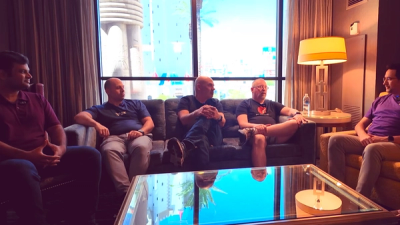
Socket CTO Ahmad Nassri joins AppSec leaders at Black Hat to discuss active malware, package manager risks, and software supply chain defense.