
Product
Socket Now Protects the Firefox Extension Ecosystem
Socket is bringing experimental protection to Firefox, scanning 97,000+ extensions in Mozilla's official directory for malware and risky updates.
By John Tuckner - Aug 20, 2026
@evan-moon/firma
Advanced tools
Local-first, AI-native CLI asset tracker for overseas stock investors. Built-in MCP server for Claude Desktop.
You earned well this year.
Do you know where it went?
Drop your trade history into Claude.
Get back a full financial picture — portfolio, net worth, cash flow — stored in a local SQLite file.


npm install -g @evan-moon/firma
You:    Here's my IBKR trade history [trades.csv]. Set up firma.
Claude: I see 47 transactions. Logging in chronological order... done.
        Syncing prices and FX history... your portfolio: $179K, +61% all-time. TSLA is 78%.

You:    My portfolio feels really volatile lately. Should I be worried?
Claude: TSLA is 74% of your equity — a 10% TSLA move is a 7% net worth move.
        Cash flow is solid at $6.4k/month saved. The volatility is market, not lifestyle.

You:    That July expense spike looks alarming.
Claude: That was $57k in TSLL — a leveraged bet, not spending.
        Strip it out: expenses flat at ~$7k/month, savings rate 47.8%.

You:    Give me a full overview with charts.
Claude: Net worth: $294k → $490k in 8 months, pulled back to $427k with TSLA's Q1 dip.
        [builds net worth trend, income vs expenses, portfolio allocation, unrealized P&L]
firma mcp install wires firma into Claude Desktop. Every command you can run in the terminal, Claude can call through MCP — log trades, sync prices, render charts, reason about your data.~/.firma/firma.db. No server, no sync, no account. Your financial data never leaves your machine.get_brief doesn't just dump data — it returns a weekly stance (lean aggressive or defensive), ranked moves (deploy idle cash, derisk, rebalance, …), and a watchlist of new tickers, all computed deterministically from your holdings, cash flow, and macro signals. It also bundles macro signals, commodity prices, the dividend calendar, global macro (World Bank), and active disaster alerts (GDACS) in one call — no extra API keys needed for the global data.--json on every read command. Three clean verb groups: add, show, report.Two ways to install — both work the same way once set up.
Download and double-click. Node.js is bundled — nothing to install first. API keys are configured via setup dialogs (opens Finnhub + FRED in your browser, then prompts you to paste each key). Claude Desktop is connected automatically.
↓ Download firma-mac-arm64.pkg
# 1. Install
npm install -g @evan-moon/firma

# 2. Set API keys (both free)
firma config set finnhub-key YOUR_KEY   # finnhub.io — prices, news, earnings
firma config set fred-key YOUR_KEY      # fred.stlouisfed.org — macro & FX history

# 3. Connect Claude Desktop
firma mcp install
# Restart Claude Desktop — firma tools will appear in the toolbar.
Drop your data into Claude. Paste a CSV, brokerage export, or plain text — Claude logs everything and syncs prices automatically.
Prefer the terminal? Every MCP tool has a matching
firmacommand — see CLI reference.
If firma helps you track your money, please ⭐ star the repo — it's the cheapest way to help others find it.
--json is available on every read command. Alias: firma rm = firma delete.
| Command | What it does |
|---|---|
firma show portfolio | Holdings with P&L, avg cost, market value |
firma show txns [ticker] | Transaction history with running avg cost |
firma show dividend | Estimated annual income + per-ticker yield |
firma show concentration | HHI concentration by ticker, currency, sector, country |
firma show snapshot [ticker] | Portfolio value history; --from/--to for date range |
firma show benchmark | Portfolio return vs SPY/QQQ (or custom benchmarks via -b) |
firma show risk | Volatility, drawdown, Sharpe, Sortino, beta — requires snapshots |
firma profile | Set up your goals (birth year, retirement target, target net worth, risk tolerance, notes) — every field optional |
firma show profile | Show the stored profile |
| Command | What it does |
|---|---|
firma add balance [-p YYYY-MM] | Monthly asset & liability snapshot |
firma add flow [-p YYYY-MM] | Monthly income & expense entry |
firma add monthly [-p YYYY-MM] | Balance + flow in one call (month-end) |
firma show balance [-p YYYY-MM] | Stored balance entries for a period |
firma show flow [-p YYYY-MM] | Stored cash flow entries for a period |
firma report | Net worth trend + cash flow charts (combined) |
firma report balance / flow / settle | Targeted views |
firma report -c USD | Display in any supported currency — -c also works on show portfolio, txns, balance, flow, dividend, snapshot, and brief |
| Command | What it does |
|---|---|
firma add txn | Record a transaction — a stock in any of 9 markets, or a non-stock asset (crypto / commodity / real estate) — type buy / sell / deposit / dividend / tax |
firma add price [name] [value] | Set the current value of non-stock holdings (they have no price feed) |
firma edit txn [id] | Edit a transaction |
firma delete txn [id] | Delete a transaction |
| Command | What it does |
|---|---|
firma add snapshot | Sync prices and record today's portfolio snapshot |
firma edit snapshot | Edit a snapshot entry (interactive picker) |
firma delete snapshot [date] | Delete all entries for a date |
| Command | What it does |
|---|---|
firma show news <ticker> | Recent company news |
firma show insider <ticker> | Insider buy/sell transactions |
firma show financials <ticker> | SEC-reported quarterly financials (income, cash flow, balance sheet) |
firma show valuation <ticker> | PEG ratio, P/S, FCF yield — computed from 8 quarters of SEC filings |
firma show earnings [ticker] | Earnings calendar + EPS history |
| Command | What it does |
|---|---|
firma show macro | VIX, 10Y yield, yield curve, USD index, HY spread, inflation, fed funds, FX + Economic Stress Index (0–100) + macro regime bias (Risk-on / Mixed / Risk-off) |
firma show fx [currency] | Inspect cached FX history with --from/--to/--limit |
| Command | What it does |
|---|---|
firma show world-intel | World Bank macro (GDP, inflation, unemployment) + GDACS active disaster alerts in one view |
| Command | What it does |
|---|---|
firma brief | Daily intelligence brief: movers, news, earnings, macro, commodities, dividend calendar, world macro, disaster alerts (cached per day; --refresh to regenerate) |
firma sync | Fetch latest prices (Finnhub) + FX rate history (FRED) |
firma sync fx | FX history only — incremental backfill from your earliest entry date |
firma doctor | Check setup status — API keys, data, FX cache |
firma mcp install | Register MCP server in Claude Desktop |
firma config set finnhub-key KEY | Set Finnhub API key |
firma config set fred-key KEY | Set FRED API key |
firma config set currency CODE | Set home currency (KRW, USD, JPY, …) |
After firma mcp install, Claude has full read/write access to your data through conversation. Two tools are available only via MCP:
| Tool | What it does |
|---|---|
fetch_fred_series | Fetch any FRED time series by ID (800K+ series) |
search_fred_series | Search the FRED catalog by keyword |
get_brief is the primary entry point for any daily check-in or market question. In a single call it returns:
drill_down pointer to the tool that explains itsync firstThe recommendations are computed in code — analysis baked into the tool result, not improvised in prose. The show_* tools (show_concentration, show_macro, …) carry their dimension's recommendation too, so a drill-down stays consistent with the brief.
If today's snapshot is missing, get_brief records one automatically before assembling the brief, so daily history accrues even when you forget to run firma add snapshot.
show_valuation and show_world_intel are available for deeper drill-downs after reading the brief.
Prompts — type / in Claude Desktop to access guided workflows:
| Prompt | What it does |
|---|---|
import-trades | Confirms column mapping then inserts every row in a single add_txn call — handles 100s of rows in one shot |
import-balance | Same flow for a net-worth spreadsheet (rows = months, columns = balance categories) → one add_balance call |
import-flow | Same flow for an income/expense spreadsheet → one add_flow call |
month-end | Walks through balance + cash flow entry for the period, submits in one batch |
morning | Calls get_brief and surfaces only what needs attention |
analyst | Activates a financial-analyst persona — Claude leads with concentration risk, frames every number against net worth or runway, and combines portfolio + cash flow + macro into a single view |
setup-profile | Captures your goals (birth year, retirement target, target net worth, risk tolerance, notes) so all future analysis is anchored to them — every field optional |
pre-mortem | Five plausible ways a position could go wrong over 12 months — concrete failure modes tied to actual data, with portfolio impact in dollars |
rebalance | Compares current allocation against your stated target, flags drift, suggests specific trades while accounting for tax cost and wash-sale risk |
tax-harvest | Scans unrealized losses, checks 30-day wash-sale rule, suggests similar-but-not-identical replacements, estimates tax savings by bracket |
scenario | Models a market shock or macro shift on your actual portfolio with explicit beta assumptions you can override |
setup_status (called by Claude at the start of any conversation) also returns an analyst_context block — a lightweight version of the analyst persona that influences every reply without a manual prompt invocation.
Historical FX note: firma sync fx backfills daily FX rates (KRW, JPY, EUR, CNY, GBP, HKD, INR, TWD) from FRED starting at your earliest transaction date. Subsequent runs are increment-only. This means a 2018 balance in KRW uses the 2018 rate — not today's.
Firma is a Yarn Berry monorepo with a layered, port-and-adapter design. The application layer never imports an external-API package directly — it talks to domain interfaces, and adapters implement those interfaces against specific services.
Workspace layout reflects the layers:
packages/
  domain/           ports + types + routers, no external-API dep
    domain/         market/ (Quote, StockSnapshot, Candle, news, …),
                    macro/ (series, country indicators, live FX, stress,
                    regime), event/ (world disaster events)
  external-api/     raw API clients, no firma-domain dep
    finnhub/  fred/  worldbank/  gdacs/  open-er-api/  yahoo-finance/
  adapter/          the only layer that imports both sides
    adapters/       provider registry — createMarketProviders, …
  use-case/         business logic
    portfolio/      brief/   advisor/
  shared/           cross-cutting
    db/             utils/
apps/
  cli/              mcp/   docs/
Import dependencies (A → B means "A imports B"):
apps/cli, apps/mcp
  → @firma/adapters        data-clients.ts builds providers via the registry
  → @firma/domain          commands/tools call domain clients directly
                           for simple reads (e.g. `show news`)
  → use-case packages      richer flows (portfolio sync, brief)

use-case (portfolio, brief, advisor)
  → @firma/domain          brief also composes @firma/advisor

@firma/adapters
  → @firma/domain          implements MarketDataProvider / MacroDataProvider /
                           EventDataProvider
  → external-api packages  calls the raw HTTP/RSS clients

external-api (finnhub, fred, worldbank, gdacs, open-er-api, yahoo-finance)
  → shared only            pure API clients; no domain/adapter knowledge

@firma/domain
  → shared only            the stable core; no external-api / adapter /
                           use-case / app dependency

shared (db, utils)
  → nothing                cross-cutting leaf; imported by every layer above
At runtime, data flows the opposite way:
External API → @firma/adapters → domain client → use-case → cli / mcp
Dependency rule: external-API packages have zero firma-domain knowledge; domain packages have zero external-API knowledge. @firma/adapters is the only package that imports both sides. Application code (apps/cli, apps/mcp) talks to domain clients; the one place it touches @firma/adapters is data-clients.ts, which constructs the concrete providers.
Capabilities — each domain interface declares a capability set; the router picks a provider per capability:
| Sub-domain | Capabilities |
|---|---|
market | quote, snapshot, candles, news, insider, financials, earnings, dividends, peers, economic-calendar |
macro | series, metadata, search, country-indicator, live-fx |
event | disasters |
Why this matters: adding a data source touches no command or business-logic code. Adding KRX coverage, for example, means a new packages/external-api/naver/ raw client, a createNaverProvider(): MarketDataProvider in packages/adapter/adapters/src/, and one registration line in packages/adapter/adapters/src/registry.ts. See CONTRIBUTING.md for the full recipe.
Requires Node.js 22+ and Yarn Berry.
corepack enable
yarn install

yarn dev:cli show portfolio    # CLI dev mode
yarn typecheck                 # Full type check
yarn test                      # Run unit tests
See CONTRIBUTING.md for the full architecture walkthrough and the recipe for adding a new external data provider.
Firma is the financial intelligence layer of the Herald ambient voice assistant stack. When connected, Herald can:
Herald + Firma + Memex — ambient voice, financial intelligence, and persistent memory in one personal AI stack.
llms.txt is a machine-readable summary of this project for LLM agents — concise description with documentation links, following the llms.txt standard.
MIT © Evan Moon
FAQs
Local-first, AI-native CLI asset tracker for overseas stock investors. Built-in MCP server for Claude Desktop.
The npm package @evan-moon/firma receives a total of 37 weekly downloads. As such, @evan-moon/firma popularity was classified as not popular.
We found that @evan-moon/firma demonstrated a healthy version release cadence and project activity because the last version was released less than a year ago. It has 1 open source maintainer collaborating on the project.
Did you know?

Socket for GitHub automatically highlights issues in each pull request and monitors the health of all your open source dependencies. Discover the contents of your packages and block harmful activity before you install or update your dependencies.
Product
Socket is bringing experimental protection to Firefox, scanning 97,000+ extensions in Mozilla's official directory for malware and risky updates.
Research
/Security News
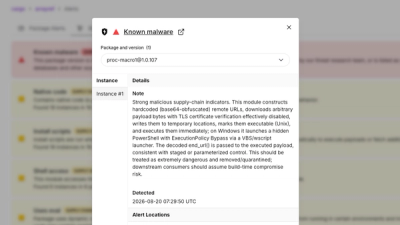
Three compromised Rust crates pulled in a malicious dependency that downloaded and executed cross-platform malware during Cargo builds.

Research
/Security News
Socket uncovered 77 linked Firefox extensions, including 40 that steal wallet secrets or credentials and 37 deceptive sports-score shells.