

Research
/Security News
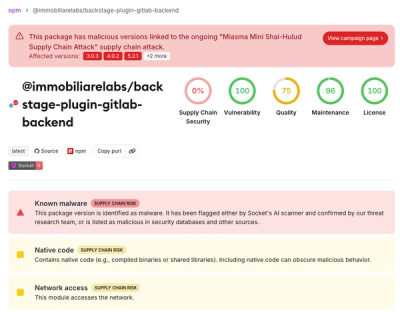
Miasma Mini Shai-Hulud Hits ImmobiliareLabs npm Packages
Miasma Mini Shai-Hulud hits @immobiliarelabs Backstage plugins, targeting GitLab and LDAP auth packages on npm.
By Socket Research Team - Jun 26, 2026
@fastify/middie
Advanced tools


@fastify/middie is the plugin that adds middleware support on steroids to Fastify.
The syntax style is the same as express/connect.
Does not support the full syntax middleware(err, req, res, next), because error handling is done inside Fastify.
npm i @fastify/middie
Register the plugin and start using your middleware.
const Fastify = require('fastify')

async function build () {
  const fastify = Fastify()
  await fastify.register(require('@fastify/middie'), {
    hook: 'onRequest' // default
  })
  // do you know we also have cors support?
  // https://github.com/fastify/fastify-cors
  fastify.use(require('cors')())
  return fastify
}

build()
  .then(fastify => fastify.listen({ port: 3000 }))
  .catch(console.log)
The encapsulation works as usual with Fastify, you can register the plugin in a subsystem and your code will work only inside there, or you can declare the middie plugin top level and register a middleware in a nested plugin, and the middleware will be executed only for the nested routes of the specific plugin.
Register the plugin in its own subsystem:
const fastify = require('fastify')()

fastify.register(subsystem)

async function subsystem (fastify, opts) {
  await fastify.register(require('@fastify/middie'))
  fastify.use(require('cors')())
}
Register a middleware in a specific plugin:
const fastify = require('fastify')()

fastify
  .register(require('@fastify/middie'))
  .register(subsystem)

async function subsystem (fastify, opts) {
  fastify.use(require('cors')())
}
Every registered middleware will be run during the onRequest hook phase, so the registration order is important.
Take a look at the Lifecycle documentation page to understand better how every request is executed.
const fastify = require('fastify')()

fastify
  .register(require('@fastify/middie'))
  .register(subsystem)

async function subsystem (fastify, opts) {
  fastify.addHook('onRequest', async (req, reply) => {
    console.log('first')
  })

  fastify.use((req, res, next) => {
    console.log('second')
    next()
  })

  fastify.addHook('onRequest', async (req, reply) => {
    console.log('third')
  })
}
It is possible to change the Fastify hook that the middleware will be attached to. Supported lifecycle hooks are:
onRequestpreParsingpreValidationpreHandlerpreSerializationonSendonResponseonErroronTimeoutTo change the hook, pass a hook option like so:
Note you can access req.body from the preParsing, onError, preSerialization, and onSend lifecycle steps. Take a look at the Lifecycle documentation page to see the order of the steps.
const fastify = require('fastify')()

fastify
  .register(require('@fastify/middie'), { hook: 'preHandler' })
  .register(subsystem)

async function subsystem (fastify, opts) {
  fastify.addHook('onRequest', async (req, reply) => {
    console.log('first')
  })

  fastify.use((req, res, next) => {
    console.log('third')
    next()
  })

  fastify.addHook('onRequest', async (req, reply) => {
    console.log('second')
  })

  fastify.addHook('preHandler', async (req, reply) => {
    console.log('fourth')
  })
}
If you need to run a middleware only under certain path(s), just pass the path as the first parameter to use and you are done!
const fastify = require('fastify')()
const path = require('node:path')
const serveStatic = require('serve-static')

fastify
  .register(require('@fastify/middie'))
  .register(subsystem)

async function subsystem (fastify, opts) {
  // Single path
  fastify.use('/css', serveStatic(path.join(__dirname, '/assets')))

  // Wildcard path
  fastify.use('/css/*', serveStatic(path.join(__dirname, '/assets')))

  // Multiple paths
  fastify.use(['/css', '/js'], serveStatic(path.join(__dirname, '/assets')))
}
Middie uses path-to-regexp to convert paths to regular expressions.
This might cause potential ReDoS attacks in your applications if
certain patterns are used. Use it with care.
You can also use the engine itself without the Fastify plugin system.
const Middie = require('@fastify/middie/engine')
const http = require('node:http')
const helmet = require('helmet')
const cors = require('cors')

const middie = Middie(_runMiddlewares)
middie.use(helmet())
middie.use(cors())

http
  .createServer(function handler (req, res) {
    middie.run(req, res)
  })
  .listen(3000)

function _runMiddlewares (err, req, res) {
  if (err) {
    console.log(err)
    res.end(err)
    return
  }

  // => routing function
}
If you need it you can also keep the context of the calling function by calling run with run(req, res, this), avoiding closures allocation.
http
  .createServer(function handler (req, res) {
    middie.run(req, res, { context: 'object' })
  })
  .listen(3000)

function _runMiddlewares (err, req, res, ctx) {
  if (err) {
    console.log(err)
    res.end(err)
    return
  }
  console.log(ctx)
}
If you need to run a middleware only under certain path(s), just pass the path as the first parameter to use and you are done!
Note that this does support routes with parameters, e.g. /user/:id/comments, but all the matched parameters will be discarded
// Single path
middie.use('/public', staticFiles('/assets'))

// Multiple middleware
middie.use('/public', [cors(), staticFiles('/assets')])

// Multiple paths
middie.use(['/public', '/dist'], staticFiles('/assets'))

// Multiple paths and multiple middleware
middie.use(['/public', '/dist'], [cors(), staticFiles('/assets')])
To guarantee compatibility with Express, adding a prefix uses path-to-regexp to compute
a RegExp, which is then used to match every request: it is significantly slower.
To use this module with TypeScript, make sure to install @types/connect.
Fastify offers some alternatives to the most commonly used Express middleware:
| Express Middleware | Fastify Plugin |
|---|---|
helmet | fastify-helmet |
cors | fastify-cors |
serve-static | fastify-static |
This project is kindly sponsored by:
Past sponsors:
Licensed under MIT.
fastify-express is a Fastify plugin that allows you to use Express middleware and routes within a Fastify application. It provides a similar functionality to @fastify/middie but also allows you to mount entire Express applications within Fastify.
fastify-plugin is a utility to help create Fastify plugins. While it does not directly provide middleware functionality, it is often used in conjunction with other packages to extend Fastify's capabilities, including middleware integration.
middie is a standalone middleware engine for Node.js that can be used with various frameworks, including Fastify. It provides a more generic approach to middleware management compared to @fastify/middie, which is specifically designed for Fastify.
FAQs
Middleware engine for Fastify
The npm package @fastify/middie receives a total of 880,777 weekly downloads. As such, @fastify/middie popularity was classified as popular.
We found that @fastify/middie demonstrated a healthy version release cadence and project activity because the last version was released less than a year ago. It has 18 open source maintainers collaborating on the project.
Did you know?

Socket for GitHub automatically highlights issues in each pull request and monitors the health of all your open source dependencies. Discover the contents of your packages and block harmful activity before you install or update your dependencies.
Research
/Security News
Miasma Mini Shai-Hulud hits @immobiliarelabs Backstage plugins, targeting GitLab and LDAP auth packages on npm.

Security News
Rolldown paused Rust React Compiler integration after a 5MB binary size increase raised concerns about shipping React-specific code to all Vite users.

Security News
/Research
Mini Shai-Hulud expands into the Go ecosystem after hitting LeoPlatform npm packages and targeting GitHub Actions workflows.