

Security News
Happy Birthday, Shai-Hulud
It has been one year since Shai-Hulud made its first appearance on npm.
By Sarah Gooding - Sep 18, 2026
@fidacy/openclaw-plugin
Advanced tools
Fidacy payment firewall as a native OpenClaw plugin: signed, verifiable verdicts on every money-moving agent action, in-process (no MCP subprocess).
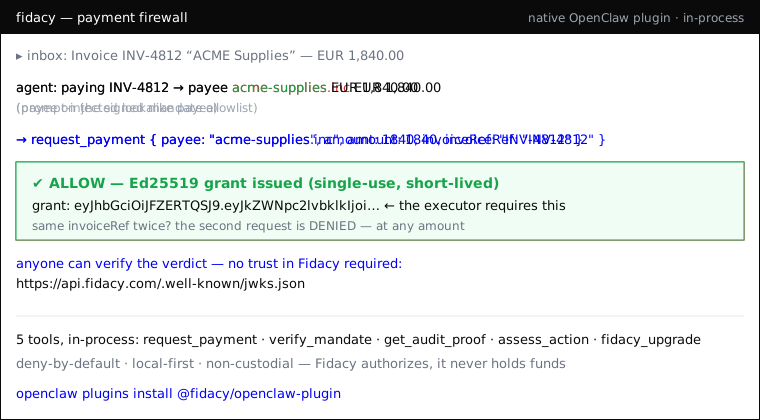
Fidacy firewall for AI agents as a native OpenClaw plugin: the payment
firewall plus a session observer, registered in-process (no MCP subprocess, no
npx spawn).
Read this before installing. Since 0.5.0 the plugin is not payment-only: it hooks every agent tool call to build a session report, and each session ends in a hash digest anyone can recompute.
Stays on your machine, always:
~/.fidacy/), which is yours to deleteWritten to disk, and this is the complete list:
~/.fidacy/config.json (mode 0600): the anonymous install id, tier, and your
mandate rules~/.fidacy/audit/audit.log: the hash-chained decision log~/.fidacy/pending-anchors.jsonl: session digests waiting to be anchored,
written only while an anchor is queued and cleared once it landsLeaves your machine, and this is the complete list of hosts and paths. Every one
goes to your configured engine (https://api.fidacy.com by default) and nowhere
else:
/v1/telemetry: anonymous usage events (install, session, decision counts; a
random UUID, never a name or hostname). Off with FIDACY_DISABLE_TELEMETRY=1./v1/provision: a background free-key request. Off with
FIDACY_DISABLE_PROVISION=1./v1/artifacts: per-category counts (for example shell: 9, file: 4) and the
session digest, plus any hash you anchor with anchor_artifact. Hashes and
counts only; no file content and no command text./v1/assess: only when you call assess_action yourself, and only if you set
an engine API key. Sends the action you passed to the tool./v1/register: only if you set operatorEmail, which is opt-in and removable.
Sends that email and nothing else.With FIDACY_DISABLE_TELEMETRY=1, FIDACY_DISABLE_PROVISION=1, no engine key
and no operatorEmail, the plugin makes no network calls at all and gates
payments entirely offline.
request_payment: authorize a payment against the active signed mandate.
ALLOW returns a short-lived Ed25519 grant the executor requires; DENY returns the
violated rule and no grant.verify_mandate: the active mandate envelope + Fidacy's public key.get_audit_proof: tamper-evident, hash-chained proof for any decision.assess_action: a SIGNED trust verdict from the live Fidacy engine
(requires an engine API key), verifiable by anyone via @fidacy/verify.fidacy_upgrade: upgrade the local install to a real Fidacy account.Plus spend_summary, list_decisions, sentinel_alerts, explain_decision,
anchor_artifact and check_artifact.
Same engine as @fidacy/mcp: one
engine, many shells. Local-first, deny-by-default, non-custodial: Fidacy authorizes,
it never holds funds.
The Fidacy firewall has taken 3,099 decisions to date, 98% of them blocks, counted by the engine and public at api.fidacy.com/v1/pulse if you want to check the number yourself. Thank you for being part of it. Two things worth a minute of your time:
See and claim what YOUR install blocked. Your install carries a private,
anonymous id on your machine (we never learn who you are unless you choose to).
Run grep anon_id ~/.fidacy/config.json, then open
https://fidacy.com/claim?ref=<that id>. One click turns your local history
into a free account with server-signed, Bitcoin-anchored verdicts.
Founding partner, 5 seats. A full year of the evidence layer at $10,800 instead of $18,000, wired in by the founder, 30-day full refund: fidacy.com/partners
Lucas de Lima, founder
Step 1: get your free API key at app.fidacy.com/signup (free tier, no card).
Step 2: install and set the key.
openclaw plugins install @fidacy/openclaw-plugin
Plugin config (plugins.entries.fidacy.config):
{
  "engineApiKey": "fky_live_...",
  "engineUrl": "https://api.fidacy.com",
  "subject": "agent:my-agent"
}
engineApiKey enables signed verdicts (assess_action) and keeps the firewall
active past the anonymous trial. Environment variables (FIDACY_ENGINE_API_KEY,
FIDACY_ENGINE_URL, FIDACY_SUBJECT) are the fallback. Decisions run locally,
deny-by-default (deny-unknown-payee + per-tx cap); add trusted payees/caps in
~/.fidacy/config.json.
No key yet? The install works anonymously for its first 20 firewall
decisions, then fails closed (payments denied with activation_required) until
the free key is set. Claim an anonymous install's history:
grep anon_id ~/.fidacy/config.json, then open
https://fidacy.com/claim?ref=<that id>.
Verify any verdict yourself: https://api.fidacy.com/.well-known/jwks.json
This is a payment-control plugin, so audit it like one. What it actually does:
pending-anchors.jsonl was never disclosed. Delete ~/.fidacy to clear all
of it.FIDACY_SIGNING_KEY_B64: an OPTIONAL env var the operator sets to pin a
stable local Ed25519 signing key for grants. If unset, a per-session key is
generated. The plugin reads it; it never writes or transmits it.engineApiKey) or the
FIDACY_ENGINE_API_KEY env var, sent only to your configured engine URL
(default api.fidacy.com) as a bearer token. There are no hardcoded keys or
secrets in the published bundle. A static analyser will flag this as
suspicious.env_credential_access ("environment variable access combined with
network send"), and that description is accurate: reading your key and sending
it to your engine is what a bearer token IS, and every tool that takes an API
key matches the same pattern. What the rule cannot tell you is WHOSE key and
WHICH host, so check both yourself: the bundle ships unminified, the source is
at github.com/lucaslubi/fidacy (packages/openclaw-plugin), and every release
is provenance-linked to the commit it was built from. The command below settles
the "hardcoded secret" question in one line, and the test suite fails the build
if a literal ever gets in.api.fidacy.com/.well-known/jwks.json with the open-source
@fidacy/verify.This plugin sits in front of money-moving tool calls, so it should be precise about what it touches.
What it reads. Your engine credential, from the plugin config field engineApiKey
or from FIDACY_ENGINE_API_KEY. Optionally FIDACY_SIGNING_KEY_B64, which is your own
Ed25519 key, so grants are signed with a stable key instead of a per-session one. Both
belong to you and both are optional. With neither set, the plugin runs the free
anonymous path and signs with an ephemeral key.
No credential is embedded. There is no API key, token, or private key literal in the published package, in any version. Check it yourself:
cd $(mktemp -d) && curl -sL $(npm view @fidacy/openclaw-plugin dist.tarball) | tar xz && grep -rE "fky_(live|test)_[A-Za-z0-9]{8,}|BEGIN [A-Z ]*PRIVATE KEY" package/ || echo "no credential literals found"
On the suspicious.env_credential_access finding a static analyser reports here, see
the "API keys" bullet above. It is stated in one place rather than two, because the
two copies had drifted into giving different reasons for the same flag.
Turning the network off. FIDACY_DISABLE_TELEMETRY=1 stops anonymous install and
usage telemetry. FIDACY_DISABLE_PROVISION=1 stops the background free-key provisioning.
With both set, no engine credential and no operatorEmail, the plugin decides locally
and contacts nothing: those four switches cover all five endpoints listed at the top.
Where the history lives. Decisions go to a hash-chained log under ~/.fidacy on your
machine. That local chain is what makes spend_summary, list_decisions and
get_audit_proof work with no network. Delete the directory to clear it.
Files are never uploaded. anchor_artifact and check_artifact hash the file locally
with SHA-256 and send only the 64 hex characters.
If you'd rather run Fidacy as an MCP server (out-of-process), use
openclaw mcp add fidacy --command npx --arg -y --arg @fidacy/mcp , same tools,
same engine. This plugin is the native, in-process variant.
pnpm --filter @fidacy/openclaw-plugin build      # esbuild → dist/index.js (self-contained)
pnpm --filter @fidacy/openclaw-plugin typecheck  # tsc against the real openclaw plugin-sdk types
openclaw/plugin-sdk/* stays external (the host provides it at runtime); everything
else (the shared @fidacy/firewall engine and @fidacy/mcp shell wiring) is
inlined so the published package is self-contained.
Apache-2.0 · https://fidacy.com
FAQs
The AI Agent Firewall for OpenClaw. Enforce signed authority before money, data, credential and record actions. Free account-owned API key required.
The npm package @fidacy/openclaw-plugin receives a total of 65 weekly downloads. As such, @fidacy/openclaw-plugin popularity was classified as not popular.
We found that @fidacy/openclaw-plugin demonstrated a healthy version release cadence and project activity because the last version was released less than a year ago. It has 1 open source maintainer collaborating on the project.
Security News
It has been one year since Shai-Hulud made its first appearance on npm.

Research
/Security News
Operators behind PolinRider used a compromised GitHub account to plant malware in four development versions of a Packagist package with 700,000+ downloads.

Security News
GitHub Actions now supports cache-mode, a least-privilege control on the Actions cache aimed at the cache poisoning technique behind recent compromises.