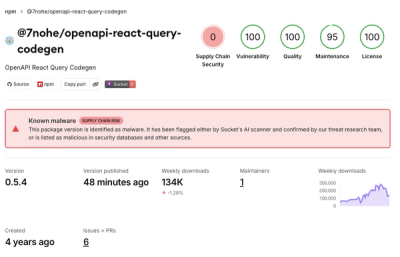
@flashcatcloud/hvigor-plugin
Uploads HarmonyOS debug symbols to FlashCat (fc-rum) so crash stacks are
symbolicated in the FlashCat console:
- ArkTS —
sourceMaps.map (+ nameCache.json for obfuscated release builds)
to de-obfuscate ArkTS/TS frames.
- Native — unstripped
.so files (DWARF, keyed by GNU build-id) to resolve
C/C++ frames from hiAppEvent native crashes.
Zero runtime dependencies (uses Node ≥18 built-in fetch/FormData).
Install
The plugin is published on npm, not ohpm. Declare it in
hvigor/hvigor-config.json5 — hvigor fetches it from npm itself:
{
  "modelVersion": "5.0.0",
  "dependencies": {
    "@flashcatcloud/hvigor-plugin": "0.1.4"
  }
}
You can install it with npm instead, but a HarmonyOS project has no root
package.json, and npm install walks up the directory tree looking for one —
so run npm init -y in the project root first, or npm will install into whatever
unrelated project it finds in a parent directory (often your home directory):
npm init -y
npm install -D @flashcatcloud/hvigor-plugin
Pin the exact version and commit the lock file: the plugin has zero runtime
dependencies, so the lock stays a few lines.
Usage (hvigor task)
In the module's hvigorfile.ts:
import { hapTasks } from '@ohos/hvigor-ohos-plugin';
import { flashcatSymbolUploadPlugin } from '@flashcatcloud/hvigor-plugin';
export default {
system: hapTasks,
plugins: [
flashcatSymbolUploadPlugin({
apiKey: process.env.FLASHCAT_API_KEY ?? '',
service: 'my-app',
version: '1.0.0'
})
]
};
Then, after a release build, run the task as its own hvigor invocation:
FLASHCAT_API_KEY=*** \
  hvigorw uploadFlashcatSymbols --no-daemon \
  --mode module -p module=entry@beta -p product=beta
--no-daemon is not optional if you configure the plugin from environment
variables. hvigor builds through a long-lived daemon process, which copies the
environment once when it is created and afterwards refreshes only a fixed
allowlist (DEVECO_SDK_HOME, OHOS_BASE_SDK_HOME, and two incremental-build
flags). A reused daemon therefore sees the environment of whoever started it — an
IDE build, or an earlier command — not the one you just typed. The failure is easy
to miss: FLASHCAT_API_KEY reads as unset and the task skips with only a warning,
or a stale version uploads the symbols under the wrong version number. Values
written directly into hvigorfile.ts are not affected.
Endpoint resolution (first match wins):
endpoint option — if provided (even as ''), it is the only source; empty/invalid skips upload (no SaaS fallback)FLASHCAT_SOURCEMAP_INTAKE_URL (preferred for private deploys; same name as Android / flashcat-cli)- Legacy
FLASHCAT_ENDPOINT (deprecated; emits a warning — historically often set to the RUM host browser.flashcat.cloud, which 404s on symbol upload)
- SaaS default
https://ci.flashcat.cloud
Do not use browser.flashcat.cloud / jira.flashcat.cloud for symbol upload — those are RUM ingest hosts only.
The task declares no build dependencies, so it works on HAP, HAR and HSP modules
alike — a module has at most one of assembleHap/assembleHar, and naming both
breaks task-graph resolution for every module. Build first, then run the upload
task. A missing artifact or an upload failure is logged but never fails the build,
so read the log: flashcat: sourcemap upload OK (200) is the success line.
The directory scanned follows the product being built (-p product=beta →
<module>/build/beta), read from the project's OHOS app context. Pass buildDir
only if your artifacts live somewhere else. Either way the resolved directory is
logged (flashcat: scanning <dir> (...)) so a wrong guess is visible immediately.
Programmatic / CI use
import { uploadAll } from '@flashcatcloud/hvigor-plugin';
const result = await uploadAll('entry/build/default', {
  endpoint: process.env.FLASHCAT_SOURCEMAP_INTAKE_URL || 'https://ci.flashcat.cloud',
  apiKey, service, version, pluginVersion: '0.1.4'
}, console.log);
Upload contract (must match fc-rum)
POST {endpoint}/sourcemap/upload, multipart/form-data, headers:
DD-API-KEY | FlashCat API key (resolves the account) |
DD-EVP-ORIGIN | flashcat-hvigor-plugin (routes to the HarmonyOS handler) |
DD-EVP-ORIGIN-VERSION | plugin version |
ArkTS sourcemap upload — form fields:
event: {"type":"harmony_sourcemap","service","version","cli_version"}source_map: the sourceMaps.map filename_cache: the nameCache.json file (optional; obfuscated builds only)
Native symbol upload — one request per .so, form fields:
event: {"type":"harmony_symbol_file","service","version","arch","lib_name","build_id"}symbol_file: the unstripped .so
arch ∈ {arm64,arm,x64,x86}. build_id is the GNU build-id hex (the
same value fc-rum re-derives from the .so — verified identical across the
TypeScript and Go extractors). Build .so with -Wl,--build-id (the default for
HarmonyOS NDK) so this is present.
Test
npm test