

Security News
Risky Biz Podcast: AI Agents Are Raising the Stakes for Software Supply Chain Security
Open source attacks are accelerating as AI coding agents pull in dependencies faster, with less human review.
By Sarah Gooding - Jun 30, 2026
@fluojs/graphql
Advanced tools
Decorator-based GraphQL module, schema exposure, and execution pipeline for Fluo.
English 한국어
Decorator-based GraphQL integration for fluo. Built on GraphQL Yoga, it provides a high-performance, specification-compliant GraphQL execution pipeline with deep DI integration and first-party DataLoader support.
pnpm add @fluojs/graphql graphql graphql-yoga
GraphQLSchema object into a fluo application.Register GraphqlModule.forRoot(...) and define a resolver using standard decorators. @fluojs/graphql currently exposes a synchronous module entrypoint only; there is no GraphqlModule.forRootAsync(...) contract.
import { Module } from '@fluojs/core';
import { bootstrapNodeApplication } from '@fluojs/runtime/node';
import { GraphqlModule, Query, Resolver, Arg } from '@fluojs/graphql';

class HelloInput {
  @Arg('name')
  name = '';
}

@Resolver()
class HelloResolver {
  @Query({ input: HelloInput })
  hello(input: HelloInput): string {
    return `Hello, ${input.name}!`;
  }
}

@Module({
  imports: [
    GraphqlModule.forRoot({
      resolvers: [HelloResolver]
    })
  ],
  providers: [HelloResolver]
})
class AppModule {}

const app = await bootstrapNodeApplication(AppModule);
await app.listen(3000);
// curl -X POST http://localhost:3000/graphql \
//   -H "Content-Type: application/json" \
//   -d '{"query": "{ hello(name: \"fluo\") }"}'
fluo uses standard decorators to define your GraphQL schema. Use @Resolver, @Query, @Mutation, and @Subscription to map class methods to GraphQL operations. GraphQL arguments are declared on input DTO fields with @Arg(...), then passed to the resolver method through the operation input option.
@fluojs/graphql currently supports root operation resolvers only. Object field-resolver patterns such as author(book, context) remain design-only and are documented in packages/graphql/field-resolver-rfc.md, not in the runtime contract.
Efficiently solve the N+1 problem with built-in DataLoader integration. Loaders are automatically isolated per GraphQL operation.
import { createDataLoader, type GraphQLContext } from '@fluojs/graphql';

const userLoader = createDataLoader(async (ids: string[]) => {
  const users = await userService.findByIds(ids);
  return ids.map(id => users.find(u => u.id === id));
});

class UserInput {
  @Arg('id')
  id = '';
}

@Resolver()
class UserResolver {
  @Query({ input: UserInput })
  async user(input: UserInput, context: GraphQLContext) {
    return userLoader(context).load(input.id);
  }
}
@Scope('request'); this keeps DI lifetime rules explicit and avoids singleton-to-request dependency mismatches.@fluojs/graphql creates one operation-scoped DI container for each HTTP GraphQL request or websocket subscription operation, shares it across resolver calls in that operation, and disposes it when the operation completes or the websocket operation disconnects.GraphQLContext operation boundary, so loader caches are shared only within one GraphQL operation.import { Inject, Scope } from '@fluojs/core';
import { Query, Resolver } from '@fluojs/graphql';
@Scope('request')
class RequestState {
private static nextId = 0;
readonly requestId = `request-${++RequestState.nextId}`;
}
@Inject(RequestState)
@Scope('request')
@Resolver()
class RequestResolver {
constructor(private readonly state: RequestState) {}
@Query('requestId')
requestId(): string {
return this.state.requestId;
}
}
graphql-ws support for real-time subscriptions when the active adapter exposes a Node HTTP/S server with upgrade listeners (for example, the Node HTTP adapter).GraphqlModule.forRoot({
subscriptions: {
websocket: {
enabled: true,
limits: {
maxConnections: 100,
maxPayloadBytes: 64 * 1024,
maxOperationsPerConnection: 25,
},
}
}
})
graphiql or set introspection: true.100 concurrent connections, 64 KiB maximum payload size, and 25 active operations per connection.subscriptions.websocket.limits = false only when you intentionally need unbounded websocket behavior and can enforce equivalent controls elsewhere.limits: false only when you intentionally need unbounded behavior and can compensate with external controls.GraphqlModule.forRoot({
graphiql: false,
introspection: false,
limits: {
maxDepth: 8,
maxComplexity: 120,
maxCost: 240,
},
subscriptions: {
websocket: {
enabled: true,
limits: {
maxConnections: 100,
maxPayloadBytes: 64 * 1024,
maxOperationsPerConnection: 25,
},
},
},
resolvers: [HelloResolver],
})
GraphqlModule.forRoot(options): Main entry point for GraphQL integration.Resolver, Query, Mutation, Subscription: Operation decorators.Arg: Input DTO field-to-GraphQL-argument mapping decorator.createDataLoader, createDataLoaderMap: DataLoader factory helpers.GraphQLContext: Type definition for the GraphQL execution context.@fluojs/core: Core DI and module system.@fluojs/http: Underlying HTTP abstraction.@fluojs/validation: Integrated DTO validation for GraphQL inputs.packages/graphql/src/module.test.ts: Integration tests and usage examples.examples/graphql-yoga: Complete GraphQL application example.FAQs
Decorator-based GraphQL module, schema exposure, and execution pipeline for Fluo.
We found that @fluojs/graphql demonstrated a healthy version release cadence and project activity because the last version was released less than a year ago. It has 1 open source maintainer collaborating on the project.
Did you know?

Socket for GitHub automatically highlights issues in each pull request and monitors the health of all your open source dependencies. Discover the contents of your packages and block harmful activity before you install or update your dependencies.
Security News
Open source attacks are accelerating as AI coding agents pull in dependencies faster, with less human review.

Research
/Security News
Malicious Chrome and Firefox extensions posed as free VPNs while stealing clipboard data through later extension updates.
Research
/Security News
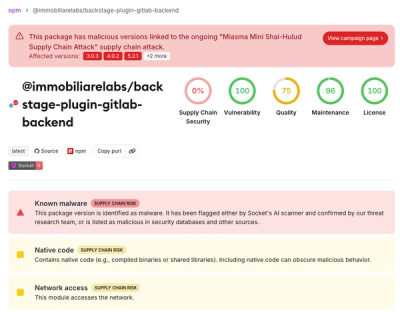
Miasma Mini Shai-Hulud hits @immobiliarelabs Backstage plugins, targeting GitLab and LDAP auth packages on npm.